Table of Contents
On October 7, the Solana Foundation said Samsung Wallet and Samsung Pay will support stablecoins on Solana. U.S. users can send USDC across borders starting the last week of October. Samsung Electronics America confirmed the timing, partners and eligibility rules in its own Samsung Newsroom release.
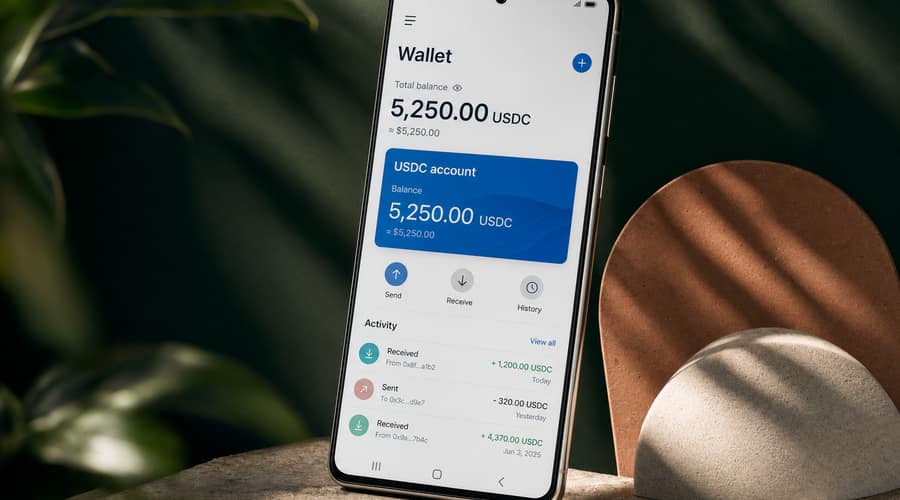
The feature will reach the 82 million U.S. Galaxy devices compatible with Samsung Wallet (a device count, not a user count), with more markets to follow as local rules allow. It sits in the same interface that already holds cards, boarding passes and IDs.
Transfers can land in digital wallets and bank accounts in more than 60 countries. Users tap "Buy Stablecoin," USDC appears as the default dollar, and a biometric check on a registered device approves the send.
Samsung first promised this in July. At Galaxy Unpacked in London it showed a USDC mockup but named no issuer, chain or date. Three months later, all three are filled in. We covered that Galaxy Unpacked 2026 preview at the time, and our Samsung Wallet USDC launch guide covers eligibility, fees and custody in full.
By the Numbers
- 82 million: U.S. Galaxy devices compatible with Samsung Wallet, per the Samsung Newsroom release
- 60+: countries where transfers can land in a wallet or bank account
- 6: names in the stack, of which the user sees one
- 3 months: from the July 22 Unpacked tease to a named chain, coin and launch week
- Nearly 20%: year-over-year growth in stablecoin supply on Solana
- 42%: growth in stablecoin payments during Q3, while total supply stalled near $304 billion
- 3 billion+: users across Meta's apps, the next distribution giant working the same model
Who Does What
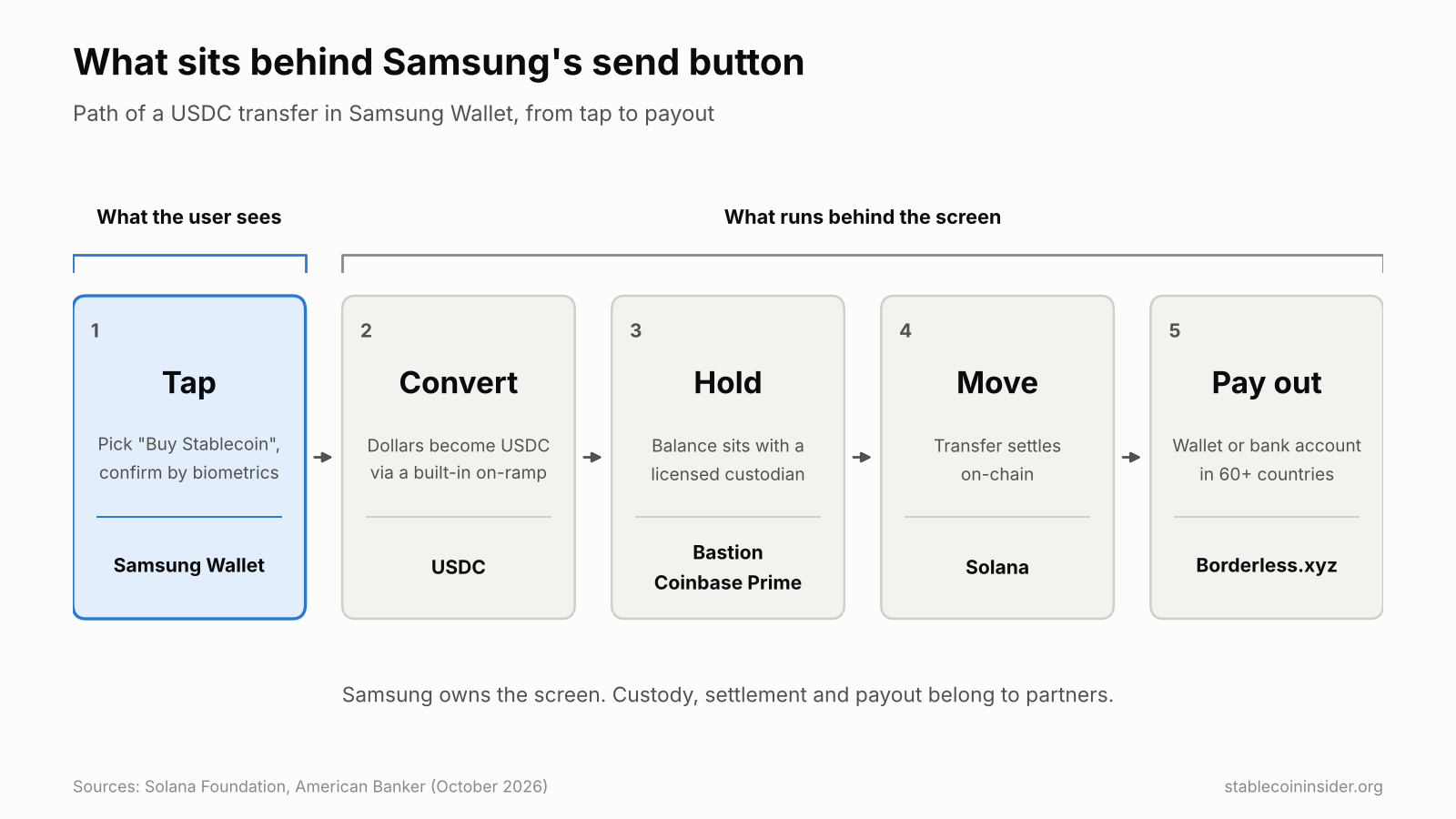
Samsung owns the screen and almost nothing else. Five other names sit between the tap and the payout.
Layer | Company | Role |
|---|---|---|
Interface | Samsung Wallet and Samsung Pay | The send screen and the biometric gate |
Network | Solana and Sui (both named in the Samsung release) | Settles the transfer "behind the scenes" |
Stablecoin | USDC | Default dollar; the release does not name Circle as a partner |
Custody | Licensed custodian running the cross-border framework | |
Sub-custody | Coinbase | Holds the USDC in Coinbase Prime Vault |
Bank payouts | Borderless.xyz | Connects to licensed institutions for bank-account delivery |
This is the same "don't issue, don't custody, just distribute" playbook we described in Meta's arm's-length return to stablecoins. Samsung now has a launch week.
How a Transfer Works
A send takes five steps, and the blockchain is the shortest of them.
- Qualify. Samsung limits the feature to U.S. residents aged 18 or older with a Samsung Account, a compatible Galaxy device on Android 13 or higher, identity verification and biometric authentication, per the Samsung Newsroom release.
- Buy. The user selects "Buy Stablecoin" and a built-in on-ramp converts dollars into USDC.
- Approve. A biometric check on the phone authorises the transfer. No seed phrase, no separate app.
- Settle. The USDC moves over a supported network (Samsung names Solana and Sui) while Bastion and Coinbase hold custody in the background.
- Pay out. The money lands in a digital wallet, or Borderless routes it to a bank account in local currency.
Steps two and five are where the time and the cost sit. In the Bank of Italy test, stablecoin transfers settled in under 20 minutes where the receiving country had instant payments, and in one to two business days where it did not.
The trade-off is control. A user who wants to hold their own keys still needs one of the self-custodial wallets, which is exactly the step Samsung is betting most people will skip.
It is also a compact version of the map we drew in September, when we counted 50+ companies across eight layers of the U.S. stablecoin stack. Samsung's feature is a working slice of it.
Why the Phone Maker Matters
Every stablecoin adoption story so far has started with a download. Install an app, fund an account, learn what a wallet is.
Samsung removes all three steps. Its wallet chief, Woncheol Chai, said eligible users can start without installing another app or managing private keys. Borderless CEO Kevin Lehtiniitty put it more bluntly to American Banker: this is a mass-market consumer product, not crypto sold to crypto users.
That changes who owns the customer. Exchanges held distribution first, then fintech apps. Now it belongs to whoever controls the default wallet on the device.
Samsung has been walking here for years. It shipped a blockchain wallet in 2019 and brought Coinbase into Samsung Wallet for 75 million U.S. users last October. Rivals are still one step removed: Apple Pay works through crypto network Mesh, and Google is pushing a payments protocol that supports stablecoins among other methods.
The choice of asset is telling too. USDC handled about 70% of adjusted volume in the first half of 2026, against roughly 25% for USDT. Samsung picked the dollar that moves.
For Solana, it is a consumer front door on top of institutional plumbing. The network has processed more than $5.25 trillion in stablecoin volume this year, and Visa, now at a $20B settlement run rate, already settles USDC there.
What It Means for Remittance Apps
Remittance apps lose their acquisition edge before they lose on price. They pay to get installed. Samsung Wallet is already on the phone.
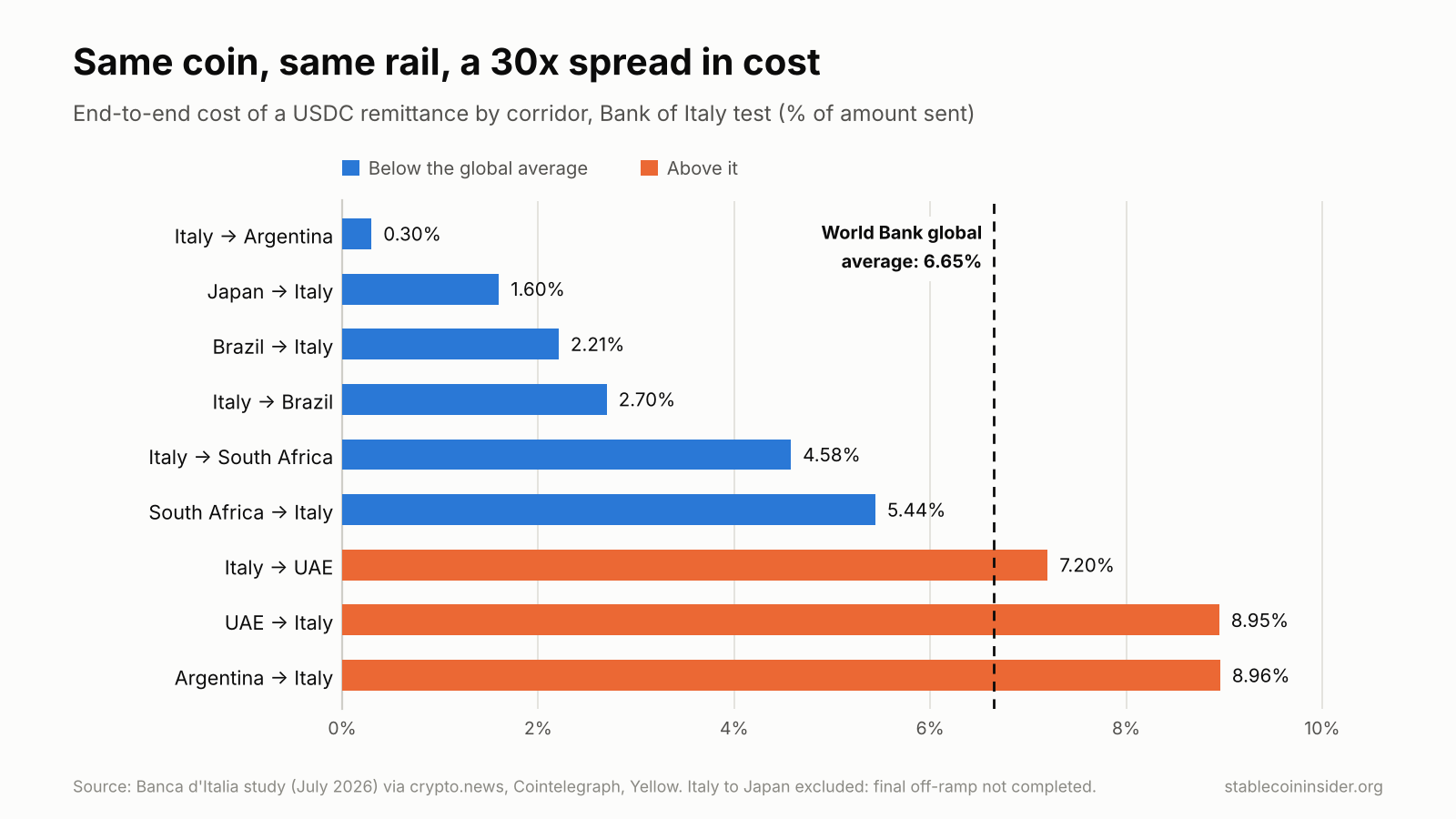
The price gap is real on paper. Sending money abroad still costs 6.49% on average, while stablecoin platforms charge below 1% on a $200 transfer. Mastercard's CEO called cross-border the clearest stablecoin use case, the same line that earned his company $3.5B in Q2.
But the rail is not where the cost lives. A Bank of Italy test of 200 USDC remittances found total costs between 0.3% and nearly 9%, with fiat conversion driving most of it. Stablecoins beat Wise in only three of seven comparable corridors.
So Samsung's pricing will be decided by its ramps, not by the chain. Samsung has published part of the answer: it charges no fee on USDC sent to an external wallet, while transfers to bank accounts carry fees that vary by destination country and amount and are shown in the app before the user confirms, according to the Samsung Newsroom release. The bank-payout fee schedule and FX spread are not public yet.
Three groups should read this closely:
- App-first remitters. Zepz says senders aged 25 to 34 are now its largest group, at 30% of all senders. That is the cohort most likely to use whatever wallet is already on the phone.
- Incumbents on the same chain. Western Union and PayPal already run stablecoin activity on Solana. They share Samsung's rail but not its screen.
- Off-ramp providers. Every wallet that copies this model needs local payout partners. The Borderless and Bastion roles are the ones that get replicated.
The launch is U.S. senders only. The larger prize sits elsewhere: Asia originates 60% of stablecoin payments, and Samsung's "additional markets" line has no dates yet.
The Regulatory Map
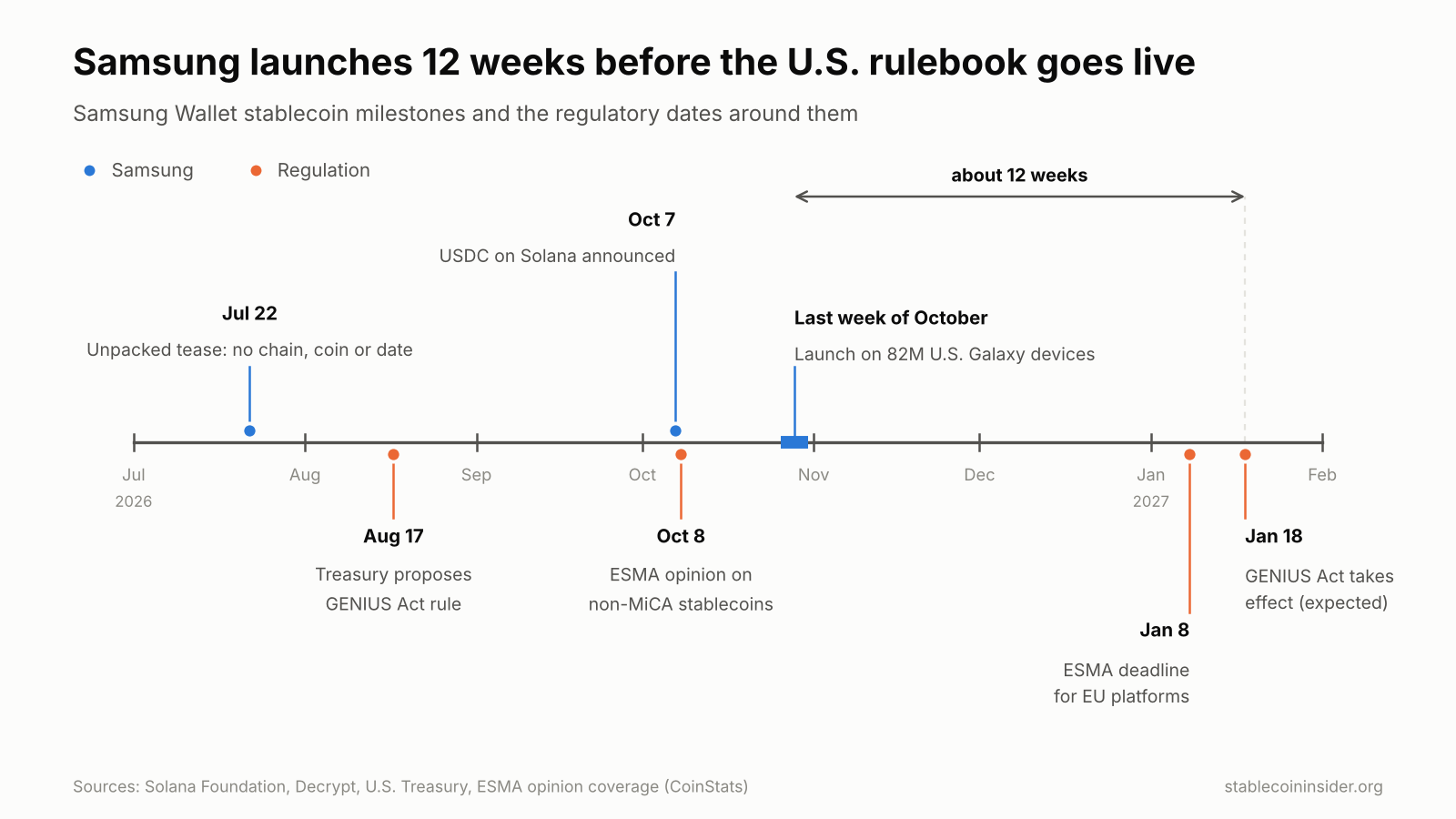
Samsung said more markets will follow "subject to local regulatory requirements." The rulebooks below decide the order, and two of them carry January deadlines.
Market | Rule that matters | Date | What it means for Samsung |
|---|---|---|---|
United States | GENIUS Act takes effect; Treasury's proposed rule defines what it means to offer or sell a payment stablecoin in the U.S. | January 18, 2027 | The feature launches about 12 weeks before the regime goes live |
European Union | ESMA tells MiCA platforms to drop non-compliant stablecoins | January 8, 2027 | USDC is MiCA-authorised and USDT is not, so the coin choice keeps Europe open |
Hong Kong | HKMA granted two issuer licences from 36 applicants | April 10, 2026 | A licensed regime is already live |
Singapore | Consultation on Payment Services Act amendments | Closes October 16, 2026 | Framework is not yet law |
South Korea | Digital Asset Basic Act | Targeted for H2 2026 | No won stablecoin yet in Samsung's home market |
The U.S. is first for a reason. After the Senate's 49–50 Clarity Act vote, stablecoins are the only regulated U.S. crypto asset, and Samsung's stack leans on a licensed custodian rather than its own licence.
Home is harder. Bank of Korea researchers warned in September that dollar stablecoin demand can move exchange rates, which is one reason a USDC button on Korean phones may wait.
Open Questions
- What does a bank transfer cost? Samsung says sends to external wallets carry no Samsung fee, but bank-payout fees vary by country and amount and no schedule or FX spread has been published (Samsung Newsroom release). The Bank of Italy data says this is the number that matters most.
- Whose balance is it? Custody runs through Bastion and Coinbase, so users hold a claim rather than keys. As we covered on Friday, a custodial stablecoin balance carries no FDIC or SIPC cover.
- Where is Circle? The coin is named. The issuer is not listed as a partner.
- One dollar or several? USDC is the "default" stablecoin, which leaves room for others. Open USD went live on September 30 with a model built to pay its distributors.
- Does it stop at sending? Samsung is weighing stablecoin payments online and by tapping in stores. That would put it in card territory.
What to Watch Next
- Launch week pricing. The last week of October brings the first real fee and FX numbers, and the list of live corridors.
- The second market. Which country follows the U.S. will show whether Samsung is chasing senders or receivers.
- The reply from other wallets. A native stablecoin feature from Apple or Google, or a second coin beside USDC in Samsung Wallet, would confirm the device is the new front line.
See you next week,
The Stablecoin Insider team