
Table of Contents
36 companies applied for a Hong Kong stablecoin issuer licence by the September 2025 deadline.
Two got one.
That 5.6% approval rate, announced by the HKMA on 10 April 2026, tells you more about Asia's regulatory posture than any consultation paper: the region is not opening the door to stablecoins, it is deciding exactly who walks through it.
Stablecoin Insider tracks how regulation reshapes where stablecoin volume moves, and Asia-Pacific is now the most licensed stablecoin economy in the world: four jurisdictions with named-issuer regimes live or passed in a single twelve-month window, and three more on the watchlist.
APAC's regulators are not absorbing stablecoins into existing law the way Latin America's did. They are building dedicated issuer regimes from scratch, with capital requirements, reserve rules, and criminal penalties attached, and then licensing a handful of banks and bank-backed consortia first.
This article compares stablecoin regulation across Singapore, Hong Kong, Japan, Taiwan, South Korea, Australia, and the UAE in 2026, drawing on the Money Moves East: The Stablecoin Corridors in Asia in 2026 report and the operator research behind it: the frameworks, the licensed coins, the deadlines, and what "licensed" actually unlocks for businesses operating on these rails.
Key Takeaways
- Hong Kong granted its first two stablecoin issuer licences on 10 April 2026, to Anchorpoint Financial and HSBC, out of 36 applicants.
- Singapore published draft legislation on 1 September 2026 to write its stablecoin framework into the Payment Services Act; consultation closes 16 October 2026.
- Japan now has all three issuer lanes active: JPYC (funds-transfer), JPYSC (trust bank), and a megabank coin due by March 2027.
- Taiwan passed its Virtual Asset Service Act on 30 June 2026 with dual FSC and central-bank approval for stablecoin issuers and up to seven years' imprisonment for unlicensed operation.
- No APAC jurisdiction passports another's licence yet; Singapore's proposal to recognise foreign-issued stablecoins is the first opening.

Why Stablecoin Regulation in APAC Matters Now
Regulation is following volume, and in Asia the volume is institutional. Asia originated roughly $245 billion of the $390 billion in genuine stablecoin payments recorded globally in 2025, about 60% of the world's total, driven almost entirely by Singapore, Hong Kong, and Japan, according to McKinsey and Artemis Analytics research cited in the report.
Fireblocks' State of Stablecoins survey found 56% of Asian institutions already live on stablecoins, the highest rate of any region.
When a region carries that share of institutional stablecoin flow, its regulators stop writing guidance and start issuing licences.
The template emerging across APAC is neither absorption nor prohibition. It is gatekeeping: dedicated issuer regimes, bank-grade capital and reserve requirements, and a first wave of licences granted almost exclusively to banks and bank-backed consortia. That formalises the market, raises the bar for entry, and rewards operators who built licensed standing before the regimes went live.
According to research by Capital Layer, the Taipei-based bank connectivity and settlement orchestration provider, corridors are built bank by bank rather than rail by rail: a corridor becomes real when a regulated institution on each end can operate it, and the operational layer, not the licence itself, is where adoption will be decided.
Singapore: The Framework Becomes Law
Singapore finalised its Single-Currency Stablecoin (MAS-SCS) framework in August 2023, covering stablecoins pegged to the Singapore dollar or any G10 currency and issued in Singapore. For three years it operated as a policy framework rather than statute.
That changed on 1 September 2026, when the Monetary Authority of Singapore published a consultation paper on amendments to the Payment Services Act 2019 to write the framework into law. The consultation closes on 16 October 2026.
The proposals introduce a dedicated stablecoin issuance licence, 100% reserve backing, redemption at par, a ban on paying interest or yield to holders, mandatory stress testing, and recovery and wind-down plans.
Two proposals matter more than the rest for the corridor economy.
MAS proposes to allow stablecoins jointly issued by a Singapore issuer and a foreign issuer to carry the "MAS-regulated stablecoin" label, provided risks are mitigated. And, recognising cross-border wholesale use cases, it proposes to recognise a limited number of foreign-issued stablecoins regulated under comparable foreign frameworks. That is the first explicit regulatory opening in APAC to foreign and multi-jurisdiction issuance, and it is the mechanism most likely to connect Singapore to Hong Kong's and Japan's licensed coins.
Singapore's payments licences already do much of the practical work. According to research by Triple-A, the payment institution licensed in the United States, Europe, and Singapore, its APAC merchants see 15–20% of total processed volume come through stablecoin checkout, with Singapore, Hong Kong, South Korea, Indonesia, Vietnam, and Thailand among its strongest markets.
None of that requires an issuer licence; it requires a Major Payment Institution licence and regulated on/off-ramps.
Hong Kong: Two Licences, Thirty-Six Applicants
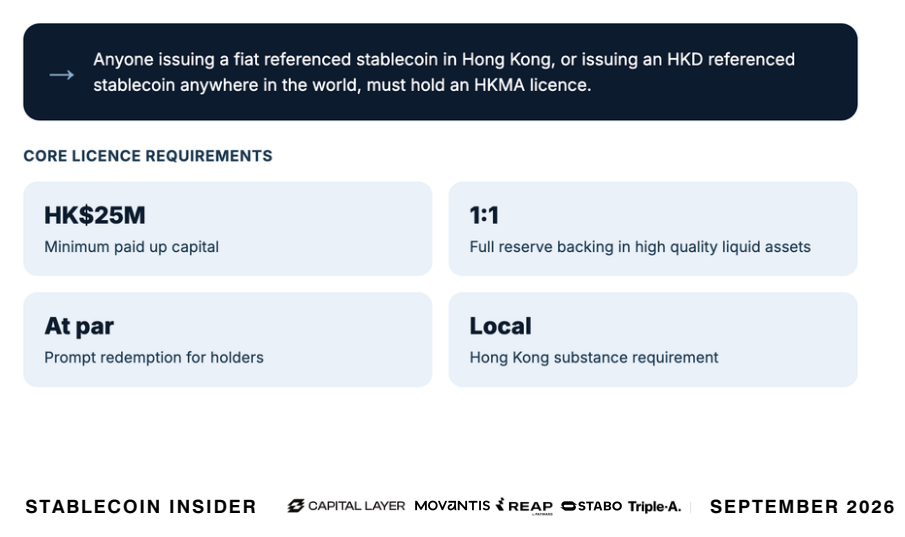
Hong Kong's Stablecoins Ordinance came into force on 1 August 2025. Anyone issuing a fiat-referenced stablecoin in Hong Kong, or issuing an HKD-referenced stablecoin anywhere in the world, needs an HKMA licence.
The requirements are HK$25 million in paid-up capital, full 1:1 reserve backing in high-quality liquid assets, prompt redemption at par, and Hong Kong substance. Only licensed issuers' stablecoins may be offered to retail investors.
The HKMA received 36 formal applications by the 30 September 2025 deadline and granted the first two licences on 10 April 2026: Anchorpoint Financial Limited, a joint venture of Standard Chartered Bank (Hong Kong), HKT, and Animoca Brands, and The Hongkong and Shanghai Banking Corporation.
The coins are now live. Anchorpoint began the phase-one institutional rollout of HKDAP, its Hong Kong dollar stablecoin, on 12 August 2026, restricted to institutional distributors and professional investors through HashKey Exchange and OSL Group, with retail access targeted for as early as end-2026.
Standard Chartered subsequently became the first bank to distribute a regulated Hong Kong stablecoin. HSBC plans to launch its own HKD coin in the second half of 2026, integrated into PayMe and the HSBC HK App.
Hong Kong's second regulatory layer is where non-issuers build. According to research by STABO, the Hong Kong-based stablecoin treasury platform, its Trust or Company Service Provider (TCSP) structure allows it to support trust and asset-segregation arrangements for clients through STABO Trust, alongside a US MSB registration and a Canadian MSB in progress.
STABO does not think about regulation as obtaining one licence and building around it: financing activities in Hong Kong may require money-lending permissions, while investment and virtual-asset activities increasingly sit within the SFC's perimeter, and the direction of regulation around virtual-asset dealing, custody, advisory, and asset management is what the company is preparing for.
Hong Kong is also where the region's card layer is licensed. According to research by Reap, the stablecoin-native card issuer being acquired by Kraken's parent Payward for up to $600 million, its Visa Principal Issuer membership in Hong Kong and Mexico lets it issue stablecoin-funded corporate cards without being a stablecoin issuer at all.
Japan: The Three-Lane Yen Stack
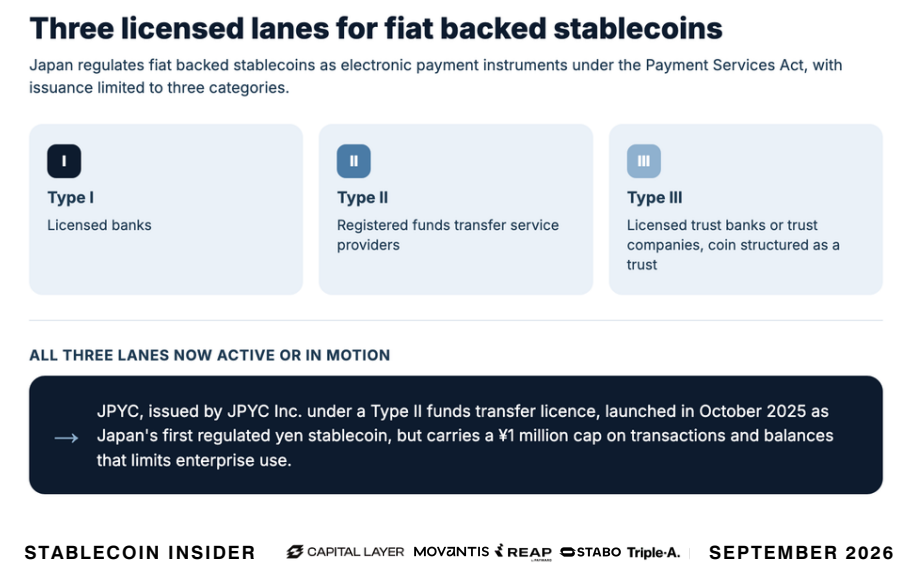
Japan regulates fiat-backed stablecoins as electronic payment instruments under the Payment Services Act. Issuance is limited to three categories: Type I for licensed banks, Type II for registered funds-transfer service providers, and Type III for licensed trust banks or trust companies, where the coin is structured as a trust.
All three lanes are now active or in motion. JPYC, issued under a Type II licence, launched in October 2025 as Japan's first regulated yen stablecoin, but carries a ¥1 million cap on transactions and balances that limits enterprise use.
JPYSC, issued by SBI Shinsei Trust Bank and co-developed with Startale Group, launched on 24 June 2026 as the first Type III trust-bank yen stablecoin, with no transaction cap and beneficial interests in segregated trust reserves for holders. And MUFG, Mizuho, and SMBC have established a joint council to co-issue a yen stablecoin under a trust agreement by March 2027, with their Project Pax proof of concept targeting ¥1 trillion in B2B issuance by 2028.
Japan's trust-bank lane is the cleanest statutory "trust stablecoin" anywhere in the region, and it is the model Taiwan chose to copy.
Taiwan: Bank-Anchored, Dual-Approved, Criminally Enforced
Taiwan's Legislative Yuan passed the Virtual Asset Service Act on 30 June 2026, moving the island from AML registration to a full licensing regime across seven categories of virtual asset service provider.
Stablecoin issuance requires approval from both the Financial Supervisory Commission and the central bank, 100% reserves held in trust, redemption at face value, and a prohibition on paying yield. Unlicensed operation carries up to seven years' imprisonment.
The Act and its nine subordinate regulations are expected to take effect together in the first quarter of 2027 at the earliest, with already-registered firms given 12 months to apply and up to 21 months to reach full approval.
According to research by Capital Layer, Taiwan lands closest to Japan's PSA model: bank-system-anchored, issuer-restrictive, and built for institutional participants rather than retail trading. It is more conservative than Singapore on issuance, with dual-regulator approval, and like Hong Kong it criminalizes unlicensed activity, a signal that regulators expect institutional-grade operations from day one.
The demand is already there: Taiwan's export-driven enterprises face requests from overseas counterparties to transact in stablecoins; until the Act, their banks had no framework to receive those flows. Of Taiwan's 38 banks, 18 to 20 have already applied for stablecoin services licences, according to Capital Layer's chief executive Justin Wang. With Japan's regime live and Taiwan's framework passed, the Japan–Taiwan lane becomes one of the first corridors in Asia with regulated stablecoin frameworks on both ends.
The Watchlist: South Korea, Australia, and the UAE
South Korea has the demand and not the law. Won-denominated trades accounted for 30% of global spot crypto volume in 2026 to date, second only to the dollar, yet a won stablecoin remains blocked by a dispute between the Bank of Korea, which wants issuance limited to bank-led consortia with 51% bank ownership, and the Financial Services Commission, which argues that rule would suppress innovation.
On 29 July 2026 the FSC said it is preparing a government-backed Digital Asset Basic Act to consolidate ten pending bills, targeting passage in the second half of 2026.
Australia has licensed coins and no dedicated issuer regime. The Corporations Amendment (Digital Assets Framework) Bill passed on 1 April 2026, requiring exchanges and custody providers to hold an Australian Financial Services Licence, while payment stablecoins are being treated separately as tokenised stored-value facilities.
Two AUD coins already operate under AFSLs:
- AUDM, issued by Macropod since October 2025
- AUDD, whose issuer AUDC received its own AFSL from ASIC on 10 February 2026 after surpassing $1.4 billion in payments volume on Stellar.
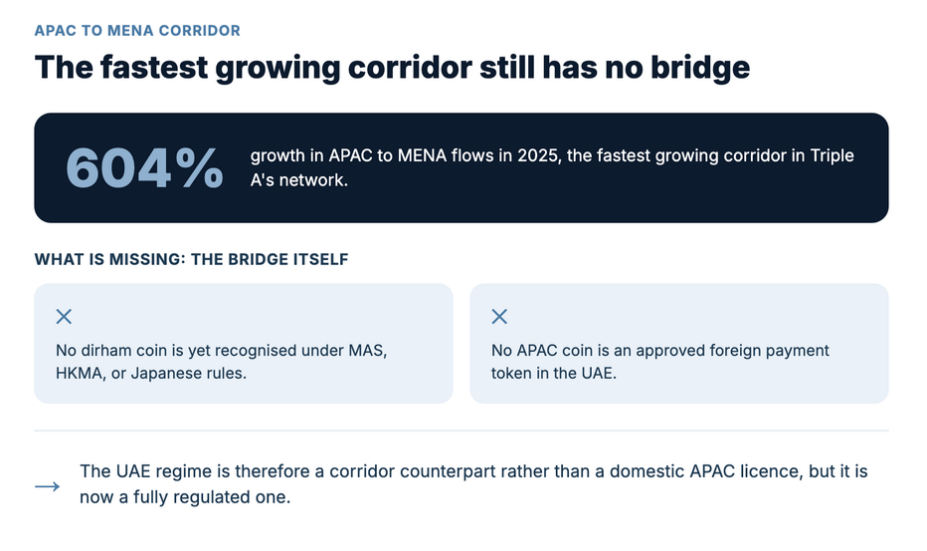
The UAE is the corridor counterpart. Under the Central Bank of the UAE's Payment Token Services Regulation, mainland payments may only be made with CBUAE-approved dirham payment tokens. DDSC, initiated by IHC and First Abu Dhabi Bank, was approved to go live on 11 February 2026 and cleared for distribution through VARA-regulated exchanges in July; AE Coin, issued by Al Maryah Community Bank, was integrated into Network International's merchant systems in January 2026; and RAKBANK received in-principle approval for its own dirham coin on 7 January 2026.
The Gulf now has a licensed local-currency settlement asset on the sending end of Asia's largest remittance corridors.
The Regulatory Map at a Glance
| Market | Framework status (September 2026) | What it means for stablecoins |
|---|---|---|
| Singapore | MAS-SCS framework (2023); PSA amendments under consultation to 16 Oct 2026 | Dedicated issuance licence, 100% reserves, yield ban, proposed recognition of foreign and jointly issued coins |
| Hong Kong | Stablecoins Ordinance in force 1 Aug 2025; first two licences 10 Apr 2026 | HK$25m capital, 1:1 HQLA reserves, retail limited to licensed coins; HKDAP live, HSBC coin H2 2026 |
| Japan | Payment Services Act; Types I, II, III | JPYC (Type II, ¥1m cap), JPYSC (Type III, no cap), megabank coin by Mar 2027 |
| Taiwan | Virtual Asset Service Act passed 30 Jun 2026; effective Q1 2027 earliest | Dual FSC and central-bank approval, 100% trust reserves, up to 7 years for unlicensed operation |
| South Korea | Digital Asset Basic Act targeted H2 2026 | Won stablecoin blocked by bank-ownership dispute |
| Australia | Digital Assets Framework passed 1 Apr 2026; stablecoins as tokenised SVFs | AUDM and AUDD live under AFSLs; no dedicated issuer regime |
| UAE | CBUAE Payment Token Services Regulation | DDSC and AE Coin live; RAKBANK approved in principle; corridor counterpart, not APAC licence |
What "Licensed" Actually Unlocks
Issuance is only one of four capabilities
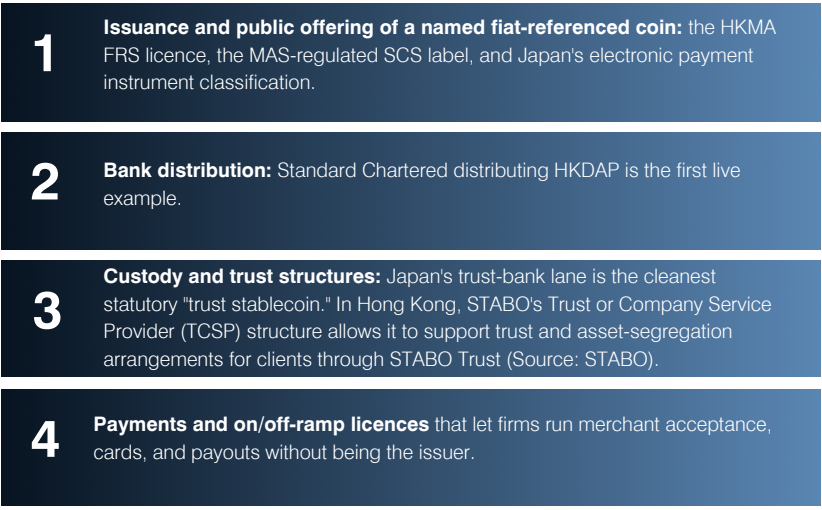
Licensing in APAC unlocks four distinct things, and almost no operator holds all of them.
- Issuance and public offering of a named coin: the HKMA FRS licence, the MAS-regulated label, Japan's EPI classification.
- Bank distribution: Standard Chartered distributing HKDAP is the first live example.
- Custody and trust structures: Japan's trust-bank lane and Hong Kong's TCSP regime.
- And payments licences that let firms run acceptance, cards, and payouts without issuing anything.
The last category is where most of the region's stablecoin volume actually moves.
Regulated standing on both ends is the moat
According to research by Movantis, the regulated settlement network holding more than 60 licences across the Americas with 90,000+ payout locations and a Circle Payments Network membership, reaching a payout location is easy to claim; reaching it with regulated settlement on both ends is not.
Movantis is entering APAC through USDC settlement into the Philippines, India, and Indonesia using the hybrid fiat-plus-stablecoin model it built in Latin America, and its position is that the winning infrastructure is measured by compliance depth, not by how many countries appear on a coverage map.
Operations decide who walks through the door
According to research by Capital Layer, the advantage in Asia's regulated markets will not go to whoever settles fastest but to institutions that can run stablecoin flows through their own audit and control systems, localised to their regulators and governed inside their existing environment.
Its Digital Asset Stacks platform was demonstrated with Taiwanese bank O-Bank in July 2026, receiving a yen-stablecoin payment and settling it to fiat inside the bank's existing risk and compliance controls.
Licensing changes the risk, not the compliance load
According to research by STABO, stablecoin payments remove the card-scheme chargeback mechanism but introduce a different set of risks around wallet provenance and illicit-source funds, which is why its collection infrastructure includes on-chain KYT, wallet screening, and transaction monitoring. Regulated status does not reduce the compliance surface; it relocates it.
The Regulatory Trajectory: 2026–2027
Four vectors dominate the outlook:
- Singapore's foreign-recognition proposal is the first crack in APAC's no-passporting wall. If it survives the October consultation, it becomes the only official path toward a multi-currency labelled coin in the region.
- The yield ban becomes universal. Singapore's proposal joins Hong Kong, Japan, and Taiwan, aligning with the US GENIUS Act and Europe's MiCA.
- Bank-issued coins scale before fintech-issued ones. HSBC's HKD coin, Japan's megabank council, RAKBANK's dirham token, and Taiwan's bank applicants all point to a first wave dominated by balance-sheet institutions.
- The second licensing wave arrives: Hong Kong's next batch after the two-bank first round, Korea's Digital Asset Basic Act, and Taiwan's Q1 2027 commencement.
The Money Moves East report names the constraint plainly: licensing opens the door, but there is no mutual recognition among Singapore, Hong Kong, and Japan, and the absence of passporting is the arbitrage that will define which hub wins.
Conclusion
Stablecoin Insider covers the data behind stablecoin adoption, and in Asia-Pacific licensing is now the variable that decides who operates.
Hong Kong has licensed two banks out of 36 applicants, Singapore is writing its framework into statute with the region's first opening to foreign coins, Japan has all three yen-issuer lanes live or scheduled, Taiwan has passed a bank-anchored regime with criminal enforcement, and Korea, Australia, and the UAE are at different points on the same path, while operator research from Capital Layer, Movantis, Reap, STABO, and Triple-A points to one conclusion: the licence is the entry ticket, and regulated operations on both ends of a corridor are the product.
The full regulatory map, the corridor-by-corridor analysis, and the CFO entry points by jurisdiction are in the Money Moves East: The Stablecoin Corridors in Asia in 2026 report; if you want the complete dataset behind these figures or want to discuss how they apply to your market, get in touch with our team.
Read Next:
FAQs:
1. Which Asian countries have stablecoin regulation in 2026?
The Asian countries with stablecoin regulation in 2026 are Singapore, with the MAS Single-Currency Stablecoin Framework now being written into the Payment Services Act; Hong Kong, under the Stablecoins Ordinance in force since 1 August 2025; Japan, under the Payment Services Act's electronic payment instrument rules; and Taiwan, whose Virtual Asset Service Act passed on 30 June 2026, while South Korea and Australia are still building dedicated issuer regimes.
2. Who holds a Hong Kong stablecoin licence?
The holders of a Hong Kong stablecoin licence are Anchorpoint Financial Limited, a joint venture of Standard Chartered Bank (Hong Kong), HKT, and Animoca Brands, and The Hongkong and Shanghai Banking Corporation, both licensed by the HKMA on 10 April 2026 out of 36 applicants.
3. Is there a regulated yen stablecoin in Japan?
There is a regulated yen stablecoin in Japan: JPYC, issued under a Type II funds-transfer licence since October 2025 with a ¥1 million cap, and JPYSC, issued by SBI Shinsei Trust Bank under a Type III trust-bank licence since 24 June 2026 with no transaction cap, with a third coin from MUFG, Mizuho, and SMBC due by March 2027.
4. What does Singapore's 2026 stablecoin consultation propose?
Singapore's 2026 stablecoin consultation proposes a dedicated stablecoin issuance licence under the Payment Services Act, 100% reserve backing, redemption at par, a ban on interest or yield to holders, stress testing, recovery and wind-down plans, the "MAS-regulated stablecoin" label for jointly issued coins, and recognition of a limited number of foreign-issued stablecoins regulated under comparable frameworks, with the consultation closing on 16 October 2026.
5. What does a stablecoin licence unlock for businesses in APAC?
A stablecoin licence unlocks for businesses in APAC one of four capabilities depending on its type: issuance and public offering of a named coin, bank distribution, custody and trust structures, or payments and on/off-ramp services such as merchant acceptance, cards, and payouts, with no jurisdiction yet recognising another's licence, which makes regulated standing on both ends of a corridor the practical requirement for operating at scale.
Disclaimer:
This content is provided for informational and educational purposes only and does not constitute financial, investment, legal, or tax advice; no material herein should be interpreted as a recommendation, endorsement, or solicitation to buy or sell any financial instrument, and readers should conduct their own independent research or consult a qualified professional.