Table of Contents
Q4 opens with an odd split.
Supply is flat, but the infrastructure buildout underneath it has never moved faster.
Open USD is due to go live, Visa and Mastercard are scaling settlement, banks are moving tokens into treasury, and Washington is now openly treating dollar stablecoins as foreign policy.
Here's what we expect between now and year-end.
Where market cap likely ends the year
2026 has been a flat year for supply.
Total market cap was $308 billion at the end of 2025, peaked above $321 billion in April, and was back to $308 billion by mid-August, 4.5% below the May peak. It was sitting around $311 billion as of this month.
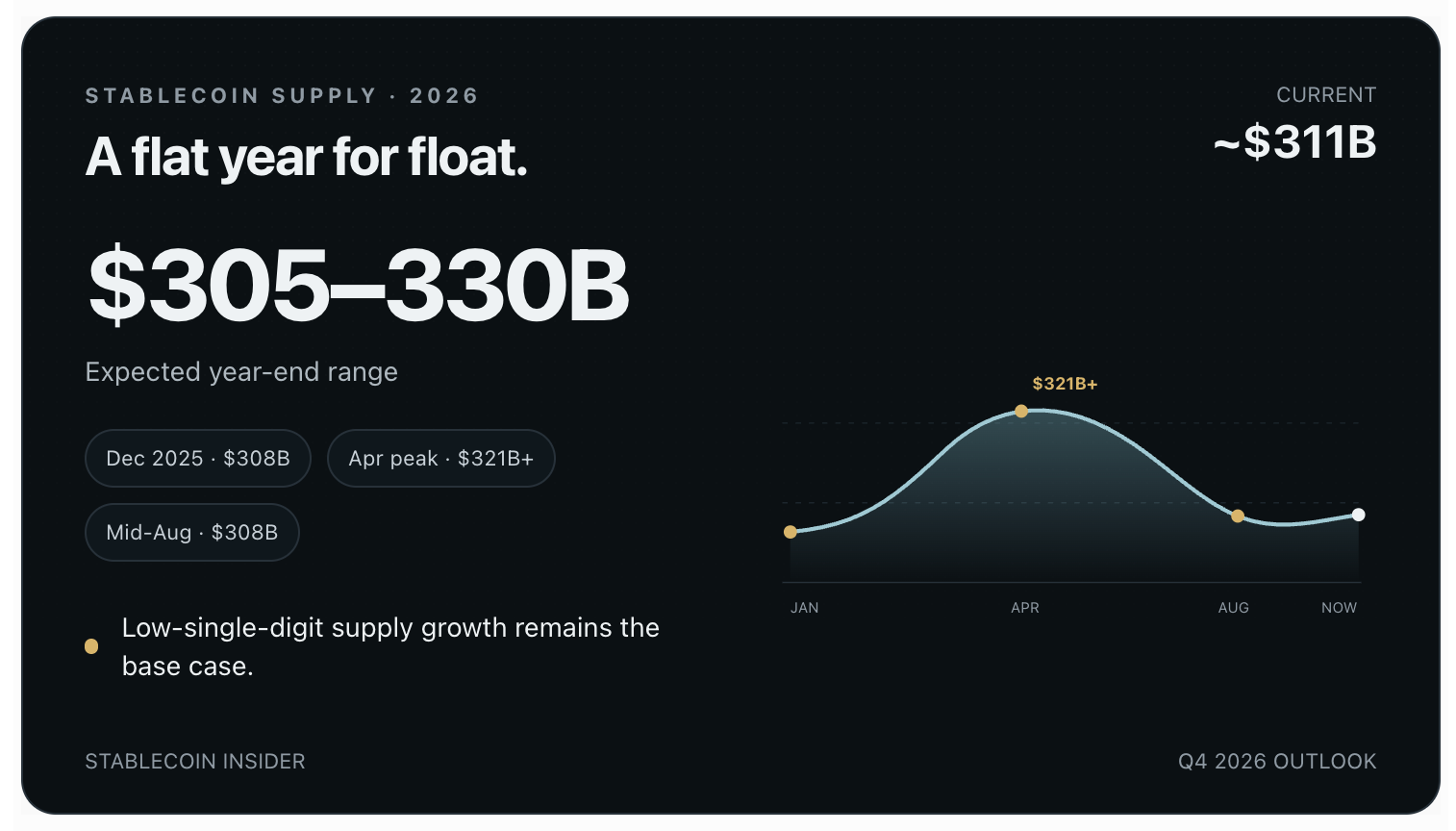
Our read: expect year-end in the $305–330 billion range, meaning 2026 closes with low-single-digit supply growth.
Here's why:
- Macro is a headwind, not a tailwind. The 10-year Treasury yield is above 5.1%, a 19-year high, after the Fed's first rate hike since 2023. That's good for issuer margins but hasn't translated into supply growth.
- New launches start small. Open USD, Qivalis, HSBC's HKD coin, and the bank tokens will add volume and distribution before they add meaningful float. The precedent is sobering: Paxos' revenue-sharing Global Dollar Network has grown to only about $3 billion since late 2024.
- The trillion-dollar calls were never for this year. No major forecaster expected $1 trillion within 2026. The long-range numbers still stand: Citi's base case is $1.9 trillion by 2030, and Standard Chartered expects $2 trillion by 2028.
The upside case is an early, fast Open USD mint driven by Stripe and Visa distribution. The downside case is a hawkish December FOMC pulling crypto liquidity further. Either way, the metric that matters for this audience in Q4 is payment and settlement volume, not float.
Expected launches
Here's what's slated for the remainder of 2026:
Open USD (OUSD)
Expected to go live later this year, with fee-free mint and redeem, no volume caps, and most reserve earnings returned to partners. Stripe has said it will be its default stablecoin, and it's the first asset on Visa's new stablecoin platform. Watch the launch chains and the first 30 days of mint volume against USDC. Also note the OUSD ticker is shared with the older Origin Dollar, so verify contract addresses.
Qivalis (EUR)
The 37-bank consortium will issue on public Ethereum and plans to launch as soon as it's approved, but its e-money application with De Nederlandsche Bank is still pending.
HSBC (HKD)
Targeted for H2 2026, integrated into PayMe and the HSBC HK app, with merchant payments and tokenized investment subscriptions in the first phase.
21-bank USD consortium
Company formation is expected in H2 2026 ahead of an H1 2027 token launch. Still no name, chain, or custodian disclosed, so any of those details landing in Q4 is news.
BPI (Philippines)
Bank of the Philippine Islands plans to pilot stablecoin rails for remittances with Meridian, with the client never touching the stablecoin, settling on-chain and paying out in fiat.
Western Union Stable Card
WU said it would launch a USD Stable Card across dozens of markets later this year, extending USDPT to consumers.
Government stablecoins
Government involvement is splitting into two tracks: states issuing their own tokens, and Washington promoting private dollar stablecoins abroad.
On the state side, Wyoming's FRNT has been publicly available since January 7, backed by dollars and short-duration Treasuries at a statutory 102% reserve ratio, managed by Franklin Templeton, and live on seven chains.
Its use cases are squarely B2G: the state is deploying it to cut card interchange costs and simplify vendor payments. The token also appears to sit outside GENIUS, since the Act seems to exclude state-issued stablecoins, which leaves it in a legal gray area worth tracking.
North Dakota is next. The Roughrider coin, built with Fiserv, was slated for banks and credit unions in 2026, with interbank transfers as the initial use case.
The Bank of North Dakota has been explicit that it's not open to the public and can't be bought or sold, making it a pure wholesale test. If the pilot launches before year-end, it becomes the first state-issued interbank settlement token in the U.S.
The bigger story broke last week.
The Trump administration is weighing joint ventures with private firms to promote dollar stablecoins overseas, with the Treasury, State Department, and the DFC as possible participants.
No firms, structure, or timeline have been disclosed. Its framing is explicit: stablecoin issuers already hold close to $200 billion of U.S. debt, placing them among the top 20 holders of Treasuries.
For B2B operators, the implication is significant.
If DFC money or diplomatic backing starts flowing toward dollar stablecoin rails in emerging markets, cross-border corridor infrastructure could get subsidized. The counterweight: the IMF has warned about capital flight and weakened domestic currencies, so expect pushback from EM central banks.
We'll be watching whether the plan gets confirmed with named partners this quarter.
Card and settlement rails
Visa's September 8 figures set the benchmark for Q4:
- Stablecoin settlement topped a $20 billion annualized run rate, up more than 15x year over year, from about $3.5 billion late last year and $7 billion by March.
- More than 160 stablecoin-linked card programs are live, with payment volume up nearly 200% year over year.
- Visa is pairing VisaNet settlement data with onchain lending for card-program working capital. Rain has financed about $2 billion through the Credit Coop facility with zero defaults, with borrowing costs down as much as 30%.
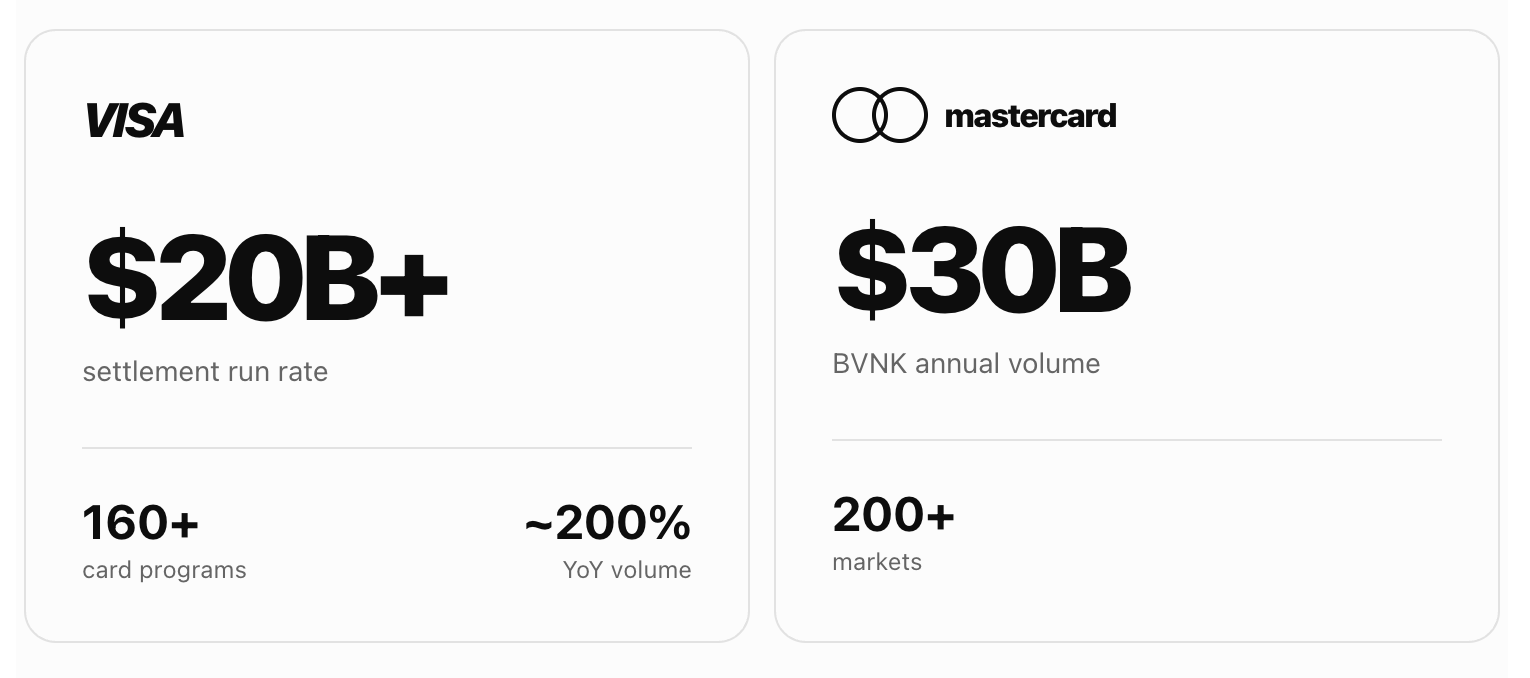
On the other side, Mastercard closed BVNK on August 3, picking up infrastructure moving $30 billion a year across 200-plus markets.
Q4 is its first full quarter under Mastercard, and BVNK has already flagged card functionality and broader fund-movement capabilities coming to its customers.
Expect the next Visa and Mastercard earnings calls to become the quarter's clearest volume checkpoints.
Bank treasury tokens
U.S. Bank's USBDC pilot is the template to watch.
The September 9 transfer moved value between its North American and European entities on public Stellar, testing mint, redeem, freeze, and clawback.
It remains internal, with no disclosed size, customer access, or launch timeline. Named next steps are liquidity management, collateral mobility, and cross-border treasury.
The Q4 question for bank tokens is whether any of them cross from intercompany to client-facing. That would be the first real proof that bank-issued stablecoins can compete for corporate treasury flows, not just demonstrate them.
Q4 calendar
- Sept 28 – Oct 1: Sibos, Miami Beach
- Oct 7–8: TOKEN2049 Singapore
- Oct 19: Comments due on Treasury's proposal defining issuance "in the United States"
- Oct 27–28 and Dec 8–9: FOMC meetings
- Nov 3: U.S. midterm elections
- Anytime in Q4: OUSD go-live, Qivalis license, HSBC HKD launch, 21-bank company formation, BPI pilot, Roughrider pilot
- Jan 18, 2027: GENIUS Act takes effect
Our Q4 bottom line
Don't expect the float to move much. Expect the plumbing to. The signals that will define how 2027 opens:
- Open USD's launch and whether early mint volume dents USDC's B2B share
- Visa's run rate pushing past $20 billion and BVNK's first Mastercard-branded products
- Any bank token (USBDC, the 21-bank company, Qivalis) crossing from pilot to client-facing
- Whether Washington's overseas stablecoin push gets named partners and real money
Download our latest report: Money Moves East

Partner/Advertise with Stablecoin Insider
Fill out this form to partner and advertise on the only publication, dedicated entirely to the Stablecoin ecosystem.
See you next week,
The Stablecoin Insider team