
Table of Contents
A shift ends at eleven at night on a Saturday. The rail that would move that worker's pay is awake, costs a fraction of a cent, and would settle the transfer in under a minute.
So the obvious question follows. If the money can move the moment the shift ends, why does an hourly worker wait until Friday of the following week?
The answer has almost nothing to do with payments. Everything that makes daily pay hard sits upstream of the transfer, in the hours, the overtime arithmetic, and the withholding, and none of those get faster because the settlement did.
Same-day pay is not a payments problem any more. It is a question of whether you can close the books on a single shift, which is a much harder thing to automate.
Key Takeaways
- Settlement is no longer the constraint. Transfers clear on nights and weekends.
- Overtime is weekly, not daily. Paying daily at straight time risks shortfalls.
- Withholding resists daily calculation. Gross-to-net assumes a pay period.
- Daily overpayments multiply. Five irreversible mistakes instead of one.
- Approved hours are the prerequisite. No clean timesheet means no same-day pay.
What Daily Pay Is Actually Worth
Start with why anyone wants this, because the demand is real and it is strongest exactly where the money is tightest.
For hourly staff, the gap between doing the work and being paid for it is the thing that drives people toward expensive short-term credit. Removing a week of that gap is worth more to a worker on an hourly wage than almost any benefit a small employer can otherwise afford.
Employers notice it in retention and in filling shifts nobody wants. Faster pay has become a recruiting feature in hospitality and retail rather than a finance decision.
The behavioural evidence on the settlement side points the same direction, and our explainer on stablecoin payroll documents workers keeping digital dollars rather than converting them immediately.
What to note: treat daily pay as a staffing lever rather than a payments upgrade, because that is where the return shows up.

The Timesheet Is the Real Bottleneck
Paying for a shift the day it happens requires knowing, that same day, exactly what the shift was.
That sounds trivial until you look at how small teams actually record hours. Someone covered for someone else, a break was not logged, a clock-out happened twenty minutes after the work stopped, and the manager fixes all of it on Monday when the week is reconciled.
Weekly payroll absorbs that mess. Daily pay cannot, because the correction arrives after the money has already left on a rail that does not take it back.
This is also the part the law cares about. Federal recordkeeping rules require accurate hours worked each day and each workweek, total straight-time and overtime earnings, and the payment date with the period it covers, with payroll records kept three years and time cards two.
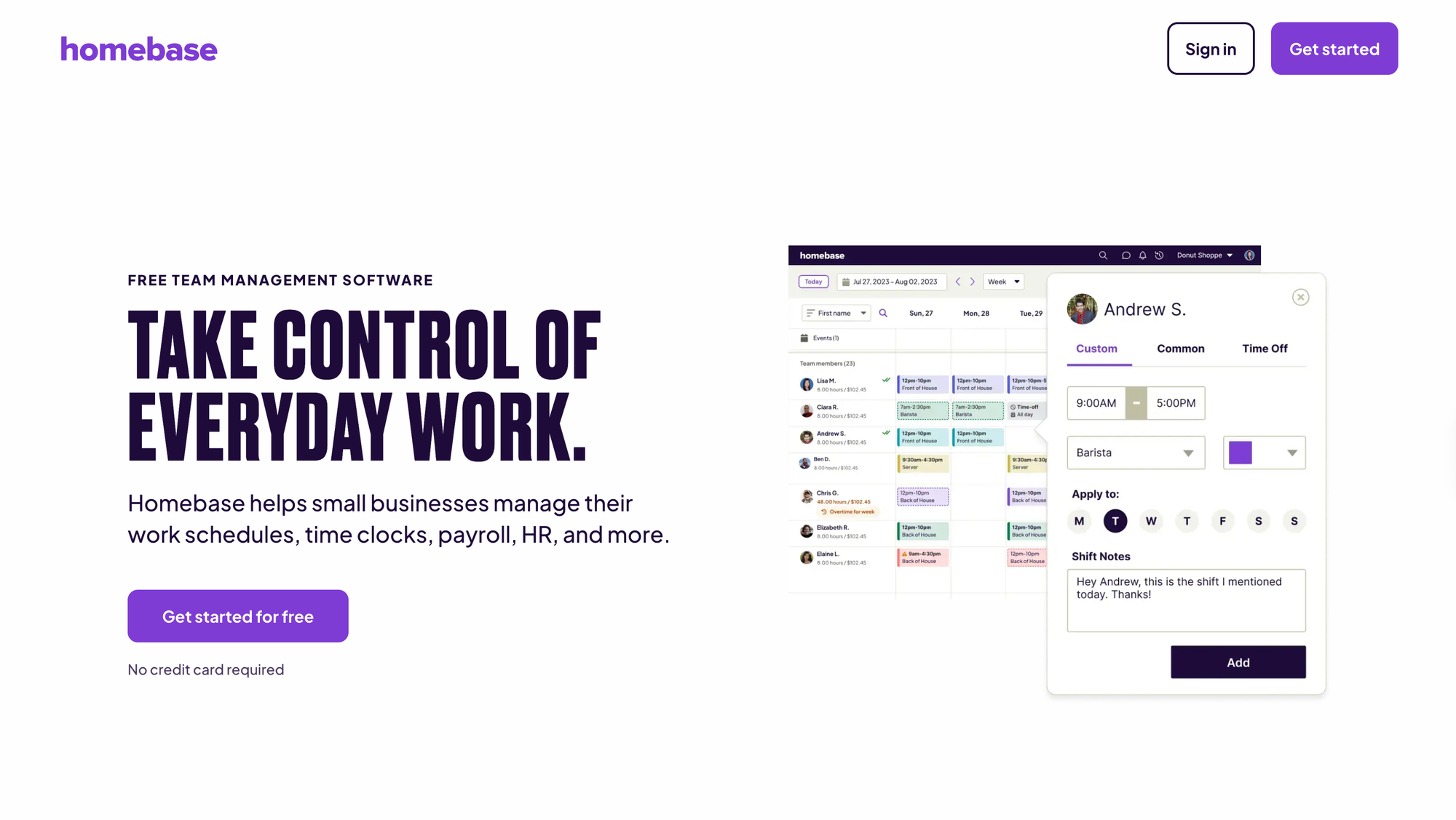
Free employee scheduling and time tracking for your team is what makes a shift closeable on the day, with hours approved before anything settles and payroll and HR added when you need them. No card or code required, so the record can be running before any decision about rails is made.
What to note: if hours are approved on Monday for the week before, same-day pay is not available at any speed of settlement.
Overtime Does Not Work Daily
This is the trap that catches employers who solve the timesheet problem and assume the rest follows.
Overtime under federal rules is calculated on the workweek rather than the day. A worker who does nine hours on Monday and six on each of the next three days has no overtime until the week passes forty hours, and nobody knows on Monday night whether Monday's ninth hour will eventually be paid at time and a half.
Pay each day at the straight rate and the week can close with an overtime premium still owed. That is recoverable in theory, since you simply pay the difference, and it means the week is never actually closed until you have topped it up.
Some states add daily overtime thresholds on top of the weekly one, which changes the calculation again depending on where the person works.
What to note: any daily model needs a weekly true-up step, and the true-up is not optional in weeks where someone goes long.
Withholding Assumes a Pay Period
The second structural problem is that net pay is not a property of a shift.
Withholding tables, allowances, and most deductions are built around a pay period, so dividing a paycheck into daily slices is not arithmetic anyone should do by hand. Benefit deductions and garnishments are scheduled per period rather than per day, which makes a daily net figure an estimate rather than a calculation.
That is why most implementations keep the formal pay cycle intact and treat the daily transfer as an advance against wages already earned, with the real gross-to-net run happening on the normal schedule.
The dollar discipline stays the same either way, because wages are calculated and reported in currency regardless of what settles them, which is the framing our guide to payroll in USDC sets out.
What to note: the advance model keeps one compliant payroll run and simply moves cash earlier, which is why it is the common answer.
Three Ways to Structure It
| Model | What the worker gets | What the employer carries | Fits |
|---|---|---|---|
| True daily payroll | Net pay for each shift, settled that day | Daily withholding, daily records, weekly true-up | Almost nobody without a platform |
| Daily advance against earned wages | Most of the shift's value within hours | One normal payroll run, advances reconciled against it | Most hourly teams |
| Weekly settlement on a fast rail | Pay on the Friday, including weekends and holidays | Nothing new beyond the rail itself | Teams wanting speed without restructuring |
| Contractor daily payout | Invoice settled the day work is accepted | Acceptance criteria and a clean invoice trail | Independent workers, not employees |
The fourth row is worth separating because it is the easy case. Contractors have no withholding and no overtime calculation, so daily settlement is genuinely just a payments decision for them and genuinely not one for employees.
What to note: decide which row you are in before choosing any tooling, since rows two and three need almost nothing new.
How to Run It Without Creating a Problem
1. Close the shift before you pay it
Hours approved by a manager, breaks recorded, and the rate confirmed. An unapproved timesheet settled on an irreversible rail is a dispute you have already funded.
2. Pay a percentage, not the full amount
Advancing a portion of the shift's earned value leaves room for the weekly overtime true-up and for any correction. The buffer is what keeps a mistake recoverable.
3. Keep the formal payroll cycle
Run gross-to-net on the normal schedule and net the advances against it. The pay statement still has to show the period, the hours, and the withholding whatever the cash timing was.
4. Make participation optional and keep a fiat route
Some workers will want the tokens, some will want a bank transfer, and some will want the normal Friday. All three have to keep working every cycle.
5. Record the dollar value at each transfer
Daily settlement means many more payment events, each one income at its value when received, which is the mechanic our guide to stablecoin taxes works through. Capture the amount, the date, and the hash as they happen rather than reconstructing them later.
What to note: more frequent pay means proportionally more records, so the logging has to be automatic before the frequency increases.
Risks and Limitations
- Overtime can only be known weekly: daily payment at straight rates leaves a premium owed in any week that runs long.
- Mistakes multiply with frequency: five daily transfers mean five chances to overpay, each of them final.
- Deduction rules are local: recovering an advance from a later paycheck is governed by state and national wage rules rather than by your agreement alone.
- Reconciliation work scales up: twenty payments per worker per month is twenty records, not one, and the effort is per payment.
- Worker experience varies: anyone converting to local currency each day pays the spread each day, which can quietly erase the benefit.
Conclusion
Can you pay hourly workers in stablecoins the same day they work? The transfer can happen minutes after the shift ends, including on a Sunday, and that part is genuinely solved.
What is not solved is everything that has to be true before the transfer. The hours must be approved that day, the overtime premium cannot be known until the week closes, and withholding is built around a pay period rather than a shift.
The workable version for most teams is therefore narrower and still valuable. Keep one compliant payroll run, advance part of each shift's earned value on a fast rail, true up weekly, and the worker stops waiting a week for money they already earned.
Read Next:
FAQs:
1. Is it legal to pay employees daily?
Pay frequency rules set minimums rather than maximums, so paying more often than required is generally permitted while the underlying obligations do not change. Wage statements, accurate daily and weekly hour records, and correct withholding still apply to every payment, and the specifics vary by jurisdiction.
2. Why is overtime a problem for same-day pay?
Because the federal calculation is based on the workweek rather than the day. Nobody knows on Monday night whether Monday's extra hour will fall above forty hours for the week, so a daily payment at the straight rate can leave a premium owed once the week closes.
3. What is the difference between daily payroll and a daily advance?
Daily payroll calculates and withholds per shift, which is difficult without a platform built for it. A daily advance pays part of the value already earned and nets it against a normal payroll run, keeping one compliant cycle and simply moving the cash earlier.
4. Do stablecoins actually help here?
They remove the settlement constraint, which matters because shifts end at night and at weekends when bank rails are closed. They do nothing for the timesheet, the overtime calculation, or the withholding, which is where the real work sits.
5. How long do the records need to be kept?
Under federal rules, payroll records are kept for three years and the records used to compute wages, including time cards and work schedules, for two. Paying more frequently multiplies the number of those records rather than changing the requirement.
Disclaimer:
This content is provided for informational and educational purposes only and does not constitute financial, investment, legal, or tax advice; no material herein should be interpreted as a recommendation, endorsement, or solicitation to buy or sell any financial instrument, and readers should conduct their own independent research or consult a qualified professional. Wage payment frequency, overtime thresholds, permitted deductions, and advance recovery rules vary significantly by jurisdiction; confirm the requirements that apply to your workers with qualified counsel before changing how or how often they are paid.