

Table of Contents
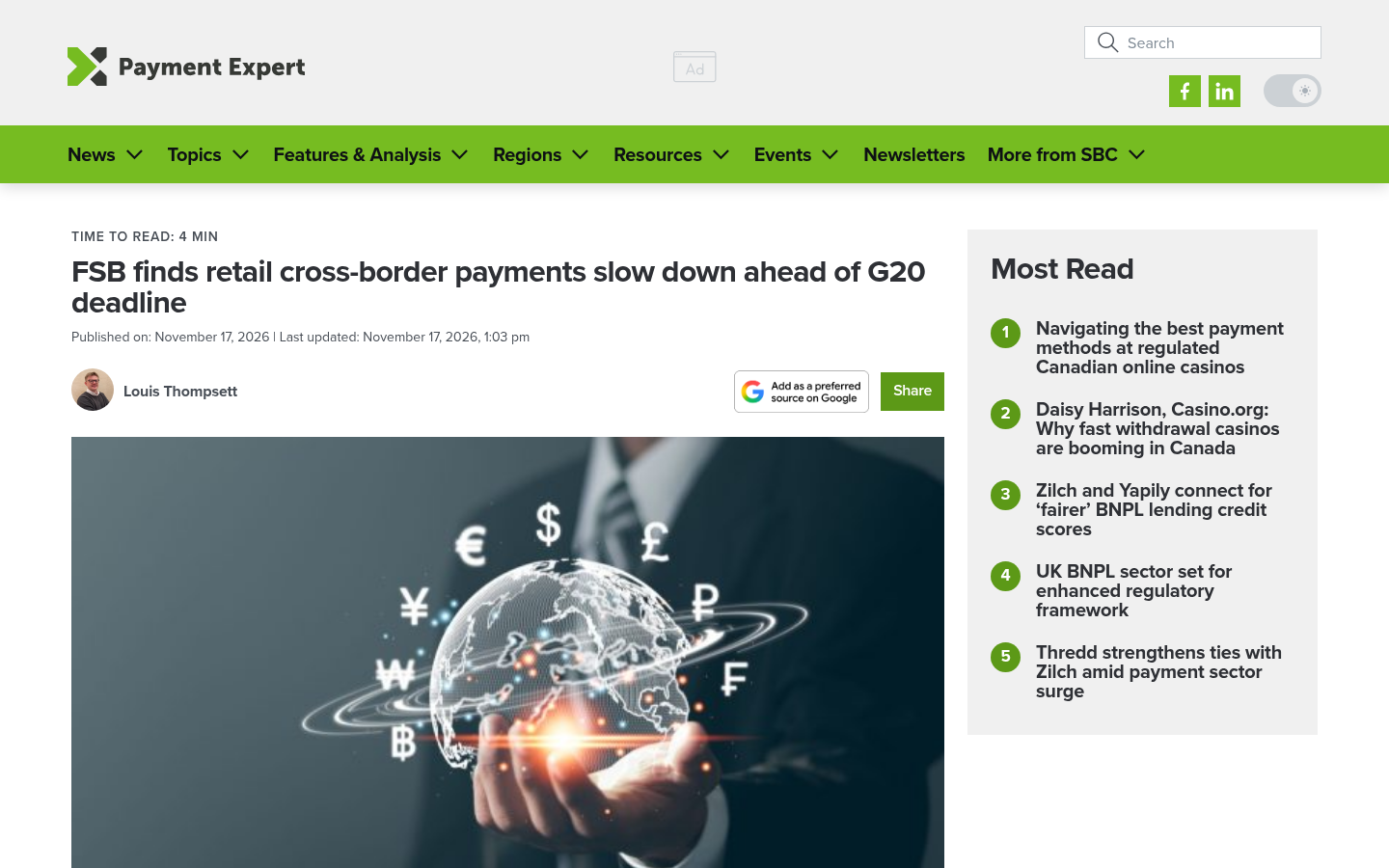
Only 32.9% of retail cross-border payments now reach the recipient within one hour, against a G20 target of 75% by end-2027, and the share credited within one business day fell to 59.8% in 2026 from 74% in 2023 (Source: PaymentExpert).
Stablecoin Insider tracks how money moves across borders, and the G20's cross-border payment targets are the main global yardstick for how well that system works.
The targets, set in 2021, aim to make cross-border payments cheaper, faster, more accessible and more transparent by the end of 2027.
With a year to go, the Financial Stability Board's latest progress report shows most of them are out of reach.
This analysis sets out the targets, the scorecard for 2026, why progress has stalled, where stablecoins and instant payment links fit, and what to watch before the deadline.
Key Takeaways
- The G20 wants 75% of cross-border payments credited within one hour.
- Retail payments became slower in 2026, not faster.
- Average retail costs of 1.5% to 2.7% remain above the 1% target.
- Wholesale payments on Swift improved to 57% within one hour.
- Stablecoins carried only about 0.31% of retail cross-border flows in 2025.
What the G20 Targets Are
In 2021, G20 leaders endorsed 11 global targets for cross-border payments across three segments: wholesale payments, retail payments and remittances. The targets cover four problems: cost, speed, access and transparency. Most fall due at the end of 2027, while the remittance cost target follows the UN goal for 2030 (Source: Financial Stability Board).
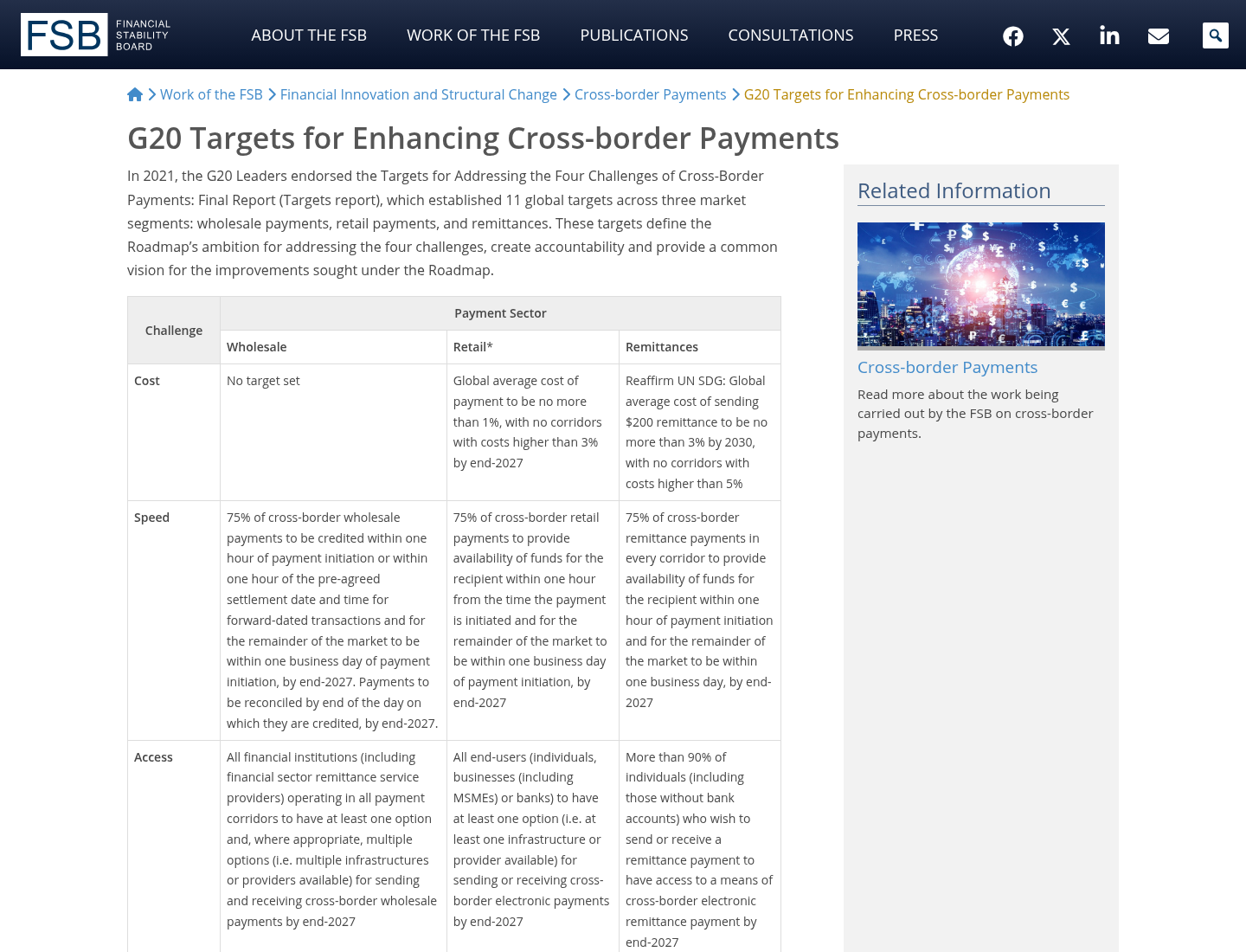
| Target | Goal | Deadline |
|---|---|---|
| Retail cost | Under 1% average | End-2027 |
| Retail speed | 75% within 1 hour | End-2027 |
| Wholesale speed | 75% within 1 hour | End-2027 |
| Remittance cost | 3% for $200 | 2030 |
| Remittance access | Over 90% of people | End-2027 |
The transparency target requires all payment providers to show the total cost, including FX charges, the expected delivery time, payment tracking and terms of service by end-2027.
The 2026 Scorecard
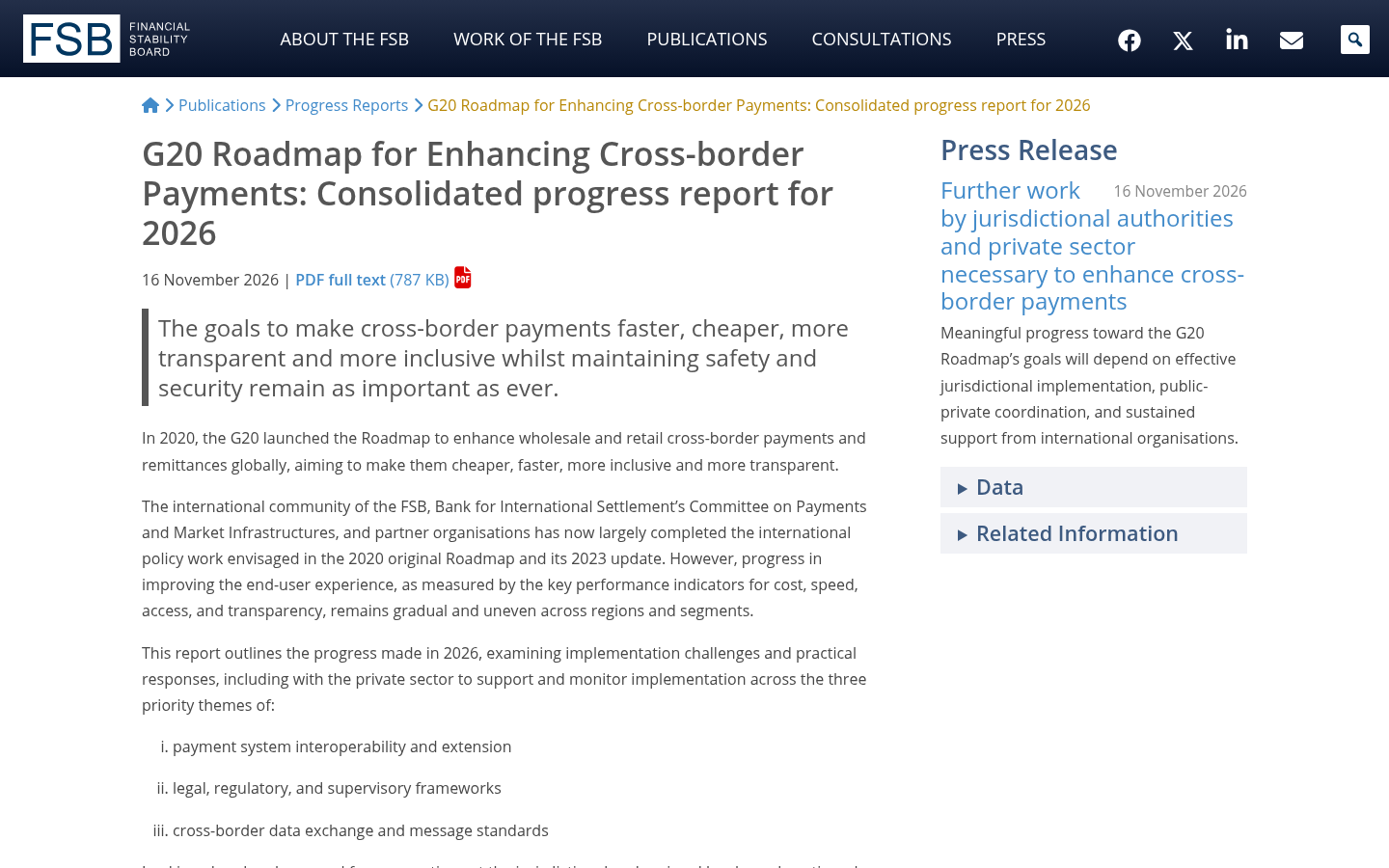
The FSB published its 2026 consolidated progress report on 16 November. It says the international policy work under the G20 Roadmap is largely complete, but progress for end users, as measured by cost, speed, access and transparency, "remains gradual and uneven across regions and segments" (Source: FSB).
| Measure | Target | 2026 result |
|---|---|---|
| Retail within 1 hour | 75% | 32.9% |
| Retail within 1 day | Rest of market | 59.8% |
| Retail cost | 1% | 1.5% to 2.7% |
| $200 remittance cost | 3% | 5.7% |
| Wholesale within 1 hour | 75% | 57% |
- Retail speed fell: The share credited within one business day dropped from 74% in 2023 and 67.3% in 2025 to 59.8% in 2026.
- Retail costs flat: Average costs range from 1.5% for business-to-business to 2.7% for person-to-person payments, unchanged since 2023, according to PaymentExpert's summary.
- Expensive corridors: The share of retail corridors costing more than 3% fell to 15.1% from 18.3%, but not enough to move the averages.
- Remittance caveat: The $200 remittance cost fell to 5.7%, but almost all of the drop since 2023 came from rebasing benchmarks for exchange rates. Without it, the cost would be 6.2%.
- Wholesale progress: On Swift, 57% of wholesale payments were credited within one hour, up from 53.8% in 2023, helped by better data after the ISO 20022 migration.
Why Progress Has Stalled
The FSB says the remaining barriers sit mostly at national level, in data, licensing and fraud rules. Its survey with the BIS Committee on Payments and Market Infrastructures found several worrying trends, as reported by PaymentExpert.
- Data localisation: 48% of responding jurisdictions reported rules restricting where payment data can be held, up from 31% in 2025.
- Old licensing rules: A third had not updated expectations for payment providers since 2020, and 57% had not run risk assessments covering both bank and non-bank providers.
- Fraud data: Little progress was made on sharing fraud data across borders, held back by differing privacy rules.
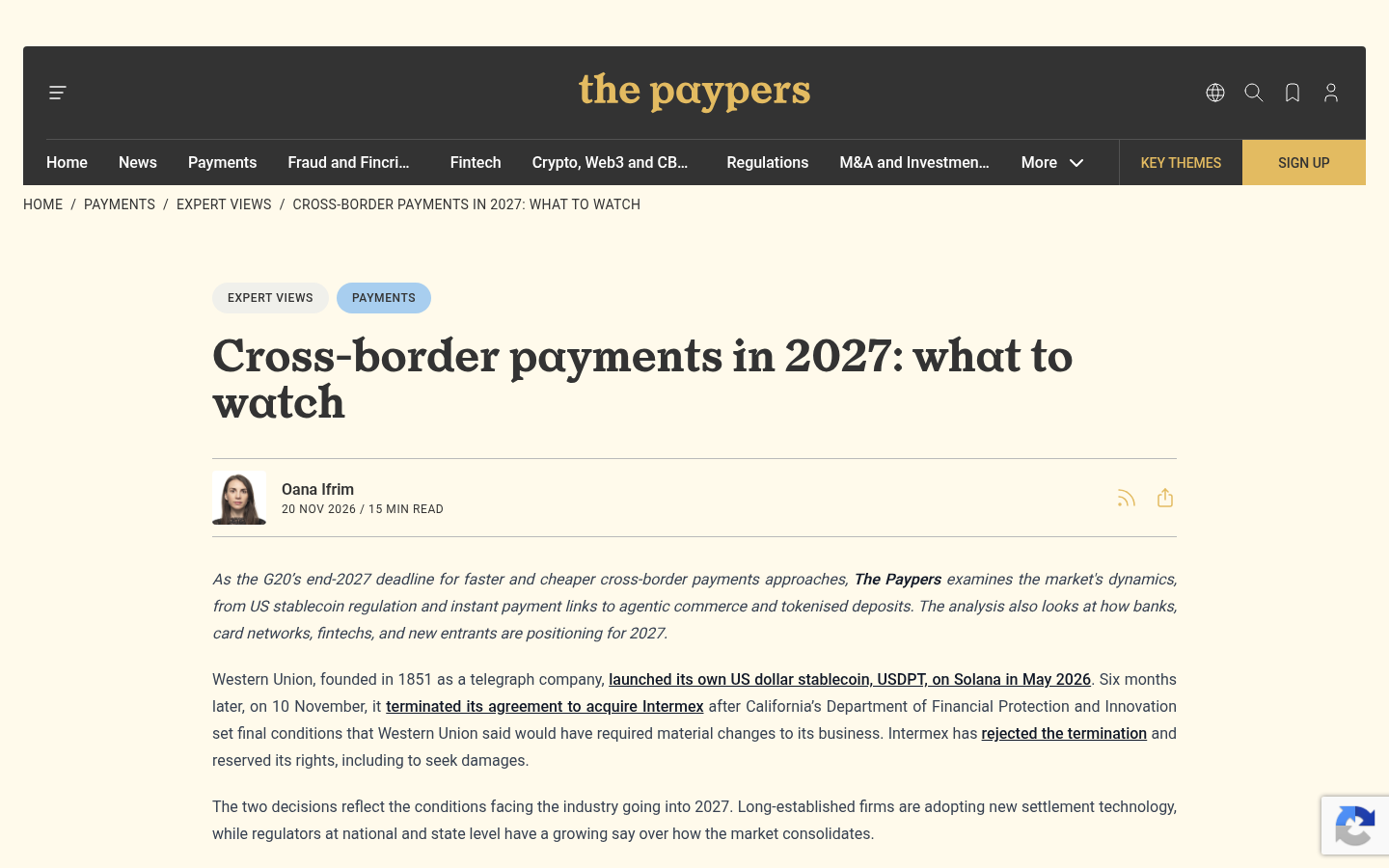
Delays also come from the last mile. Swift data cited by The Paypers shows that up to 80% of delays happen after a payment has left the Swift network, on the way to the recipient's account.
The FSB has asked jurisdictions for national action plans setting out what they will do through end-2027, and almost all G20 members have said they will produce one.
Where Stablecoins Fit
Stablecoins are often pitched as the answer to slow and expensive cross-border payments, but their share is still small. FXC Intelligence and Allium estimate stablecoins carried about $135 billion of the $44.3 trillion retail cross-border market in 2025, or 0.31%, up from 0.20% in 2024, as The Paypers reports in its 2027 outlook (Source: The Paypers).
- Settlement, not checkout: In most arrangements, customers send and receive ordinary currency and stablecoins are used for settlement in between.
- Incumbents moving in: Mastercard completed its acquisition of BVNK in August 2026, and Western Union launched its own stablecoin, USDPT, in May 2026.
- US rules start: The GENIUS Act takes effect on 18 January 2027, after which payment stablecoins in the US must come from approved issuers.
Development lenders are testing the same idea, as covered in our analysis of the World Bank, Citi and Circle stablecoin disbursement test. For options available today, see our guide to stablecoin FX platforms for cross-border payments.
Instant Payment Links and Other Fixes
Linking domestic instant payment systems is the main public-sector answer to the speed problem. The Paypers notes that Nexus Global Payments, set up by central banks and payment system operators from India, Malaysia, the Philippines, Singapore and Thailand, is targeting go-live in 2027, and that the number of fast payment systems planning links abroad doubled over the past year.
- Nexus: Each domestic system connects once to a shared hub instead of building many bilateral links.
- Swift: Better ISO 20022 data has helped wholesale speed, and Swift is expanding its retail payments scheme.
- Domestic rails: Systems such as the EU's SEPA Instant and the US FedNow decide how fast the final leg arrives.
Our comparisons of Swift's blockchain ledger vs stablecoins and FedNow vs RTP vs stablecoins look at how these rails compete.
What It Means for Payment Firms and Users
- Corridor results matter: Providers that can show specific corridors already meet the speed and cost targets will have a strong selling point.
- Transparency is the easiest win: Showing full costs, FX margins and delivery times upfront is within each provider's control.
- Regulation drives access: Licensing and data rules in each country will decide which providers can offer faster routes.
- Remittance users still overpay: At around 6% for a $200 transfer, comparing providers remains important.
Remittance costs also face new pressure in the US, as covered in our explainer on the US remittance tax.
What to Watch
- National action plans: The FSB plans to publish a summary of G20 members' plans in early 2027.
- New deadline: Whether the G20 extends the timeline or revises the targets after 2027.
- Nexus go-live: Whether the Nexus hub links Asian instant payment systems in 2027.
- GENIUS Act: How US stablecoin rules from 18 January 2027 affect cross-border settlement.
- Peer review: The FSB's 2027 review of how members apply its rules for payment providers and data.
Conclusion
Stablecoin Insider follows the rails that move money across borders, and the G20 scorecard shows how far the system still is from its own goals.
The rules and standards are largely in place, but end users are not yet seeing faster or cheaper payments, and retail speed actually worsened in 2026.
The fixes now depend on national governments, through data rules, licensing and links between domestic payment systems.
Stablecoins and instant payment links offer faster routes, but at current scale they will not close the gap before the end-2027 deadline.
Read Next
- Pension Surplus Sharing: What the New DB Rules Mean for You From April 2027
- Chime vs SoFi in 2026: Savings APY, Fees and Overdraft
- Direct Group Liquidation: 21 Companies Wound Up, and Who Gets Paid First
FAQs
1. What are the G20 cross-border payment targets?
The G20 cross-border payment targets are 11 goals endorsed in 2021 to make cross-border payments cheaper, faster, more accessible, and more transparent. They cover wholesale payments, retail payments and remittances, and most are due by the end of 2027.
2. Will the G20 meet its 2027 cross-border payment targets?
The G20 is unlikely to meet most of its 2027 cross-border payment targets. The FSB's 2026 report shows retail payments slowed, retail costs stayed flat since 2023, and only wholesale speed on SWIFT improved meaningfully.
3. How fast are cross-border payments in 2026?
Cross-border payments in 2026 vary by segment. Only 32.9% of retail payments arrive within one hour and 59.8% within one business day, while 57% of wholesale payments on SWIFT are credited within one hour.
4. How much does it cost to send money abroad in 2026?
It costs about 5.7% on average to send a $200 remittance abroad in 2026, or 6.2% without the FSB's exchange-rate adjustment. Retail cross-border payments cost between 1.5% and 2.7% on average.
5. Can stablecoins help meet the G20 targets?
Stablecoins can help meet the G20 targets in some corridors because they settle in minutes at any time. However, they carried only about 0.31% of retail cross-border flows in 2025, so their impact on the global averages is still small.
Disclaimer: This content is provided for informational purposes only and does not constitute legal, financial, or investment advice. Figures and dates cited here reflect publicly available information as of November 2026 and may change. Check the latest FSB reports and official sources before making decisions.