
Table of Contents
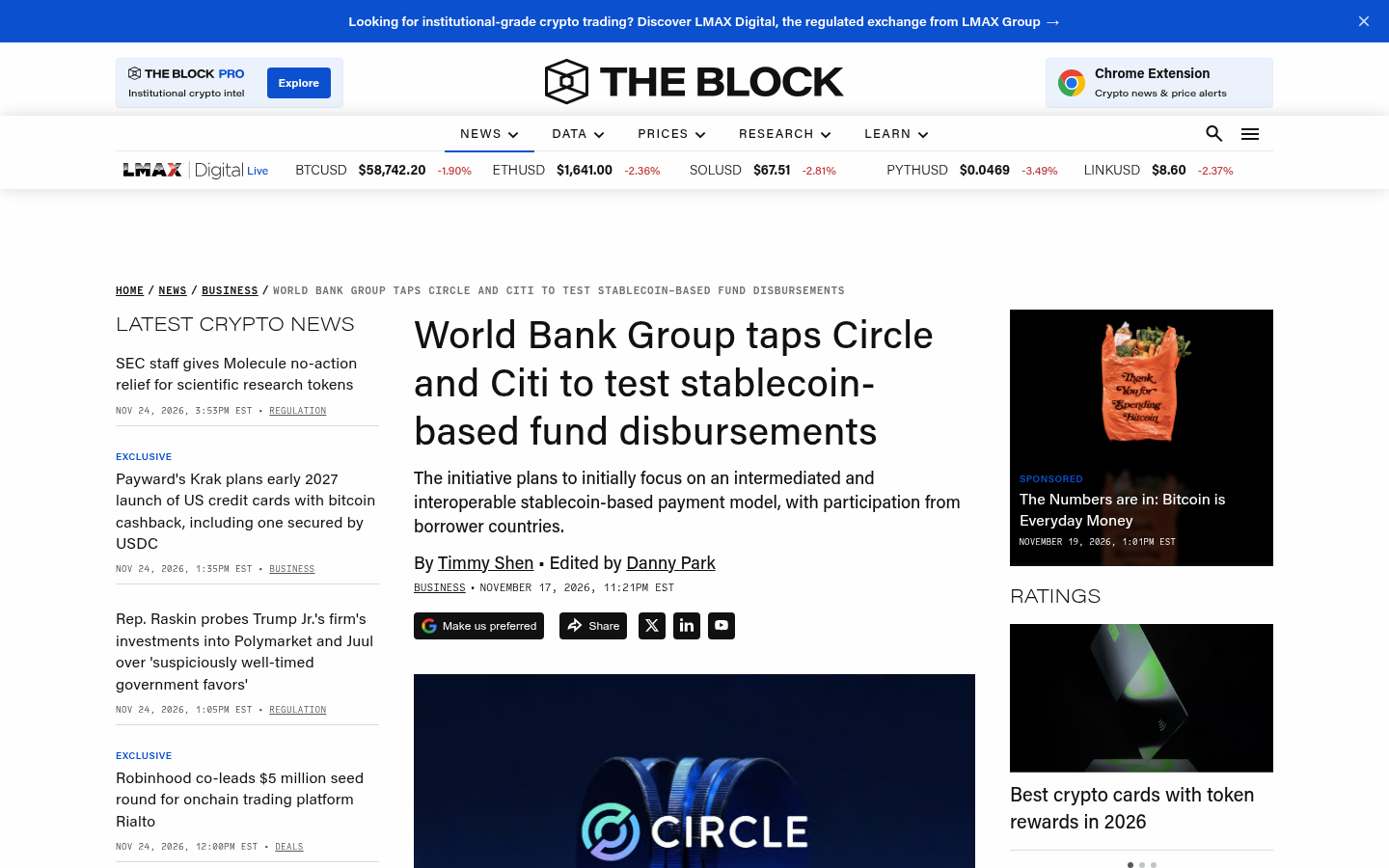
The World Bank Group delivered $123.5 billion in loans, grants, equity investments and guarantees in the fiscal year to 30 June 2026, and on 17 November it said it will test moving some of that money in USDC with Citi and Circle (Source: The Block).
Stablecoin Insider follows how banks and public institutions put stablecoins to work, and the World Bank's move is one of the largest institutional tests of dollar stablecoins so far.
Development money still travels through correspondent banks, a chain of intermediaries that can be slow, costly and hard to trace.
The World Bank Group now wants to see whether a regulated stablecoin, settled through Citi's banking network, can do the job faster and cheaper.
This analysis explains what was announced, how the model would work, why it matters for development finance, what the risks are, and what to watch next.
Key Takeaways
- The World Bank Group will explore USDC for fund disbursements.
- Citi provides banking rails and Circle mints and settles USDC.
- The test builds on FundsChain, used in 350-plus projects.
- Only borrower countries that permit digital assets will take part.
- It is an exploration, not a live payment program yet.
What Was Announced
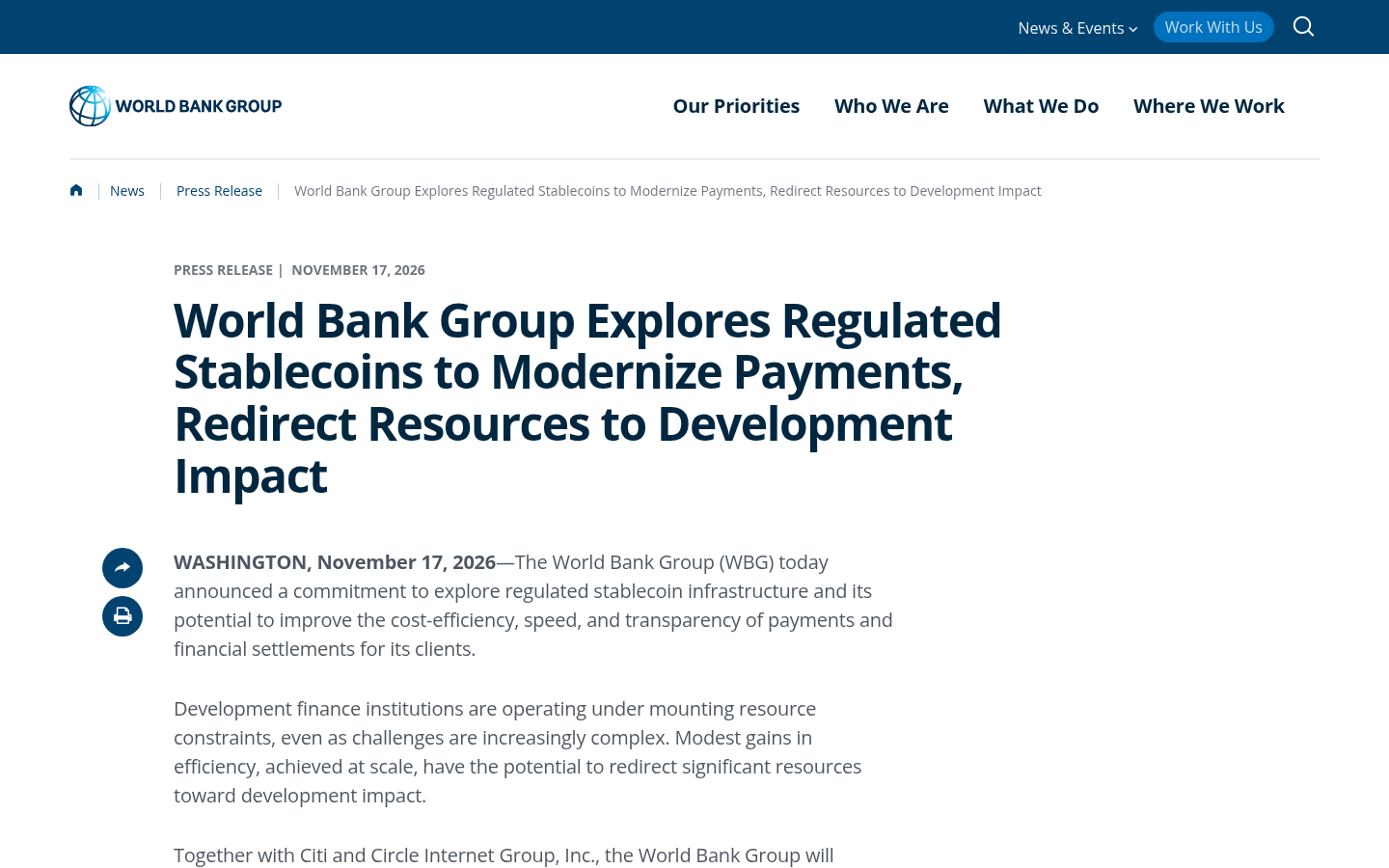
The World Bank Group said it will explore how US dollar regulated stablecoins and blockchain payment rails could work alongside or improve its existing disbursement system, which is based on correspondent banking. Citi will bring its connections to established banking rails, and Circle will provide the infrastructure to mint and settle funds in USDC (Source: World Bank Group).
| Partner | Role | Key asset |
|---|---|---|
| World Bank Group | Sends funds | FundsChain ledger |
| Citi | Banking rails | 180+ jurisdictions |
| Circle | Mints USDC | Stablecoin rails |
World Bank Group President Ajay Banga framed it as fixing the "financial plumbing" of development, so that a clinic gets built on time or a farmer gets paid before harvest. Citi said the work would bring 24/7 capabilities so funds move in real time, according to the same statement.
How the Model Would Work
The World Bank Group said the first phase will focus on an intermediated and interoperable model. In plain terms, the World Bank would not hand USDC directly to end users. Regulated banks would sit in the middle, converting between dollars and USDC and connecting to local banking systems.
- Funding: Dollars from the World Bank Group are converted to USDC through Circle, with Citi handling the banking side.
- Transfer: USDC moves on blockchain rails, which run 24/7 and settle in minutes rather than days.
- Payout: Funds reach recipients in borrower countries through banks or partners that can convert them to local currency.
- Tracking: FundsChain records how money flows through each project.
FundsChain is not new. More than 350 projects across 96 countries are already onboarded to its digital ledgers, which let all parties see how project funds are used. The stablecoin test adds a payment layer on top of that tracking layer.
The World Bank Group also said it will only engage borrower countries where the use of digital assets is supported and permitted, and that it will look to add other banks over time.
Why Development Finance Is a Good Test Case
Development and aid payments share the problems stablecoins claim to solve: many cross-border hops, high fees, slow settlement and limited visibility on where money ends up. Even small savings matter at the World Bank's scale.
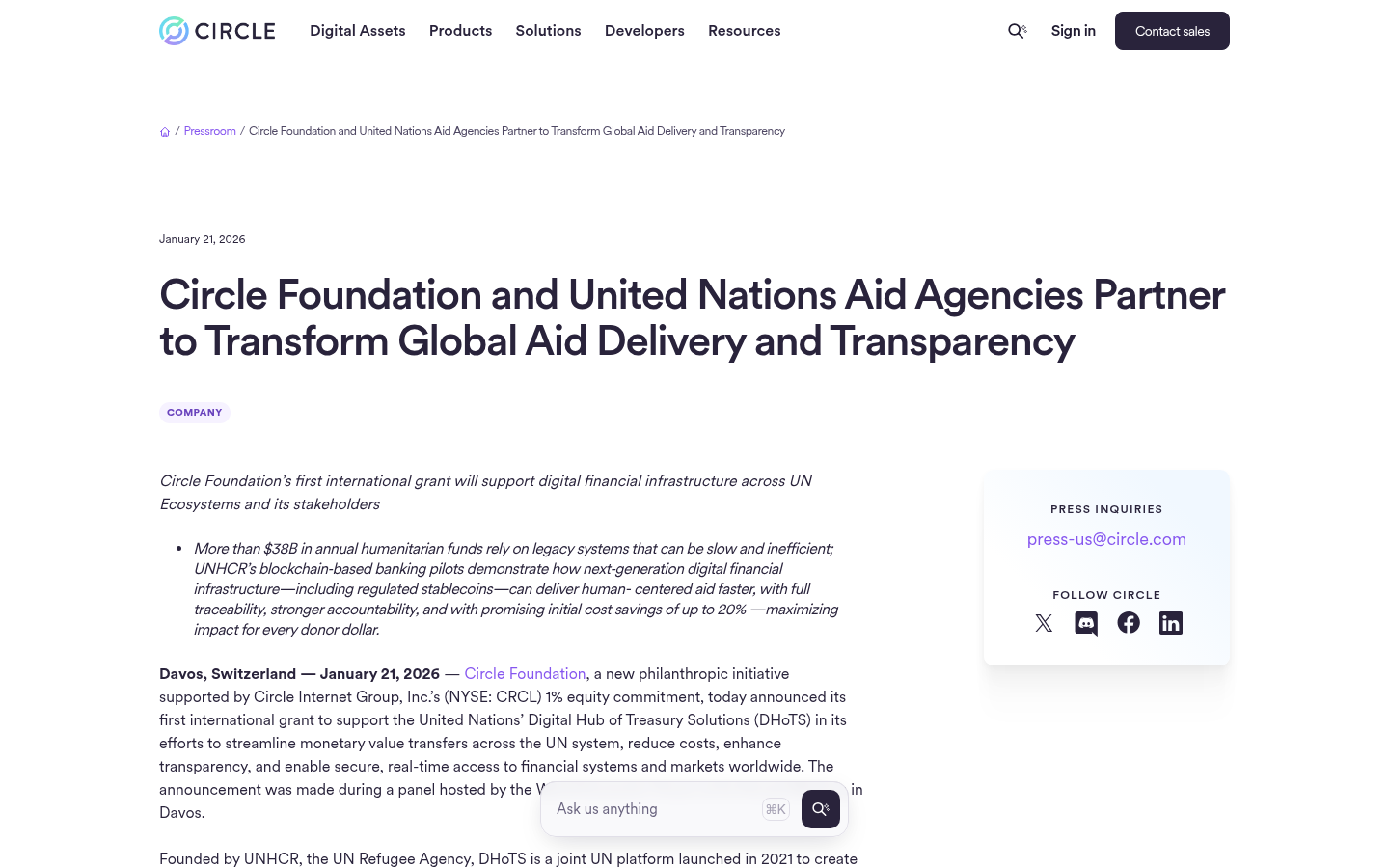
The aid sector has already run smaller trials. Circle Foundation's January 2026 grant to the UN's Digital Hub of Treasury Solutions noted that more than $38 billion in annual humanitarian funds rely on legacy systems, and that UNHCR's blockchain pilots showed initial cost savings of up to 20% (Source: Circle).
| Feature | Correspondent banking | USDC rails |
|---|---|---|
| Hours | Bank hours | 24/7 |
| Settlement | One to several days | Minutes |
| Intermediaries | Several banks | Fewer hops |
| Traceability | Limited | On-chain record |
UNHCR used USDC in 2022 to send aid to displaced Ukrainians, according to the same Circle release. The World Bank test applies the same idea to development finance.
What It Means for Citi and Circle
For Circle, a role in World Bank payment flows is a strong signal of institutional trust in USDC, the second-largest stablecoin. For Citi, it shows banks can sit at the centre of stablecoin payments rather than be bypassed by them. Decrypt noted the news comes as Goldman Sachs, Citi and other banks commit roughly $270 million to a joint stablecoin venture (Source: Decrypt).
- Citi's track record: Citi already works with Coinbase on stablecoin payments, as covered in our explainer on the Citi and Coinbase partnership.
- Bank rails race: Banks are also testing tokenized deposits, such as the DBS, Citi and Swift weekend payment.
- Circle's position: Analysts have already backed Circle as a leading issuer, as in Citi's call on Circle.
Risks and Open Questions
- Local cash-out: Recipients still need dollars or local currency. The model depends on banks and partners able to convert USDC in each country.
- Country rules: Many borrower countries restrict or ban crypto assets, which limits where the test can run.
- Dollar dependence: USD stablecoins can speed up dollarisation in countries with weak currencies, a concern for some central banks.
- Issuer risk: USDC is backed by reserves held by Circle, so the model relies on a single private issuer.
- No numbers yet: The World Bank Group has not published cost savings, volumes or a timeline for live payments.
Cross-border rails are changing quickly on several fronts. Our comparison of Swift's blockchain ledger vs stablecoins shows how traditional networks are responding.
What to Watch
- First countries: Which borrower countries join the initial phase.
- Live payments: When the first real disbursements in USDC take place, and in what amounts.
- Other banks: Which banks join Citi as the program widens.
- Published results: Whether the World Bank Group reports cost and speed savings.
- Other lenders: Whether regional development banks follow with their own stablecoin tests.
Conclusion
Stablecoin Insider tracks how public institutions adopt stablecoins, and the World Bank Group's move puts USDC in front of one of the world's largest sources of development money.
The plan is careful. It starts as an exploration, keeps regulated banks in the middle and limits itself to countries that allow digital assets.
If it works, the gain is practical: funds that arrive faster, cost less to send and can be traced from donor to project.
The real test will be the first live payments and the numbers that come with them.
Read Next
These three guides go deeper on stablecoin payment rails, bank adoption and cross-border transfers.
- Digital Euro 2026: Where It Stands After the November Trilogue
- 401(k) Limits 2027: $25,500 Cap, $34,000 at 50+ and the New Roth Catch-Up Rule
- Square vs Clover in 2026: Fees, Hardware and Contracts
FAQs
1. Is the World Bank using stablecoins?
The World Bank is exploring the use of stablecoins, but is not yet using them for live disbursements. On 17 November 2026, the World Bank Group said it will test USDC payments with Citi and Circle to see if they can make fund transfers faster and cheaper.
2. Which stablecoin will the World Bank test?
The World Bank will test USDC, the US dollar stablecoin issued by Circle. Circle will mint and settle funds in USDC, while Citi connects the process to established banking rails.
3. What is FundsChain?
FundsChain is a World Bank Group blockchain platform that tracks how project funds are disbursed and used. More than 350 projects across 96 countries are onboarded to its digital ledgers.
4. Will aid recipients receive USDC directly?
Aid recipients will not necessarily receive USDC directly. The first phase uses an intermediated model, where regulated banks convert between dollars, USDC, and local currency for recipients in permitted countries.
5. Why would the World Bank use stablecoins?
The World Bank would use stablecoins to make disbursements faster, cheaper, and easier to trace than correspondent banking. Stablecoin rails run 24/7 and settle in minutes, which can help funds reach projects on time.
Disclaimer: This content is provided for informational purposes only and does not constitute legal, financial, or investment advice. Details of the World Bank Group initiative reflect publicly available information as of November 2026 and may change as the project develops. Check official statements from the World Bank Group, Citi and Circle for the latest updates.