Table of Contents
Ghana has one of West Africa's most active crypto markets, and USDT is the coin most people use to hold dollars. Freelancers, traders and families receiving money from abroad all need a way back to cedis.
Unlike South Africa, Ghana has no deep local exchange order book for USDT yet. Most conversions happen on P2P marketplaces, with buyers paying by mobile money.
This guide compares three ways to convert USDT to GHS in 2026, using live rates from 27 November 2026, and explains the new licensing rules and tax.
On 27 November 2026, regular P2P buyers on Bybit and OKX paid GHS 12.51 to 12.55 per USDT, mostly via MTN MoMo and Telecel Cash. That was about 7% above the Bank of Ghana interbank rate of around GHS 11.73.
Key Takeaways
- Bybit and OKX P2P paid GHS 12.51 to 12.55.
- P2P rates sat about 7% above interbank.
- MTN MoMo was the main payout method.
- One Bybit offer sat 13% above market.
- The VASP Act requires exchanges to be licensed.
The 3 Ways to Convert USDT to GHS at a Glance
| Route | Payout | Rate seen (GHS per USDT) | Best for |
|---|---|---|---|
| Bybit P2P | MTN MoMo, Telecel Cash | 12.51 to 12.53 | Zero taker fees |
| OKX P2P | MTN MoMo, Telecel Cash | 12.52 to 12.55 | Most offers |
| Local crypto apps | Mobile money, bank | Varies by app | Simple instant sales |
For background on the new rules, see our report on Ghana's new VASP framework.
What to note: rates were read around midday in Accra and change through the day.
1. Bybit P2P: Zero Taker Fees
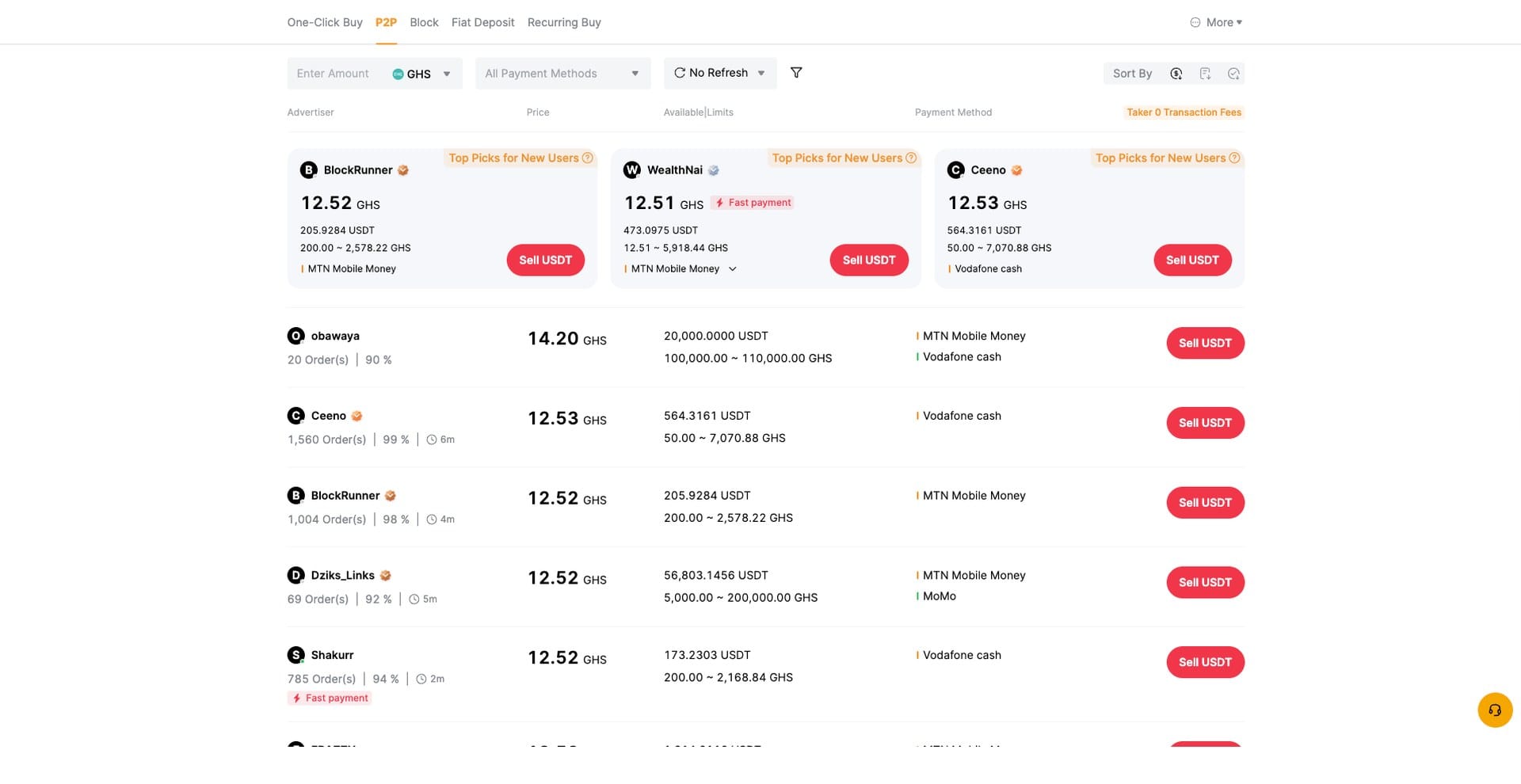
Bybit's GHS market showed "Taker 0 Transaction Fees," so sellers taking an existing offer paid no platform fee. Regular buyers paid GHS 12.51 to 12.53 per USDT.
Bybit also pinned three "Top Picks for New Users" offers at GHS 12.51 to 12.53. Unlike in some other markets we have checked, these were in line with regular offers that day.
One offer paid GHS 14.20, about 13% above every other buyer. It came from an account with only 20 orders and a minimum trade of GHS 100,000.
What to note: an offer that far above the market is a red flag, so skip it.
2. OKX P2P: The Deepest Order List
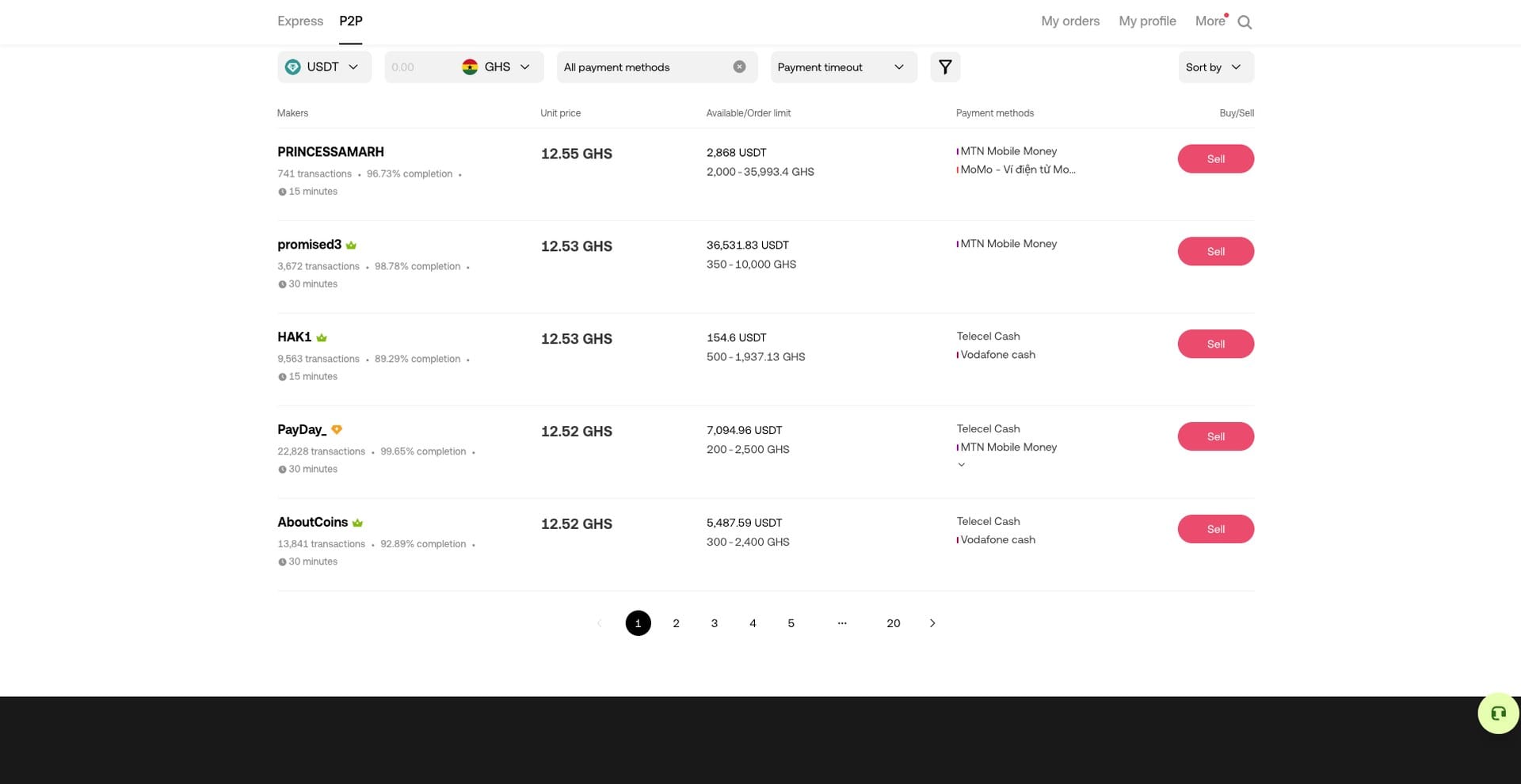
OKX listed 20 pages of buyers for USDT in cedis. The best offer paid GHS 12.55, with a minimum trade of GHS 2,000.
Other buyers near the top paid GHS 12.52 to 12.53, including one merchant with over 22,000 completed trades. Most paid through MTN MoMo or Telecel Cash, formerly Vodafone Cash.
The difference between 12.55 and 12.52 is only GHS 30 on 1,000 USDT. A buyer's completion rate and trade history matter more than a few pesewas.
What to note: release USDT only after the cedis appear in your own MoMo wallet.
3. Local Crypto Apps: Wait for Licences
Several apps let Ghanaians sell USDT instantly for cedis paid to mobile money or a bank account. They are simpler than P2P, but their quoted rates usually include a margin.
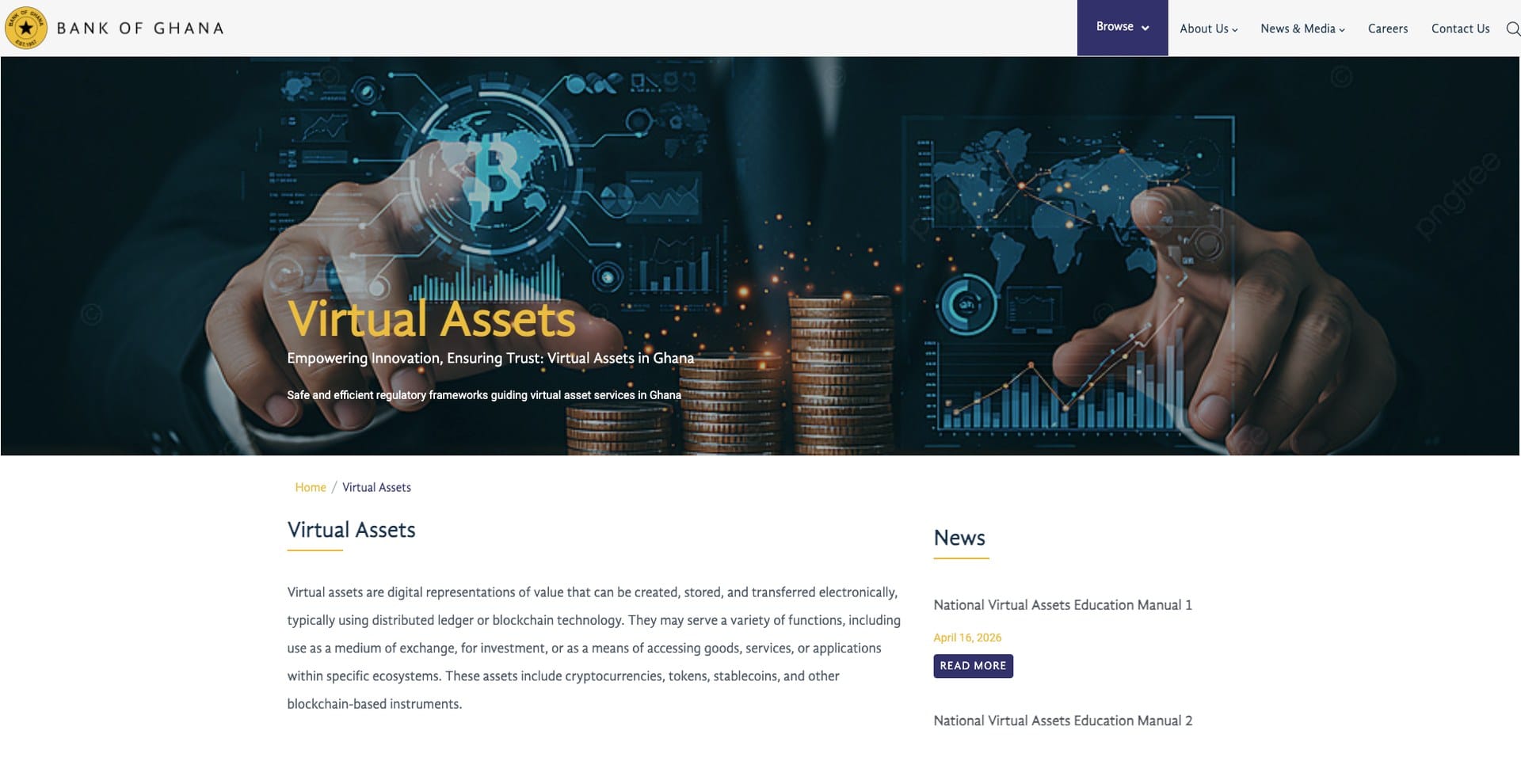
Under the VASP Act, wallet providers, exchanges and dealing services must register or be licensed. The Bank of Ghana said its application page would be available by the end of the third quarter of 2026.
Before using an app, check whether it has applied for or received a licence. Our guide to converting USDT to ZAR shows what a mature licensed market looks like.
What to note: compare any instant quote with live P2P rates before you sell.
What About Binance P2P?
When we tried to open Binance P2P for cedis on 27 November 2026, the page switched to another currency and showed no GHS market.
We could not confirm why. Availability may differ when logged in, so check the app yourself.
For now, Bybit and OKX showed the most active cedi P2P markets.
What to note: never follow a "Binance GHS" link from a stranger, as it may be a fake site.
Why P2P Pays More Than the Bank Rate
On 17 November 2026, the Bank of Ghana interbank rate was about GHS 11.72 to 11.74 per dollar, while forex bureaus quoted about GHS 12.35.
P2P buyers paid around GHS 12.53 per USDT ten days later. That is about 7% above interbank and about 1.5% above bureau rates.
The premium reflects demand for dollars that the banking system does not fully meet. It can shrink quickly if the cedi strengthens.
What to note: the premium is not guaranteed, so do not hold USDT only to chase it.
Is It Legal to Sell USDT in Ghana?
Yes. Parliament passed the Virtual Asset Service Providers Act, 2025 (Act 1154) on 19 December 2025, and it was signed on 29 December 2025.
The Bank of Ghana regulates virtual asset services through a new Virtual Assets Department, working with the Securities and Exchange Commission and the Financial Intelligence Centre. Licensing is being phased in during 2026.
Crypto is legal to trade, but it is not legal tender. The cedi remains Ghana's only official currency.
What to note: licensed providers must follow anti-money laundering rules, so expect ID checks.
Do You Pay Tax on USDT in Ghana?
Ghana has no crypto-specific tax law yet. The Ghana Revenue Authority applies the general rules of the Income Tax Act 2015 to gains.
Published guides differ on the exact rate for crypto gains, and regular trading can be taxed as business income at rates up to 35%. That is why the answer depends on how often you trade.
Because USDT tracks the dollar, a weaker cedi can create a gain in cedis even when the dollar value did not change.
What to note: keep records of every purchase and sale, and ask a tax adviser.
Ghana vs Nigeria and South Africa
Ghana looks a lot like Nigeria: P2P dominates, and mobile or bank payouts settle most trades. Our guide to converting USDT to naira compares those routes.
South Africa is different, with deep licensed exchanges and very tight spreads, so sellers there usually use an order book instead.
As Ghana's licensing regime matures, local exchanges may close some of that gap.
What to note: in every market, compare several offers before you sell.
Risks and Limitations
- Offers far above the market are a red flag.
- Fake MoMo payment messages are a common scam.
- MoMo wallets have daily transaction limits.
- The P2P premium over interbank can shrink fast.
- Many local apps are still awaiting licences.
No funds were sent, traded or withdrawn for this guide. Rates were read from Bybit and OKX on 27 November 2026.
What to note: check the MoMo app itself, not an SMS, before releasing USDT.
Conclusion
Converting USDT to GHS in 2026 mostly means P2P. On 27 November 2026, regular buyers on Bybit and OKX paid GHS 12.51 to 12.55 per USDT, about 7% above the interbank rate.
MTN MoMo and Telecel Cash were the main payout methods. One Bybit offer at GHS 14.20 was a clear warning sign.
Choose experienced buyers, confirm payment in your own wallet, and watch for licensed local exchanges under the new VASP Act.
Read Next:
- Ghana Legalizes Crypto Trading: New VASP Framework
- How to Convert USDT to Naira in 2026: 5 Ways Compared
- How to Convert USDT to ZAR in South Africa (2026): 4 Ways Compared
FAQs:
1. What is the best way to convert USDT to GHS?
For most people, a P2P marketplace such as Bybit or OKX with payment to MTN MoMo or Telecel Cash. On 27 November 2026, regular buyers paid GHS 12.51 to 12.55 per USDT.
2. Why is the P2P rate higher than the Bank of Ghana rate?
P2P buyers pay a premium for dollars. On 27 November 2026, P2P rates were about 7% above the interbank rate seen earlier that month.
3. Can I use Binance P2P in Ghana?
When we checked on 27 November 2026, Binance P2P showed no GHS market. Bybit and OKX both had active cedi markets.
4. Is selling USDT legal in Ghana?
Yes. The VASP Act 2025 (Act 1154) made crypto trading legal and regulated, with licensing by the Bank of Ghana and the SEC being phased in during 2026.
5. Do I pay tax when I sell USDT in Ghana?
Gains fall under the general Income Tax Act 2015, as there is no crypto-specific tax law yet. Regular trading can be taxed as business income, so ask a tax adviser.
Disclaimer:
This content is provided for informational and educational purposes only and does not constitute financial, investment, tax or legal advice; no material herein should be interpreted as a recommendation, endorsement, or solicitation to buy or sell any token, and readers should conduct their own independent research or consult a qualified professional. Rates, fees, licensing status and tax rules are drawn from public pages and reporting at the time of writing, are not independently verified here, and may change. No funds were sent, traded or withdrawn for this article.