Table of Contents
Digital transfers reached more than 61% of all remittance transactions to Latin America and the Caribbean in 2026, up from about 55% in 2025, with the new 1% US tax on cash transfers named as one of the drivers (Source: Inter-American Dialogue).
Stablecoin Insider tracks how money moves across borders, from correspondent banking to stablecoin rails, and the US remittance tax is now one of the forces deciding which rail people choose.
Since January 1, 2026, anyone in the United States who pays for an international transfer with cash, a money order or a cashier's check pays an extra 1% to the IRS.
The tax is small per transfer, but it lands on the senders least likely to have a bank account, and it has started pushing volume toward digital channels.
This guide explains exactly which transfers the tax covers, who pays it, what it costs in dollars, where the proposed rules stand, and the legal ways to send money abroad without paying it.
Key Takeaways
- The 1% tax applies only to remittances paid with cash, money orders or cashier's checks.
- Transfers funded from a US bank account or US-issued card are exempt.
- Senders owe the tax; providers collect it and file quarterly on Form 720.
- Congress expects about $10 billion in revenue from 2026 through 2034.
- Wallet-to-wallet stablecoin transfers sit outside the tax's clear scope, for now.
Where Remittances Stand in 2026
Remittances to Latin America and the Caribbean are projected to reach about $188 billion in 2026, growing 4.5% to 4.7%, down from roughly 7% in 2025 (Source: Inter-American Dialogue).
The same report puts 2026 growth at 2.3% for Mexico and 7.3% for Central America, and values the digital remittance market at $99.5 billion this year, up from $88.3 billion in 2025.
Mexico, the largest corridor, is recovering slowly. It received $47.164 billion from January to September 2026, up 2.1% on the same period of 2025, while the average transfer rose 5% to $411 and the number of transfers fell 2.7% (Source: Enfoque Noticias).
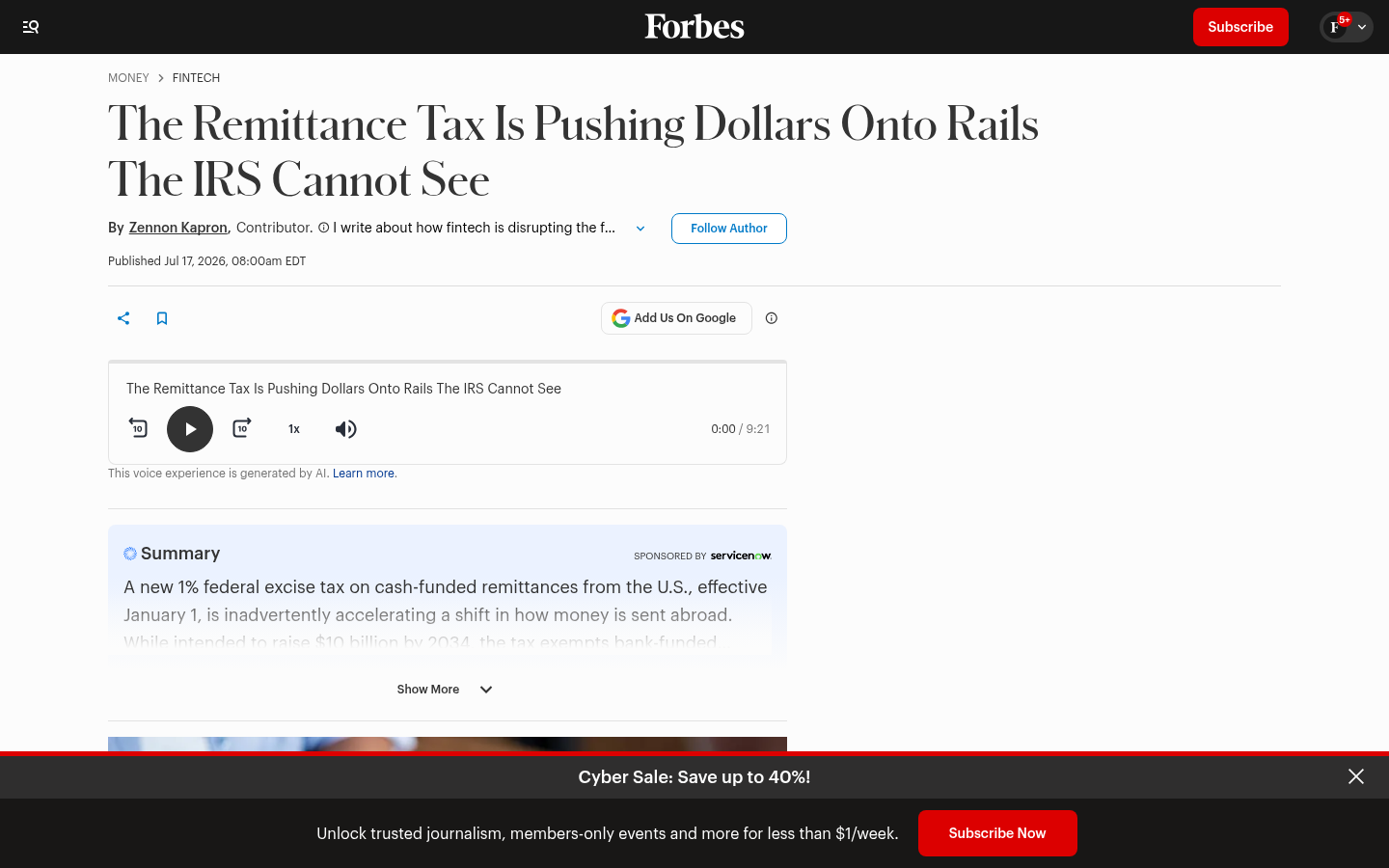
That follows a weak 2025. Mexico received $61.8 billion last year, down 4.6%, its first annual decline in eleven years (Source: Forbes).
Central America moved the other way. Remittances in 2025 rose 25.3% to Honduras, 18.7% to Guatemala and 17.8% to El Salvador, a jump the same analysis links partly to senders moving money before the tax arrived. Our guide to stablecoin regulation in Latin America covers how receiving countries treat digital dollars.
Why Washington Taxed Remittances
The tax came from the One Big Beautiful Bill Act, signed on July 4, 2025, and applies to transfers made from January 1, 2026 (Source: Ria).

The revenue target is modest. Congress's Joint Committee on Taxation estimates the tax could raise about $10 billion from 2026 to 2034 (Source: BBVA Research).
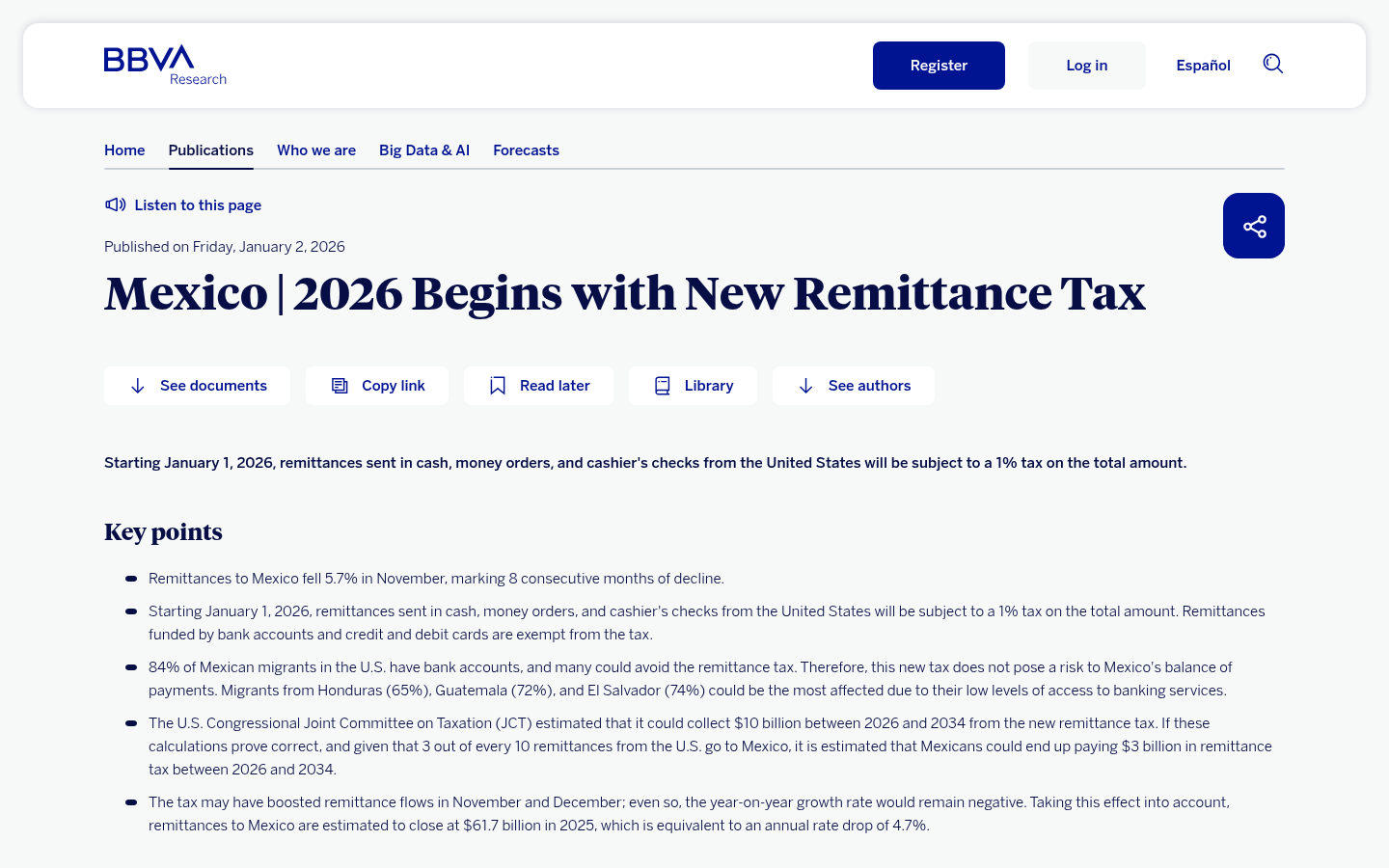
Because about 3 in 10 US remittances go to Mexico, BBVA Research estimates Mexican families could carry roughly $3 billion of that total if sender behaviour does not change.
The design matters more than the rate. By taxing only physical funding methods, the law falls hardest on cash-based senders, while anyone sending from a bank account pays nothing extra. Cheaper digital routes, including cross-border payments on stablecoin rails, are the obvious substitutes.
How the 1% Remittance Tax Works
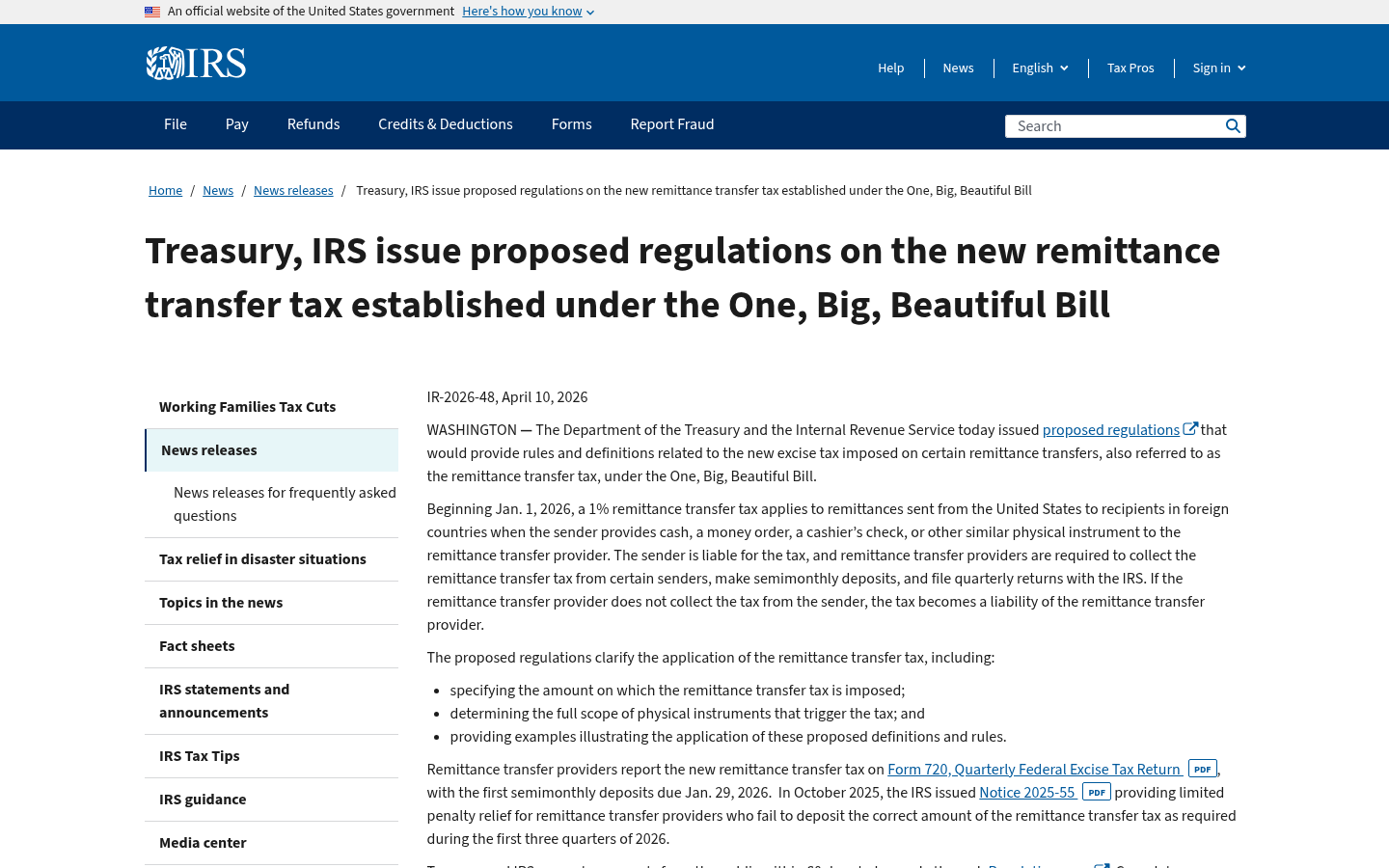
The tax applies to remittances sent from the United States to a recipient abroad when the sender pays with cash, a money order, a cashier's check or a similar physical instrument. The sender is liable, the provider must collect it, and if the provider fails to collect it, the tax becomes the provider's liability (Source: IRS).
| Rule | What it means |
|---|---|
| Rate | 1% of the amount sent |
| Taxed funding | Cash, money order, cashier's check |
| Exempt funding | US bank account or US-issued card |
| Who owes it | The sender |
| Who collects it | The transfer provider |
| Deposits | Twice a month, first due Jan 29, 2026 |
| Return | Form 720, filed quarterly |
| Applies to | Transfers made from Jan 1, 2026 |
Two details catch senders out. The tax is added on top of the transfer fee, not taken out of it, and it is not refundable or deductible on a federal return (Source: Ria).
It also applies regardless of citizenship or immigration status. A US citizen paying cash at a counter owes it just as a visa holder does.
What It Costs: Worked Examples
The arithmetic is simple, but it compounds for regular senders. These figures cover the tax alone, before the provider's fee and exchange rate margin.
| Transfer | Paid in cash | Paid from a bank |
|---|---|---|
| $200 once | $2.00 tax | $0 |
| $500 once | $5.00 tax | $0 |
| $1,000 once | $10.00 tax | $0 |
| $400 a month | $48 a year | $0 |
| $800 a month | $96 a year | $0 |
For a family sending $800 a month in cash, the tax adds $8 to every transfer, on top of the provider's fee and exchange rate margin. Our Western Union alternatives comparison prices those fees by corridor.
The Proposed Regulations: Where the Rules Stand
Treasury and the IRS issued proposed regulations on April 10, 2026. They define the amount the tax is imposed on, set out the full range of physical instruments that trigger it, and include worked examples (Source: IRS).
The comment period closed on June 12, 2026. Providers also received limited penalty relief under Notice 2025-55 for deposit errors during the first three quarters of 2026, which ended on September 30.
As of Ria's October 20, 2026 update, the regulations were still proposed rather than final, so some details could change (Source: Ria).
The open question is scope. The phrase "similar physical instrument" leaves room for interpretation, and senders using anything other than a bank account or a US-issued card should ask their provider directly whether the tax applies.
Who Pays the Most
The tax falls on senders without bank accounts, and account access varies sharply by community. About 84% of Mexican migrants in the US hold bank accounts, compared with 74% of Salvadorans, 72% of Guatemalans and 65% of Hondurans (Source: BBVA Research).
That makes Central American senders the most exposed. They come from the corridors growing fastest, and they are the least likely to have an exempt way to pay.
The shift is visible in the data. More than 80% of remitters now have a bank account, and digital transfers grew over 6% in 2026, compared with about 4% a year since 2020 (Source: Inter-American Dialogue).
How to Send Money Abroad Without the Tax, Legally
The exemption is built into the law, so avoiding the tax is a matter of changing how a transfer is funded, not of hiding it.
- Fund from a US bank account: Transfers paid by bank debit or ACH are exempt. This is the single most effective change for regular senders.
- Pay with a US-issued debit or credit card: Card-funded transfers are exempt, though credit cards can add cash advance fees on the card side.
- Use a digital wallet funded from an exempt source: A wallet loaded from a bank account or card keeps the transfer exempt.
- Open an account if you do not have one: Some banks and digital providers accept a foreign passport or consular ID, and an account turns every future transfer into an exempt one.
- Compare the full cost, not just the tax: Exchange rate margins often cost more than 1%. Our Remitly vs Wise comparison shows how far quotes for the same corridor can differ.
What does not work is splitting cash transfers into smaller amounts. The tax is a flat percentage of each cash-funded transfer, so splitting a payment does not reduce it.
Where Stablecoins Fit
Stablecoins were already a meaningful share of the largest corridor before the tax. Bitso processed $6.5 billion in US to Mexico remittances in 2024, more than 10% of the corridor, mostly as stablecoins (Source: Forbes).
The same analysis notes that a wallet-to-wallet stablecoin transfer does not clearly fall within the tax, because stablecoin infrastructure often sits outside the definition of a remittance transfer provider. It also flags that final regulations could extend that definition to stablecoin businesses.
Two caveats apply. Buying stablecoins with cash through a provider that then sends them abroad may still be treated as a cash-funded transfer, and stablecoin disposals carry their own income tax rules, covered in our guide to stablecoin taxes in the US.
The practical bottleneck is the receiving end. A stablecoin transfer only saves money if the recipient can cash out cheaply, which is why our list of the best stablecoin on and off-ramps in Latin America matters as much as the sending rail.
What to Watch Next
- Final regulations: Whether Treasury narrows or widens the "similar physical instrument" language.
- The provider definition: Whether final rules pull stablecoin businesses into the collection regime that already sits beside the GENIUS Act framework.
- Revenue data: The first full year of Form 720 filings should be visible in 2027, showing how much cash volume actually remained.
- Corridor shifts: Whether Central American growth slows once the pre-tax rush fades.
- Digital share: Whether digital transactions keep climbing past 61% as more senders open accounts.
Conclusion
Stablecoin Insider follows remittances because the rail a family chooses decides how much of every dollar arrives, and in 2026 a small federal tax started changing that choice.
The US remittance tax charges 1% on transfers funded with cash, money orders or cashier's checks, while transfers from a US bank account or US-issued card remain exempt.
Senders owe it, providers collect it, and the proposed rules that define it were still not final in October 2026. Central American senders, with the lowest rates of bank account access, carry the most exposure.
The legal way around it is the same for everyone: fund transfers digitally, compare the full cost, and treat stablecoin rails as an option only where the recipient can cash out cheaply.
Read Next
These three guides go further on the cheapest ways to move money across borders in 2026.
- Best Hardware Signing Solutions for Business Crypto and Stablecoin Treasuries
- OCC Charter Tracker 2026: Which Fintechs and Crypto Firms Got Bank Charters
- Best Software Supply Chain Security Tools for Crypto and Stablecoin Teams
FAQs
1. What is the US remittance tax in 2026?
The US remittance tax in 2026 is a 1% federal excise tax on money sent from the United States to recipients abroad when the transfer is paid with cash, a money order, a cashier's check or a similar physical instrument. It took effect on January 1, 2026 under the One Big Beautiful Bill Act.
2. Who pays the 1% remittance tax?
The 1% remittance tax is paid by the sender, but the transfer provider collects it at the time of the transfer and reports it to the IRS on Form 720. If the provider fails to collect it, the provider becomes liable for the tax.
3. How can I avoid the remittance tax legally?
You can avoid the remittance tax legally by funding your transfer from a US bank account, a US-issued debit or credit card, or a digital wallet loaded from one of those sources. Only cash, money orders, cashier's checks and similar physical instruments trigger the tax.
4. Does the remittance tax apply to stablecoin transfers?
The remittance tax does not clearly apply to wallet-to-wallet stablecoin transfers, because stablecoin infrastructure often falls outside the definition of a remittance transfer provider. The IRS announcement of the proposed regulations does not mention digital assets, and final rules could still extend the provider definition.
5. How much does the remittance tax cost?
The remittance tax costs 1% of the amount sent, so a $500 cash transfer carries $5 in tax and a family sending $800 a month in cash pays $96 a year. The tax is added on top of the provider's fee and is not refundable or deductible.
Disclaimer: This content is provided for informational purposes only and does not constitute legal, financial, or compliance advice. Protocol versions, governance arrangements, and partner counts cited here reflect publicly announced milestones as of November 2026 and are moving quickly. Adoption figures come from vendor and foundation announcements with differing methodologies and should be treated as directional signals rather than guaranteed outcomes.