
Table of Contents
Colombia has one of Latin America's most active USDT markets, used by freelancers, remote workers and families receiving money from abroad. Converting it to pesos is quick, thanks to Nequi, Daviplata and the new Bre-B instant payment system.
The rate still varies a lot. On the morning we checked, the best and worst platforms were more than COP 230 apart per USDT.
This guide compares four ways to convert USDT to COP in 2026, using live rates from 26 November 2026, and explains payouts, DIAN reporting and tax.
On 26 November 2026, Saldo, CryptoMarket Pro and Binance paid about COP 3,520 to 3,537 per USDT, while Ripio paid COP 3,304. On Binance P2P, the "Promoted Ad" paid COP 171 less per USDT than the regular offers below it.
Key Takeaways
- Saldo paid the most, about COP 3,537 per USDT.
- Binance's spread was only 0.19%.
- Promoted P2P ads paid far less than regular ones.
- Many P2P buyers now pay through Bre-B keys.
- Exchanges report users to DIAN from tax year 2026.
The 4 Ways to Convert USDT to COP at a Glance
| Route | Examples | Sell rate seen (COP per USDT) | Best for |
|---|---|---|---|
| Global exchange spot market | Binance | 3,522 | Tight spread, any amount |
| P2P markets | OKX P2P, Binance P2P, Bybit P2P | 3,426 to 3,520 | Payouts to Nequi or Bre-B |
| Regional exchanges | CryptoMarket Pro, Bitso, Buda | 3,462 to 3,523 | Local support |
| Wallet apps | Saldo, Vita Wallet, Lemon Cash, Ripio | 3,304 to 3,537 | Simple app experience |
Rates come from the CriptoYa comparison site for a 500 USDT sale. We used the same method in our guide to converting USDT to MXN.
What to note: rates were read early in the Bogotá morning and move with the dollar through the day.
1. Comparing Every Platform on CriptoYa
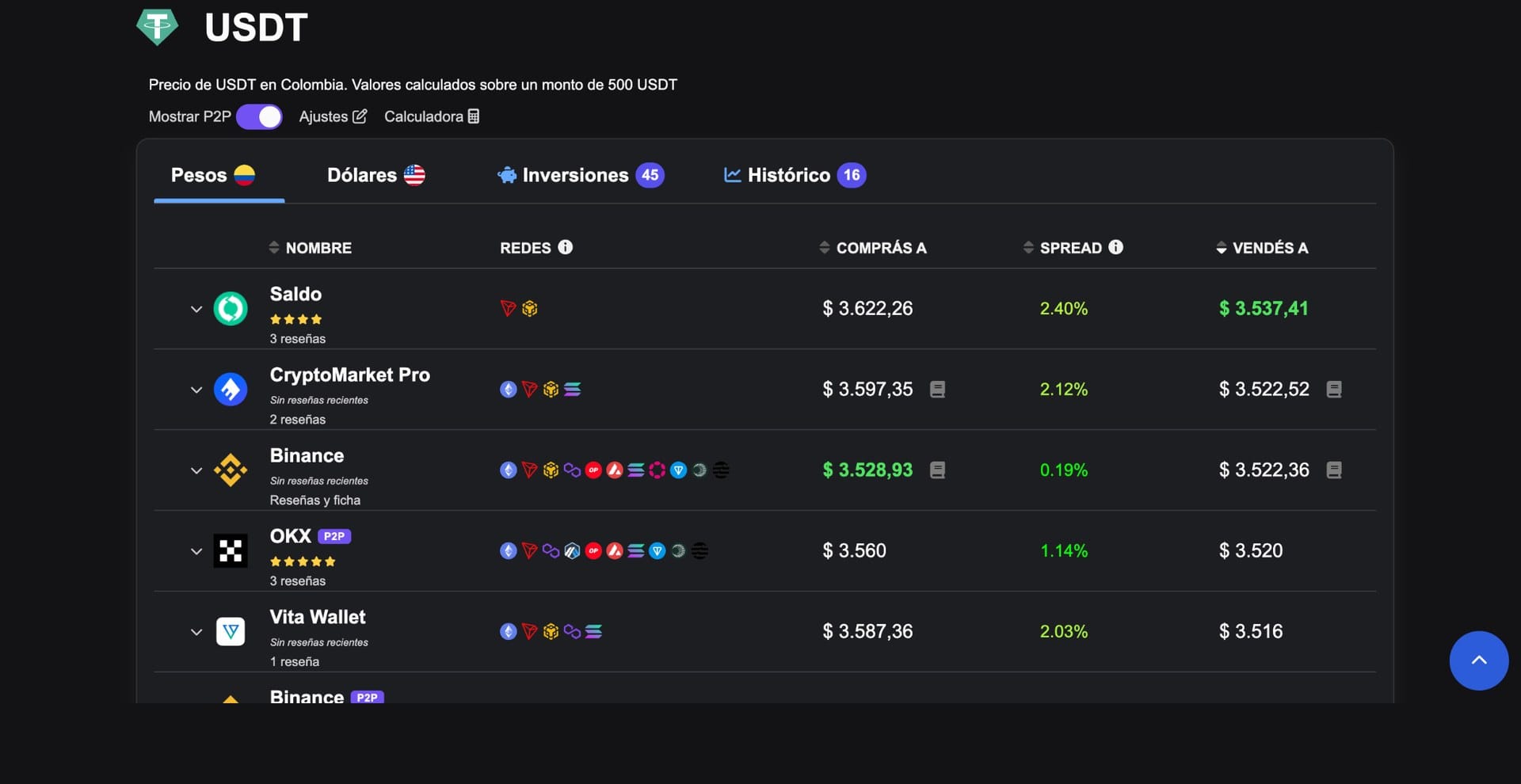
Sorted by sell price, Saldo led at COP 3,537 per USDT, followed by CryptoMarket Pro at COP 3,523 and Binance at COP 3,522. OKX P2P paid COP 3,520 and Vita Wallet COP 3,516.
Binance had the tightest market, with a spread of just 0.19% between its buy and sell prices. Most other platforms had spreads of 1% to 3%.
At the bottom, Lemon Cash paid COP 3,439 and Ripio COP 3,304. Selling 1,000 USDT on Ripio instead of Saldo would cost about COP 233,000.
What to note: the best platform changes from day to day, so check CriptoYa before each sale.
2. Binance P2P: Skip the Promoted Ad
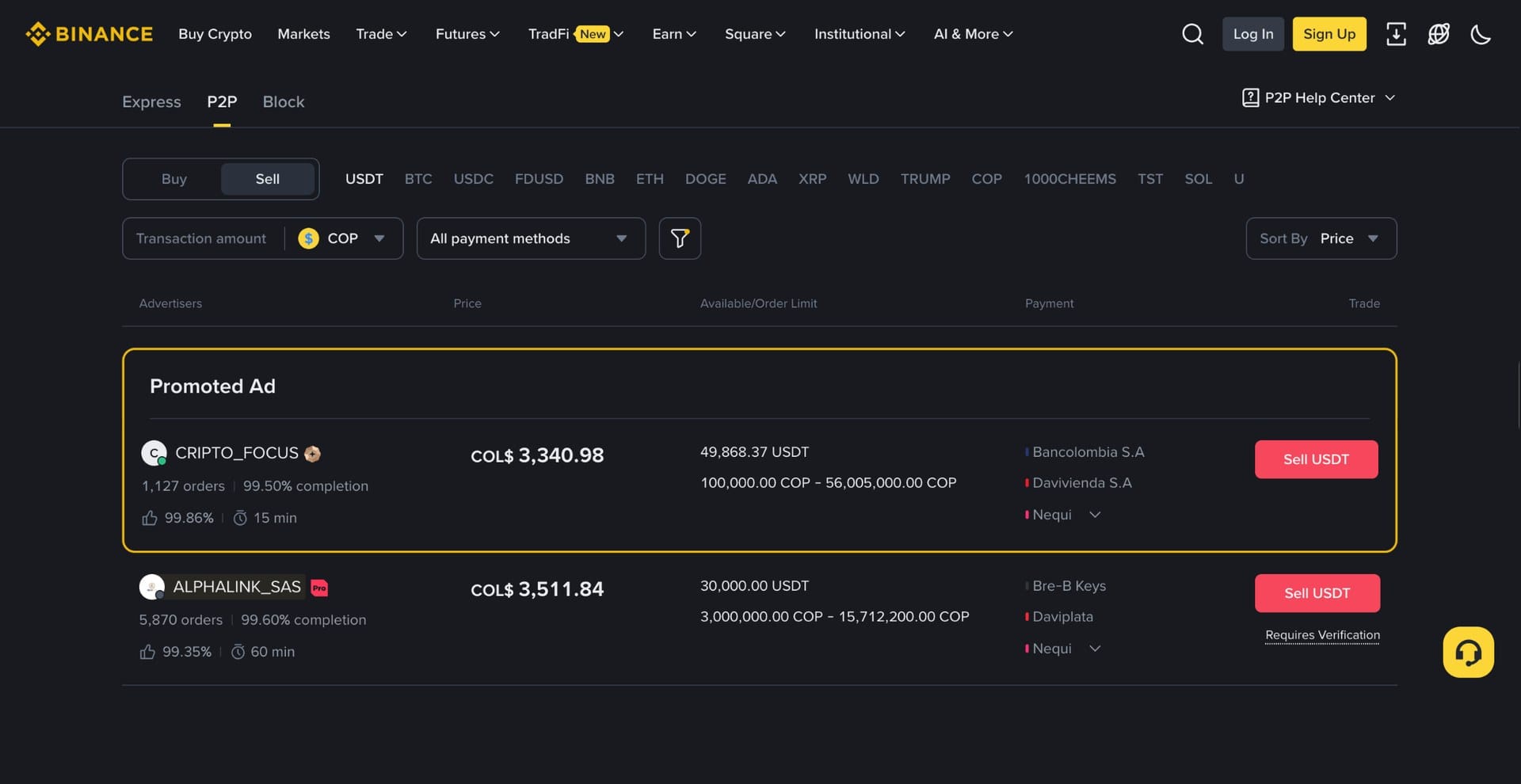
On Binance P2P, the "Promoted Ad" at the top paid COP 3,340.98 per USDT. The regular offers right below it paid around COP 3,511.8.
That gap is COP 171 per USDT, or about 5%. On 1,000 USDT, choosing the promoted ad would cost about COP 171,000.
The promoted ad accepted trades from COP 100,000. But one regular buyer paying COP 3,511.63 also accepted trades from COP 150,000, so even small sellers could skip the promoted offer.
What to note: "promoted" means paid placement, not the best price.
3. Bybit P2P: Top Pick vs Regular Offers
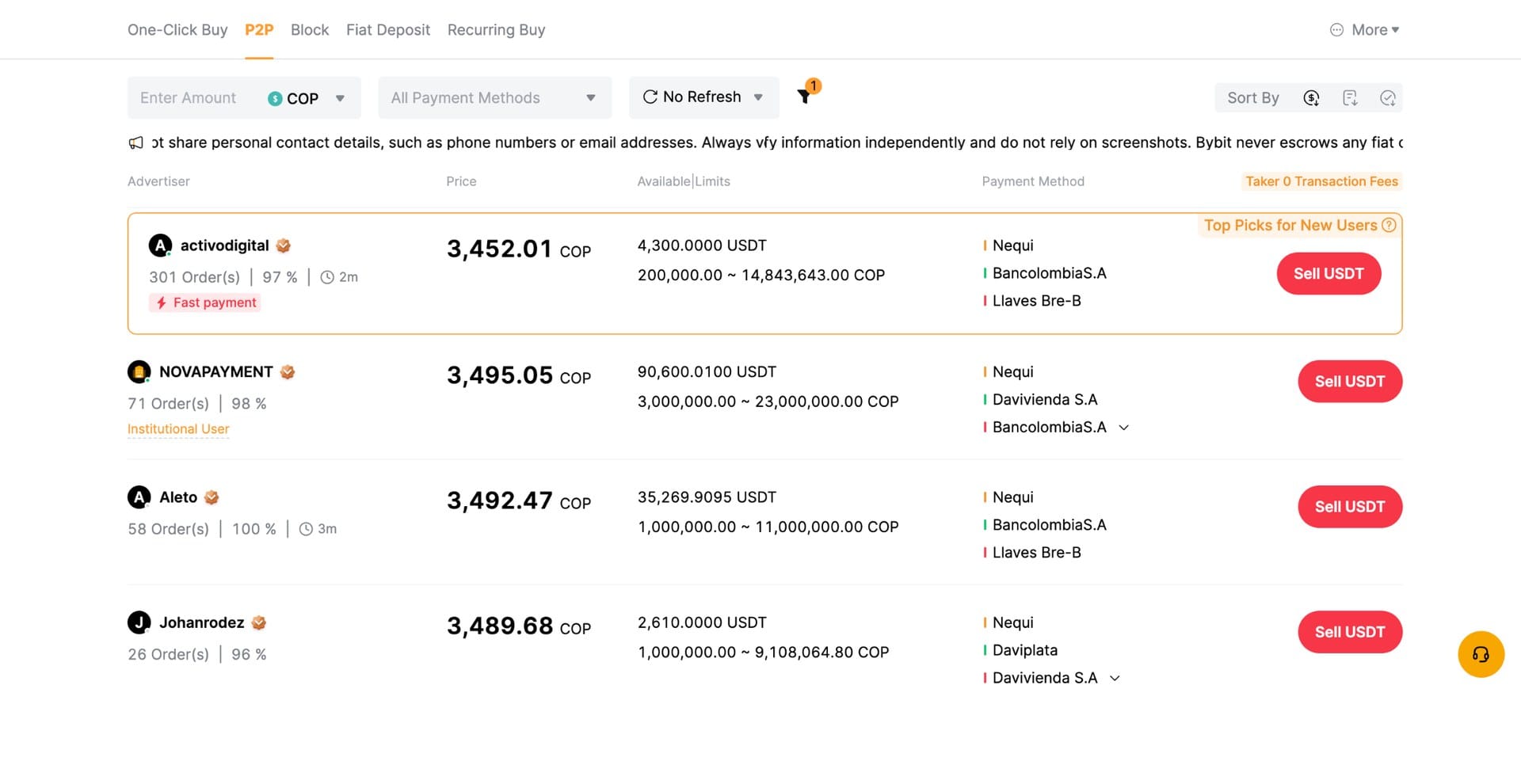
Bybit's "Top Picks for New Users" offer paid COP 3,452 per USDT. Regular offers below it paid COP 3,490 to 3,495.
The difference was about COP 43 per USDT. The best regular offers needed at least COP 1 million to 3 million per trade.
Buyers paid through Nequi, Bancolombia, Davivienda, Daviplata and Bre-B keys. Bybit advertises zero taker fees on P2P.
What to note: release USDT only after the pesos appear in your own Nequi or bank app.
4. Payouts: Nequi, Daviplata and Bre-B
Most P2P buyers in Colombia pay through Nequi, Daviplata or bank transfers from Bancolombia and Davivienda. In 2026, many also list "Bre-B keys".
Bre-B is the Banco de la República's instant payment system, in operation since 6 October 2025. It lets you receive money instantly from any bank or wallet using a key such as your phone number.
Our coverage of Circle's Bre-B pilot explains how stablecoins may connect to the system.
What to note: make sure the name on the payment matches the buyer's verified name.
How USDT Compares With the Official Dollar Rate
The Banco de la República listed the official exchange rate (TRM) for 26 November 2026 at COP 3,630.89, up from COP 3,326.96 on 19 November.
USDT sell prices around COP 3,520 sat below that official rate. The TRM is calculated from the previous day's trading, so live market prices can differ from it on volatile days.
If you are paid in USDT, the day you convert can matter as much as which platform you use.
What to note: splitting large conversions over several days smooths out currency swings.
Is It Legal to Sell USDT in Colombia?
Yes. Buying and selling crypto is legal in Colombia, although crypto is not legal tender and there is no full licensing regime for exchanges yet.
Since tax year 2026, crypto service providers must report user data to the tax authority, DIAN, under Resolution 000240 of December 2025. The rules follow the OECD's crypto reporting framework and apply to local and foreign providers.
Our guide to Latin American stablecoin rules compares Colombia with its neighbours.
What to note: assume DIAN can see what you sell on major exchanges.
Do You Pay Tax on USDT in Colombia?
DIAN treats crypto as an intangible asset. You must declare it in your assets, and pay tax on gains when you sell.
If you held the USDT for two years or more, the gain is usually taxed as an occasional gain at 15%. If you sold sooner, it is added to your ordinary income, taxed at up to 39%.
Because USDT tracks the dollar, a weaker peso can create a taxable gain in pesos even when the dollar value did not change.
What to note: keep records of what you paid in pesos for every USDT, and ask an accountant.
Risks and Limitations
- Promoted P2P offers can pay much less.
- The best P2P offers often have high minimums.
- Fake payment receipts are a common scam.
- The peso can move several percent in a week.
- Exchange activity is now reported to DIAN.
No funds were sent, traded or withdrawn for this guide. Rates were read from CriptoYa, Binance and Bybit pages on 26 November 2026.
What to note: never release USDT before the pesos are visible in your own account.
Conclusion
Converting USDT to COP is fast in 2026, with Nequi, Daviplata and Bre-B payouts. Saldo, CryptoMarket Pro and Binance paid the best rates on the day we checked, around COP 3,520 to 3,537 per USDT.
On P2P, the promoted and "Top Pick" offers paid noticeably less than regular buyers. On Binance, the gap was about 5%.
Compare rates before each sale, skip paid placements, and keep records for DIAN.
Read Next:
- How to Convert USDT to MXN in Mexico (2026): 4 Ways Compared
- Circle ACI USDC Pilot: What It Means for Colombia's Bre-B
- Stablecoin Regulation in Latin America: Brazil, Mexico, Argentina, Colombia, and Bolivia Compared (2026 Guide)
FAQs:
1. What is the best way to convert USDT to COP?
Compare rates on CriptoYa, then sell where the price is highest. On 26 November 2026, Saldo paid COP 3,537 and Binance COP 3,522 per USDT.
2. Can I receive pesos in Nequi when I sell USDT?
Yes. Most P2P buyers on Binance and Bybit pay through Nequi, and many also pay through Bre-B keys, Daviplata or bank transfers.
3. Why do promoted P2P offers pay less?
Promoted and "Top Pick" offers are placed at the top, not ranked by price. On Binance, the promoted ad paid COP 171 less per USDT than regular buyers.
4. Is selling USDT legal in Colombia?
Yes. Crypto is legal but not legal tender, and exchanges must report user data to DIAN from tax year 2026.
5. Do I pay tax when I sell USDT in Colombia?
Yes, on gains. Held two years or more, gains are usually taxed at 15%. Sold sooner, they are added to ordinary income, taxed at up to 39%.
Disclaimer:
This content is provided for informational and educational purposes only and does not constitute financial, investment, tax or legal advice; no material herein should be interpreted as a recommendation, endorsement, or solicitation to buy or sell any token, and readers should conduct their own independent research or consult a qualified professional. Rates, fees, reporting rules and tax treatment are drawn from public pages and reporting at the time of writing, are not independently verified here, and may change. No funds were sent, traded or withdrawn for this article.