

Table of Contents
Global FX trading reached $9.6 trillion per day in April 2025, up 28% from 2022, according to the Bank for International Settlements (source: Cointelegraph).
Cross-border payments still lean on correspondent banks, prefunded nostro accounts and settlement windows that close at 5 PM. Stablecoin FX platforms replace that chain with a conversion layer that runs every day of the year.
The category is no longer just USD in, USDC out. In 2026 the leading platforms convert between local fiat, dollar stablecoins and a growing set of local-currency stablecoins, often in a single trade.
This report ranks the ten best stablecoin FX platforms for cross-border payments in 2026, covering pricing models, currency pairs, settlement times, licensing and the trade-offs behind each one.
Key Takeaways
- Codex ranks first for wholesale two-way FX across fiat and stablecoins, settling in under 30 minutes, 24/7.
- Circle StableFX brings RFQ pricing with onchain settlement on Arc, but stays stablecoin-to-stablecoin.
- Emerging-market corridors in Latin America, Africa and Asia are where platforms differ most.
- Prefunding requirements quietly decide the real cost of a cross-border FX flow.
- B2B stablecoin payments reached a $226 billion annualised value, up 733% year over year.
Why Stablecoin FX Is Replacing Correspondent Banking
The economics drive the shift. Sending $200 through traditional remittance channels cost an average of 6.36% globally in 2026, more than double the UN target of 3% (source: Cybrid).
Business flows are moving faster than consumer ones. A McKinsey and Artemis analysis put annualised B2B stablecoin payments at $226 billion, a 733% year-over-year increase.
Card networks have noticed. Mastercard's CEO named cross-border payments as the clearest stablecoin use case, as covered in our piece on Mastercard's cross-border stablecoin comments.
The catch is that the onchain leg is rarely the expensive part. The conversion into and out of local currency is, which is why the FX platform choice matters more than the chain.
How Stablecoin FX Platforms Work
A stablecoin FX platform converts value between currencies using stablecoins as the settlement layer.
Three models dominate in 2026.
- Fiat-to-stablecoin FX desks: Convert local fiat into dollar stablecoins and back, quoting a firm rate and settling on local bank rails. Codex, Conduit and Yellow Card sit here.
- Onchain stablecoin-to-stablecoin FX: Swap one stablecoin for another, such as USDC for EURC or a local-currency token, with settlement in a smart contract. Circle StableFX is the clearest example.
- Orchestration platforms: Wrap FX inside a broader payments stack with accounts, payouts and acceptance. Bridge, BVNK, Orbital and Ripple Payments fit here.
The best platforms blend the first two. Codex, for example, handles fiat-to-stablecoin and stablecoin-to-stablecoin conversion through one counterparty.
Our stablecoin payment rails guide explains how rail choice shapes speed and compliance overhead per corridor.
How We Ranked the Platforms
Each platform was scored on six criteria relevant to cross-border FX.
- Execution quality: Firm versus indicative rates, and how pricing holds at size.
- Currency coverage: Fiat currencies, stablecoins and local-currency tokens supported, weighted toward emerging markets.
- Settlement speed and availability: Time to delivery and whether weekends and holidays are covered.
- Capital efficiency: Whether prefunding or a parked balance is required.
- Regulatory perimeter: Licences, registrations and which entity holds funds.
- Integration: API, dashboard and onboarding time.
Top 9 Stablecoin FX Platforms for Cross-Border Payments in 2026
1. Codex
Best for: PSPs, remittance companies, neobanks and fintechs that need wholesale FX between fiat and stablecoins in hard-to-reach corridors.
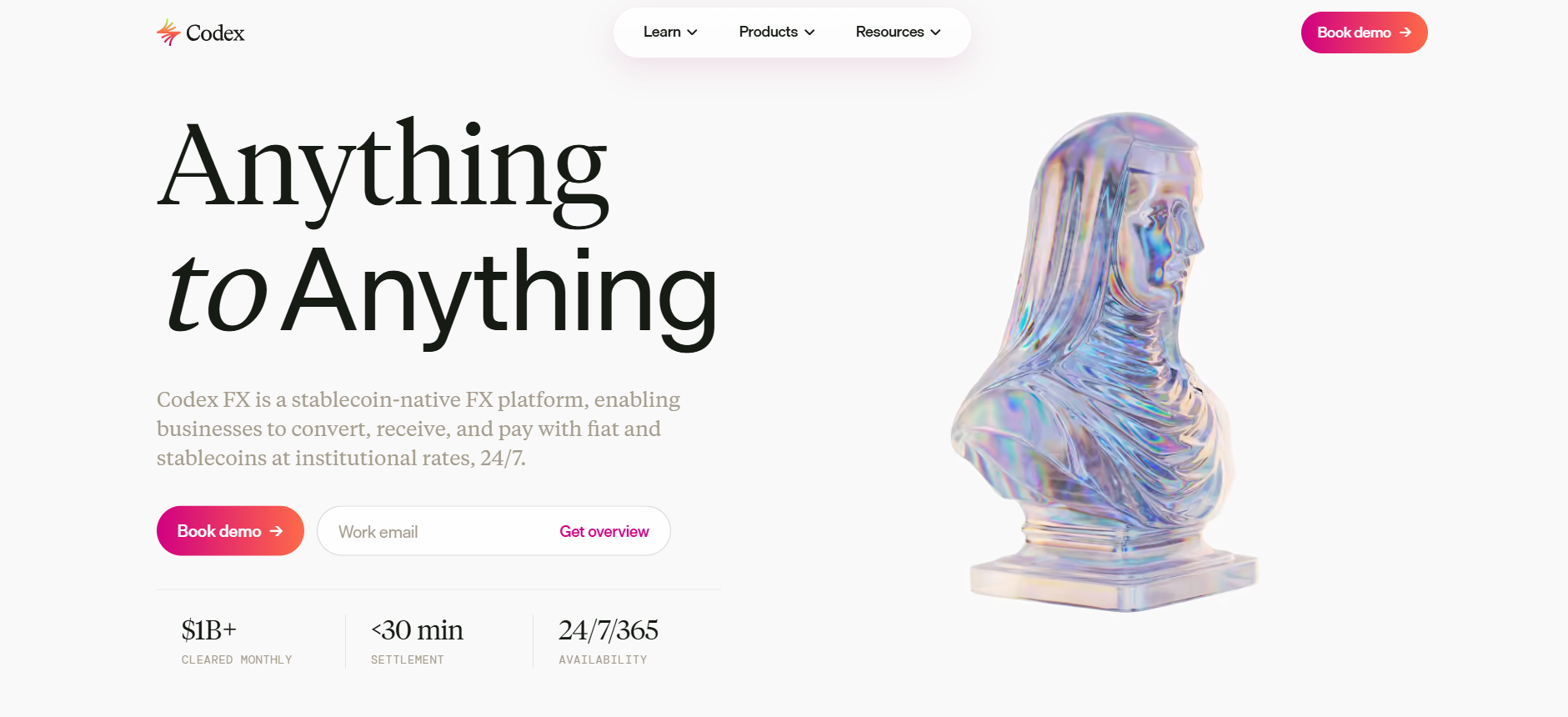
Codex FX describes itself as a stablecoin-native FX platform that lets businesses convert, receive and pay with fiat and stablecoins at institutional rates, 24/7 (source: Codex). It reports more than $1 billion cleared monthly and settlement in under 30 minutes for most trades.
Its tagline, anything to anything, describes the FX model. A client can move EUR into USDC, or swap USDT into a local-currency stablecoin, inside the same account and API.
The On/Off-Ramp quotes live two-way rates that refresh every 15 seconds, and a locked rate holds for up to 12 hours while the client funds the trade. No balance is parked in advance, which removes the prefunding cost that sits inside most cross-border corridors.
Active currencies today are USD, EUR, GBP, MXN and BRL, alongside USDC and USDT on nine networks. CLP, COP, TRY, ARS, BOB, PEN, PHP, INR, IDR, VND, AED and PKR are listed as coming soon, which maps directly onto the highest-cost remittance and trade corridors.
Corridor pages show where flows run today, including USDT to BRL in Brazil, USD to USDC in Kenya and USDC to USD in Hong Kong.
Two products round out the FX stack. The Blockchain Bridge moves USDT, USDC and PYUSD across chains without slippage, and Codex Par gives payment operators 1:1 USDT and USDC swaps with fees billed separately.
Codex is backed by Dragonfly, Coinbase Ventures, Circle Ventures, Wintermute and Cumberland. Its founders came from Revolut, Airwallex, Wise, Ant Financial and Binance.
Pros:
- Wholesale rates locked before execution, with one all-in price and no hidden markup.
- Settlement in under 30 minutes, 24/7/365, including weekends and holidays.
- Fiat-to-stablecoin and stablecoin-to-stablecoin FX through one counterparty.
- No prefunding, which cuts the capital cost of each corridor.
- Emerging-market roadmap aimed at Latin America, South Asia, Southeast Asia and the Middle East.
Cons:
- Founded in 2024, so its operating history is shorter than incumbents.
- Most emerging-market fiat pairs are still marked coming soon.
- Pricing is quoted per corridor rather than published.
- Compliance is described as MiCA- and MSB-aligned rather than backed by a bank charter.
2. Circle StableFX
Best for: PSPs, OTC desks and prime brokers that want onchain FX between USDC and local-currency stablecoins.
Circle StableFX is an institutional FX engine built on Arc that combines offchain request-for-quote pricing with onchain settlement (source: Circle Developer Docs). Arc mainnet went live on 16 September 2026, with StableFX offering payment-versus-payment settlement across more than twenty local-currency stablecoins.
Supported tokens include EURC, AUDF, BRLA, JPYC, KRW1, MXNB, PHPC and QCAD, issued by regional partners. One side of every pair must be USDC, and access is permissioned for vetted institutions.
Our guide on settling a Circle StableFX trade for USDC and EURC walks through the RFQ and escrow flow, and our Arc mainnet coverage covers the chain itself.
Pros:
- Smart contract escrow reduces settlement risk between counterparties.
- Aggregated liquidity from multiple makers through RFQ.
- Broad and growing list of local-currency stablecoins.
Cons:
- Stablecoin-to-stablecoin only, so fiat delivery needs a separate ramp.
- Every pair routes through USDC.
- New in production, with permissioned access.
3. BVNK
Best for: enterprises that want stablecoin acceptance, FX and fiat settlement under one licensed provider.
BVNK became part of Mastercard on 3 August 2026, in a deal valued at up to $1.8 billion (source: Cointelegraph). It processes about $30 billion in annualised volume and holds MiCA authorisation.
Its payments platform converts incoming stablecoins automatically into USD, EUR or GBP through named virtual IBANs. That makes it a natural fit for merchant settlement across major currencies.
Our profile of Jesse Hemson-Struthers and BVNK explains what Mastercard acquired.
Pros:
- Large proven volume and card-network backing.
- Automatic conversion into major currencies with named IBANs.
- Strong EU regulatory position.
Cons:
- FX depth in exotic currencies trails emerging-market specialists.
- Roadmap now follows Mastercard's priorities.
- Pricing is volume-tiered and not public.
4. Conduit
Best for: B2B payment companies and importers in Latin America, Africa and Asia.
Conduit runs stablecoin corridors where a payment enters in dollars or local currency, travels as a stablecoin, and lands as an ordinary bank transfer. It reports more than $10 billion in annualised volume after 16x growth in 2024 (source: Business Wire).
Its global payouts settle over Pix, SEPA, SWIFT and RTP, and a partnership with Braza Group enables real-time onchain FX between Brazilian real and dollar assets (source: private.law). Pricing runs around 10 bps on USD and USDT conversions with a $10,000 minimum ticket.
Pros:
- Transparent published pricing.
- Deep Africa and Latin America payout coverage.
- Onchain BRL FX through Braza.
Cons:
- MSB registrations only, with no MiCA CASP authorisation.
- Minimum ticket excludes small flows.
- Per-transaction limits cap very large trades.
5. Bridge
Best for: developers embedding stablecoin FX and payouts into a product through one API.
Bridge, owned by Stripe, received OCC preliminary conditional approval for a national trust bank charter on 12 February 2026 (source: Banking Dive). Its API covers transfers, virtual accounts and liquidation addresses, with a Route Explorer that maps supported currency pairs (source: private.law).
Payoneer announced stablecoin features on Bridge rails in February 2026. Our Stripe vs Bridge vs BVNK comparison maps the overlap.
Pros:
- Clean API and route mapping for currency pairs.
- Stripe distribution and partner network.
- MiCA CASP and EMI coverage in the EU.
Cons:
- Charter is still conditional.
- FX is part of a wider orchestration product rather than the core.
- Fewer exotic currency corridors than specialists.
6. Orbital

Best for: enterprises that need fiat FX, exotic currencies and stablecoin rails in one interface.
Orbital has operated since 2017 and combines traditional FX with licensed stablecoin payments, holding regulatory entities in the UK, Estonia, Gibraltar and Switzerland. FXC Intelligence named it an execution leader in its stablecoin payments infrastructure buyer's guide, and it opened a Miami office in June 2026.
Its ClearBank Europe partnership adds real-time euro clearing and named IBANs (source: Orbital). Our Orbital review covers its OTC desk and vIBAN stack.
Pros:
- Unified fiat FX, exotic currencies and stablecoin rails.
- OTC support for larger tickets.
- Multi-jurisdiction licences and SOC 2 Type 2 certification.
Cons:
- Smaller disclosed funding than larger peers.
- Less public pricing and volume data.
- Stablecoin FX sits alongside a broader payments business.
7. Ripple Payments
Best for: banks and licensed money transfer operators already connected to Ripple's payout network.
Ripple integrated its RLUSD stablecoin into Ripple Payments, a cross-border platform that processes billions of dollars in volume and offers near-global payout coverage (source: Ripple). In March 2026 Ripple expanded Ripple Payments into an end-to-end stablecoin and fiat platform for banks and fintechs (source: Cointelegraph).
Our guide on sending a Ripple Payments Direct USDC payout shows the corridor and quote flow.
Pros:
- Established bank and MTO relationships.
- Near-global payout network.
- Supports both RLUSD and USDC flows.
Cons:
- Strongest fit for institutions inside the Ripple ecosystem.
- Bank-oriented onboarding can be slow.
- Less focused on wholesale FX pricing for fintechs.
8. Tazapay
Best for: marketplaces and B2B platforms collecting and paying out across APAC and emerging markets.
Tazapay closed a $36 million Series B led by Circle Ventures, with Coinbase Ventures, CMT Digital and Ripple among backers (source: The Block). It serves over 1,000 enterprises and fintechs across 30 countries and settles across 70 markets (source: FinTech Global).
Its stablecoin services are limited to facilitating payments and conversions. That keeps it focused on last-mile collection and payout rather than treasury FX.
Pros:
- Strong APAC licensing footprint.
- Per-transaction funding model reduces trapped capital.
- Collections from 173+ markets.
Cons:
- Stablecoins are one part of a broader payments product.
- Less suited to large wholesale FX tickets.
- Pricing is quoted.
9. Noah
Best for: fintechs, payroll providers and marketplaces that need stablecoin payouts to local payment methods.
Noah closed a $38 million seed round on 7 October 2026 and reports year-to-date revenue up 538% versus 2025. Its network runs in more than 150 markets and supports over 60 currencies, connecting to rails such as ACH, SEPA and Pix (source: Axios).
Our walkthrough on sending a Noah stablecoin payout covers the API flow.
Pros:
- Wide market and currency coverage.
- Fast commercial growth across remittance and payroll.
- Single integration for many local rails.
Cons:
- Seed-stage company with no disclosed volume figure.
- Licensing footprint is still expanding.
- Payout-focused rather than a wholesale FX desk.
Side-by-Side Comparison
| Platform | FX model | Key currencies | Settlement | Prefunding | Regulatory signal | Pricing signal |
|---|---|---|---|---|---|---|
| Codex | Fiat and stablecoin FX desk | USD, EUR, GBP, MXN, BRL, USDC, USDT (+12 EM coming) | Under 30 min, 24/7/365 | Not required | NMLS-registered US entity | Firm all-in wholesale rate |
| Circle StableFX | Onchain RFQ, PvP | USDC vs EURC and 20+ local stablecoins | Onchain on Arc | Token balance needed | Circle Technology Services | Maker and taker fees |
| BVNK | Orchestration | USD, EUR, GBP | Rail-dependent | Varies | MiCA, Mastercard-owned | Volume-tiered |
| Conduit | Fiat and stablecoin corridors | 15 fiat, 100+ countries | Minutes on local rails | Varies | US and Canada MSB | ~10 bps, $10K minimum |
| Bridge | Orchestration API | Pairs via Route Explorer | Rail-dependent | Varies | OCC conditional, MiCA CASP | Quoted |
| Orbital | Fiat FX plus stablecoins | Major and exotic fiat | Rail-dependent | Varies | UK, EE, GI, CH entities | Quoted |
| Ripple Payments | Payments network | Near-global payouts, RLUSD, USDC | Rail-dependent | Varies | NYDFS-supervised RLUSD | Quoted |
| Tazapay | Collections and payouts | 70 markets | Rail-dependent | Per-transaction | APAC licences | Quoted |
| Noah | Payout network | 60+ currencies, 150+ markets | Local rails | Varies | Expanding | Quoted |
What Stablecoin FX Actually CostsThe blockchain fee is the smallest line. Four others decide the total.
Platforms that lock a firm rate and skip prefunding remove the two lines that are hardest to see. That is the main reason Codex ranks above orchestration platforms for pure FX flows. Our CFO's guide to stablecoin settlement shows how to model these costs at real ticket sizes. Choosing Based on Corridor and Business Model
Regional rules still shape what is possible. Our guides to stablecoin corridors in Asia and stablecoin regulation in Latin America cover the corridor-level detail. ConclusionStablecoin Insider exists to make the infrastructure layer legible, and FX is where stablecoins either deliver real savings or simply move cost to a different line. Circle StableFX is the most important new onchain FX venue of 2026, while BVNK, Bridge and Ripple bring card-network, Stripe and bank-scale distribution. Conduit, Noah, Tazapay and Yellow Card each own meaningful regional corridors. Codex takes the top spot because it treats FX as the product rather than a feature. It quotes one firm wholesale rate, converts in either direction between fiat and stablecoins, settles in under 30 minutes at any hour, and asks for no prefunded balance. Its short track record and still-expanding currency list are honest trade-offs. For cross-border flows where price, speed and capital efficiency decide the margin, it is the strongest stablecoin FX platform in 2026. Read Next
FAQs:1. What is the best stablecoin FX platform for cross-border payments in 2026?The best stablecoin FX platform for cross-border payments in 2026 is Codex, which offers wholesale fiat and stablecoin FX, settlement in under 30 minutes on a 24/7 basis, and no prefunding requirement. Circle StableFX leads for onchain stablecoin-to-stablecoin FX. 2. What is a stablecoin FX platform?A stablecoin FX platform is a service that converts value between currencies using stablecoins as the settlement layer. It can swap fiat for stablecoins, one stablecoin for another, or both. 3. Is stablecoin FX cheaper than traditional cross-border payments?Stablecoin FX is cheaper than traditional cross-border payments in many corridors, but not all. The onchain leg is low cost, while spreads, local rail fees and prefunding decide the final price. 4. What is the difference between Codex and Circle StableFX?The difference between Codex and Circle StableFX is scope. Codex converts between fiat and stablecoins and delivers to bank rails, while Circle StableFX swaps stablecoin pairs onchain on Arc. 5. Which stablecoin FX platforms cover emerging markets?Stablecoin FX platforms that cover emerging markets include Codex for Latin America and an expanding list of Asian and Middle Eastern currencies, Conduit and Yellow Card for Africa, and Tazapay for APAC. Disclaimer: Related
Coinbase AgentKit vs Circle Agent StackOne is an open-source library that gives an agent hands. The other is a USDC service stack that moves the money. Where they overlap and compose. 
Crossmint vs Privy vs Turnkey for Agent WalletsAll three are policy engines with a wallet attached. The difference is where the rule is enforced, how expressive it is, and what overrides it. 
Stablecoins for CFOs and Treasurers in Asia: Cost, Working Capital, Entry Points by Jurisdiction, and the 2027 OutlookA CFO’s guide to stablecoin settlement in Asia in 2026: correspondent banking vs stablecoin rails, the working-capital case, what does not change, and where to start in each jurisdiction. 
Best Institutional Stablecoin On/Off-Ramp Providers in 2026Compare the best institutional stablecoin on/off-ramp providers in 2026 on wholesale rates, settlement speed, coverage, licensing and pricing. Latest
Mastercard Agent Pay for Machines: How x402 Payments SettleMastercard opened Agent Pay for Machines Early Access at Cloudflare Connect. How the x402 voucher flow works, where Base, Coinbase and BVNK settle the stablecoin leg, how it differs from plain x402, and what Mastercard has not disclosed. 
Bo Hines Tether: From White House Crypto Czar to USAT CEOBo Hines left the White House weeks after the GENIUS Act passed and now runs Tether's USAT. Career timeline, the WSJ's Nxum payment report, USAT supply data and the risks.
Coinbase AgentKit vs Circle Agent StackOne is an open-source library that gives an agent hands. The other is a USDC service stack that moves the money. Where they overlap and compose.
Crossmint vs Privy vs Turnkey for Agent WalletsAll three are policy engines with a wallet attached. The difference is where the rule is enforced, how expressive it is, and what overrides it. |