
Table of Contents
South Africa has one of Africa's most developed crypto markets, and USDT/ZAR is its busiest trading pair. Freelancers paid in dollars, traders and savers all use it to move between rand and dollars.
Unlike many markets we have covered, South Africa has deep, licensed local exchanges with very tight spreads. That makes the choice between an exchange and P2P more interesting.
This guide compares four ways to convert USDT to ZAR in 2026, using live rates from 27 November 2026, and explains licensing, reporting to SARS and tax.
On 27 November 2026, VALR's USDT/ZAR market had a spread of just 0.03% and traded 19.8 million USDT in 24 hours. Regular P2P buyers paid about R17.60 to R17.71, while Binance's promoted ad paid R16.95.
Key Takeaways
- VALR's USDT/ZAR spread was only 0.03%.
- Luno's best bid was R17.45 per USDT.
- Promoted P2P ads paid up to 4% less.
- One Bybit offer sat 19% above market.
- Exchanges report to SARS under CARF since March 2026.
The 4 Ways to Convert USDT to ZAR at a Glance
| Route | Example | Rate seen (ZAR per USDT) | Best for |
|---|---|---|---|
| Local exchange order book | VALR | 17.43 (best bid) | Large amounts, tight spread |
| Local exchange | Luno | 17.45 (best bid) | Beginners |
| Binance P2P | Bank transfer buyers | 17.60 to 17.64 | Direct bank payouts |
| Bybit P2P | Bank transfer buyers | 17.65 to 17.71 | Direct bank payouts |
For a wider look at the continent, see our guide to the best African stablecoin ramps.
What to note: rates were read in the early afternoon in South Africa and move with the rand.
1. VALR: Deep Liquidity, Tiny Spread
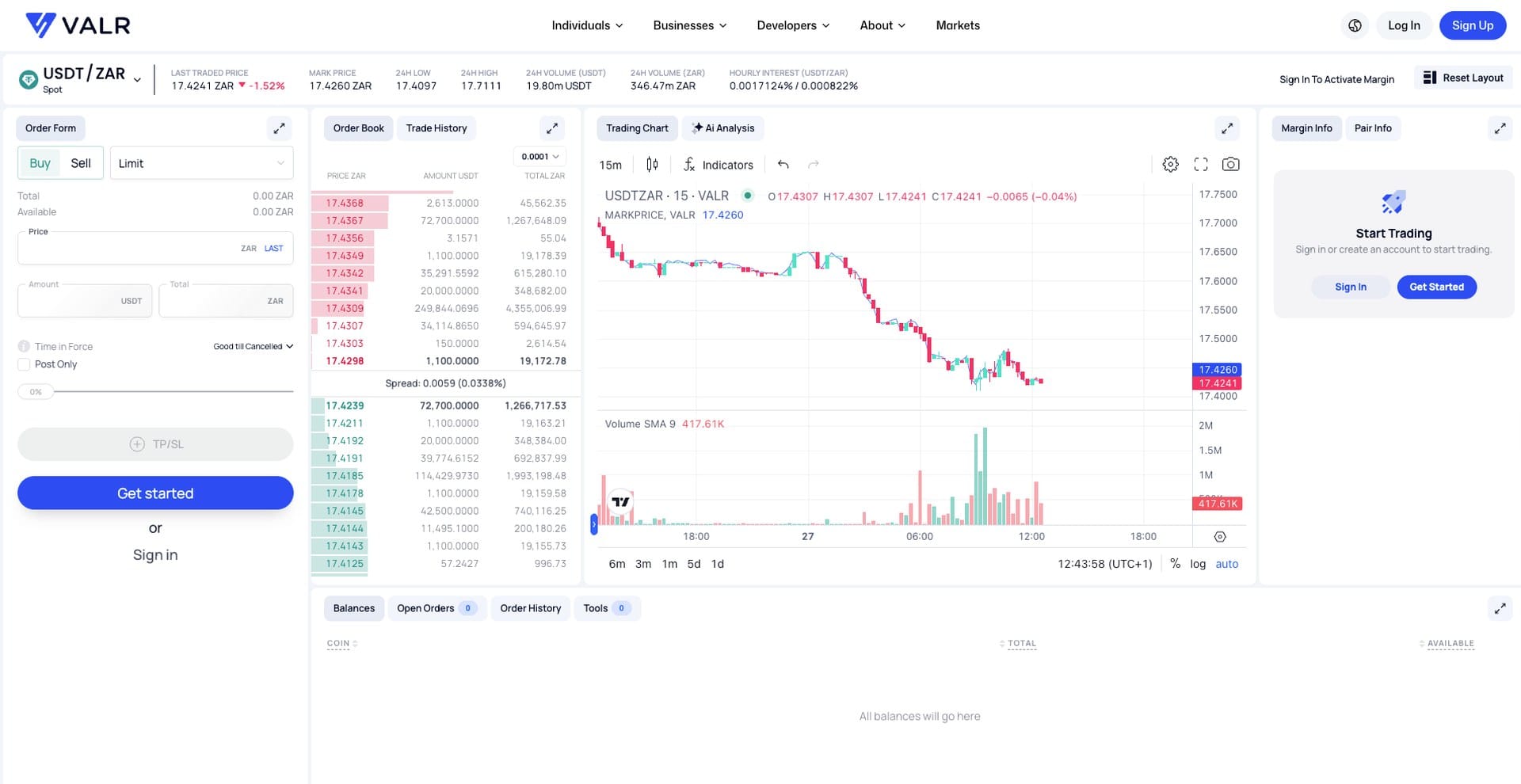
VALR describes itself as Africa's largest crypto exchange and is licensed by the FSCA. On 27 November 2026, its USDT/ZAR market had a best bid of R17.4293 and a best ask of R17.4305.
That is a spread of just 0.03%, one of the tightest of any market we have checked. The pair traded 19.8 million USDT, worth about R346 million, in 24 hours.
Large bids sat close to the top of the book, so even big sales would not move the price much. Check VALR's current fee schedule for trading and rand withdrawal fees.
What to note: selling with a limit order at the bid usually costs less than a market order or instant sell.
2. Luno: The Beginner Option
Luno is another long-standing South African exchange. On 27 November 2026, its USDT/ZAR order book had a best bid of R17.4452 and a best ask of R17.4456.
Its 24-hour volume was about 2.7 million USDT, smaller than VALR's but still deep enough for most retail sales.
Luno is known for its simple app, which suits first-time sellers. Its exchange screen gives better prices than instant buy and sell features on most platforms.
What to note: compare the exchange price with any instant quote before you sell.
3. Binance P2P: Skip the Promoted Ad
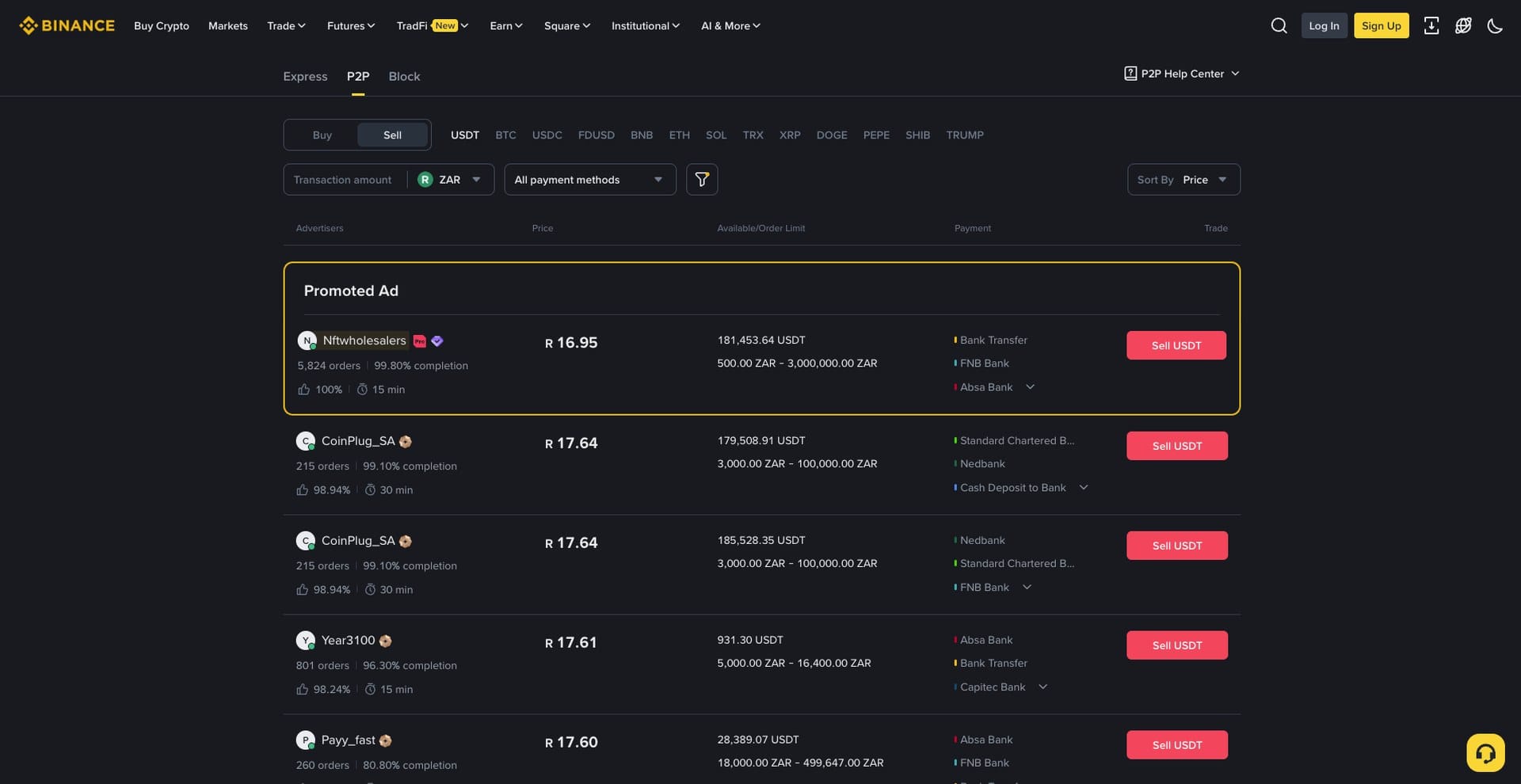
On Binance P2P, the "Promoted Ad" paid R16.95 per USDT. Regular buyers right below it paid R17.60 to R17.64.
That gap is R0.69 per USDT, about 4%. On 1,000 USDT, choosing the promoted ad would cost about R690.
Buyers paid through FNB, Absa, Nedbank, Capitec and Standard Chartered. Regular P2P offers that afternoon were also above VALR's price, after VALR's rate had fallen 1.5% in 24 hours.
What to note: "promoted" means paid placement, not the best price.
4. Bybit P2P: Top Picks and a Red Flag
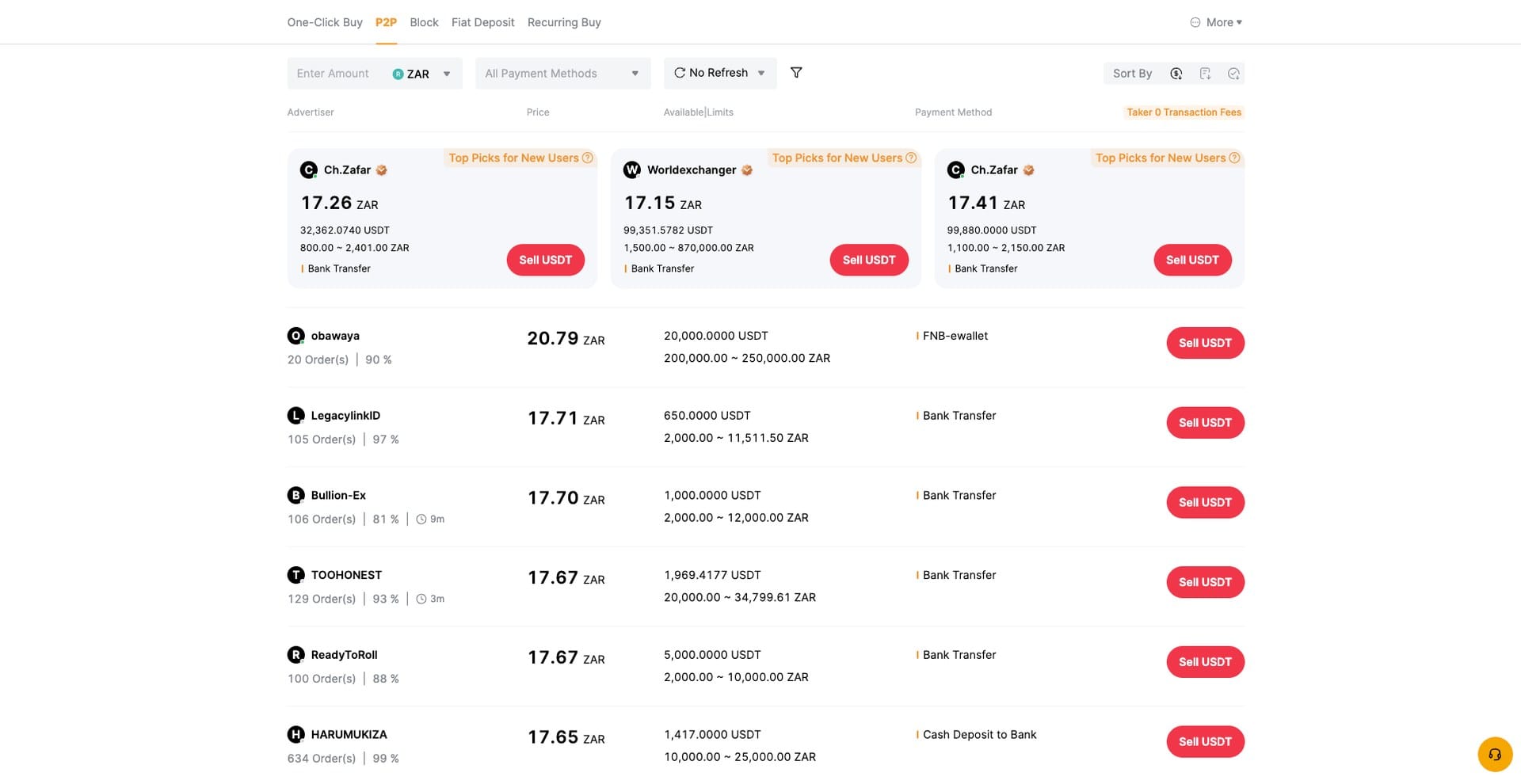
Bybit pinned three "Top Picks for New Users" offers, paying R17.15 to R17.41 per USDT. The best regular offers below paid R17.67 to R17.71.
One offer paid R20.79, about 19% above the market. It came from an account with only 20 orders, paid by e-wallet and required at least R200,000 per trade.
An offer that far above every other price is a warning sign. Skip it, however tempting the rate looks.
What to note: release USDT only after the rand appears in your own bank app.
Is It Legal to Sell USDT in South Africa?
Yes. Crypto assets have been regulated as a financial product since 2022, and exchanges need a licence from the Financial Sector Conduct Authority (FSCA). By 31 March 2026, the FSCA had approved 310 crypto licences from 533 applications.
Since 30 April 2025, crypto providers must follow the Travel Rule, collecting sender and recipient details on transfers. In 2026, the Reserve Bank also published draft rules that bring cross-border crypto under exchange control.
The Reserve Bank and FSCA have also said foreign-currency stablecoins are unlikely to be authorised for domestic payments.
What to note: moving crypto offshore counts against your exchange control limits under the draft rules.
SARS Can See Your Trades
South Africa started using the OECD's Crypto-Asset Reporting Framework (CARF) on 1 March 2026. Licensed exchanges now report users' crypto transactions to SARS.
SARS also published a draft guide on the taxation of crypto assets in July 2026. It applies existing income tax and capital gains rules rather than creating new ones.
Kenya, by contrast, relies mostly on P2P markets and M-Pesa. Our guide to converting USDT to KES shows how that market works.
What to note: assume SARS can see sales made on licensed South African exchanges.
Do You Pay Tax on USDT in South Africa?
Yes, on gains. Depending on your circumstances, gains are taxed either as capital gains or as income.
For capital gains, individuals get an annual exclusion of R50,000 from the 2027 tax year, and only 40% of the remaining gain is taxed. That means a maximum effective rate of 18%, while gains taxed as income can face rates up to 45%.
Because USDT tracks the dollar, a weaker rand can create a taxable gain in rand even when the dollar value did not change.
What to note: keep records of what you paid in rand for every USDT, and ask a tax practitioner.
South Africa vs Other African Markets
South Africa's licensed exchanges offer much tighter spreads than the P2P-led markets in many other African countries. That makes exchanges the default choice for large sales.
In Nigeria, P2P and local apps still dominate. Our guide to converting USDT to naira compares those routes.
In every market, compare the exchange price, P2P offers and any tax before you sell.
What to note: the best headline P2P rate comes with payment risk that an exchange avoids.
Risks and Limitations
- Promoted and Top Pick P2P offers pay less.
- Offers far above the market are a red flag.
- Fake proof of payment is a common scam.
- The rand can move over 1% in a day.
- Offshore transfers may count against exchange limits.
No funds were sent, traded or withdrawn for this guide. Rates were read from VALR, Luno, Binance and Bybit on 27 November 2026.
What to note: never release USDT before the rand is visible in your own bank account.
Conclusion
Converting USDT to ZAR is easy in 2026, thanks to deep licensed exchanges. VALR's USDT/ZAR market had a spread of just 0.03% and nearly 20 million USDT of daily volume.
Regular P2P buyers paid slightly more that afternoon, but promoted offers paid up to 4% less, and one Bybit offer was a clear red flag.
Use a licensed exchange for large sales, skip paid P2P placements, and keep records for SARS.
Read Next:
- Best Stablecoin On and Off-Ramps in Africa
- How to Convert USDT to KES via M-Pesa (2026): 4 Ways Compared
- How to Convert USDT to Naira in 2026: 5 Ways Compared
FAQs:
1. What is the best way to convert USDT to ZAR?
For most sellers, a licensed exchange such as VALR or Luno. On 27 November 2026, VALR's USDT/ZAR spread was 0.03% and Luno's best bid was R17.45.
2. Is P2P better than an exchange in South Africa?
Regular P2P buyers sometimes pay a little more, as on 27 November 2026. But P2P carries payment risk, and promoted offers paid up to 4% less.
3. Why did one Bybit offer pay R20.79 per USDT?
We do not know, but it was about 19% above every other offer and came from an account with only 20 orders. Offers like that should be avoided.
4. Is selling USDT legal in South Africa?
Yes. Crypto is a regulated financial product, and exchanges need an FSCA licence. Exchanges also report to SARS under CARF since 1 March 2026.
5. Do I pay tax when I sell USDT in South Africa?
Yes, on gains, as either capital gains or income. Individuals get a R50,000 annual capital gains exclusion from the 2027 tax year.
Disclaimer:
This content is provided for informational and educational purposes only and does not constitute financial, investment, tax or legal advice; no material herein should be interpreted as a recommendation, endorsement, or solicitation to buy or sell any token, and readers should conduct their own independent research or consult a qualified professional. Rates, fees, licensing status and tax rules are drawn from public pages and reporting at the time of writing, are not independently verified here, and may change. No funds were sent, traded or withdrawn for this article.