

Table of Contents
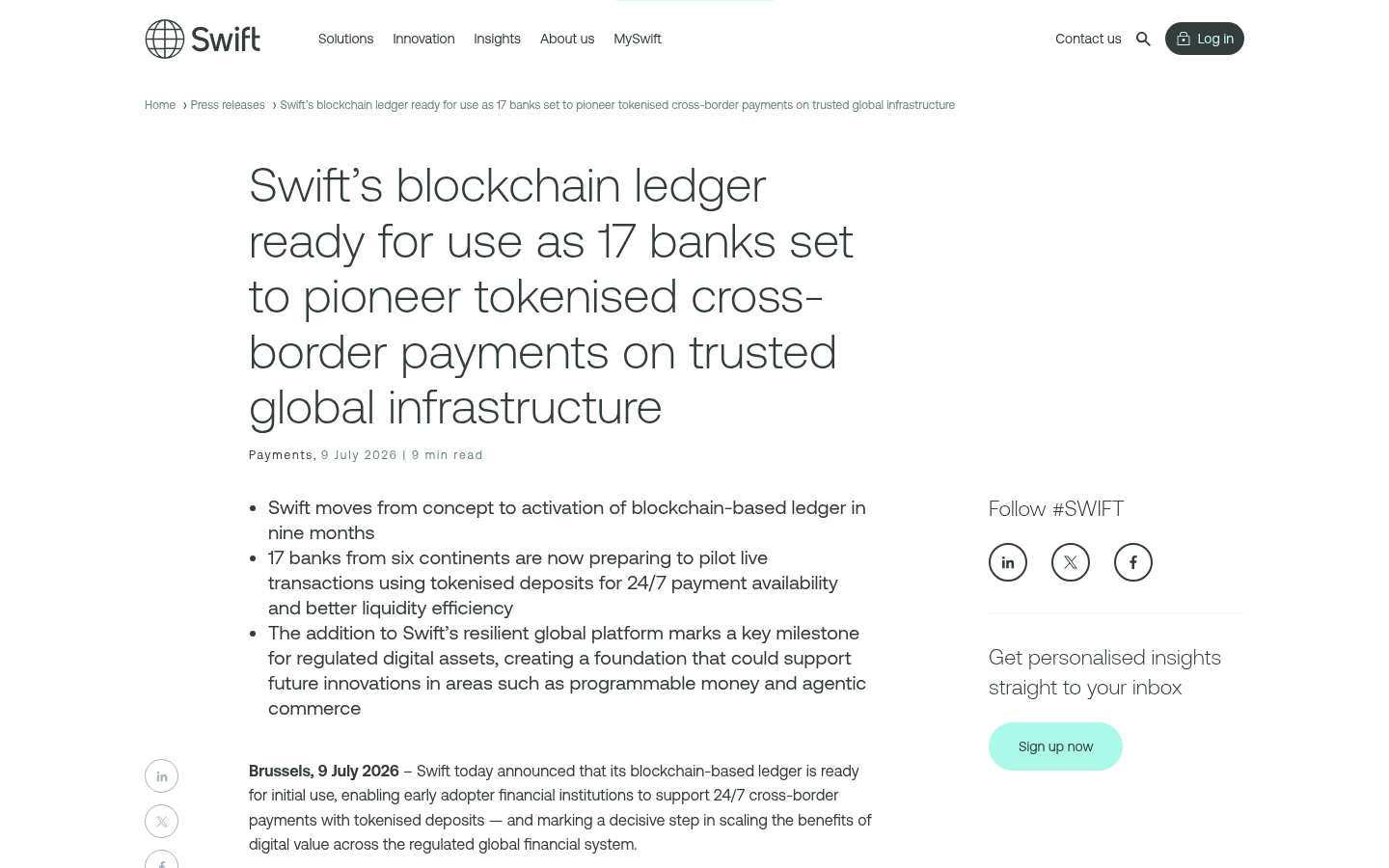
Swift's blockchain ledger opened for live use in July 2026, with 17 banks from six continents, including Citi, HSBC, UBS and Wells Fargo, preparing to pilot 24/7 cross-border payments with tokenised deposits (Source: Swift).
Stablecoin Insider tracks every rail that moves digital dollars across borders, and Swift's ledger is the most direct answer yet from the banking system to stablecoins.
Both promise the same thing: money that moves across borders at any hour, settles in minutes and carries its own rules. They get there in very different ways.
Swift's ledger coordinates bank money that stays inside regulated banks. Stablecoins are bearer tokens that anyone with a wallet can hold and send on public blockchains.
This comparison explains how each rail works, where each one is live today, how they differ on speed, cost, access and risk, and which one fits which kind of payment in 2026.
Key Takeaways
- Swift's ledger moves tokenised bank deposits; stablecoins move tokens on public blockchains.
- Seventeen banks are piloting Swift's ledger since it opened in July 2026.
- Stablecoin supply stood at $284.2 billion on 17 November 2026.
- Stablecoins reach anyone with a wallet; Swift's ledger only serves participating banks.
- Most banks will likely run both rails rather than choose one.
What Swift's Blockchain Ledger Actually Is
Swift announced the ledger in September 2025 and built it in nine months. It is an orchestration layer: banks keep their tokenised deposits on their own ledgers, and Swift's ledger records, matches and coordinates the payment obligations between them, with final settlement still running through existing systems (Source: Swift).
The technology is permissioned. The minimum viable product uses an EVM-compatible architecture based on Hyperledger Besu, and Swift said it was working with more than 40 financial institutions on the ledger (Source: Swift).
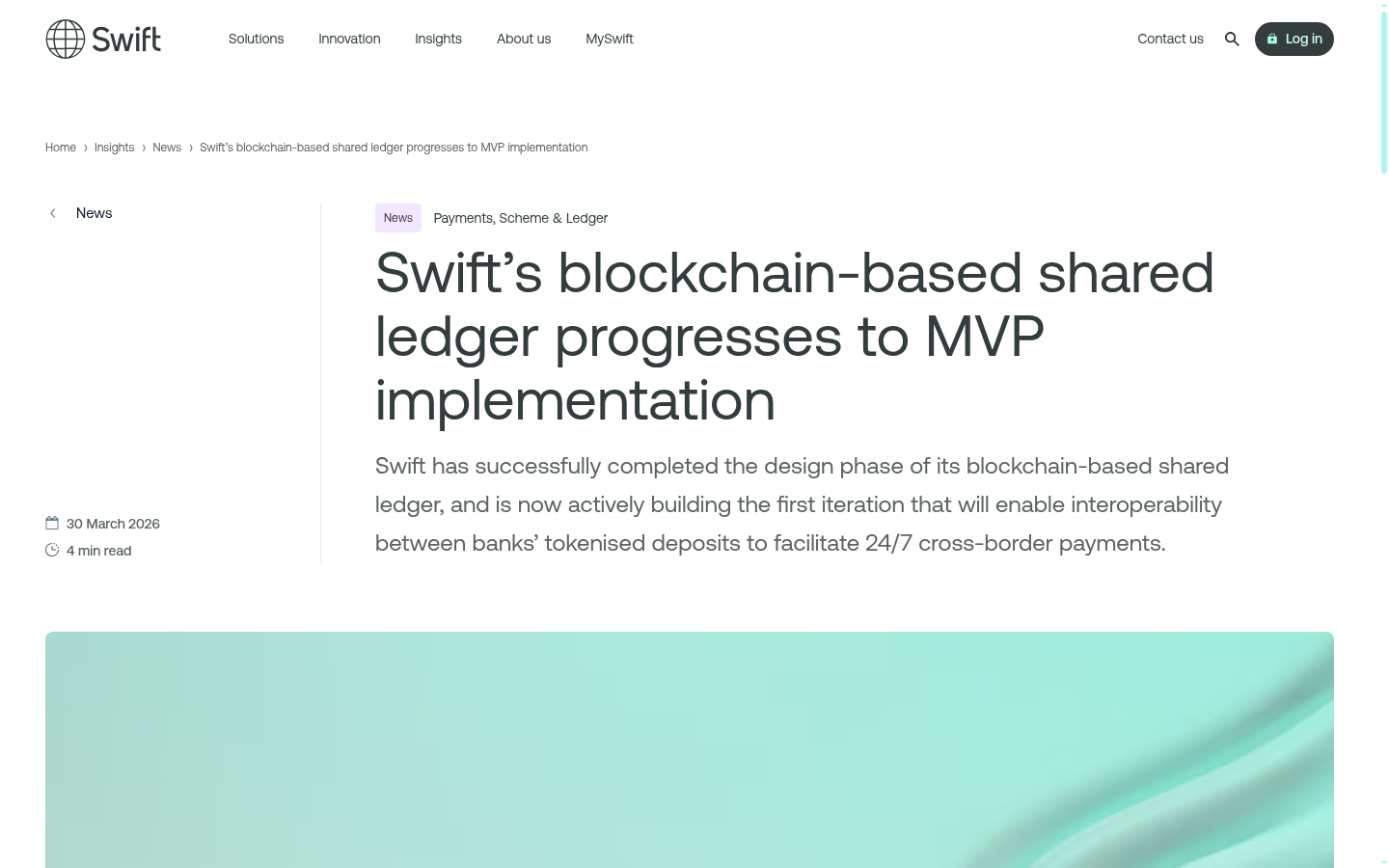
Its starting position is Swift's existing network, which connects more than 11,500 banking and securities organisations, market infrastructures and corporates in over 200 countries and territories.
The first use case is tokenised deposits, which are digital claims on a commercial bank rather than a separate asset. Our explainer on what tokenized deposits are covers how they differ from stablecoins in more detail.
Where Stablecoins Stand in Cross-Border Payments
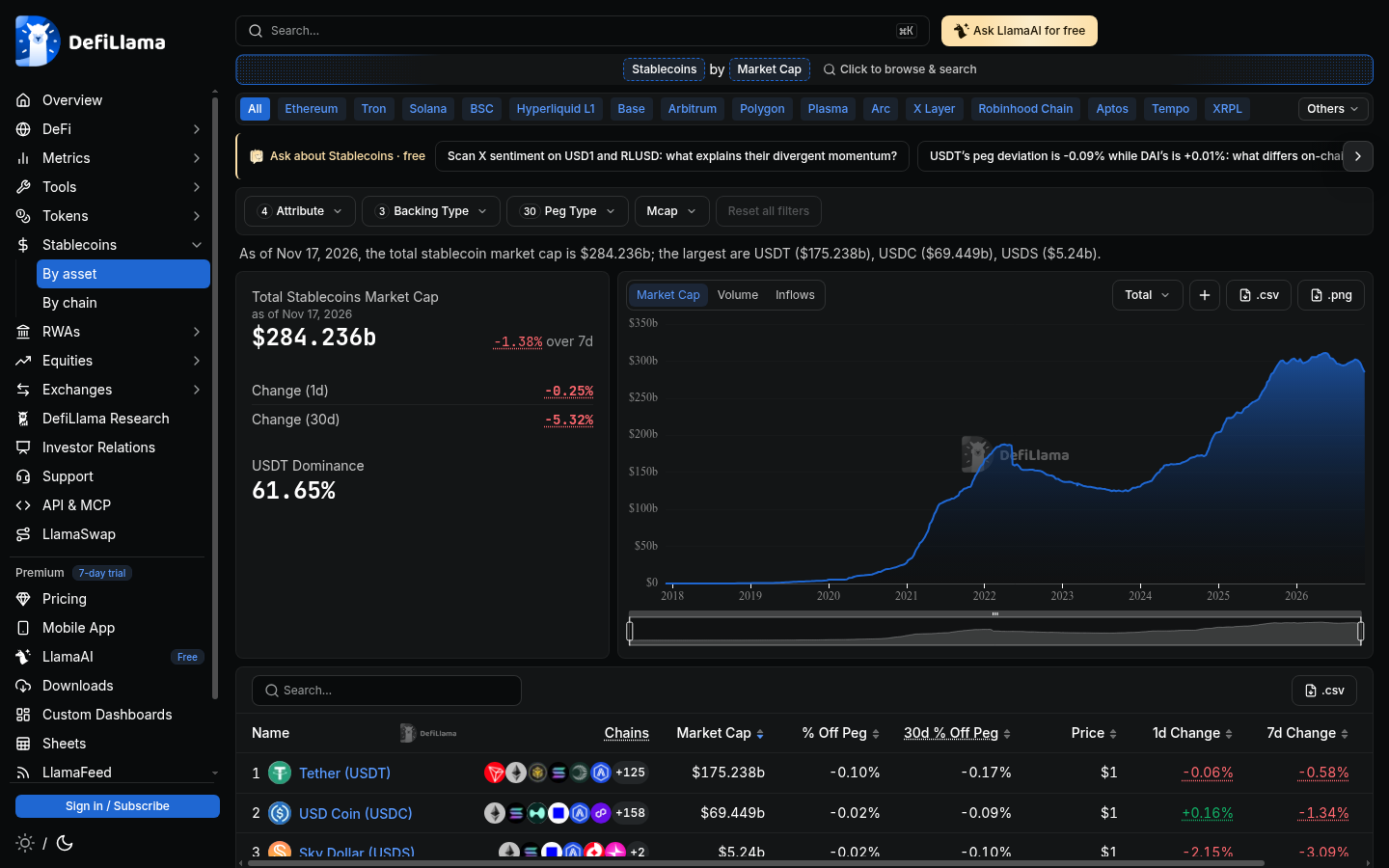
Stablecoins are already a large, open market. Total stablecoin supply was $284.2 billion on 17 November 2026, and Tether alone held 61.65% of it (Source: DefiLlama).
Most of that supply is not used for payments. McKinsey estimates that actual stablecoin payments run at about $390 billion a year, roughly 0.02% of global payment volumes, with B2B payments making up about $226 billion of that total (Source: McKinsey).

Card networks are using them too. Visa's stablecoin settlement passed a $20 billion annualized run rate in 2026, more than 15 times higher than a year earlier (Source: The Block).

The business side of that growth is covered in our report on stablecoin B2B cross-border payments.
How Each Rail Moves Money
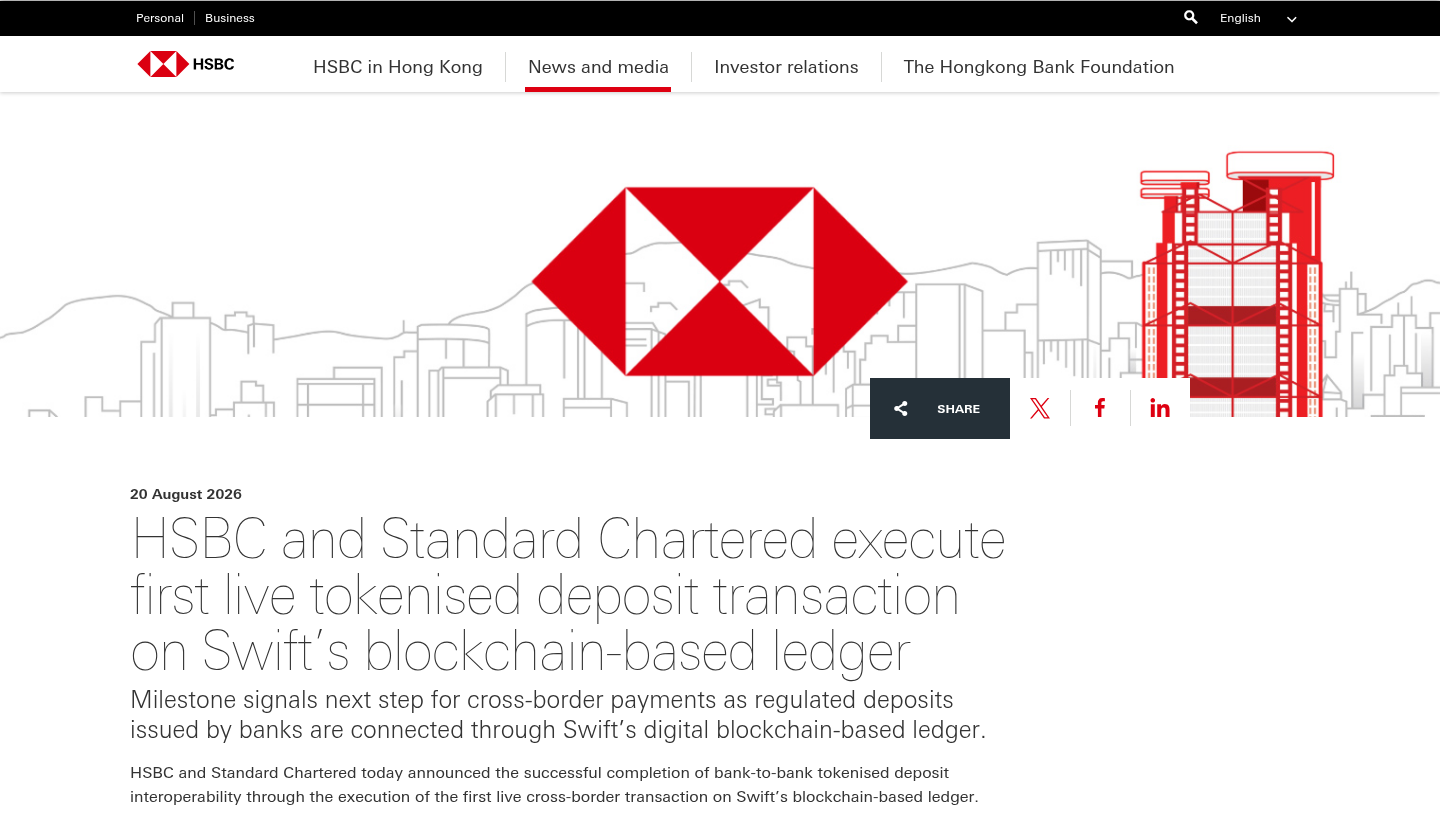
On Swift's ledger, a sending bank and a receiving bank exchange payment messages, and the resulting obligations are recorded as tokenised deposit obligations on each bank's own system. The ledger matches and nets those obligations before final settlement through existing payment systems (Source: HSBC).
The customer never holds a token. They see a faster bank transfer, while the bank keeps its existing compliance, credit and risk controls.
With stablecoins, the token itself is the money. A sender buys or holds a dollar stablecoin, transfers it on a blockchain to the recipient's wallet, and the recipient either keeps it or converts it to local currency through an exchange or off-ramp.
That makes stablecoins a bearer asset that moves the same way at 3 a.m. on a Sunday as at noon on a Tuesday. Platforms that handle the conversion legs are compared in our guide to the best stablecoin FX platforms.
Swift Ledger vs Stablecoins at a Glance
| Feature | Swift ledger | Stablecoins |
|---|---|---|
| What moves | Tokenised deposits | Bearer tokens |
| Issuer | Commercial banks | Licensed issuers |
| Network | Permissioned | Public blockchains |
| Access | Pilot banks only | Anyone with a wallet |
| Hours | 24/7 | 24/7 |
| Final settlement | Existing bank systems | On-chain |
| Status | Live pilot | $284B in supply |
The biggest difference is who sits in the middle. Swift's ledger keeps banks in every payment, while stablecoins let businesses and people pay each other directly once they hold the token.
Speed and Availability
Swift is already fast for most payments. Half of payments on its network reach the recipient bank within 40 seconds and 75% arrive within 10 minutes, but the last mile, from the receiving bank to the customer's account, accounts for 80% of total transaction time (Source: FF News).

The weak point is time. Traditional cross-border payments stop when correspondent banks close, which is the gap the ledger targets.
The first proof came on Saturday, 5 September 2026, when DBS and Citi completed a Singapore to US dollar payment over Swift's Digital Ledger in minutes, against up to two business days on traditional rails (Source: The Block).

Stablecoins have offered weekend settlement since they launched, which is why our coverage called it the weekend payment stablecoins were built for. On-chain transfers typically confirm in seconds to minutes, but the conversion back to local currency still depends on the off-ramp's banking hours.
Cost and Fees
Neither rail has a single price tag yet. Swift's ledger announcements do not include pricing, and banks will set what their customers pay.
Swift is tackling cost through a separate retail scheme. More than 50 banks support a framework that promises customers certainty of cost, full-value delivery and end-to-end traceability, and more than 25 committed to processing payments under it by June 2026 (Source: Swift).
By Sibos in October 2026, more than 100 banks had signed up to the scheme, and the next step is pay-by-alias using a phone number or email address (Source: Swift).
Stablecoin transfer fees are usually small, but the full cost includes buying the token, network fees and the off-ramp spread on the other side. Our analysis of cross-border payments on stablecoin rails breaks those costs down by corridor.
Who Can Use Each One
- Swift's ledger: Only participating banks, and through them their customers. The pilot group of 17 includes ANZ, BNP Paribas, BNY, Citi, DBS, HSBC, MUFG, Standard Chartered, UBS and Wells Fargo.
- Stablecoins: Anyone who can open a wallet, including businesses in countries with weak banking links and fintechs that are not banks.
- Corporates: Large treasuries will reach the ledger through their existing banks; HSBC has already connected its Tokenised Deposit Service to it.
- Smaller businesses: Stablecoins are the faster route today, because bank access to the ledger is still limited to the pilot.
Regulation and Settlement Risk
Tokenised deposits stay on bank balance sheets, so they carry the same regulation, deposit protection rules and credit risk as an ordinary bank account. That is the main reason banks prefer them, as discussed in our coverage of the BIS view on stablecoins and tokenised deposits.
Stablecoins in the US are moving under a federal regime. The OCC finalised the first GENIUS Act rule for payment stablecoin issuers on 21 October 2026, and the Act takes effect on 18 January 2027 (Source: The Block).

The rule requires reserve backing and redemption standards, which reduces the risk that a regulated dollar stablecoin loses its peg. What changed for issuers is covered in our breakdown of the OCC GENIUS Act final rule.
The Live Transactions So Far
| Date | Milestone | Rail |
|---|---|---|
| Sep 2025 | Ledger announced | Swift |
| Jul 2026 | Opens to 17 banks | Swift |
| Aug 2026 | HSBC and StanChart | Swift |
| Sep 2026 | DBS and Citi weekend | Swift |
| Oct 2026 | OCC final rule | Stablecoins |
| Jan 2027 | GENIUS Act in force | Stablecoins |
HSBC and Standard Chartered completed the first live interbank transaction on the ledger on 20 August 2026, and the DBS and Citi weekend payment followed in September. Both were pilots, not full commercial launches.
The Third Option: Bank Tokenised Deposit Networks
Swift is not the only bank-led rail. JPMorgan, Citi, Bank of America, Wells Fargo, HSBC and other US banks plan a shared tokenised deposit network run by The Clearing House, with a launch targeted for the first half of 2027 (Source: Retail Banker International).
That network would connect on-chain bank money to US rails such as RTP and CHIPS, and lists cross-border payments among its use cases.
Some banks are moving straight to stablecoins instead. Our report on 21 banks committing to a USD stablecoin company shows the same institutions hedging across both models.
Which Rail Fits Which Payment
- Large corporate treasury flows between major banks: Swift's ledger, once your bank is live on it. It keeps payments inside existing controls.
- Payments to suppliers in markets with weak correspondent links: Stablecoins, which do not need the receiving bank to join any network.
- Weekend and holiday liquidity: Both work 24/7, but only stablecoins are available today without being in a bank pilot.
- Consumer remittances: Watch Swift's retail scheme for price certainty, and stablecoin apps for lower-cost corridors.
- Programmable payments: Stablecoins today, with Swift naming programmable money and agentic commerce as future ledger use cases.
What to Watch in 2027
- Ledger expansion: How quickly Swift moves from 17 pilot banks to wider commercial use.
- Stablecoin connectivity: Whether Swift's ledger starts coordinating regulated stablecoins alongside tokenised deposits.
- The GENIUS Act start date: How many bank and nonbank issuers are licensed by 18 January 2027.
- The Clearing House network: Whether its first-half 2027 launch connects to Swift for cross-border flows.
- The G20 2027 targets: Swift's own deadline for faster, cheaper and more transparent cross-border payments.
Conclusion
Stablecoin Insider follows both bank-led and blockchain-native payment rails, because the contest between them will decide how most cross-border money moves by the end of the decade.
Swift's ledger brings 24/7 settlement to the banking system without taking money out of banks. It is live but limited to pilot transactions among 17 large banks.
Stablecoins are already open to anyone, hold $284.2 billion in supply and settle on-chain around the clock, but their payment use is still a small share of global flows.
For 2026, the practical answer is that the two rails serve different users: banks and their corporate clients on Swift's ledger, and everyone outside that network on stablecoins.
Read Next
These three guides go deeper on tokenised money and the fastest ways to move dollars across borders in 2026.
- Best Pension Providers UK 2026: 7 SIPPs Compared on Fees
- Wero vs PayPal in 2026: Fees, Protection and Coverage Compared
- CoW Swap Review 2026: Fees, MEV Protection, Batch Auctions and Stablecoin Swaps
FAQs
1. What is Swift's blockchain ledger?
Swift's blockchain ledger is a permissioned shared ledger that coordinates tokenised bank deposits between banks so they can make cross-border payments 24/7. It opened for live use in July 2026, with 17 banks piloting transactions and final settlement still running through existing systems.
2. Is Swift's ledger a stablecoin?
Swift's ledger is not a stablecoin. It does not issue any token of its own; it coordinates tokenised deposits that stay on each participating bank's balance sheet, while stablecoins are separate tokens issued by licensed companies and held directly by users.
3. Which is faster, Swift's ledger or stablecoins?
Swift's ledger and stablecoins are both fast and available 24/7. Swift's pilot settled a weekend Singapore to US payment in minutes, and stablecoin transfers usually confirm on-chain in seconds to minutes, though converting them back to local currency can take longer.
4. Can businesses use Swift's blockchain ledger today?
Businesses can use Swift's blockchain ledger today only through one of the participating pilot banks, such as Citi, HSBC or DBS. There is no direct access for companies, so most businesses outside those banks still rely on traditional wires or stablecoins for 24/7 payments.
5. Will Swift's ledger replace stablecoins?
Swift's ledger is unlikely to replace stablecoins. It serves banks and their clients inside the regulated system, while stablecoins serve anyone with a wallet, so the two rails are more likely to grow side by side, with banks running tokenised deposits and stablecoins serving the edges of the system.
Disclaimer: This content is provided for informational purposes only and does not constitute legal, financial, or compliance advice. Protocol versions, governance arrangements, and partner counts cited here reflect publicly announced milestones as of November 2026 and are moving quickly. Adoption figures come from vendor and foundation announcements with differing methodologies and should be treated as directional signals rather than guaranteed outcomes.


