
Table of Contents
In this interview Scorechain's Co-Founder and CEO, Pierre Gérard explains why a stablecoin issuer's compliance responsibility does not stop at minting and redeeming, what a bank asks about a stablecoin rail that a crypto-native firm does not, and where humans must stay in the loop as AI agents take on more compliance work.
Once a stablecoin is issued, it does not stay with its issuer. It circulates across secondary markets, DeFi protocols, and unhosted wallets, and that is where much of the compliance risk sits.
According to Pierre Gérard, Co-Founder and CEO of Scorechain, the biggest misconception in the industry is that an issuer's compliance responsibility ends at minting and redeeming. Gérard co-founded the Luxembourg-based blockchain analytics and AML compliance company in 2015, when Bitcoin was the main asset in play. Today, Scorechain is developing new features to monitor stablecoin activity and provide insights to stablecoin issuers.
In a conversation with Stablecoin Insider, Gérard explained which compliance problems are specific to stablecoins, how he ranks the risk factors in a stablecoin, what banks ask that crypto-native firms do not, and why regulators will expect issuers to monitor the entire circulating supply.
Why Did Scorechain Start With Blockchain Compliance in 2015?
You started Scorechain in 2015, when Bitcoin was the main asset in play. What did you see then that made blockchain compliance a business, and how has that thesis changed now that stablecoins carry most of the on-chain payment volume?
We founded Scorechain because we saw early on that blockchain would become a core part of the new financial architecture, and that without regulation, adoption wouldn't be possible—for either large financial institutions or startups. In 2015, we started with Bitcoin while anticipating the new blockchains and asset types that would follow.
Stablecoins are simply the most popular use case of what this technology has already made possible for several years. Now, with new regulations covering stablecoins, we are developing new features to monitor their activity and, in particular, provide insights to stablecoin issuers.
Which Compliance Problems Are Specific to Stablecoins?
Which compliance problem is specific to stablecoins, and which is simply crypto compliance at a bigger scale?
AML transaction monitoring for stablecoins is very similar to any other digital asset, just at a much larger scale. The major difference is that stablecoins are issued by a central entity that has ongoing responsibilities: it must monitor secondary markets, prevent usage by sanctioned wallets (we can then provide sanction lists on-chain) and block hacks through on-chain interventions (such as freezing and burning tokens).
Because of this, even with huge transaction volumes, full real-time monitoring is essential.
How Does Scorechain Assess a Stablecoin as a Whole?
Scorechain recently launched a feature that assesses the integrity of a stablecoin or tokenized asset as a whole, beyond screening individual transactions. What does that assessment look at, and who is asking for it first: banks, issuers, exchanges?
Monitoring the entire circulating supply is critical not only for reserve-backing controls, but also to understand how stablecoins are being used and by what types of players. It also provides insights into potential suspicious activities linked to those stablecoins.
Obviously, with these features we target stablecoin issuers, but we also serve any of their counterparties that want to assess the global risks of a stablecoin.
How Should the Risk Factors in a Stablecoin Be Ranked?
If you had to rank the risk factors in a stablecoin (reserves, issuer governance, chain, freeze capability, counterparties), what order would you put them in?
I think I will almost keep this ranking; the reserve as it is fundamental for the promise of 1:1 redemption, the governance as this is the only way to guarantee the respect of other factors.
But even a well-governed issuer with good reserves relies on third parties—commercial banks holding the cash, custodians, and exchanges. Furthermore, from an AML perspective, if the stablecoin's main ecosystem is dominated by high-risk VASPs, mixers, or sanctioned entities, regulators may cut the issuer off from the banking system.
The freeze capability recently showed its importance after the Binance hack.
I will add the importance of the underlying chain: native issuance on established chains (like Ethereum or Solana) carries relatively low infrastructure risk, whereas bridged or "wrapped" versions introduce severe third-party smart-contract risk.
What Do Banks Ask That Crypto-Native Firms Don't?
When a bank evaluates a stablecoin rail, what does it ask Scorechain that a crypto-native firm would not?
A crypto-native firm focuses on fast transaction monitoring checks to see if a specific wallet is safe right now. A bank would evaluate the entire stablecoin ecosystem with all the factors we discussed earlier.
Banks have set a much higher bar for risk assessment and are far more cautious with this new type of asset.
What Illicit-Flow Patterns Are Showing Up in Stablecoins?
Stablecoins are now the main vehicle for on-chain illicit flows. What patterns are you seeing, and how does that compare with what the public narrative says?
You're right: stablecoins offer high liquidity, low fees, and price stability, which makes them attractive not only to legitimate users, but also to criminals. They can also be used for sanctions evasion.
However, new regulations—such as MiCA in Europe and the GENIUS Act in the US—are the first steps toward bringing stronger control and monitoring to stablecoin activity.
And we shouldn't forget that issuers can freeze stablecoins at any time, which actually makes them more secure than physical fiat currency in that respect.
Can Freezable Stablecoins Coexist With Permissionless Money?
How do you handle the tension between issuers' ability to freeze funds and the principle of open, permissionless money?
These are two different things using the same technology layer. I like to say that Bitcoin-like assets are pure crypto assets (or permissionless money), whereas real-world assets, including stablecoins, are digital assets controlled by a central entity. They do not compete with each other because they have different objectives.
However, what is really important is that the foundation of trust on the underlying blockchains exists only thanks to native crypto assets used for mining Proof of Work or Proof of Stake. Without assets like Bitcoin or Ethereum, there would be no stablecoins.
What Does AI Change in a Compliance Analyst's Daily Work?
Scorechain has been working on AI-driven tooling for compliance teams, including an MCP-based interface. What does it change in an analyst's daily work, and where must a human stay in the loop?
Like any SaaS provider, we need to integrate AI capabilities and offer them to our customers. In the near future, almost any task performed today by a compliance officer could be executed by an AI agent. However, supervising these agents, handling alerts, and auditing their decisions will still be managed by humans.
Under regulations like MiCA in Europe, regulated entities can use AI, but final responsibility always stays with the person in charge—they cannot blame the algorithm.
That said, daily compliance work will be done much faster, on a 24/7 basis, and many routine tasks will be automated.
What Will Be Standard in Stablecoin Compliance in Three Years?
In three years, what will be standard in stablecoin compliance that is rare today?
With the deployment of new agents able to initiate payment transactions, I think there will be more autonomous compliance agents integrated with protocols like x402 to monitor and potentially freeze transactions.
What Is the Biggest Misconception About Stablecoin Compliance?
What is one assumption in the industry about stablecoin compliance that you think is wrong?
The biggest misconception is that an issuer's compliance responsibility stops at minting and redeeming.
Once a stablecoin is issued, it circulates freely across secondary markets, DeFi protocols, and unhosted wallets. Regulators will more and more expect issuers and counterparties to monitor the entire circulating supply to detect illicit flows and sanctions evasion across the whole ecosystem.
What Should Issuers and Banks Do in the Next 90 Days?
What should a stablecoin issuer or bank do in the next 90 days if it has done nothing on this yet?
Do the best to follow the topic raised in the previous question and push for more transparency and specifically, real-time transparency when it comes to monitoring the peg and reserve backing.
About Scorechain
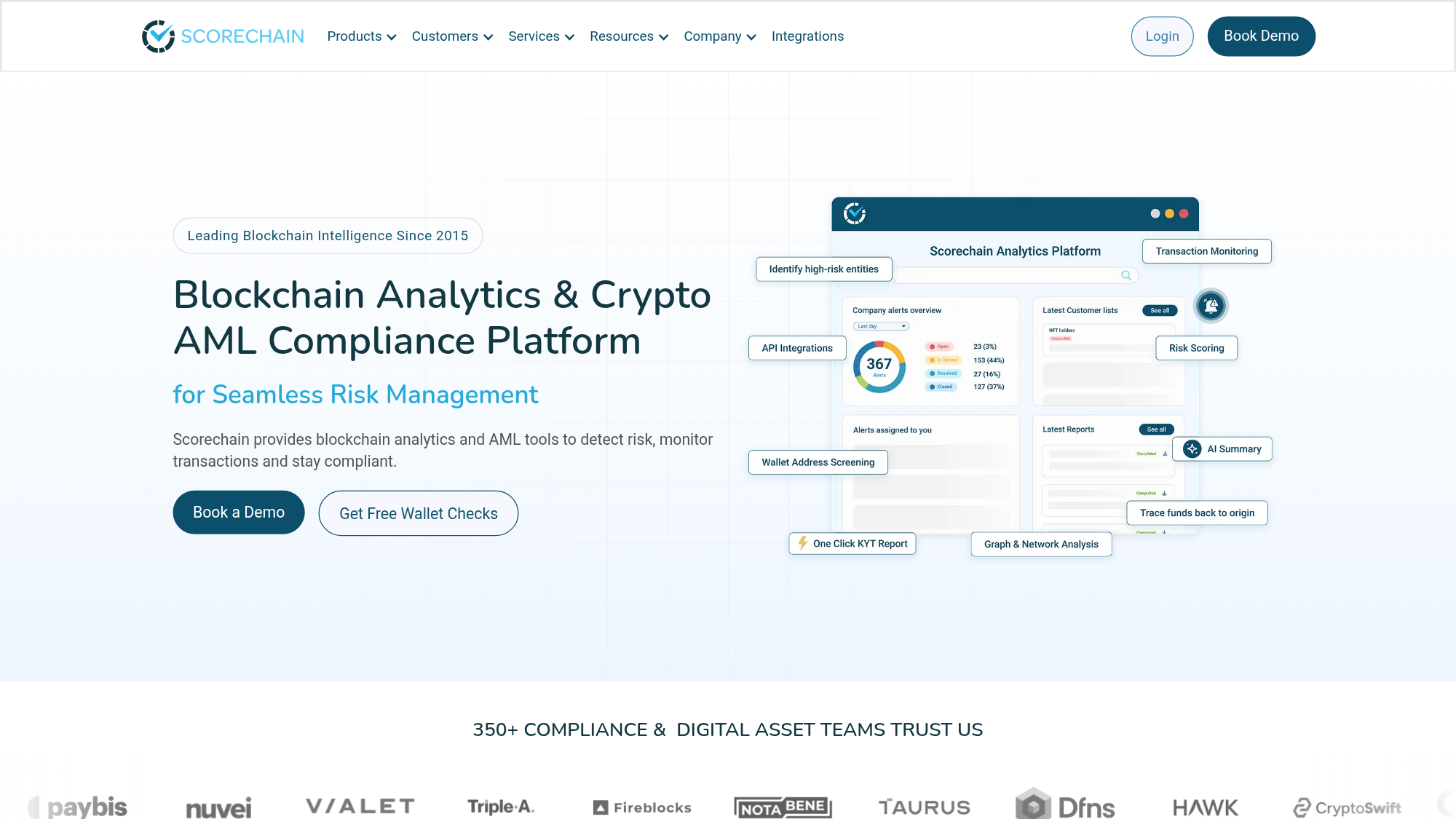
Scorechain is a blockchain analytics and crypto AML compliance platform, founded in 2015 and based in Luxembourg. It provides wallet screening, transaction monitoring, on-chain investigation tools, and risk reports for crypto businesses such as exchanges, custodians, wallet providers, and token issuers, as well as for banks, fintechs, asset managers, payment providers, regulators, and law enforcement. Customers can use it through an API or a web dashboard, and the platform runs on an EU-hosted private cloud.
About Stablecoin Insider
Stablecoin Insider is the leading media and research platform covering stablecoins, digital payments, on-chain finance, treasury infrastructure, and the evolving global financial system. The publication focuses on enterprise adoption, fintech innovation, banking transformation, and the broader stablecoin ecosystem.