
Table of Contents
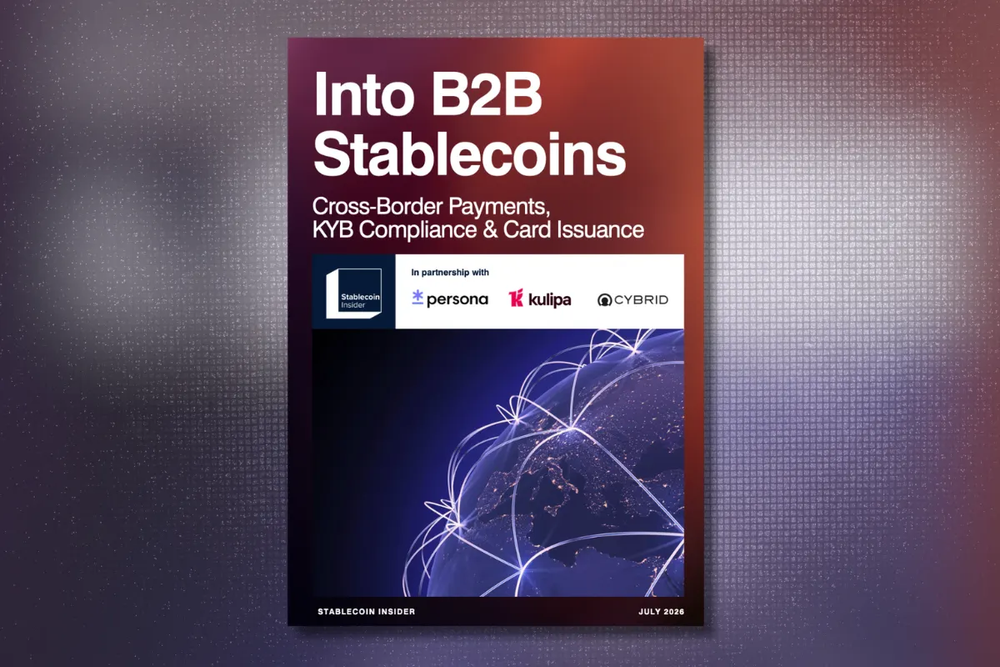
The EU-wide MiCA transitional period for existing crypto-asset providers ended on 1 July 2026, after which full authorization became mandatory to provide crypto-asset services in the EU, according to the July 2026 report Into B2B Stablecoins: Cross-Border Payments, KYB Compliance & Card Issuance.
That deadline is one signal of a broader shift: regulatory clarity for stablecoins has arrived faster than the prevailing skepticism assumed, and it is the single biggest unlock pulling enterprise treasurers off the sidelines.
Only a couple of years ago, the two questions dominating the conversation were whether the technology works and whether regulators would allow it; both are now effectively settled.
This article maps the stablecoin regulatory landscape as of mid-2026 across the EU, US, and Asia-Pacific, explains what each framework means in practice for B2B platforms and enterprises, and examines the open question of whether these regimes will converge or fragment.
Key Takeaways
- MiCA's transitional period ended 1 July 2026; full authorization is now mandatory.
- The GENIUS Act became US law in July 2025, with rules finalizing through 2026.
- The EU AML package applies from July 2027, harmonizing beneficial-ownership standards.
- Regulatory clarity is the single biggest unlock for enterprise stablecoin adoption.
- Similar principles across regimes do not yet mean interoperable rules.
Why Regulation Was the Missing Piece for Enterprise Adoption
For most of the last decade, enterprise treasurers had two reasons to stay on the sidelines of stablecoin payments: uncertainty about whether the technology was reliable, and uncertainty about whether regulators would permit it at all. The first question has been answered in production.
The rails settle in minutes, verification infrastructure can catch industrialized fraud, and stablecoin-backed corporate cards authorize in under two seconds.
The second question is the subject of this article, and its answer changed decisively between 2024 and 2026. The GENIUS Act is now US law, MiCA is fully in force in the EU, and the EU's AML overhaul is scheduled.
Card issuer Kulipa identifies regulatory clarity as the single biggest unlock for enterprise adoption, because it removes the risk that procurement and legal teams could not previously accept at scale. What was once a compliance gamble is becoming a documented framework.
The EU: MiCA Is Live and the Transition Is Over
MiCA (Markets in Crypto-Assets) is live, and 2026 is the year its grace period ended.
The stablecoin provisions, covering asset-referenced tokens (ART) and e-money tokens (EMT), have applied since June 2024, and the core CASP (crypto-asset service provider) authorization regime has applied since December 2024.
The critical date for operators reading this in 2026: the EU-wide transitional period for existing providers ended on 1 July 2026, after which full MiCA authorization became mandatory to provide crypto-asset services in the EU.
The practical effect is a consolidation around compliant operators, because firms that did not secure authorization can no longer serve the market.
The EU AML overhaul: AMLD6 and AMLA
The second EU track is anti-money laundering. AMLD6 will introduce harmonized beneficial-ownership standards, a direct response to the fragmented UBO-disclosure problem that makes cross-jurisdictional business verification so difficult.
The broader EU AML package, AMLD6 alongside the directly applicable AML Regulation, is scheduled to apply from July 2027, with the new AML Authority (AMLA) already standing up and beginning to select entities for direct supervision during 2026.
The direction is unambiguous: harmonized beneficial-ownership transparency and full inclusion of MiCA-authorized CASPs as obliged entities. For identity platforms like Persona, which describe fragmented UBO disclosure as a core KYB pain point, this is the specific problem the EU is legislating against.
The US: The GENIUS Act and the Rulemaking Phase
The US regulatory picture changed decisively with the GENIUS Act, which established the first federal framework for payment stablecoins and was signed into law in July 2025.
As of mid-2026, the framework is in the rulemaking phase. Federal regulators including the OCC and FDIC have issued proposed rules and are working toward finalization, but the foundational legal certainty enterprises were waiting for now exists. The practical effect is twofold:
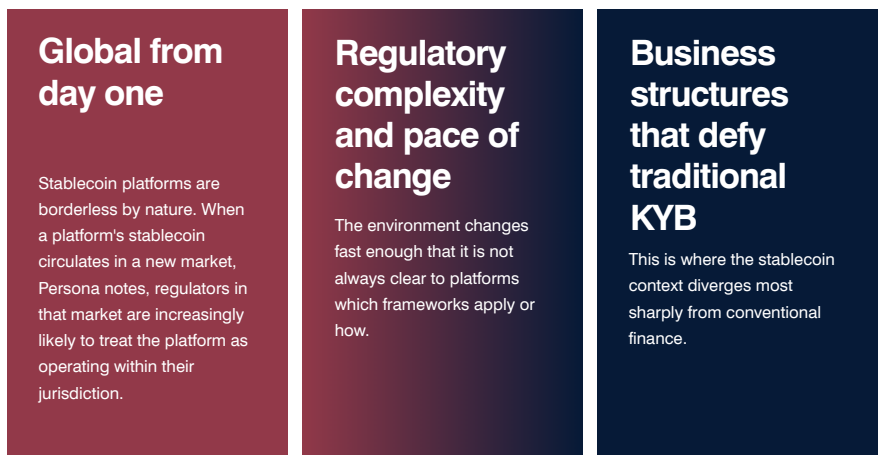
- For platforms, the GENIUS Act now sits alongside MiCA and the FATF Travel Rule as one of the frameworks they must continuously adapt to. Compliance is a moving target, not a one-time build.
- For banks and payment providers, the GENIUS Act creates an on-ramp for regulated institutions to participate directly. The question those institutions now face is whether to build, partner, or acquire.
Asia-Pacific: Interoperability Work That Cross-Border Operators Need
Singapore's Project Guardian and Hong Kong's Project Ensemble are creating new frameworks for practical interoperability. This work matters disproportionately for cross-border operators because it begins to address how value and identity move between regimes, not just within them.
The regional context matters too: Asia leads global stablecoin payment activity at roughly 60% of volume according to McKinsey/Artemis data, driven largely by Singapore, Hong Kong, and Japan. The jurisdictions building interoperability frameworks are the ones where the volume already sits.
For a country-by-country licensing map covering Singapore, Hong Kong, Japan, and Taiwan, see our dedicated APAC stablecoin regulation guide.
The Regulatory Timeline at a Glance
| Framework | Jurisdiction | Status as of mid-2026 |
|---|---|---|
| MiCA (ART/EMT provisions) | EU | In force since June 2024 |
| MiCA (CASP authorization) | EU | In force since December 2024; transition ended 1 July 2026 |
| GENIUS Act | US | Law since July 2025; rulemaking finalizing through 2026 |
| EU AML package (AMLD6 + AML Regulation) | EU | Applies from July 2027; AMLA standing up in 2026 |
| Project Guardian / Project Ensemble | Singapore / Hong Kong | Active interoperability frameworks in development |
| FATF Travel Rule | Global | Ongoing obligation platforms must continuously adapt to |
What Regulatory Clarity Changes for Each Player
For enterprise treasury teams
Regulatory clarity has substantially de-risked early adoption. Kulipa argues that MiCA in Europe and the GENIUS Act in the US materially de-risk stablecoin programs for CFOs, whose procurement and legal teams previously would not accept the patchwork of cross-border workarounds at scale.
The strategic cost of waiting is real: in Kulipa's framing, first movers may lock in 18–24 months of treasury-efficiency advantage, while those waiting for perfect regulatory certainty will find their competitors got there first. That is a vendor's framing of urgency and should be weighed as such, but it sits on top of growth rates and a regulatory shift that are independently documented.
For B2B platforms and fintech builders
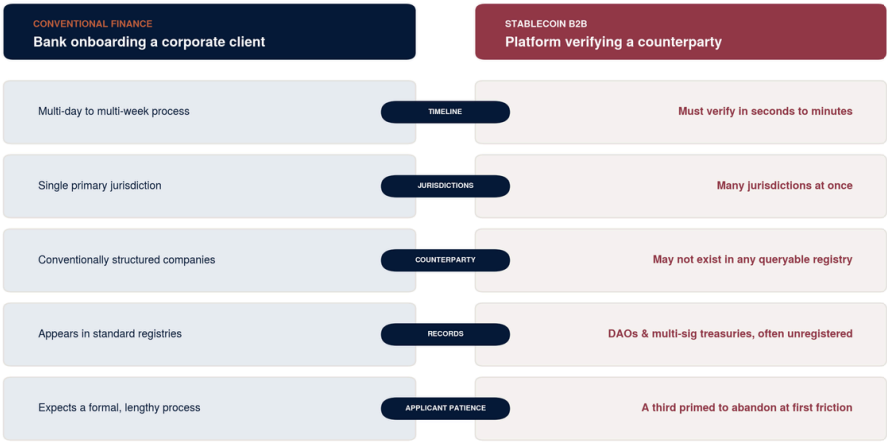
The winning approach is to treat compliance as core infrastructure from day one, not a later bolt-on. According to Persona, platforms should verify continuously rather than once at the front door, build automated KYB triggers into onboarding and sanctions screening at the transaction layer, and design audit-ready data structures before a regulator ever asks.
The platforms managing the regulatory pace well invest in verification architecture that adjusts as rules shift, rather than hard-coding today's requirements into systems that will be obsolete in a year.
For banks and payment providers
The GENIUS Act creates an on-ramp for regulated institutions to participate directly. Distribution, deposit infrastructure, and regulatory relationships are genuine advantages, but only if paired with infrastructure that meets the reliability and compliance bar enterprises now expect: entity-level KYB, sub-2-second authorization, and consistent multi-corridor coverage.
On the payments side, orchestration platforms like Cybrid are building toward "dollar-in, payment-out" workflows supported by auditable, bank-grade infrastructure that satisfies both regulators and CFOs.
The Convergence Question: One Framework or a Patchwork?
The open question for the next phase is whether these frameworks converge, aligning enough that a single provider can offer consistent multi-region coverage, or whether divergence persists and creates compliance-arbitrage opportunities.
There is an encouraging signal: MiCA and the GENIUS Act are independently arriving at broadly similar prudential principles, including full reserves, redemption rights, and AML obligations.
But "similar principles" is not the same as interoperable rules, and the timelines do not line up neatly either. MiCA's transitional period closed in mid-2026, while the EU's AML overhaul does not fully apply until July 2027 and US implementing rules are still being written.
The reading is that a provider promising seamless multi-region coverage today is, to some degree, promising to absorb a fragmentation that has not actually been resolved yet. Enterprises with multi-region treasury operations need consistent compliance coverage across the EU, US, LATAM, and APAC, and until regulatory convergence is further along, multi-region operators must navigate a patchwork.
What Remains Unresolved
A balanced view of the 2026 landscape must name what regulation has not yet settled:
- Accounting treatment: Treasury teams require USDC to be treated as a functional equivalent to USD on the balance sheet, and until US GAAP and IFRS formally recognize stablecoins as cash equivalents, CFOs face internal-audit and board-level friction. The FASB's 2024 guidance on crypto assets was a step forward but does not yet fully address the stablecoin-as-operational-cash use case.
- Enforcement track record: The prudential frameworks now exist, but enforcement history and counterparty transparency are still being built.
- The coordination problem: Getting institutions to trust one another's verification decisions, the portable-decisions problem Persona names, would require industry-wide agreement on risk thresholds. That is not the kind of thing a regulation or a product release resolves on a schedule.
- The fraud arms race: Synthetic identity fraud will continue to evolve alongside the detection built to catch it, regardless of what the rulebooks say.
Conclusion
Stablecoin regulation in 2026 has crossed a threshold: the GENIUS Act is law, MiCA is fully in force with its transition complete, the EU's AML overhaul is scheduled for July 2027, and APAC interoperability work is addressing how value and identity move between regimes.
The question of whether regulators will allow stablecoin payments is effectively settled, and what remains is the harder work of convergence, accounting recognition, and industry coordination that no single rulebook resolves.
For the full analysis, including the cross-border payments, KYB compliance, and card issuance layers this regulation governs, download the complete Into B2B Stablecoins report.
Read Next:
- Stablecoin-Backed Corporate Cards: The B2B Card Issuance Model Explained
- KYB for Stablecoin Platforms: Why Business Verification Is the Gating Function of B2B Crypto Payments
- Stablecoin B2B Cross-Border Payments: How They Work, Costs, and Growth in 2026
- New Stablecoin Insider Report: 'Into B2B Stablecoins'
FAQs:
1. What is the GENIUS Act for stablecoins?
The GENIUS Act for stablecoins is the first US federal framework for payment stablecoins, signed into law in July 2025, with implementing rules from federal regulators including the OCC and FDIC being finalized through 2026.
2. When did the MiCA transitional period end?
The MiCA transitional period ended on 1 July 2026, after which full MiCA authorization became mandatory for providing crypto-asset services in the EU, forcing a consolidation around compliant operators.
3. What does AMLD6 mean for stablecoin platforms?
AMLD6 means stablecoin platforms will face harmonized beneficial-ownership standards across the EU, directly addressing the fragmented UBO-disclosure problem, with the broader EU AML package scheduled to apply from July 2027 under the supervision of the new AML Authority (AMLA).
4. Why is regulatory clarity the biggest unlock for enterprise stablecoin adoption?
Regulatory clarity is the biggest unlock for enterprise stablecoin adoption because it removes the compliance risk that procurement and legal teams previously would not accept at scale, giving CFOs the documented frameworks, MiCA in Europe and the GENIUS Act in the US, needed to approve stablecoin programs.
5. Will stablecoin regulations converge across the EU, US, and APAC?
Whether stablecoin regulations converge across the EU, US, and APAC remains the open question of 2026: MiCA and the GENIUS Act are independently arriving at similar prudential principles like full reserves and redemption rights, but similar principles are not interoperable rules, and the timelines do not yet line up.
Disclaimer:
This content is provided for informational and educational purposes only and does not constitute financial, investment, legal, or tax advice; no material herein should be interpreted as a recommendation, endorsement, or solicitation to buy or sell any financial instrument, and readers should conduct their own independent research or consult a qualified professional.