

Table of Contents
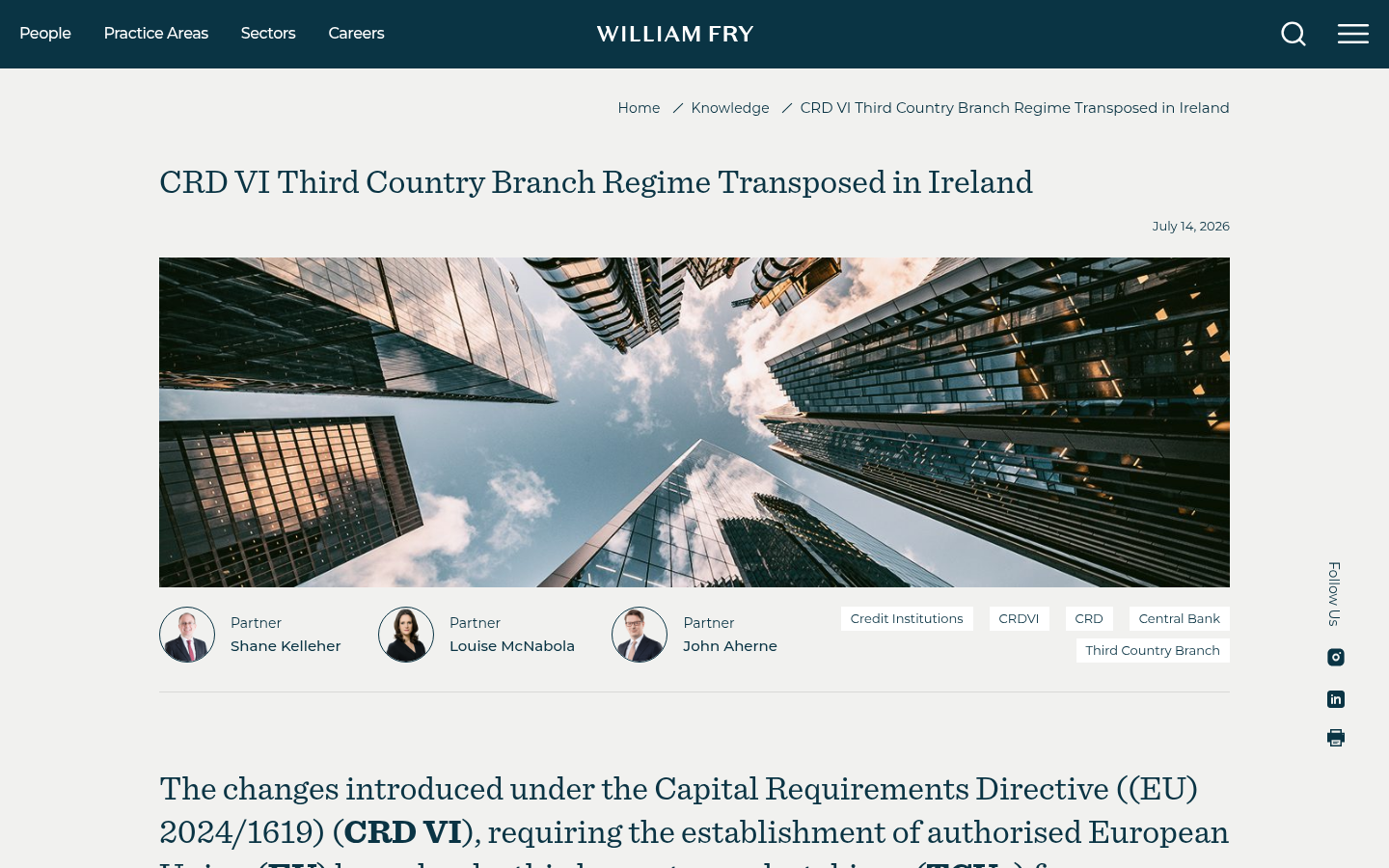
Ireland's CRD VI rules, signed on 10 July 2026, require the largest non-EU bank branches to hold capital endowment of 2.5% of average liabilities, with a €10 million floor, and every branch to keep 30 days of liquid assets in Ireland (Source: William Fry).
Stablecoin Insider tracks the rules that decide who can serve customers in Europe's financial system, and CRD VI is about to change that for every bank outside the EU.
From 11 January 2027, a bank based in the US, UK, Switzerland or Asia can no longer take deposits from, lend to or guarantee for EU clients from abroad. It will need a licensed branch or subsidiary in the EU, or a narrow exemption.
Many firms are already behind. Contracts signed after 11 July 2026 no longer benefit from grandfathering, and member states are writing their own versions of the rule.
This guide explains what Article 21c requires, which services and exemptions apply, how branches are classified and capitalised, how national rules differ, and what non-EU banks and fintechs should do before the deadline.
Key Takeaways
- From 11 January 2027, non-EU banks need an EU branch for core banking services.
- Deposits, lending and guarantees are covered; MiFID investment services are not.
- Contracts signed before 11 July 2026 are grandfathered until materially changed.
- Reverse solicitation survives but cannot support a sales strategy.
- Branches need authorisation in each member state; there is no passport.
Why the EU Is Closing the Cross-Border Door
Before CRD VI, each member state decided for itself whether a non-EU bank could serve local clients from abroad. Some required a branch, others allowed cross-border lending with few conditions, and supervisors had little visibility of the business.
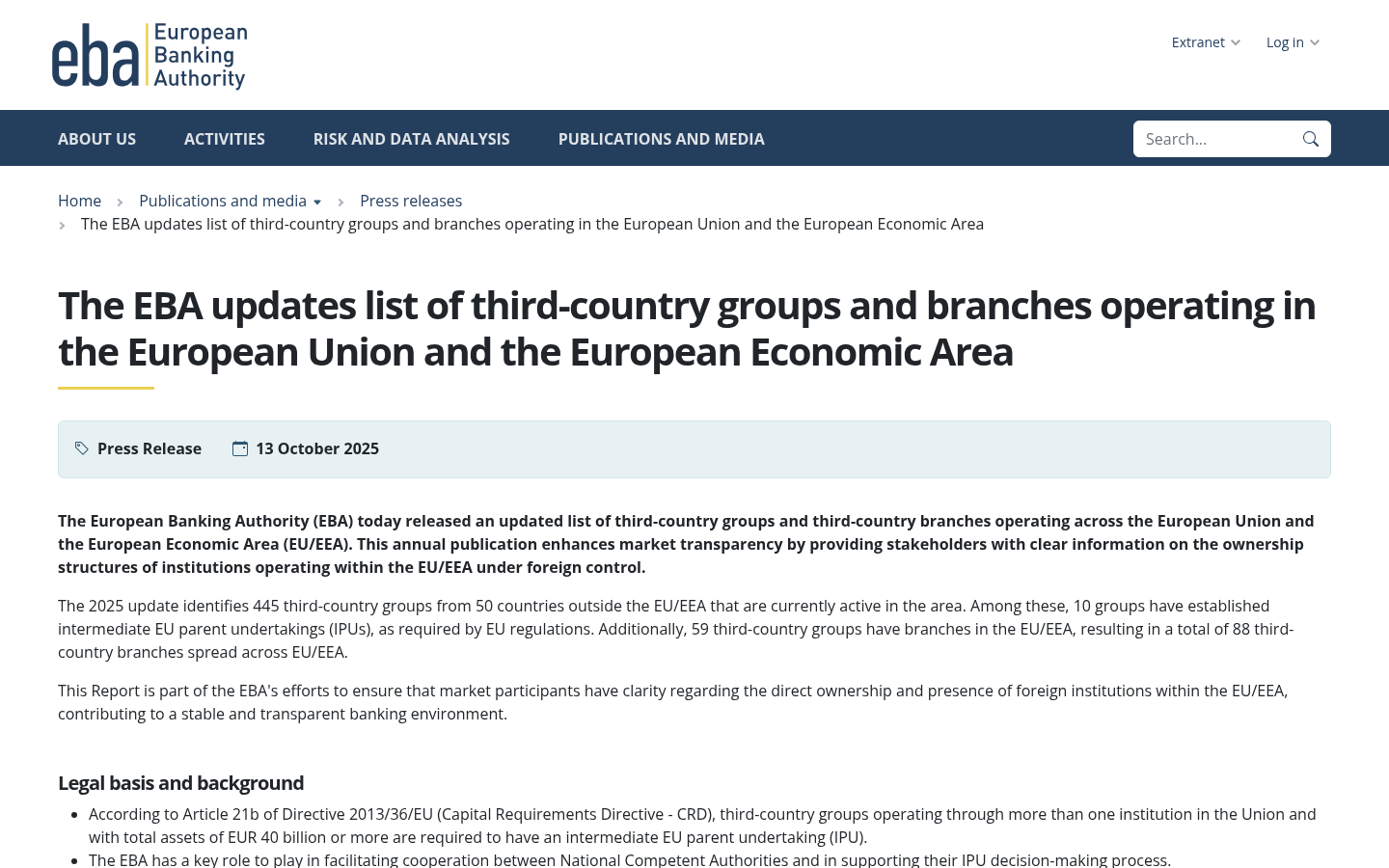
The exposure is significant. The European Banking Authority's 2025 list counted 445 third-country banking groups from 50 countries operating in the EU and EEA, including 88 third-country branches (Source: European Banking Authority).
CRD VI, the sixth Capital Requirements Directive, replaces that patchwork with a minimum EU standard. It sits beside other rulebooks covered on this site, such as PSD3 and the PSR for payments and MiCA for crypto-assets.
The Key Dates
| Date | Milestone |
|---|---|
| 10 January 2026 | Transposition deadline |
| 5 March 2026 | EBA reporting standards final |
| 7 July 2026 | EBA branch authorisation guidelines |
| 11 July 2026 | Grandfathering cut-off |
| 11 January 2027 | Branch requirement applies |
| 31 March 2027 | First branch reporting date |
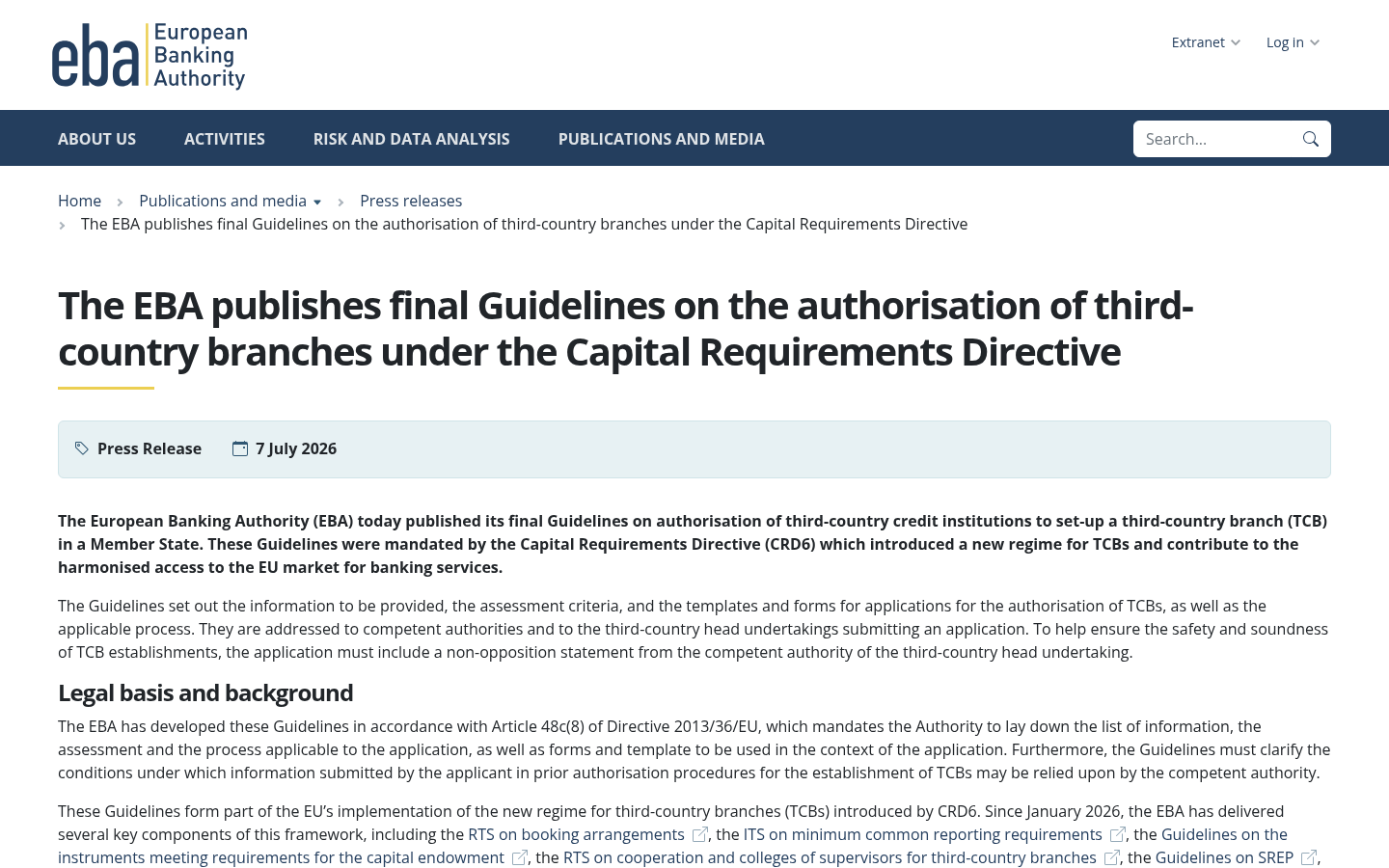
The European Banking Authority has published most of the technical rules. Its final guidelines on authorising third-country branches, issued on 7 July 2026, require every application to include a non-opposition statement from the head office's home supervisor (Source: European Banking Authority).
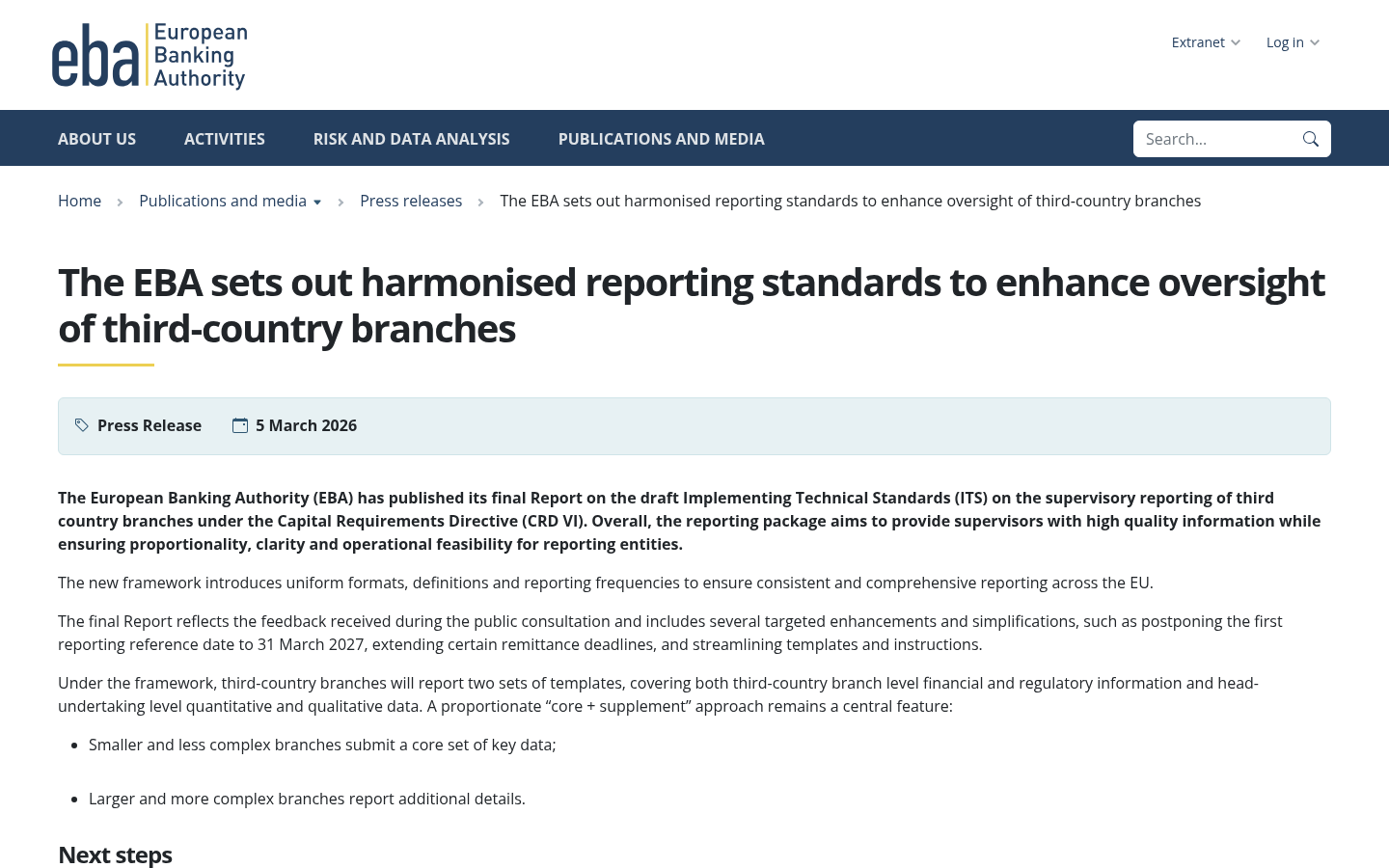
Reporting follows shortly after the deadline. The EBA postponed the first reporting reference date for third-country branches to 31 March 2027 and uses a core-plus-supplement approach, so smaller branches report less (Source: European Banking Authority).
What Article 21c Requires
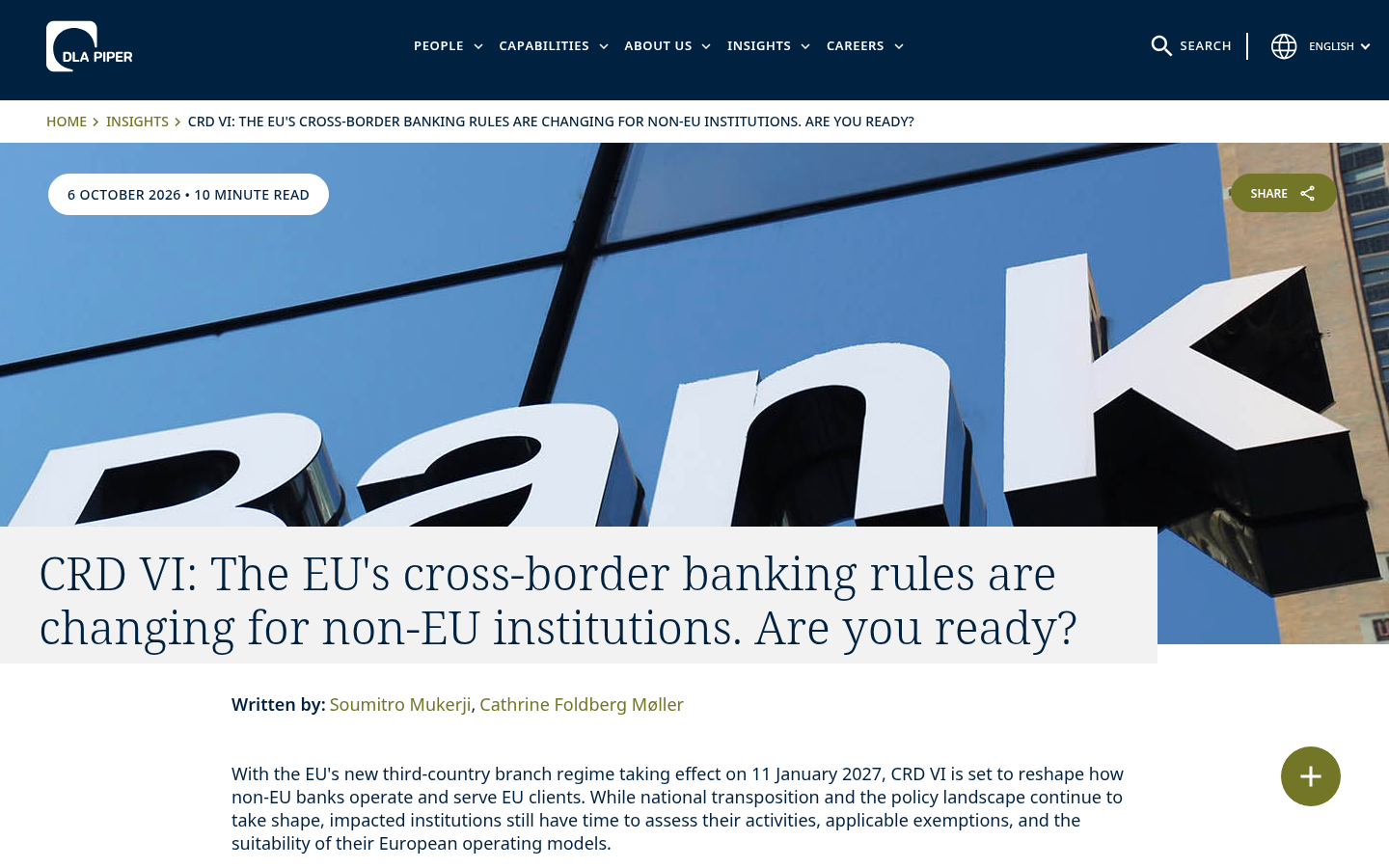
Article 21c sets the core rule. A third-country institution may not provide core banking services to a client in an EU member state unless it has an authorised branch in that state, operates through an EU-licensed subsidiary, or falls within a limited exemption (Source: DLA Piper).
The test looks at where the client is, not where the bank is. A New York bank lending to a company in Frankfurt is caught even if every document is signed and booked in New York.
Which Services Are Covered
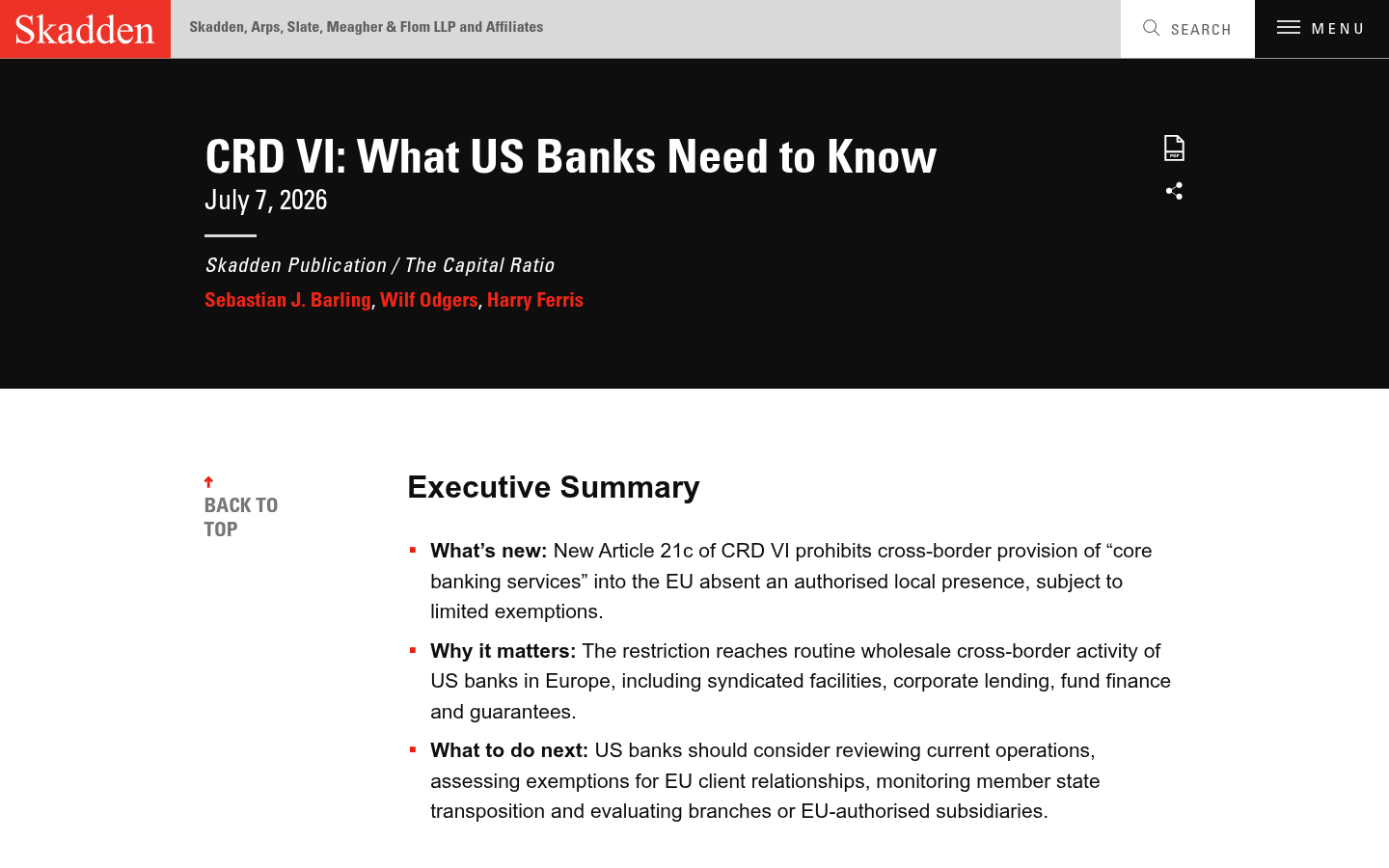
The rule targets core banking services: taking deposits, issuing guarantees and commitments, and lending, including consumer credit, real estate credit, factoring and commercial trade finance such as forfaiting. Investment services under MiFID II are excluded (Source: Skadden).
- Deposits: Taking deposits or other repayable funds from EU clients.
- Lending: The most fact-sensitive category, because national laws treat lending differently.
- Guarantees: Guarantees and commitments given to EU clients.
- Out of scope: MiFID investment services, which have their own third-country regime.
The Exemptions That Remain
- Reverse solicitation: A client may approach a non-EU bank on its own exclusive initiative. Any marketing, including through affiliates or agents, defeats it, and it covers only the service the client asked for.
- Interbank services: Services to EU credit institutions can fall outside the branch requirement.
- Intragroup services: Services within the same group may qualify, if they are clearly separated and documented.
- MiFID ancillary: Deposit-taking or lending that is genuinely ancillary to a MiFID investment service may be exempt.
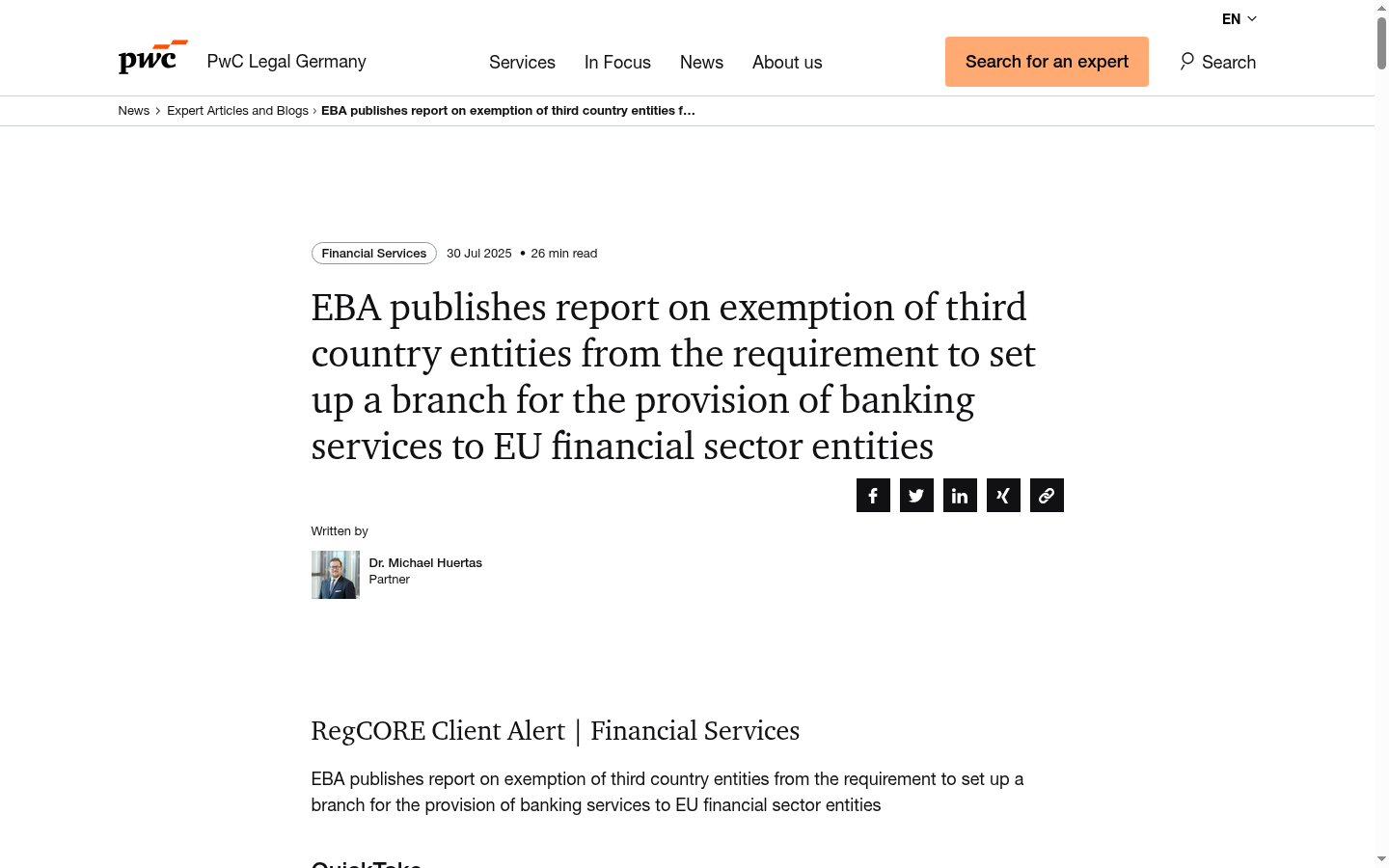
Firms hoping for wider carve-outs should not wait. In July 2025 the European Banking Authority said it did not recommend that the Commission pursue a legislative proposal to broaden the exemptions, finding the existing ones sufficient (Source: PwC Legal).
Grandfathering: Contracts Signed Before 11 July 2026
Contracts concluded before 11 July 2026 can keep running without a branch. That protection belongs to the contract, not the client relationship, and it can be lost if a facility is amended in a way that adds or preserves future drawings (Source: Zitadelle).

- Safe: Fully drawn loans that run to maturity without material changes.
- At risk: Undrawn commitments, term extensions, new drawings and changes to the nature of a loan.
- Not covered: Any new contract signed on or after 11 July 2026.
Class 1 vs Class 2 Branches
Third-country branches are split into two classes. A branch is Class 1 if its EU assets reach €5 billion or more, if it takes certain retail deposits, or if its head office is in a non-equivalent country; all others are Class 2, and Class 1 faces stricter capital, liquidity, governance, booking and reporting rules (Source: Skadden).
| Requirement | Class 1 | Class 2 |
|---|---|---|
| Capital endowment | 2.5%, min €10m | 0.5%, min €5m |
| Liquidity in Ireland | 30 days plus LCR | 30 days |
| Reporting | Twice a year | Once a year |
The figures above are Ireland's, and other member states may differ. In Ireland a branch must also be run by at least two people locally, keep a local booking record, and can be told to convert into a subsidiary if its Irish assets reach €10 billion or its EU branch assets reach €40 billion (Source: William Fry).
Branch or Subsidiary?
- Third-country branch: Authorised member state by member state. Access is generally limited to that state, so serving several markets may need several branches.
- EU subsidiary: A fully licensed EU bank that can passport across the EU, but with full capital and prudential requirements.
- Exit or restructure: Some firms will move EU clients to an existing EU affiliate or stop serving them.
Authorisation takes time. Projects commonly take 12 to 18 months (Source: Zitadelle), which means a firm starting now is unlikely to have a new branch licensed by January 2027.
National Differences
CRD VI sets a minimum, and member states are filling in the details differently. Germany's waiver route for third-country firms falls away, France overlaid the rule on its existing banking monopoly by ordinance in April 2026, and Luxembourg rewrote its branch regime in a law of 5 May 2026 (Source: The Industry Spread).

- Germany: Branch authorisation is required under the German Banking Act, and the regulator can order a firm to wind down unauthorised business.
- France: Exemptions are expressly recognised, and the supervisor sets capital requirements case by case.
- Ireland: Ireland declined to treat branches like full subsidiaries but set firm capital and liquidity floors.
- Luxembourg: Authorisation and prudential rules are aligned with the directive, with fines and licence withdrawal as sanctions.
What It Means for Fintechs and Crypto Firms
Article 21c targets banking activity, not payments or crypto services. EU payment institutions, e-money institutions and crypto-asset service providers keep their own licences, as covered in our report on MoonPay's EMI licence and our GENIUS Act and MiCA tracker.
The rule matters for non-EU firms that take deposits or lend. A US fintech with a bank charter, one of those listed in our OCC charter tracker, would need an EU branch or subsidiary to offer deposits or loans to EU clients after January 2027.
It also affects where European fintechs and stablecoin issuers keep cash. EU firms that hold reserves or operating cash with non-EU banks need to check those banks can still serve them, alongside MiCA's reserve rules covered in our piece on MiCA bank deposit rules.
What to Do Before 11 January 2027
- Map EU clients: List every EU client receiving deposits, loans or guarantees, by member state.
- Check grandfathering: Identify contracts signed before 11 July 2026 and flag any planned amendments.
- Test exemptions: Document reverse solicitation, interbank and intragroup cases carefully.
- Choose a structure: Decide between a branch, a subsidiary, an existing EU affiliate or exit.
- Stop marketing: Remove EU-facing marketing that could defeat reverse solicitation.
- Watch national law: Track each member state's transposition, since some go beyond the directive.
What to Watch in 2027
- Enforcement: How supervisors treat firms that miss the 11 January 2027 deadline.
- Reporting: The first branch reports for the 31 March 2027 reference date.
- Equivalence: Which countries the Commission treats as equivalent, which affects branch classification.
- Governance rules: Revised EBA internal governance guidelines covering branches, due by the end of 2026.
- Late transposition: Member states still finishing their laws, and any that add stricter rules.
Conclusion
Stablecoin Insider follows the regulation that shapes Europe's financial plumbing, and CRD VI ends the era when non-EU banks could serve EU clients freely from abroad.
From 11 January 2027, deposits, lending and guarantees for EU clients need a licensed branch, an EU subsidiary or a narrow exemption, and grandfathering already stopped for new contracts in July 2026.
Branches will be classified, capitalised and supervised country by country, with Ireland setting capital endowment at 2.5% for the largest branches.
For non-EU banks and the fintechs that rely on them, the weeks before the deadline are for mapping clients, protecting legacy contracts and choosing a structure.
Read Next
These three guides go deeper on European financial regulation and what it means for fintech and stablecoin firms in 2026.
- South Korea's Won Stablecoin Rule: Why Banks May Need 50% Plus One Share
- Best Apps to Buy Anthropic Stock (ANT) in 2026: 6 Brokers Compared
- Social Security Cuts: Will Benefits Be Cut in 2032, and by How Much?
FAQs
1. What is the CRD VI third-country branch rule?
The CRD VI third-country branch rule is Article 21c of the sixth Capital Requirements Directive. It requires banks based outside the EU to use an authorised EU branch or subsidiary to provide core banking services such as deposits, lending and guarantees to EU clients from 11 January 2027, unless an exemption applies.
2. When does the CRD VI branch requirement apply?
The CRD VI branch requirement applies from 11 January 2027. Contracts signed before 11 July 2026 are grandfathered as long as they are not materially changed, and the first supervisory reporting date for third-country branches is 31 March 2027.
3. Does reverse solicitation still work under CRD VI?
Reverse solicitation still works under CRD VI, but only narrowly. The EU client must approach the non-EU bank on its own exclusive initiative, any marketing by the bank or its affiliates defeats the exemption, and it covers only the service the client requested.
4. What is the difference between Class 1 and Class 2 branches?
The difference between Class 1 and Class 2 branches is size and risk. Class 1 branches have EU assets of €5 billion or more, take certain retail deposits or have head offices in non-equivalent countries, and face stricter capital, liquidity and reporting rules than Class 2 branches.
5. Does CRD VI apply to fintechs and crypto firms?
CRD VI applies to fintechs and crypto firms only when they provide core banking services from outside the EU. EU payment, e-money and crypto licences are separate regimes, but non-EU firms that take deposits or lend to EU clients will need a branch, a subsidiary or an exemption.
Disclaimer: This content is provided for informational purposes only and does not constitute legal, financial, or compliance advice. Protocol versions, governance arrangements, and partner counts cited here reflect publicly announced milestones as of November 2026 and are moving quickly. Adoption figures come from vendor and foundation announcements with differing methodologies and should be treated as directional signals rather than guaranteed outcomes.