Table of Contents
James Li and Pursuit Li explain why the stablecoin economy's real bottleneck is velocity, not circulation, and why the path to fixing it runs through corporate treasury rather than payments.
As stablecoin circulation sets records and trillion-dollar projections multiply, most of the industry is still measuring the wrong thing.
But according to James Li, Founder and CEO of STABO, and Pursuit Li, the company's COO, the number that matters is not how many stablecoins exist. It is how many times they move through the real economy before someone converts them back to fiat. And today, that number is close to one.
In a conversation with Stablecoin Insider, the two explained why stablecoin acceptance breaks at the banking interface rather than at the merchant, why the off-ramp business they run today is deliberately built to make itself less necessary, and what a mid-sized company's treasury actually looks like in 2031 if STABO succeeds.
Payments Are a Transaction. Treasury Is a Relationship.
STABO describes itself as building infrastructure for stablecoin treasury, not stablecoin payments. For James Li, that distinction is commercial, not cosmetic.
A payment is a point-in-time action, and payment companies monetize it one transaction at a time. Treasury is what an organization does with its money across the entire lifecycle: where liquidity is held, how balances move between entities, how idle funds are deployed, how working capital is financed.
"A company does not stop having financial needs the moment a payment settles. It still has to retain operating liquidity, convert part of the balance, deploy surplus capital, and fund growth." - James Li, CEO of STABO.
Two shifts make this urgent now, James Li argues. Modern businesses operate through multiple legal entities, and their harder problem is moving capital between their own approved companies, not paying third parties. And as adoption grows, businesses will start holding stablecoin balances rather than treating them as a transit vehicle. Once those balances become material, managing them stops being a payments question.
"Payments monetise transactions. Treasury creates recurring engagement around balances, liquidity and the customer's ongoing financial operations. We would rather earn the second relationship." - James Li, CEO of STABO.
STABO Pay, the company's first product, is the entry point into that relationship. Financing, liquidity deployment and spending products are extensions of it, not parallel businesses.
Where Acceptance Actually Breaks
Asked where stablecoin acceptance fails first, at the vendor, the bank, or the auditor, Pursuit Li, who leads STABO's product, operations and regulatory execution, refuses the premise of a single break point. But in the Asian markets STABO serves, one constraint binds harder than the rest: the banking and compliance interface.
A company may be entirely willing to receive stablecoins. It still depends on bank accounts for payroll, tax and suppliers. When converted funds hit a corporate account, the bank may ask about source of funds, wallet history, counterparties and the underlying transaction. The payment can be delayed, reviewed, returned or withheld.
"Cash-flow reliability matters more to a finance team than the theoretical speed or cost advantage of the rail. If a receipt earmarked for payroll is held for review, the damage propagates across the entire cash cycle. A rational CFO will decline stablecoin payments rather than accept that risk, not because they object to the technology, but because the downside is asymmetric." - Pursuit Li, COO of STABO.
Pursuit Li places the auditor further downstream, and points to an irony he thinks the industry avoids saying plainly: many banks participate publicly in tokenization consortia while their commercial banking desks remain deeply conservative when an ordinary mid-sized customer receives stablecoin-linked funds. Even in 2026, institutional experimentation and day-to-day treatment are two different worlds.
"Our role is not to persuade vendors to accept stablecoins. It is to make stablecoin liquidity usable: a controlled path for receipt, screening, conversion and settlement, so that a business can participate without putting its ordinary cash flow at risk." - Pursuit Li, COO of STABO.
The Number That Matters Is Velocity, Not Circulation
Stablecoin circulation sits around 310 billion dollars, and James Li notes Citi has projected 1.9 trillion by 2030. He treats those figures as directional rather than something anyone should underwrite, because a large float can exist without ever moving repeatedly through real commerce.
His diagnosis is the sharpest idea in the conversation: today, almost all B2B stablecoin activity is a one-leg flow.
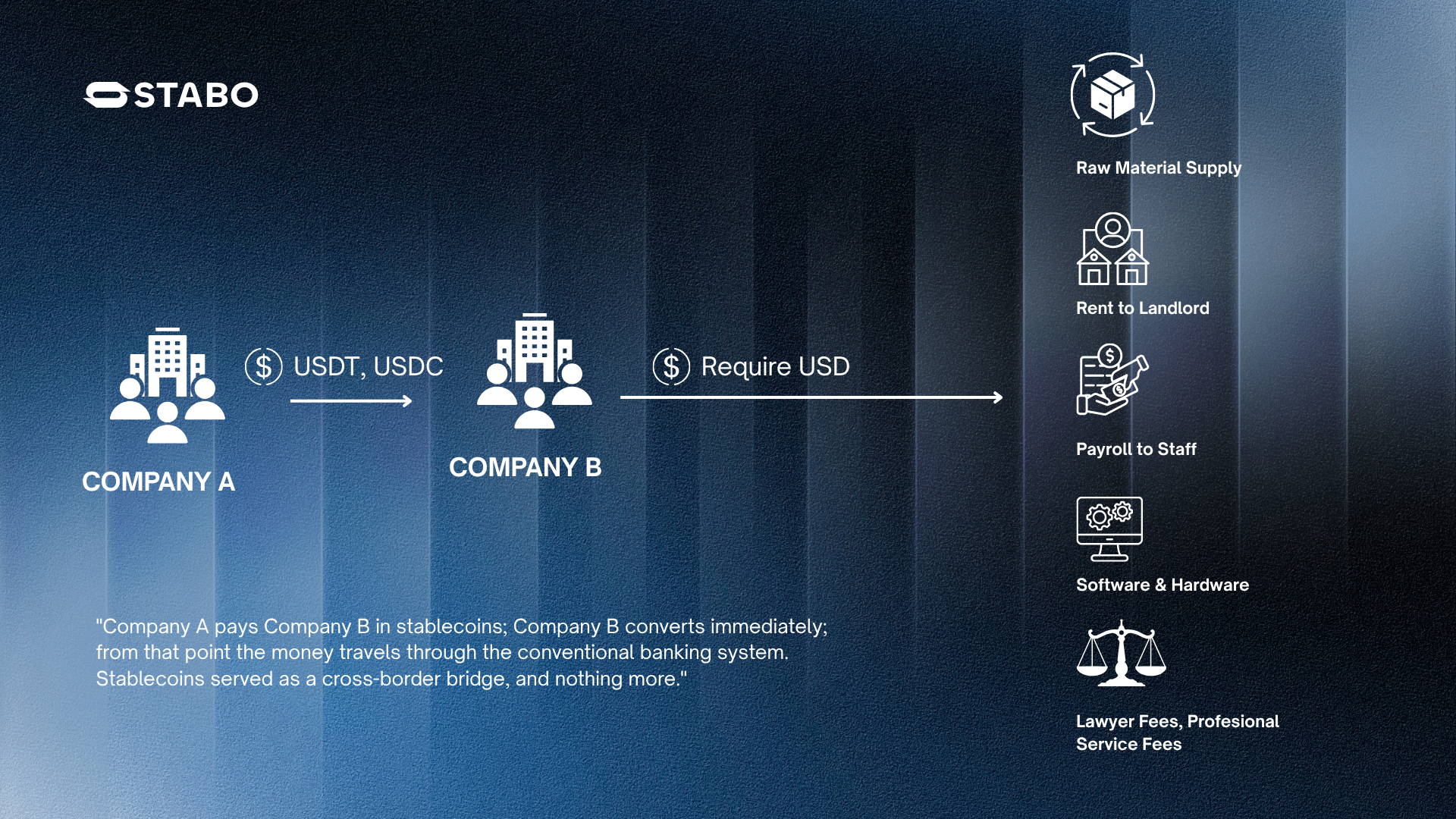
"Company A pays Company B in stablecoins; Company B converts immediately; from that point the money travels through the conventional banking system. Stablecoins served as a cross-border bridge, and nothing more." - James Li, CEO of STABO.
The medium becomes genuinely circulating only when flows turn multi-leg: A pays B, B pays C, C pays D, and the liquidity stays on stablecoin rails throughout. The obstacle is game-theoretic. Every participant decides based on the expected behavior of the next one, and each conversion is individually rational while collectively destroying velocity.
This, James Li argues, is where most projections are too optimistic. Stablecoins are already natural among Web3-native businesses, but no company operates inside a single industry. It pays rent to a property group, salaries to employees, fees to law firms. If those counterparties will not accept stablecoins, the chain terminates and the funds return to fiat.
"The operational condition is not that businesses can receive stablecoins. It is that they can receive them with reasonable confidence they will be able to spend them again." - James Li, CEO of STABO.
Building the Off-Ramp Without Betraying the Thesis
That diagnosis raises an awkward question, and James Li does not dodge it: STABO Pay's value today is converting stablecoins into fiat, which is exactly the one-leg behavior he just described as the problem.
"STABO bridges into fiat today so that businesses can participate in stablecoin commerce at all. As acceptance expands, we intend to help those businesses retain, reuse and optimise a growing share of that liquidity." - James Li, CEO of STABO.
Pursuit Li lays out the four-stage progression the product is built around. Today: receive, screen, convert, settle into the customer's existing account. Next: retain part of the balance once the customer has a reason to hold it safely. Later: reuse those balances for suppliers and subsidiaries willing to receive them. Eventually: manage stablecoin and fiat liquidity as a single treasury environment, allocated by policy rather than habit.
The commercially important point, James Li adds, is that the off-ramp is not a detour from the strategy. It is customer acquisition.
"Every conversion we process today tells us something about a business that will be relevant when that business is ready to stop converting." - James Li, CEO of STABO.
Adding a Channel, Not Transforming a Finance Team
What does a finance team need to change internally before STABO Pay works for them? Pursuit Li's answer: almost nothing, by design.
"The customer is not undergoing a digital-asset transformation. It is adding a collection channel." - Pursuit Li, COO of STABO.
The typical trigger is narrow. A prospective customer wants to pay in stablecoins; the merchant cannot receive them; the merchant either asks for another method or loses the business. STABO opens that channel, absorbing the receipt, screening, conversion, settlement and record-keeping, and delivering funds through a structure that fits the merchant's existing operation.
Pursuit Li is equally clear about what this is not.
"This is not a no-questions-asked service. The depth of information is risk-based. Our intention is that onboarding is more proportionate and faster than conventional banking onboarding, not that it is lighter in substance." - Pursuit Li, COO of STABO.
Customers complete KYB and beneficial-ownership verification, explain their business model and expected activity, and identify the receiving entity and authorized personnel. STABO Pay is being prepared for a targeted Q3 2026 go-live, and Pursuit Li is careful to frame everything he describes as the product's design at launch, not volume being processed today.
Three Entry Points, One Honest Ranking
STABO has named three entry points: Web3-to-fiat business spend, platform-embedded payments, and high-friction corridors such as Nigeria and Latin America.
Converting fastest today is Web3-to-fiat spend, because the customer already holds stablecoins and the need is urgent. Largest by 2029, James Li believes, will be platform-embedded payments, where a single integration serves a platform's entire merchant base. Then he adds a caveat most founders would not volunteer:
"I should be honest about the confidence level. That is a strategic judgement based on how distribution has worked in payments historically, not a conclusion we have yet proven with a portfolio of live platform integrations." - James L, CEO of STABO.
High-friction corridors sit differently, Pursuit Li explains. The economic value of stablecoins is most obvious there, and STABO has established operational access to African payment corridors. But strong demand does not make a corridor easy to serve, and he calls the assumption that one product deploys uniformly across emerging markets the most common mistake in the category.
On concrete footing today: STABO has operational access across Asian, Middle East, African, European and North American corridors, active customer engagements including direct customers in the Middle East and payment platforms in Hong Kong, and regulatory coverage being built across its principal markets, including planned payments and virtual-asset license applications in the Middle East and coverage being pursued or evaluated in Hong Kong, Singapore, Malaysia and North America.
Pursuit Li stresses these are applications in progress and planned coverage, not authorizations already granted.
What Makes a Bank Say Yes in 2026
Banking access has historically been the choke point for crypto-adjacent payment businesses. Pursuit Li splits the question in two, and says companies that conflate the halves tend to lose the relationship six months after opening it.
Establishing the relationship comes down to regulatory clarity. A license does not guarantee banking access, but it gives the bank a defined perimeter: which entity holds the customer relationship, what it is authorized to do, and how responsibility divides between STABO, its banking partners, liquidity providers and custodians.
"That is the difference between a discussion and a decline." - Pursuit Li, COO of STABO.
Keeping the relationship depends on the quality of the flows, because banks assess continuously, not once at onboarding.
"No stablecoin flow should reach a banking partner as an unexplained crypto transaction. It should be attributable, commercially documented, risk-screened and explainable before it enters the banking system." - Pursuit Li, COO of STABO.
Pursuit Li is careful not to oversell what that achieves. It does not make blockchain-linked funds risk-free, and he says he would distrust anyone claiming otherwise. It ensures the risk is identified and documented before the funds reach the bank rather than arriving as an exposure to investigate after the fact.
Asked why STABO is more likely to execute than the dozen other teams assembling stablecoin infrastructure, James Li declines the invincibility framing and names three things that are hard to acquire quickly: regulatory and licensing execution, banking relationships built on more than twenty years of senior banking leadership including managing-director level experience, and an operator team that is not learning financial infrastructure for the first time on this company's balance sheet.
"I would not describe them as a moat today. I would describe them as the things we think are worth being three years ahead on, in a market where the technology itself will not be a differentiator for long." - James Li, CEO of STABO.
The Roadmap Everyone Claims and Few Survive
STABO's roadmap runs payments, then financing, then yield, then cards. Most fintechs claim that sequence; Airwallex, Square and Payoneer are among the few that executed it. What breaks for the rest?
"What breaks is the connection between the products. The mistake is treating the roadmap as a collection of adjacent features rather than a progression of capabilities." - James Li, CEO of STABO.
Payments create the customer relationships and data that make responsible financing possible, James Li explains. Balances make liquidity deployment meaningful. Cards let customers spend those balances. But each stage introduces a different category of risk, and while distribution carries across products, risk-management capability does not.
What distinguished the companies that succeeded, in his reading, was discipline about preconditions: each expansion was supported by an existing flow, a real dataset and the licenses to deliver it. The companies that failed generally launched the next product because the deck said so.
"The strategic sequence is deliberate, but the timing and form of each expansion are milestone-driven. Each layer must earn the right to be built." - James Li, CEO of STABO.
James Li adds that yield is not optional for a treasury company, but its form may involve regulated partners rather than STABO manufacturing every instrument itself.
What Enterprises Keep Getting Wrong
Four misconceptions come up in almost every first meeting, Pursuit Li says.
That stablecoins are simply cheaper international wires: the durable advantage is programmability and continuous settlement, and a company adopting them purely for the fee saving will be disappointed on some corridors. That receiving a stablecoin solves the payment problem: a balance you cannot operationalize is not working capital. That all stablecoin activity is inherently high risk:
"A well-controlled corporate stablecoin payment can be more transparent and more traceable than a good deal of conventional correspondent banking activity. The generalisation is doing a lot of damage to legitimate businesses." - Pursuit Li, COO of STABO.
And that this is a binary choice between banking and stablecoins. The practical model is a connected treasury in which fiat accounts, stablecoin balances and payment networks operate together.
Treasury in 2031
If STABO succeeds entirely, what does a mid-sized global company's treasury look like in 2031? Not all-stablecoin, James Li says flatly, and he would treat anyone forecasting that as unserious.
"My own estimate, and I would present it as judgement rather than analysis, is that something in the range of 10 to 20 percent of transaction-ready balances might be held or moved through stablecoin rails." - James Li, CEO of STABO.
The exact figure matters less than the change in behavior: stablecoins stop being an exception requiring a special internal discussion and become one recognized component of treasury infrastructure alongside deposits and short-term liquidity instruments. Capabilities that historically required multinational banking infrastructure, group-wide liquidity visibility, multi-entity settlement, automated balance sweeping, come within reach of companies that could never build them.
AI belongs in this picture too. Stablecoins make corporate liquidity programmable; AI can make decisions about that liquidity more intelligent; STABO's role is to be the controlled execution layer between the two. By 2031, a finance team might express treasury policy through natural-language instructions, quantitative limits and formal approval controls, with AI assisting on forecasting, sweeps, rail selection and reconciliation.
Pursuit Li attaches three qualifications the pair explicitly do not want edited out: agentic payments are early and their maturity should not be overstated; AI must operate inside permissions, limits and approval frameworks, with material transactions subject to human authorization; and none of this involves giving an AI unrestricted control over corporate funds. It is a design posture for a future state, not a product shipping this year.
"If we succeed, a mid-sized global company's treasury in 2031 is not defined by whether it is a crypto company. It is defined by its ability to manage fiat and on-chain liquidity as one coordinated environment." - Pursuit Li, COO of STABO.
If James and Pursuit are right, the stablecoin economy's defining metric will quietly change from how much money sits on-chain to how far it travels before it leaves. And the companies that win will be the ones that built the boring, bankable plumbing that let it keep moving.
About STABO
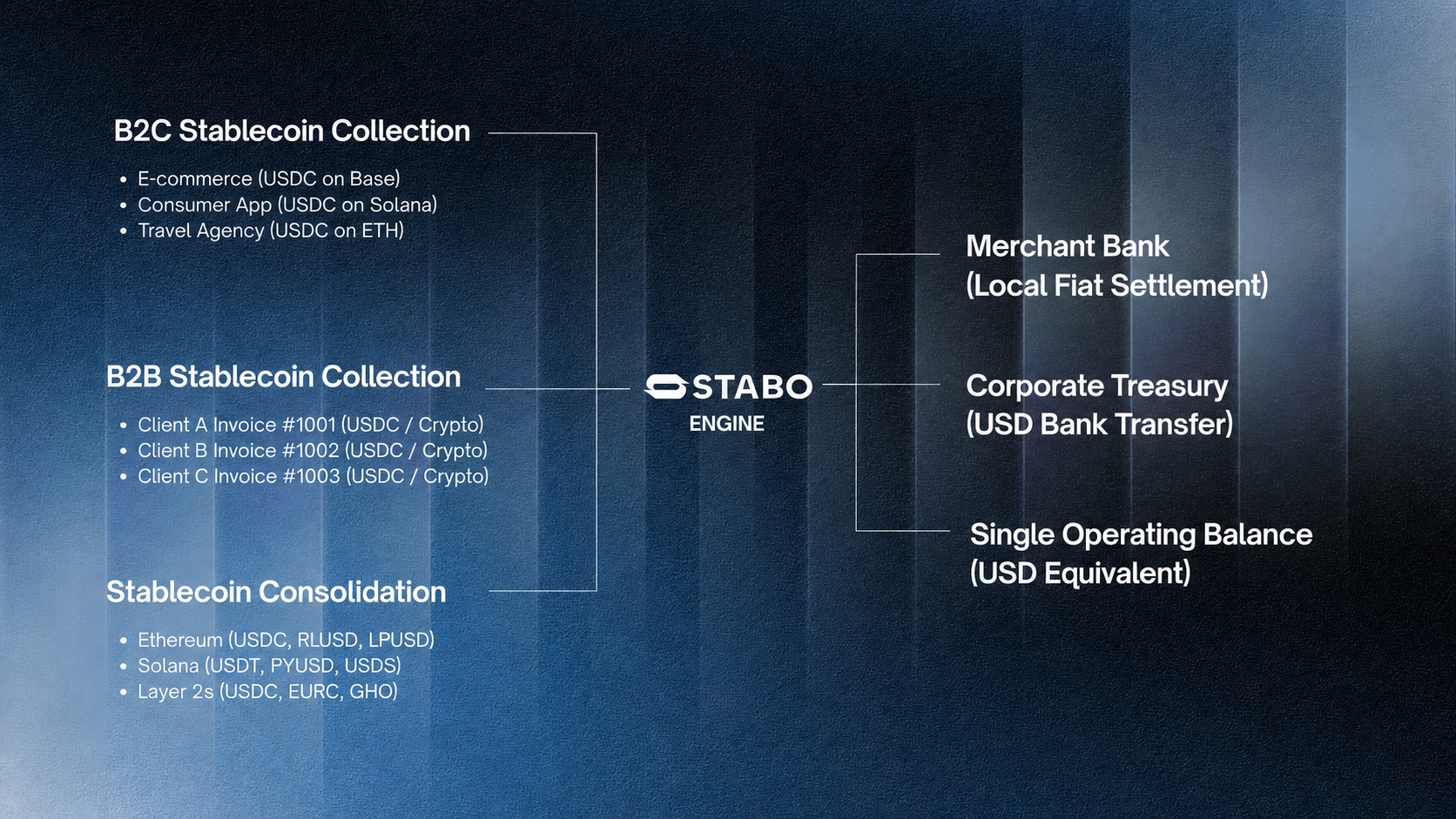
STABO is creating the global infrastructure for Stablecoin Treasury: how a business collects, holds, moves, deploys, and finances its money. The company begins with STABO Pay, a B2B stablecoin payments platform, then expands into financing, yield, cash management, and cards, helping businesses manage more of their stablecoin treasury through one trusted partner.
About Stablecoin Insider
Stablecoin Insider is the leading media and research platform covering stablecoins, digital payments, on-chain finance, treasury infrastructure, and the evolving global financial system. The publication focuses on enterprise adoption, fintech innovation, banking transformation, and the broader stablecoin ecosystem.