
Table of Contents
The best Premium Bonds alternatives in November 2026 are NS&I's own Direct ISA for a guaranteed, tax-free 4.05% with the same Treasury backing, NS&I's 1-year Guaranteed Growth Bond at 4.99% fixed for money you can lock away, and NS&I Direct Saver for balances above the Premium Bonds and ISA limits (NS&I interest rates). If you want to keep a prize draw, Chip's Prize Savings Account, the Family Building Society Windfall Bond and credit unions' PrizeSaver each run one with different trade-offs.
Interest in alternatives jumped after NS&I confirmed on 17 November 2026 that a technical error in May sent duplicate Premium Bonds prize payments, about £518,000 in total, to around 3,500 Direct Saver accounts, and that it had reversed most of them (The Independent). The product itself has not changed: Premium Bonds pay no interest, and NS&I says they are not for savers who want guaranteed returns (NS&I).
Last updated: 19 November 2026. Rates, prize draws and limits re-checked against NS&I, Chip, Family Building Society, PrizeSaver, FSCS, Bank of England and GOV.UK pages on this date. Figures are in pounds sterling (£) for UK savers.
Key Takeaways
- Premium Bonds' prize fund rate is 4.35% with odds of 21,000 to 1 per £1 Bond each month, both variable, from the September 2026 draw (NS&I).
- NS&I raised its Direct ISA to 4.05% and Direct Saver to 4.00% on 19 November 2026, from 3.80% and 3.75% (NS&I historical rates).
- 98.7% of the 6,575,175 prizes in the November 2026 draw were worth £25, £50 or £100 (NS&I prize allocation). On £10,000, those small prizes are worth about £348 a year on average, below the guaranteed £405 to £499 at NS&I's ISA and fixed bond (worked example).
- NS&I products are 100% backed by HM Treasury (NS&I). Bank, building society and credit union alternatives are covered by the FSCS up to £120,000 per person per firm (FSCS).
- Chip publishes better past odds than Premium Bonds but no interest, and 14,400 of its 15,021 November prizes are £5 (Chip).
Premium Bonds alternatives compared
The table compares Premium Bonds with six alternatives on return, access and protection. Every row links to the provider page it was read from on 19 November 2026.
| Option | Best for | Return as read 19 Nov 2026 | Limits and access |
|---|---|---|---|
| Our pick: NS&I Direct ISA | Treasury backing with a guaranteed, tax-free rate | 4.05% tax-free/AER, variable (NS&I) | £1 to £20,000 in 2026/27; no notice or penalty (NS&I) |
| Reference: NS&I Premium Bonds | Tax-free prize draw with easy access | 4.35% prize fund rate, no interest; 21,000 to 1 per £1 Bond (NS&I) | £25 to £50,000; no notice or penalty (NS&I) |
| NS&I Guaranteed Growth Bond (1 year) | Lump sums you won't touch for a year | 4.99% gross/AER, fixed, taxable (NS&I) | £500 to £1 million per Issue; no early access (NS&I) |
| NS&I Direct Saver | Large balances above the bond and ISA limits | 4.00% gross/AER, variable, taxable (NS&I) | £1 to £2 million; no notice or penalty (NS&I) |
| Chip Prize Savings Account | A prize draw with better past odds | No interest; November prizes £5 to £10,000 (Chip) | £10 to £85,000; app only; FSCS via ClearBank (Chip) |
| Family Building Society Windfall Bond | Interest plus a draw with a £50,000 top prize | 2.75% gross/AER, 3.00% from 1 Dec 2026, plus prizes (Family BS) | Exactly £10,000 per bond; 35 days' notice to close (Family BS) |
| PrizeSaver (credit unions) | Small savers who want a £3,000 top prize | Prize draw: 45 prizes worth £5,700 a month (PrizeSaver) | £1 to £200; credit union membership needed (PrizeSaver) |
Two patterns stand out. NS&I's guaranteed products now pay close to, or above, the Premium Bonds prize fund rate, so the main reason to stay in Premium Bonds is the chance of a large prize. And every prize-based alternative swaps Treasury backing for the FSCS's £120,000 limit per firm (FSCS).
Why are people looking for Premium Bonds alternatives?
People are looking for Premium Bonds alternatives because the prize error put NS&I in the news while its own guaranteed rates were rising. The Independent reported on 17 November 2026 that around £1,600 of the duplicated May payments was still outstanding (The Independent).
The same report noted a separate problem: NS&I failed to trace some accounts of customers who had died. It estimated that just under 30,300 estates, with up to £181.9 million, may be affected, had paid more than £3 million to 613 estates, and expects to finish its compensation scheme in the first half of 2027 (The Independent). Neither issue changes the Treasury backing on Premium Bonds (NS&I).
Rates are the other trigger. The Bank of England raised Bank Rate to 4% on 5 November 2026, with its next decision due on 17 December 2026 (Bank of England). On 19 November NS&I raised its variable rates on Direct ISA, Direct Saver and Income Bonds (NS&I).
How much would £10,000 earn in Premium Bonds vs the alternatives?
£10,000 in Premium Bonds earns £435 a year on average at the 4.35% prize fund rate, but about £348 of that comes from £25 to £100 prizes. The rest depends on rarely winning a prize of £500 or more. We compared that with the guaranteed alternatives.
Assumptions: £10,000 held for 12 months with no withdrawals; rates stay at the levels read on 19 November 2026; all 12 monthly draws count (new Premium Bonds and Windfall Bonds miss their first one or two draws); figures are before tax. Windfall Bond uses the 3.00% rate due from 1 December 2026 plus its average prize fund. Chip and PrizeSaver are left out because neither publishes the number of entries, so no average can be calculated.
| Option | Return on £10,000 | Certainty | Tax |
|---|---|---|---|
| NS&I 1-year Guaranteed Growth Bond | £499 | Fixed | Taxable above your allowance |
| Premium Bonds, average of all prizes | £435 | Average, not guaranteed | Tax-free |
| NS&I Direct ISA | £405 | Variable rate | Tax-free |
| NS&I Direct Saver | £400 | Variable rate | Taxable above your allowance |
| Windfall Bond, interest plus average prizes | £400 (£300 + £100) | Interest variable; prizes not guaranteed | Interest taxable |
| Premium Bonds, £25 to £100 prizes only | £348 | Average, not guaranteed | Tax-free |
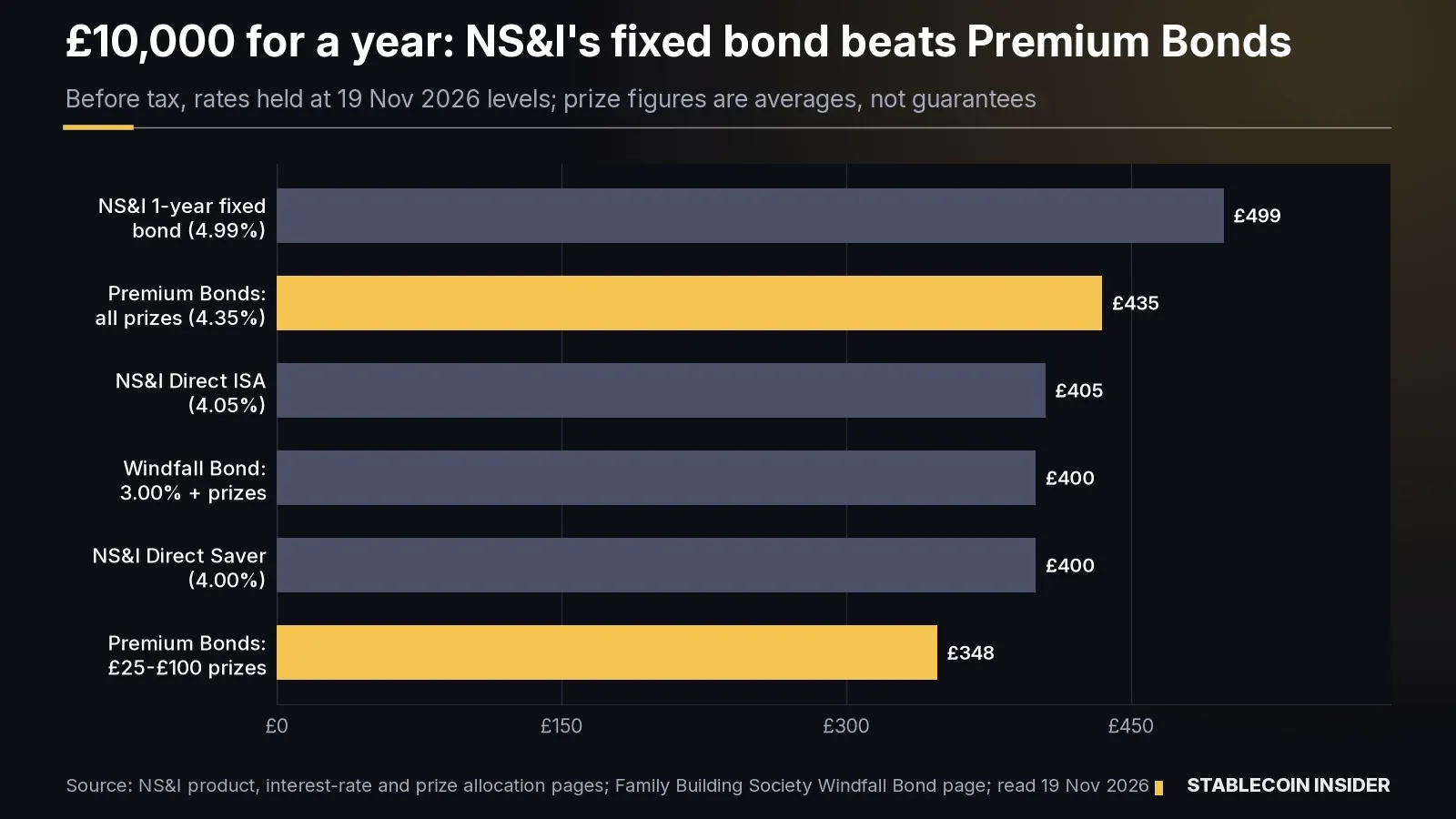
Here is how the Premium Bonds figures work. At 21,000 to 1, £10,000 of Bonds gets about 5.7 prizes a year on average (NS&I). The £25, £50 and £100 prizes take 80% of the prize fund (NS&I), so they account for 80% of the 4.35% rate, or £348. The Windfall Bond's prize fund is 1% a year of deposits, paid out as one-twelfth each month, which averages £8.33 per £10,000 bond per draw (Family Building Society).
Tax narrows the gaps for some savers. Basic-rate taxpayers can earn £1,000 of interest a year tax-free, higher-rate taxpayers £500 and additional-rate taxpayers nothing, so an additional-rate taxpayer pays Income Tax on all of the bond's interest but none on the ISA's (GOV.UK).
How likely are you to win nothing in a year?
How likely you are to win nothing in a year depends on how much you hold. Our estimate below applies NS&I's 21,000 to 1 odds to every £1 Bond in each of 12 draws (NS&I) and the November 2026 prize mix (NS&I).
| Holding | Average prizes a year | Chance of no prize in a year | Average from £25-£100 prizes |
|---|---|---|---|
| £1,000 | 0.6 | 56% | £35 |
| £5,000 | 2.9 | 6% | £174 |
| £10,000 | 5.7 | 0.3% | £348 |
| £50,000 (maximum) | 28.6 | Close to 0% | £1,740 |
Small holders feel the gap most. On £1,000, the chance of no prize at all in a year is about 56%, while NS&I's 4.05% Direct ISA would pay £40.50 (NS&I).
What are the best Premium Bonds alternatives?
The best Premium Bonds alternatives depend on whether you want certainty, a bigger prize, or the same government guarantee. Each option below lists who it suits, how it compares with Premium Bonds, and its drawbacks.
1. NS&I Direct ISA: best for keeping the Treasury guarantee
NS&I Direct ISA suits savers who like Premium Bonds' safety and tax-free status but want a known return. It pays 4.05% tax-free/AER, variable, on £1 to £20,000 in the 2026/27 tax year, with withdrawals online or by phone and no notice or penalty (NS&I). Like Premium Bonds, it is 100% backed by HM Treasury (NS&I).
Better than Premium Bonds: a guaranteed rate, with interest paid on every pound rather than only on winning Bonds. Worse: 4.05% is below the 4.35% average prize rate, it uses your ISA allowance, and NS&I says it is not a flexible ISA, so money withdrawn still counts towards the £20,000 (NS&I). The minimum age for a cash ISA is now 18 (NS&I).
2. NS&I Guaranteed Growth Bonds: best for a fixed return
NS&I Guaranteed Growth Bonds suit savers who can leave a lump sum alone for a fixed term. Issue 93 pays 4.99% gross/AER fixed for one year, and longer terms pay 5.07% (2 years), 5.10% (3 years) and 5.17% (5 years). You can invest £500 to £1 million per person in each Issue, jointly if you like (NS&I).
Better than Premium Bonds: the highest guaranteed NS&I return on our list, and above the average prize rate. Worse: you cannot get your money out before the term ends, and interest is taxable in the tax year the bond matures (NS&I).
3. NS&I Direct Saver: best for large balances
NS&I Direct Saver suits savers with more than the £50,000 Premium Bonds limit who still want Treasury backing and easy access. It pays 4.00% gross/AER, variable, on £1 to £2 million per person, with interest added each year on 1 April (NS&I). If you want a monthly income instead, Income Bonds pay 3.93% gross/4.00% AER from £500 (NS&I).
Better than Premium Bonds: a guaranteed rate and a much higher limit. Worse: interest is taxable once you exceed your Personal Savings Allowance (GOV.UK), and the account is managed online or by phone only (NS&I).
4. Chip Prize Savings Account: best for keeping a prize draw
Chip's Prize Savings Account suits savers who enjoy the draw and accept smaller prizes. It pays no interest. Each £10 of average monthly balance is one entry, from £10 up to £85,000, and the account is for UK tax residents aged 18 and over, through the app only (Chip; Chip FAQ). Deposits are held by ClearBank and covered by the FSCS up to £120,000.
November's draw has one £10,000 prize, 7 of £500, 73 of £100, 180 of £20, 360 of £10 and 14,400 of £5: £100,000 across 15,021 prizes (Chip). Chip guarantees only one £10,000 prize and 250 £10 prizes a month, and does not publish current odds. Its published past odds per £10 entry were 1 in 623 in September 2025 and 1 in 964 on average from January to September 2025 (Chip FAQ), against roughly 1 in 2,100 per £10 in Premium Bonds today, based on NS&I's 21,000 to 1 odds per £1 (NS&I).
Better than Premium Bonds: better past odds of winning something. Worse: no £1 million or £100,000 prizes, no Treasury guarantee, and prizes are paid as a bonus that becomes cash only when you withdraw your whole balance. Prizes are not FSCS protected until withdrawn and redeposited (Chip FAQ).
5. Family Building Society Windfall Bond: best for interest plus a draw
The Windfall Bond suits savers with £10,000 blocks who want both interest and a prize draw. It tracks Bank Rate minus 1%, so it pays 2.75% gross/AER now and 3.00% from 1 December 2026, and each bond enters a monthly draw for prizes from £100 to £50,000 (Family Building Society). The prize fund is 1% a year of the deposits entered, and each bond can win only one prize a month (Family Building Society).
Better than Premium Bonds: part of the return is interest you get whether or not you win, and the published prize formula averages £8.33 per bond per draw. Worse: each bond must be exactly £10,000, there are no top-ups or partial withdrawals, closing takes 35 days' notice, interest is taxable, and a new bond's first draw comes in the second calendar month after opening (Family Building Society; Family Building Society).
6. PrizeSaver: best for small savers
PrizeSaver suits people saving small amounts who want a shot at a prize. Each £1 held at the end of the month is one entry, up to 200 entries and £200. The monthly draw is worth £5,700 across 45 prizes: one of £3,000, ten of £100 and 34 of £50 (PrizeSaver).
Better than Premium Bonds: you can start with £1 rather than £25 (NS&I), and the draw is limited to members of 21 participating credit unions, with more than 25,000 active accounts in October 2026 (PrizeSaver). Worse: the £200 cap, you must join a participating credit union, you can hold only one PrizeSaver, and protection is FSCS up to £120,000 across all savings with that credit union (PrizeSaver).
How do you move money out of Premium Bonds?
You move money out of Premium Bonds by cashing in all or some of your Bonds online, by phone or by post, with no notice or penalty; payment takes 3 to 5 days to reach your bank (NS&I).
- Staying with NS&I: Direct ISA, Direct Saver and Guaranteed Growth Bond pages each link to a switching form for moving money from another NS&I account (NS&I; NS&I).
- Without an online account: NS&I lets you cash in with your holder's number and bank details (NS&I).
- Check your total per firm: outside NS&I, keep eligible deposits within £120,000 per banking licence (FSCS).
- Mind the draw timing: Bonds bought later wait a whole calendar month before entering a draw, so cashing in and buying back costs draws (NS&I).
Comparing Premium Bonds with a market-wide cash ISA? See our Premium Bonds vs cash ISA comparison. If you are moving your current account as well, see our guides to TSB alternatives and Metro Bank alternatives. For long-term money, our best UK pension providers list compares SIPP fees. And if you are curious how dollar stablecoin savings products work, and why they carry no FSCS cover, see stablecoin savings accounts.
This article is not part of a Stablecoin Insider hub: our hubs cover stablecoin regulation, payments, yield and AI agent payments, and none covers UK savings accounts.
FAQ
Are Premium Bonds still safe after the NS&I prize error?
Do I have to pay back a Premium Bonds prize paid in error?
Is there a penalty for cashing in Premium Bonds?
Will Premium Bonds rates change?
Can I have Premium Bonds and a cash ISA at the same time?
Verdict: which Premium Bonds alternative should you choose?
Choose NS&I Direct ISA if you want Premium Bonds' safety and tax-free status with a guaranteed 4.05%. Pick the 1-year Guaranteed Growth Bond at 4.99% for money you won't need for a year, and Direct Saver for large balances. Keep the prize-draw feel with Chip (better past odds, small prizes, no interest), the Windfall Bond (interest plus a draw, but £10,000 units and 35 days' notice) or PrizeSaver (up to £200). Stay in Premium Bonds only if the chance of a large prize matters more to you than a known return.
Sources: NS&I Premium Bonds, NS&I monthly prize allocation, NS&I interest rates, NS&I historical interest rates, NS&I Direct ISA, NS&I Direct Saver, NS&I Income Bonds, NS&I Guaranteed Growth Bonds, NS&I about us, The Independent, 17 November 2026, Chip Prize Savings Account, Chip: what is the Prize Savings Account, Family Building Society Windfall Bond, How the Windfall Bond works, PrizeSaver, FSCS protection checker, Bank of England: Bank Rate, GOV.UK: tax on savings interest; all read on 19 November 2026.
This content is provided for informational and educational purposes only and doesn't constitute financial, investment, legal or tax advice. Rates, prize draws, odds and limits were read on 19 November 2026, are mostly variable and may change; the worked example and win-probability figures are our estimates under stated assumptions, not forecasts or quotes. Prize-linked products do not guarantee any return. Organisations and products mentioned: NS&I (National Savings and Investments), Chip Financial Ltd, ClearBank, Family Building Society, PrizeSaver and participating credit unions, Financial Services Compensation Scheme (FSCS), Bank of England, HM Revenue and Customs.