Table of Contents
1inch and CoW Swap are two of the best-known DEX aggregators, and both have moved away from simple swap routing. Each now lets professional market makers fill your order instead of you sending a transaction straight to a pool.
They get there in different ways. 1inch runs Dutch auctions where resolvers usually pay your gas, while CoW Swap groups orders into batch auctions that keep trades out of the public mempool.
This comparison covers fees on stablecoin swaps, how each handles MEV, order types, chains and security records, and which one fits which kind of trade.
For stablecoin swaps, both charge little or nothing up front. The real difference is what happens to any price improvement: 1inch keeps the surplus, CoW Swap splits it with you.
Key Takeaways
- CoW Swap charges a 0 bps volume fee on stablecoin pairs.
- 1inch apps charge 0 to 5 bps on stablecoin pairs.
- 1inch keeps surplus; CoW Swap keeps half the improvement.
- 1inch covers more networks, including Solana and Monad.
- CoW Swap's batch auctions offer stronger MEV protection.
Quick Comparison
| Feature | 1inch | CoW Swap |
|---|---|---|
| Default execution | Fusion Dutch auction | Batch auction |
| Who fills orders | Up to 10 staked resolvers | Competing solvers |
| Fee on stablecoin pairs | 0 to 5 bps | 0 bps volume fee |
| Price improvement | Surplus kept by 1inch | 50% kept, capped at 0.98% |
| Gas | Usually paid by resolver | Recovered from the order |
| Networks | 18+ listed | Fewer, mostly EVM plus Solana |
| Extra order types | Limit orders, Terminal | Limit orders, TWAP |
Both are non-custodial, so funds stay in your wallet until the trade settles. Both also let you sign an order rather than send a swap transaction yourself.
What to note: fees on both sit inside the quote, so the amount received is the figure to compare.
How Each Fills Your Order
On 1inch, the default Swap mode uses Fusion. You sign an order, and its price starts high and falls over time until one of up to 10 approved resolvers fills it, or until it expires and you can resubmit at no cost.
CoW Swap collects signed orders into frequent batches. Independent solvers compete to settle each batch, and when two traders want opposite sides, CoW Swap can match them directly without touching a pool.
Our full 1inch review covers Fusion, Classic mode and resolvers in more detail.
What to note: 1inch Fusion usually fills faster, while CoW Swap batches can take a little longer to settle.
Fees on Stablecoin Swaps
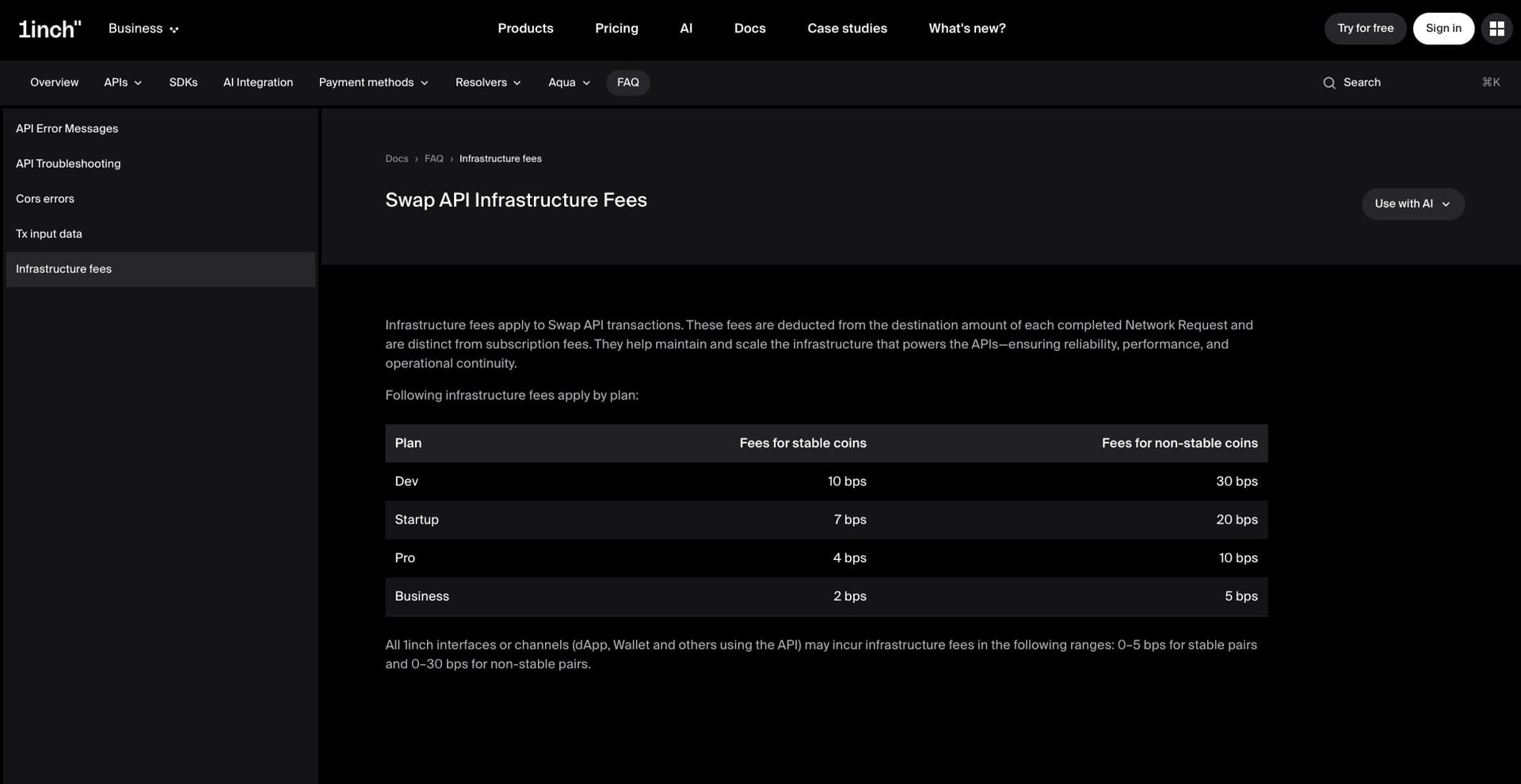
1inch charges an infrastructure fee of 0 to 5 bps on stablecoin pairs in its own apps. In the default Swap mode, the resolver covers that fee and the gas, and both are reflected in the rate you are quoted.
CoW Swap charges no protocol volume fee on stablecoin-to-stablecoin swaps and 2 bps on standard assets. Gas is recovered from the order rather than paid separately.
On a 10,000 dollar USDC to USDT swap, the 1inch infrastructure fee is at most about 5 dollars, and the CoW Swap volume fee is zero. In both cases, network costs are built into what you receive.
What to note: apps that embed either protocol can add their own fee, up to 1% on CoW Protocol.
What Happens to Price Improvement
This is where the two differ most. If a trade fills better than quoted, 1inch keeps the extra output, which it calls surplus and says is not a trading fee.
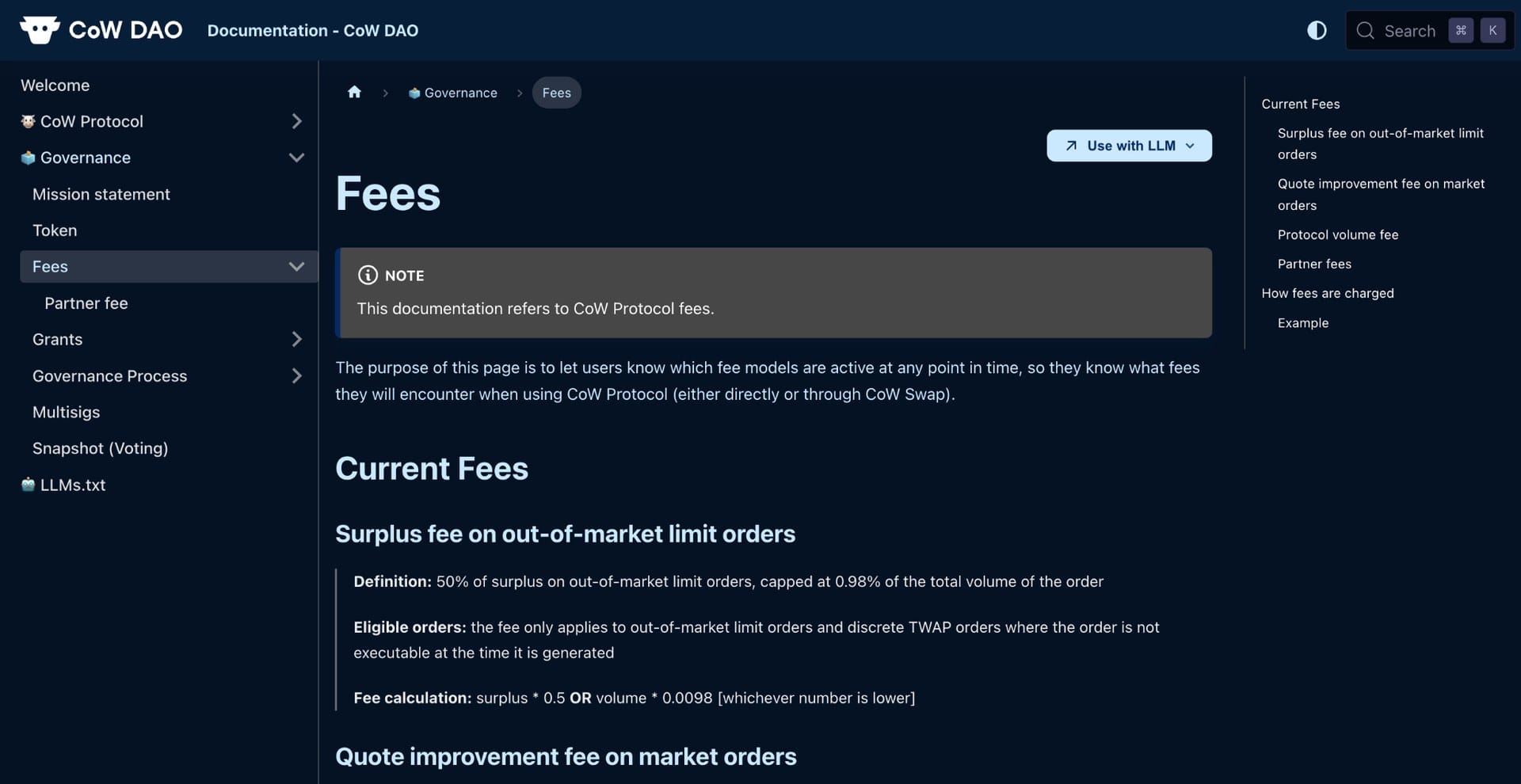
CoW Swap charges a quote improvement fee of 50% of any improvement, capped at 0.98% of volume. If a solver beats your quote by 5 dollars, you get 2.50 dollars extra and CoW Swap keeps 2.50 dollars.
Neither model ever gives you less than the amount you signed for. The difference is only in who gets the upside when the market moves in your favor.
What to note: on calm stablecoin pairs, improvements are usually small, so this matters most on large or volatile trades.
MEV Protection
Both designs keep your swap out of the public mempool, where bots look for trades to front-run or sandwich. On 1inch, resolvers execute and pay for the trade, which limits front-running.
CoW Swap goes further by settling whole batches at once and matching opposite orders directly. Its whole design is built around avoiding MEV, and treasuries such as the Ethereum Foundation have used it for large conversions.
1inch's Classic mode, under the Pro interface, is a direct swap where you pay gas yourself. That mode trades some MEV protection for near-instant execution.
What to note: for large stablecoin trades on Ethereum, CoW Swap's batch model is the more protective choice.
Order Types and Chains
1inch lists 18+ networks, including Ethereum, Arbitrum, Base, BNB Chain, Solana, Sonic, Monad and HyperEVM. It also offers cross-chain swaps, limit orders and a Terminal for active traders.
CoW Swap offers Swap, Limit and TWAP orders. Since September 2026 TWAP works from any wallet, which suits treasuries splitting a large conversion over time.
CoW Swap launched on Solana in May 2026 and advertises cross-chain swaps, but most of its activity is still on Ethereum. Our CoW Swap review covers its chains and order types in full.
What to note: neither lists Tron, so USDT on Tron needs another route.
Security Records
- 1inch, March 2025: about 5 million dollars taken through outdated Fusion v1 code in resolver contracts. 1inch said user funds were not affected.
- 1inch, May 2026: independent liquidity provider TrustedVolumes lost about 5.87 million dollars from its own contract. 1inch said its systems were not affected.
- CoW Swap, April 2026: attackers hijacked the swap.cow.fi domain. CoW DAO paused its backend, and coverage reviewed did not report confirmed losses.
The 1inch incidents hit market makers behind the gasless model, while the CoW Swap incident hit the website, not the contracts. Each points to a different layer of risk.
What to note: bookmark the official site and keep token approvals limited on both platforms.
Which One to Use
- Large stablecoin swaps on Ethereum: CoW Swap, for its zero stablecoin volume fee and batch-auction MEV protection.
- Swaps without holding gas: 1inch, since Fusion resolvers usually pay the gas.
- Swaps on Solana, Monad or newer chains: 1inch, for wider network coverage.
- Treasury conversions over time: CoW Swap, for TWAP orders from any wallet.
- Active trading tools: 1inch, for its Terminal and limit orders.
For other options on stablecoin pairs, see our list of DEX aggregators for stablecoins.
What to note: for any trade above a few thousand dollars, get a quote from both and compare the minimum received.
How This Comparison Was Done
Facts come from 1inch's and CoW DAO's websites, help centres and documentation, read on 17 November 2026 for our reviews, plus news coverage of past incidents. No trades were executed for this comparison.
Volume figures are company claims. Fee rates come from published documentation and can change through updates or governance votes.
What to note: live quotes can differ from published fee ranges, so check both apps on the day you trade.
Risks and Limitations
- Fees on both platforms are built into quotes and are harder to see.
- 1inch keeps surplus, which works like a fee on trades that fill well.
- CoW Swap batches can be slower than a direct swap.
- Resolver contracts and front ends have both been attacked before.
- Third-party apps using either protocol may add their own fees.
Conclusion
For stablecoin swaps, 1inch and CoW Swap are close on cost, and both protect you from the worst MEV. CoW Swap wins on stablecoin fees and MEV design, while 1inch wins on network coverage and gasless swaps.
The deciding factor is often price improvement. If you want a share of any upside, CoW Swap splits it, while 1inch keeps it.
The practical approach is simple: check both quotes and pick the higher amount received.
Read Next:
- 1inch Review 2026: Fees, Fusion Swaps, Safety and How It Handles Stablecoins
- CoW Swap Review 2026: Fees, MEV Protection, Batch Auctions and Stablecoin Swaps
- Best DEX Aggregators for Stablecoin Swaps in 2026, Ranked
FAQs:
1. Is 1inch or CoW Swap cheaper for stablecoins?
CoW Swap charges a 0 bps volume fee on stablecoin pairs, while 1inch apps charge 0 to 5 bps. CoW Swap does keep half of any price improvement, so compare the amount received on both.
2. Which has better MEV protection?
Both keep swaps out of the public mempool. CoW Swap's batch auctions and direct order matching give it the stronger MEV protection, especially for large trades.
3. Do I need gas to swap on 1inch or CoW Swap?
On 1inch's default Swap mode, resolvers usually pay the gas. On CoW Swap, gas is recovered from your order, so you do not need a separate gas payment for most swaps.
4. Which supports more chains?
1inch lists 18+ networks, including Solana, Monad and HyperEVM. CoW Swap supports fewer chains and does most of its volume on Ethereum.
5. Have 1inch or CoW Swap been hacked?
Resolver and liquidity provider contracts tied to 1inch lost funds in 2025 and 2026, and CoW Swap's domain was hijacked in April 2026. 1inch said user funds were not affected, and coverage of the CoW Swap incident reported no confirmed losses.
Disclaimer:
This content is provided for informational and educational purposes only and does not constitute financial, investment, or legal advice; no material herein should be interpreted as a recommendation, endorsement, or solicitation to buy or sell any token, and readers should conduct their own independent research or consult a qualified professional. Fees, features and figures are drawn from 1inch's and CoW DAO's websites and documentation and from public reports at the time of writing, are not independently verified here, and may change. Swapping tokens carries smart contract, liquidity and market risks.