Table of Contents
In this interview Capital Layer's Founder and CEO, Justin Wang explains why stablecoin adoption in Asia will run through banks, not exchanges, and why the AI supply chain may become the biggest stablecoin use case nobody is talking about.
As stablecoin regulation sweeps across Asia, most of the conversation still centers on exchanges, wallets, and retail trading.
But according to Justin Wang, Founder and CEO of Capital Layer, the far larger opportunity sits somewhere much less glamorous: inside the banking systems of Japan and Taiwan, and inside the AI supply chain that runs through them.
In a conversation with Stablecoin Insider, Wang explained why banks, not exchanges, will dominate the next generation of stablecoin distribution, why they cannot get there without a localized orchestration layer, and why Taiwan's position at the heart of the global AI supply chain makes it one of the most strategically important stablecoin markets in the world.
From Cross-Border Payments to Banking Infrastructure
Wang's route into stablecoins was anything but theoretical.
A serial entrepreneur, he built and sold his first business, a VPN company in Dubai, before joining a Singapore payments startup as Chief Business Officer in 2019, building cross-border payment partnerships and enterprise clients until the company's acquisition in 2021. It was there that clients began asking to settle in crypto: Zcash, altcoins, "all the dino tokens you can imagine."
After the acquisition, he moved back to Taiwan and went deep into the Solana ecosystem, building and eventually exiting a protocol business.
But after years in Web3, he wanted to make an impact beyond crypto-native users.
"Our goal with Capital Layer is to build the orchestration layer for institutional banks: to shorten the gap to real stablecoin adoption, so that in the next two to three years, banks across APAC markets like Japan and Taiwan can send and receive stablecoins on behalf of their customers."
His underlying thesis is blunt: banks will lead institutional stablecoin distribution. What is missing is not demand or trust; it is infrastructure.
The Next Generation of Adoption Runs Through Banks
In the first era of crypto, wallets and exchanges were by far the best distribution channels for retail users to discover and trade digital assets.
Wang believes that era is ending.
"We are passing into the next generation of adoption. There is a natural trust leaning toward banks. That is how money has always been built. Enterprises trust banks, and they leverage banks as their service layer."
Regulatory clarity is the catalyst. With the GENIUS Act and CLARITY Act advancing in the US, Asian regulators are moving quickly to build compatible frameworks so their institutions can interact with regulated counterparts in the US and Europe.
That does not mean wallets and exchanges disappear. In Wang's view, they become enterprise-grade distribution partners, reaching international retail users that a local bank in Japan or Taiwan never could.
But the corridor back into the real economy will always be regulated banking.
"You cannot stop users from using offshore solutions. People in Asia still trade on unregulated exchanges. But if they want to be taxable, wire money back into a real account, buy real estate, or hold structured products, they still need the corridor from regulated banks. If you are a listed company in Japan or Taiwan, you cannot run your treasury through an offshore exchange."
Closing the Orchestration Gap
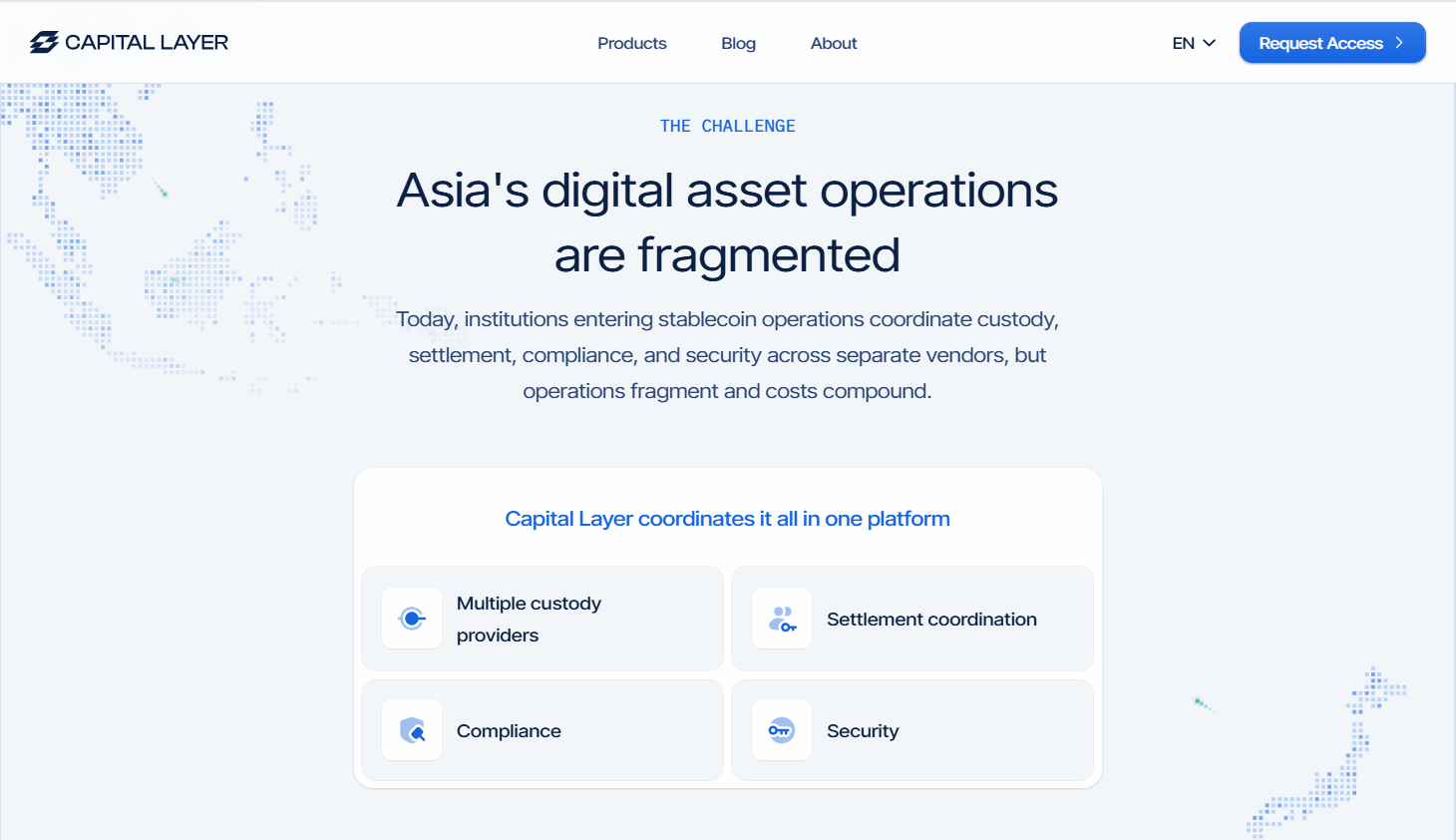
Before talking about solutions, Wang insists on naming the problem: the orchestration gap between custody, core banking, compliance, and AML systems.
An exchange can run with 30 or 40 people. A bank cannot.
"A bank has multiple departments, each with different regulations, different compliance requirements, and different software to de-risk and monitor flows. It is a complex operation on top of complex software, surrounded by legacy systems. And it is complex by design, to prevent fraud and protect users."
This is why, he argues, global vendors, from custody providers to infrastructure players like Fireblocks, struggle to sell directly into new Asian markets. Local regulators and banks ask uncomfortable questions: You have no local team. You have no local license. If something goes wrong, how do we reach you?
Capital Layer's answer is radical localization.
The company aggregates leading global vendors into a single platform, its Digital Asset Stacks (DAS), and deploys it locally, with code review and code escrow arrangements that allow governments or banks to take sovereignty over the software if anything goes wrong.
"To make the orchestration layer happen, you need to be localized. You cannot just sell custody to a bank and expect them to integrate it themselves. There has to be an orchestration layer that aggregates all these vendors into one platform, so multiple departments can operate effectively."
Every bank also has its own operational flows, which means heavy customization, communication, and integration work. Capital Layer is currently working with four to five banks across Japan and Taiwan, alongside a network of local system integrators.
Partner, Build, or Buy?
Banks confronting stablecoins face a classic dilemma: build in-house, buy a provider, or partner.
For Wang, independence is structural.
"Once you are part of a banking group, you cannot serve other banks. That is just reality. So we come in as the neutral player: extremely experienced, technically capable, with all the quality vendors aggregated into one platform. And we take operational accountability within the local jurisdiction. That is what banks want to hear."
Building in-house fares no better, in his view. The industry reinvents itself every three to six months, which means a bank that builds its own platform must continuously integrate new vendors and absorb the responsibility every time an integration goes wrong.
Culturally, he notes, banks in Japan, Taiwan, and Korea already prefer working through system integrators, which is exactly the role Capital Layer plays for digital assets.
Educating Banks Through Software, Not Textbooks
How do you convince a conservative Asian bank that stablecoins are not "another crypto scam"?
Wang's answer: you don't lecture. You demo.
"If you try to educate banks through narratives, it takes years; there will be unlimited requests. So we educate through our software. We show the tech, not the textbook."
Banks, he adds, are more aware than outsiders assume. They watch US institutions move on-chain and see initiatives like DTCC exploring 24/5 tokenized asset trading. What they lack is not awareness, but implementation capacity.
Why the AI Supply Chain Needs Stablecoins
The most striking part of the conversation was Wang's argument for why Taiwan, and APAC broadly, is the most important stablecoin battleground in the world.
His numbers: roughly 95% of the AI supply chain sits in APAC, dominated by Japanese materials, Korean memory, and Taiwanese components. By his estimate, over 80% of the components in US data centers originate in Taiwan, and Taiwanese brands produce around 70% of the world's PCs and AI devices.
This is not just an efficiency story; it is a sovereignty story. The number one agenda for every nation right now, Wang argues, is AI sovereignty, and AI sovereignty requires local data centers, which in turn depend on the APAC supply chain. That is why enterprises across the region are actively exploring stablecoins as a way to boost exports and shorten supply cycles.
"There is one industry that is dying for stablecoin adoption, and it is the AI supply chain. We believe stablecoins can reduce supply chain payment cycles by 20 to 30 percent. In a hundred-billion-dollar industry, even a 10 percent improvement in operational flow means hundreds of millions of dollars moving more effectively every year."
Then there is the emerging world of compute tokens.
As AI devices proliferate, Wang expects users to increasingly pay for computing power directly from their devices. Samsung recently announced a stablecoin wallet for its Galaxy ecosystem, and Taiwanese device makers, he says, want to follow with their own wallets and stablecoin options.
The economics are compelling. He offers the example of a major Taiwanese PC brand selling into Brazil or Eastern Europe:
"They pay 3 to 4 percent on card networks, another 3 to 4 percent on local payment rails, close to 10 percent all-in, and wait weeks to receive the money. If users can pay stablecoins directly into a device wallet controlled by a bank in Taiwan, the enterprise saves that entire spread, and the user ultimately pays less for compute."
The use cases extend beyond buying compute: topping up ecosystem points, and eventually paying for AI agent training and skills on emerging marketplaces. Wang's ambition for the category is not modest: he sees stablecoin rails embedded in devices as a way to bring some 6.4 billion people into the compute economy. And demand is already appearing on the buyer side, with purchasers in markets like Latin America increasingly asking to pay Taiwanese and Japanese suppliers in stablecoins.
Critically, these enterprises do not want exchanges anywhere near their treasuries.
"These are multi-billion dollar companies. They will never custody with an exchange; the market cap difference is a hundred times. For decades in Taiwan, they have always worked with banks. They want the banks to hold the keys."
So Capital Layer flipped its go-to-market: rather than selling stablecoins to banks in the abstract, it brings banks a list of named enterprises, including top-tier PC and AI hardware manufacturers, that have already asked for stablecoin payment rails.
Regulation: Japan Moves First, Taiwan Follows
Historically, Singapore and Hong Kong were Asia's regulatory pioneers. But over the past five to six years, Wang observes, regulation has become deeply geopolitical, and Japan and Taiwan chose to study rather than rush.
That patience is now paying off. Japan's framework has been live since 2023 and has continued to mature; Taiwan's passed just weeks before this conversation. The two markets, he notes, exchange regulatory thinking constantly: Japan moves first, Taiwan follows roughly a year behind.
His timeline is specific:
"By 2028, every bank in these markets should be able to run stablecoin services and offer digital asset trading to retail and enterprise customers."
He is careful to scope the prediction, though: it applies to stablecoins specifically. Whether RWA tokenization follows the same timeline, he says, is far less certain.
The ROI Question Banks Keep Asking
Wang is refreshingly honest about the pushback he receives. Japan and Taiwan are not underbanked markets; their financial systems work.
So banks ask the obvious question: why do we need this, and how much money will we make?
"If a bank buys a million dollars of stablecoin software, they want to know the return. They cannot buy a system for the sake of a narrative. The real blocker is whether adoption generates significant revenue, and that revenue will come from enterprises, not retail. An enterprise transaction can be millions of dollars; a retail remittance is a few hundred."
But he also points out how quickly this industry flips. New use cases emerge every few months, and when one catches, adoption booms within weeks.
"What if hyperscalers and data centers start selling computing tokens for stablecoins and actually generate serious revenue? Then every banking enterprise will ask: why aren't we doing this? That is the moment the ROI question answers itself."
His counter-argument to hesitant bankers is almost philosophical. Taiwan and Japan are exporting nations, and money is ultimately a trusted medium of exchange.
"Money, traditionally speaking, is a trusted medium of exchange. If somebody offers you a diamond in exchange for your devices, and that diamond can be transformed into cash reserves in the banking system, you should take it. If somebody gives you a Rolex that can be converted into cash in your bank account, then as an exporting nation you should take it. The question the banking industry should ask itself is: why are we avoiding a new form of money?"
Which Stablecoins Win?
Today, Wang estimates 70 to 80% of flows run through USDT, with USDC taking most of the remainder and gaining momentum in regulated markets like Japan and Korea.
But he expects the map to redraw itself around taxation and sovereignty.
"If regulators pass these laws, they have to gain something; they have to be able to tax enterprises and banks. If unregulated stablecoins flow into Taiwan and the government cannot tax on top of it, that makes no sense."
His template is Tether's own two-tier play in the United States: USDT remains the global liquidity layer, while USAT, its regulated US stablecoin, becomes the compliant trust layer on top. He expects Asia to replicate exactly that structure, following the logic of the FX market, where USD sits in the middle of most currency pairs.
"I believe Japan and Korea will come out with their own regulated stablecoins, and Taiwan will follow. The large players like USDT and USDC stay behind the shadow and become the liquidity layer, while local regulated stablecoins sit on top, traceable and taxable, with issuers on-ramping and off-ramping through them."
A Five-Year Vision: Enterprises and Banks in One Place
Wang is quick to correct a common misunderstanding: Capital Layer is not an orchestration layer for banks only.
"We are an orchestration layer for adoption: we put enterprises and banks together in one place. Banks will never build custom stablecoin payment systems for individual enterprises; it is impossible for them to move like that. So there has to be a technical player in the middle. Our job is to be on the front line enabling adoption for AI supply chain companies, while making sure custody and security gradually pivot back to the banking system."
The flywheel he describes is simple: enterprises create use cases, banks provide trust and regulated corridors, and Capital Layer's software binds the two together.
"If enterprises have to go back to exchanges, we are going backward. We need more trusted players, more banking systems embracing this, and more enterprises creating use cases so that banks take it seriously."
If Wang is right, the biggest stablecoin story of the next five years will not be written on an exchange. It will be written in the back offices of Asian banks, and on the invoices of the companies building the world's AI hardware.
About Capital Layer
Capital Layer is Asia's Digital Asset Orchestration Layer: the infrastructure that coordinates settlement, compliance, and operations between banks, enterprises, and stablecoin rails. It lets them operate stablecoins inside the systems they already run: auditable, controlled, and built to pass inspection. Capital Layer is running proof-of-concept programs with multiple banks in Taiwan and extending that work across Asia.
About Stablecoin Insider
Stablecoin Insider is the leading media and research platform covering stablecoins, digital payments, on-chain finance, treasury infrastructure, and the evolving global financial system. The publication focuses on enterprise adoption, fintech innovation, banking transformation, and the broader stablecoin ecosystem.