Table of Contents
Yes, the DWP can now have your bank check your account, but it cannot look inside it. On 26 October 2026 the Department for Work and Pensions announced it had issued its first Eligibility Verification Notice. Banks that receive one must scan accounts that receive Universal Credit, Pension Credit or New Style ESA against DWP rules on savings and time abroad, and report only the accounts that match (DWP press release).
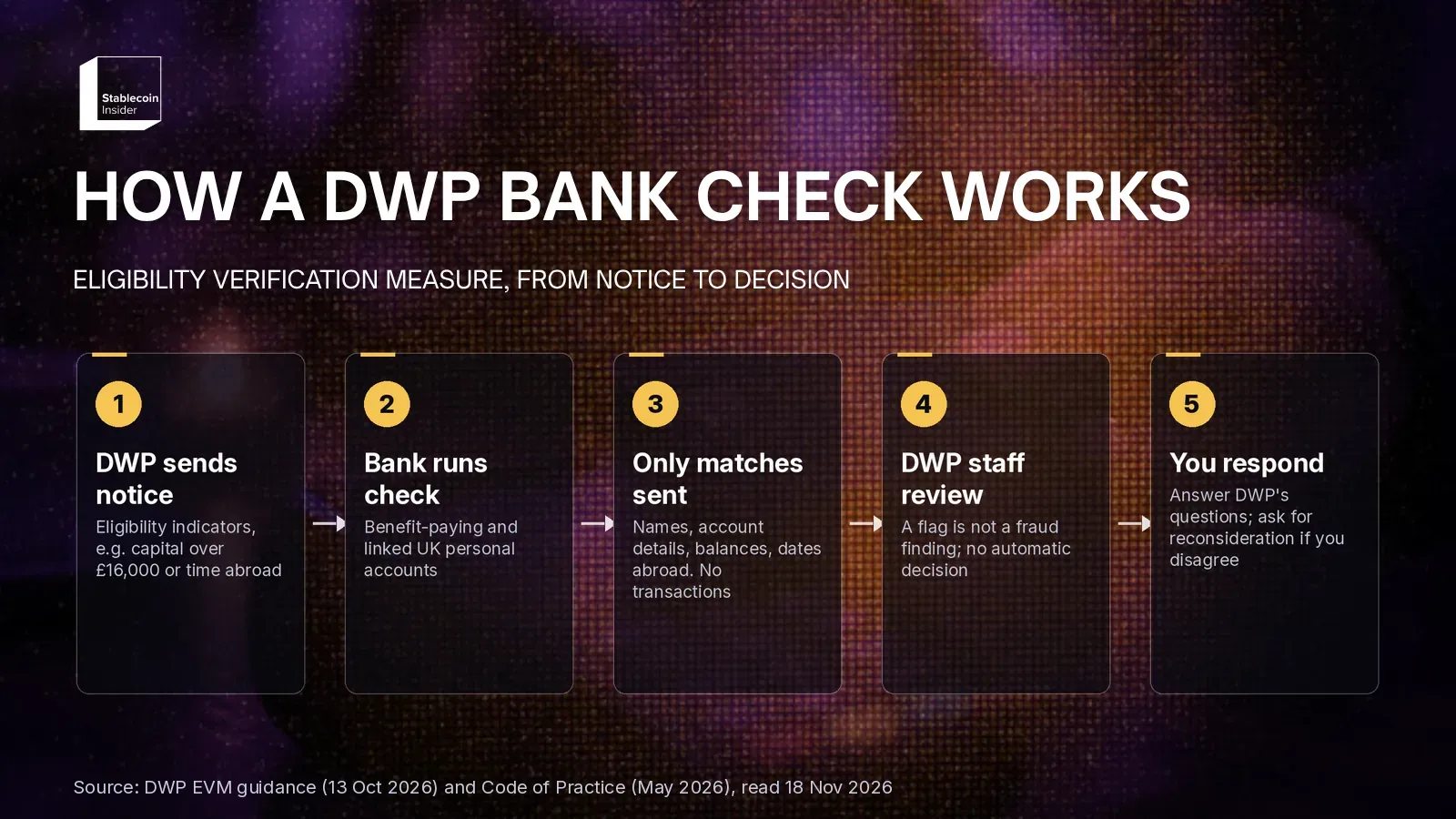
What the bank sends is limited: account holder names, account numbers and sort codes, how much money is in the accounts, and the dates of transactions made abroad. It cannot send statements, spending details or where you shopped, and DWP "cannot log into your online banking or see your account in real time" (GOV.UK EVM guidance). The checks are in a test-and-learn phase with "a small number of financial institutions" (written answer 38524).
Last updated: 18 November 2026. Rules re-checked against GOV.UK, the Code of Practice and legislation.gov.uk on this date. Covers England, Scotland and Wales; Northern Ireland runs its own benefits system.
Key Takeaways
- The checks are the Eligibility Verification Measure (EVM), created by the Public Authorities (Fraud, Error and Recovery) Act 2025 as Schedule 3B of the Social Security Administration Act 1992 (legislation.gov.uk).
- Only three benefits are in scope: Universal Credit, Pension Credit and Employment and Support Allowance. Adding another needs regulations approved by both Houses of Parliament (Code of Practice, para 3.1).
- DWP's published example indicator is total capital above £16,000, the Universal Credit upper limit. DWP may lower it to check claimants between £6,000 and £16,000 (Code, paras 3.4–3.5).
- A flag "does not indicate fraud or wrongdoing", and no benefit decision can be made on EVM data alone (DWP).
- On our worked example, £10,000 of undeclared savings on Universal Credit means an overpayment of £69.60 a month, or £835.20 over 12 months, under the GOV.UK taper (GOV.UK).
- DWP expects EVM to save £1.2 billion by 2030/31 and to reach "near full coverage of the relevant benefit caseload" as it rolls out (DWP; UK Parliament).
What are the UK benefit fraud account checks?
The UK benefit fraud account checks are bank-run eligibility checks that DWP can order under the Eligibility Verification Measure. DWP sends a bank an Eligibility Verification Notice (EVN) listing "eligibility indicators", which are criteria based on benefit rules. The bank then searches its own data for benefit-receiving accounts that meet them (GOV.UK).
The power sits in Schedule 3B of the Social Security Administration Act 1992, inserted by the 2025 Act and in force from 2 February 2026. The statutory Code of Practice was laid before Parliament in May 2026, and the minister, Lilian Greenwood, told the Commons on 26 October 2026 that the first notice had been issued (written statement HCWS415).
DWP gives two reasons for the measure. It says undeclared savings and time abroad in Universal Credit and Pension Credit cost an estimated £1.5 billion in 2025-26. And unlike PAYE earnings, which DWP already gets from HMRC, data on savings and time abroad is "not readily available in a timely fashion" (DWP; Code, para 2.2).
Which benefits and accounts are checked?
The benefits checked are Universal Credit, Pension Credit and New Style Employment and Support Allowance, and the accounts checked are UK personal current, savings and investment accounts. That includes e-money accounts: the law covers accounts operating "by reference to electronic money" and firms authorised to issue it, so app-based accounts can be in scope as well as high-street banks (Schedule 3B, paras 2 and 20).
Your other accounts at the same provider count too. A "linked" account is any other account held by the person who holds the benefit-receiving account, and an indicator can be met by several accounts combined (Schedule 3B, paras 1(8) and 3(2)).
| Account or data | In scope? | Source |
|---|---|---|
| Current account the benefit is paid into | Yes | Code 3.23 |
| Your other savings, current or investment accounts at the same provider | Yes, as linked accounts | Sch 3B para 1(8) |
| Joint account the benefit is paid into | Yes, including other accounts both holders have at that provider | Code 3.34 |
| E-money accounts | Yes, if the provider is authorised to issue e-money | Sch 3B paras 2, 20 |
| Credit cards, current account mortgages | No | Code 3.24 |
| Business, charity and non-UK accounts | No | Code 3.24–3.25 |
| Cryptoasset accounts | Not now; regulations could add them | Sch 3B para 2(3) |
Two details catch people out. If a benefit goes into a joint account, the bank cannot tell which holder is the claimant, so details of all accounts both holders have there may be sent. Appointees' data can also be returned, but DWP says it will not use it and will destroy it (Code, paras 3.33–3.34).
What can the DWP see in your bank account?
The DWP can see only a short list of facts about accounts that meet an indicator. It cannot see your statements or your spending. The GOV.UK guidance and the law set out both sides (GOV.UK; Schedule 3B para 1(5)):
| Banks may share (matched accounts only) | Banks cannot share |
|---|---|
| Names of all account holders | Full statements or transaction lists |
| Account details, including linked and joint accounts | How you spend your money |
| Account numbers and sort codes | Specific transaction locations |
| How much money is in the relevant accounts | Special category data, such as religion or political views |
| Dates of transactions made in another country | Anything on accounts that do not match an indicator |
The look-back is also capped. A notice cannot require data more than a year old, but it can ask for the date an account first began to meet an indicator (Schedule 3B para 4). DWP may share nothing about named people with the bank, so the bank screens every relevant account rather than a target list (Code, para 2.7).
Banks face penalties both ways: a fixed penalty of up to £1,000 for not complying, a daily penalty of up to £40 if the failure continues, and penalties for sharing banned information (Code, chapter 7).
What triggers a flag?
A flag is triggered when an account, alone or combined with linked accounts, meets an eligibility indicator in the notice. DWP has not published the live indicators. The Code gives two examples: capital above £16,000 for Universal Credit, and signs that the holder "may have spent more time overseas than benefit eligibility rules allow" (Code, paras 3.4–3.6). DWP declined to name the first bank or give operational details during test and learn (written answer 38524).
The underlying benefit rules are what the indicators test against:
| Benefit | Savings rule | Time abroad rule |
|---|---|---|
| Universal Credit | Payment reduced above £6,000; not eligible above £16,000 (GOV.UK) | Up to 1 month temporary absence, longer for bereavement or medical treatment (UC Regs 2013, reg 11) |
| Pension Credit | No effect up to £10,000; each £500 above counts as £1 a week of income (GOV.UK) | Up to 4 weeks, longer in set cases (GOV.UK) |
| New Style ESA | Based on National Insurance contributions; GOV.UK lists no savings limit (GOV.UK) | Time-abroad indicators can apply to any benefit in scope (Code 3.6) |
How much can undeclared savings cost you?
Undeclared savings on Universal Credit cost you £4.35 a month for every £250 between £6,000 and £16,000, plus £4.35 for any part of £250 left over (GOV.UK). That difference becomes an overpayment if the savings were not reported, and GOV.UK says you may have to pay it back (GOV.UK). We applied the rule to four balances:
| Total savings | Monthly UC reduction | 12 months unreported |
|---|---|---|
| £5,000 | £0 (below £6,000) | £0 |
| £10,000 | 16 × £4.35 = £69.60 | £835.20 |
| £12,100 | 25 × £4.35 = £108.75 (24 full £250 bands plus a part band) | £1,305.00 |
| £16,000 | 40 × £4.35 = £174.00 | £2,088.00 |
| Over £16,000 | Not eligible for UC | Potentially the whole award |
Pension Credit works differently. Savings up to £10,000 are ignored; above that, every £500 counts as £1 a week of income. GOV.UK's own example is £11,000 counting as £2 a week; on the same rule, £15,000 counts as £10 a week, or £520 over 52 weeks (GOV.UK). There is no upper savings limit on that page, so savings reduce Pension Credit rather than end it outright.
Two limits on these figures: the Universal Credit table assumes a single claimant whose award is large enough to absorb the reduction, and it ignores any other income. Couples' savings are combined on a joint claim.
What happens if your account is flagged?
If your account is flagged, DWP reviews your claim; it does not stop your benefit automatically. The review may find you are eligible, not eligible or being paid the wrong amount. DWP will contact you through your Universal Credit journal or, without an online account, by phone, letter or text, and says you should respond quickly "to avoid your benefit payments being delayed or stopped" (GOV.UK).
- Answer the questions and send the evidence asked for, such as statements or proof of travel dates.
- If you disagree with the decision, ask for a mandatory reconsideration (GOV.UK).
- If DWP suspects deliberate fraud, that is a separate process: an interview under caution, possible repayment, a penalty of £350 to £5,000 or prosecution (GOV.UK benefit fraud).
- You can ask DWP for the information it holds about you, and an independent reviewer reports to Parliament every 12 months on how the power is used (GOV.UK; Code, para 4.9).
Were the DWP bank checks scrapped?
No, the DWP bank checks were not scrapped; a different plan was. On 8 November 2026, the Telegraph reported that Chancellor John Healey had dropped an earlier proposal to verify Universal Credit applicants' savings through Open Banking before a claim is paid (The Telegraph). A DWP spokesman said that plan "relied on claimant consent" and that EVM, which requires banks to report matching accounts, is going ahead instead.
The practical difference is timing. Open Banking would have checked at the point of claim with your consent. EVM checks accounts that are already receiving benefit, with no consent needed.
How do you avoid an overpayment?
You avoid an overpayment by reporting changes as they happen, before a bank check finds them. GOV.UK lists changes to money, savings or investments, one-off payments such as gifts, refunds or compensation, and leaving England, Scotland and Wales "for any period", including holidays (GOV.UK).
- Add up every balance you and a partner on a joint claim hold, including savings and investment accounts and e-money apps.
- Compare the total with £6,000 and £16,000 for Universal Credit, or £10,000 for Pension Credit (UC; Pension Credit).
- Before travelling, tell DWP and check the 1-month (UC) or 4-week (Pension Credit) limit (Citizens Advice; GOV.UK).
- Report a one-off payment, such as an inheritance or compensation, when you receive it.
If you are reviewing where your money sits anyway, our guides compare UK current accounts in Metro Bank alternatives and TSB alternatives. Pension Credit claimants weighing a SIPP can see the best pension providers in the UK; check GOV.UK on how pensions count before moving money.
The crypto angle is still only a power on paper: Schedule 3B lets ministers add providers of accounts "that operate by reference to cryptoassets" by regulations (para 2(3)). For the UK's wider stablecoin rulebook, see the Bank of England's draft rules for systemic stablecoins.
FAQ
Does the DWP check bank accounts for PIP or State Pension?
Will I be told if my bank flags my account?
Does money in a partner's account count?
Do the checks apply in Northern Ireland?
How far back can the bank check go?
Sources: DWP: How DWP checks benefit eligibility using the EVM (13 Oct 2026); DWP press release, 26 Oct 2026; Written statement HCWS415, 26 Oct 2026; Written answer UIN 38524, 2 Nov 2026; Code of Practice on Eligibility Verification Notices (May 2026); Social Security Administration Act 1992, Schedule 3B; GOV.UK: Universal Credit, what you will get; GOV.UK: Universal Credit eligibility; GOV.UK: Pension Credit eligibility; GOV.UK: New Style ESA eligibility; Universal Credit Regulations 2013, reg 11; Citizens Advice: changes that affect Universal Credit; GOV.UK: Benefit fraud; The Telegraph, 8 Nov 2026. All read on 18 November 2026.
This content is provided for informational and educational purposes only and doesn't constitute financial, investment, legal or tax advice. It describes DWP's Eligibility Verification Measure in England, Scotland and Wales as published on 18 November 2026, when all figures were read. DWP has not published its live eligibility indicators, and the measure is in a test-and-learn phase, so details may change. Worked examples apply GOV.UK taper rules and are not individual entitlement calculations; use a benefits calculator or Citizens Advice for your own case.