

Table of Contents
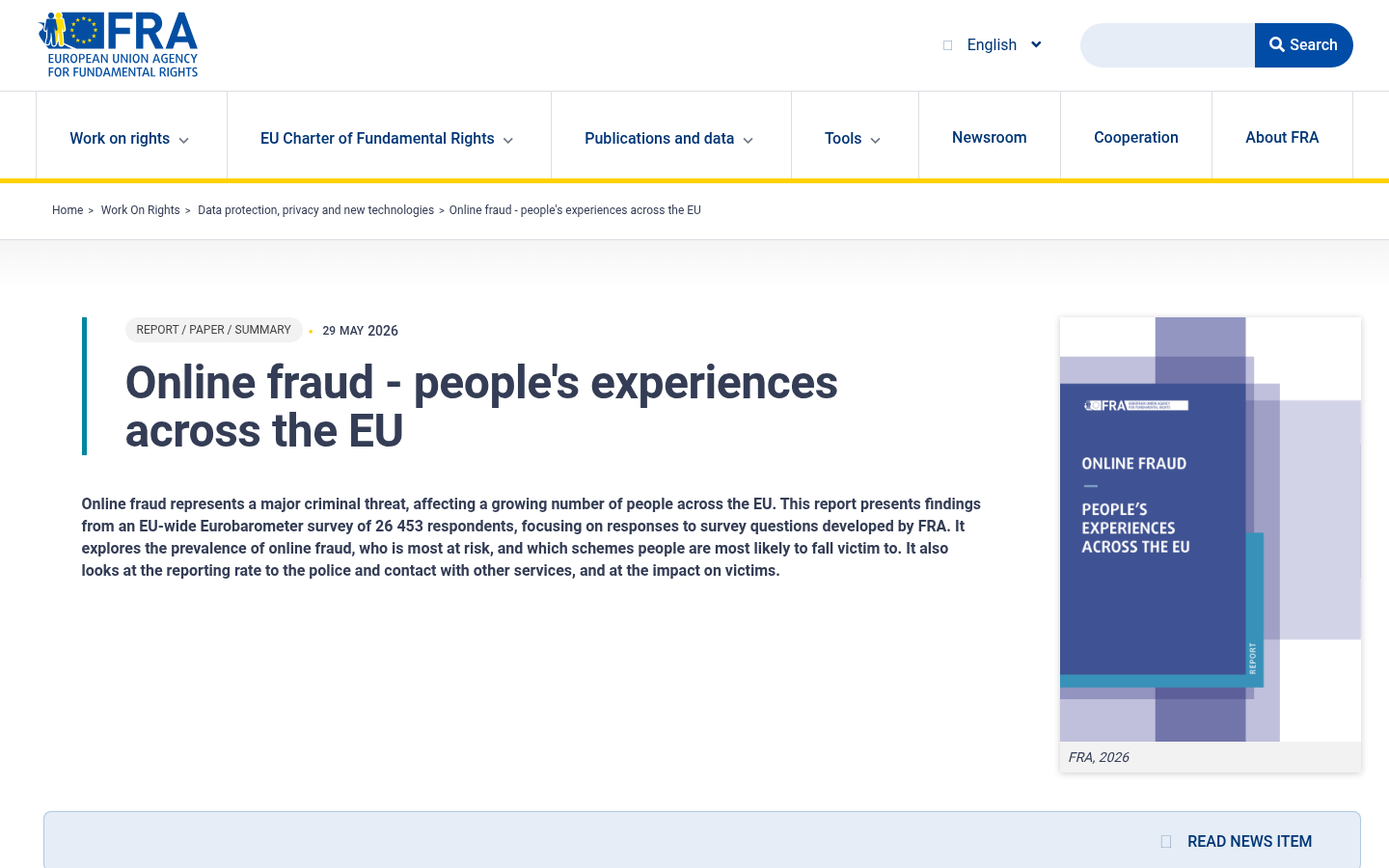
About one in four people in the EU has been a victim of online fraud, and impersonation scams, where criminals pose as a relative, a colleague or a bank, hit between 22% and 25% of victims (Source: EU Agency for Fundamental Rights).
Stablecoin Insider follows the rules that shape how money moves in Europe, and PSD3 and the Payment Services Regulation are the biggest rewrite of EU payments law since PSD2 in 2015.
The package targets exactly that kind of fraud. It adds refund rights for bank impersonation scams, makes IBAN name checks standard and pulls online platforms and telecom companies into fraud prevention.
It also changes how fintechs get licensed, how open banking APIs must perform and how strong customer authentication works. The final steps of adoption are under way in November 2026.
This guide explains what PSD3 and the PSR are, what changes for consumers and fintechs, where the law stands today and when each rule will apply.
Key Takeaways
- PSD3 covers licensing; the PSR is a directly applicable EU payments rulebook.
- Victims of bank impersonation scams gain a new refund right.
- Name checks against IBANs become mandatory for all credit transfers.
- Payment and e-money institutions merge into one licence type.
- Most rules apply 21 months after entry into force, around 2028.
Why the EU Is Replacing PSD2
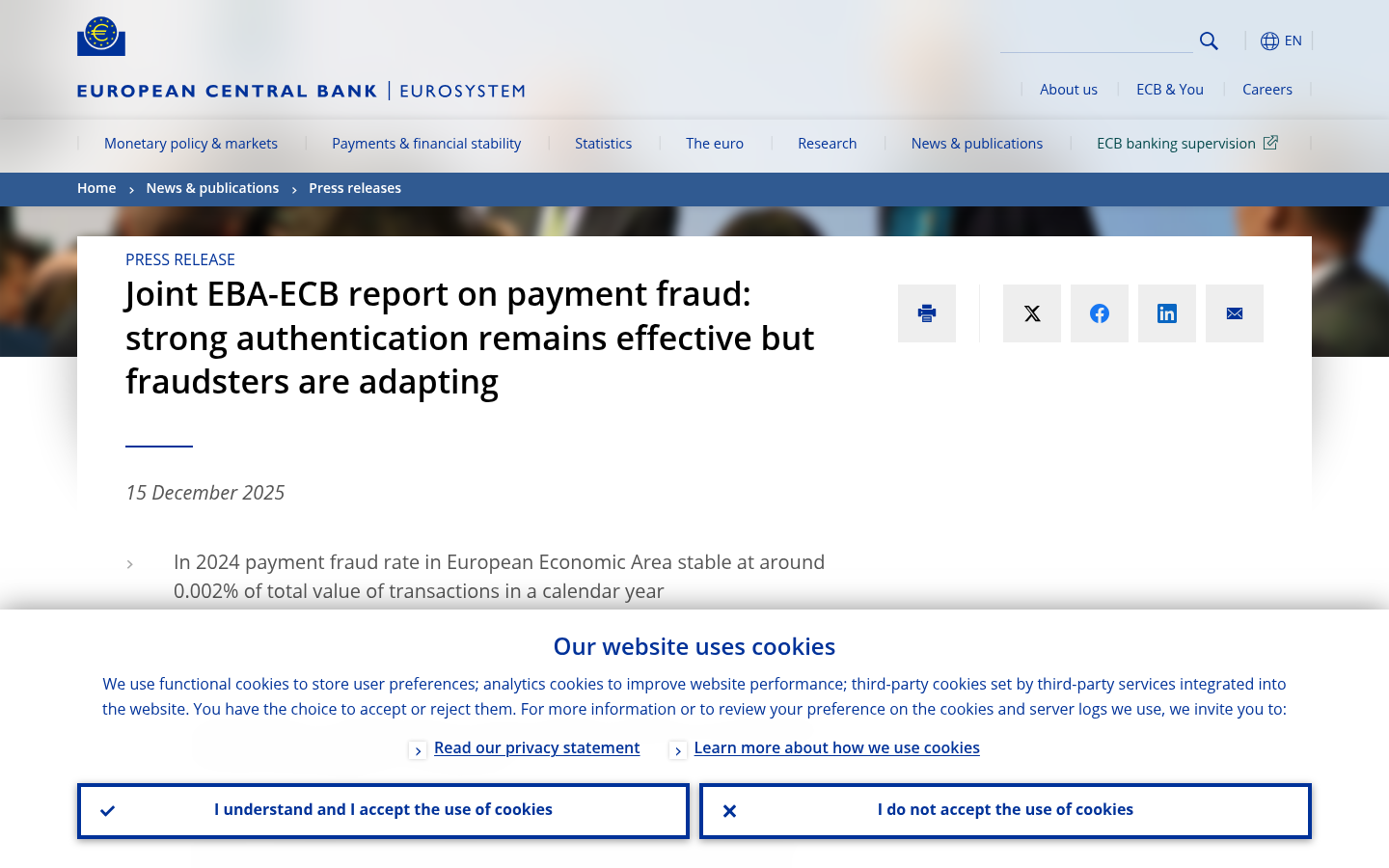
PSD2 brought strong customer authentication and open banking, but fraud moved to where those protections are weakest. Payment fraud in the European Economic Area reached €4.2 billion in 2024, up from €3.5 billion in 2023, and payment service users bore about 85% of credit transfer fraud losses, mostly from scams that tricked them into sending money (Source: European Central Bank).
That 85% is the core problem the PSR addresses. Under PSD2, a customer who authorises a payment, even after being deceived, usually carries the loss.
The other driver is fragmentation. PSD2 was a directive, so each member state wrote its own version, and open banking performance varied widely from bank to bank.
Where PSD3 and the PSR Stand in November 2026
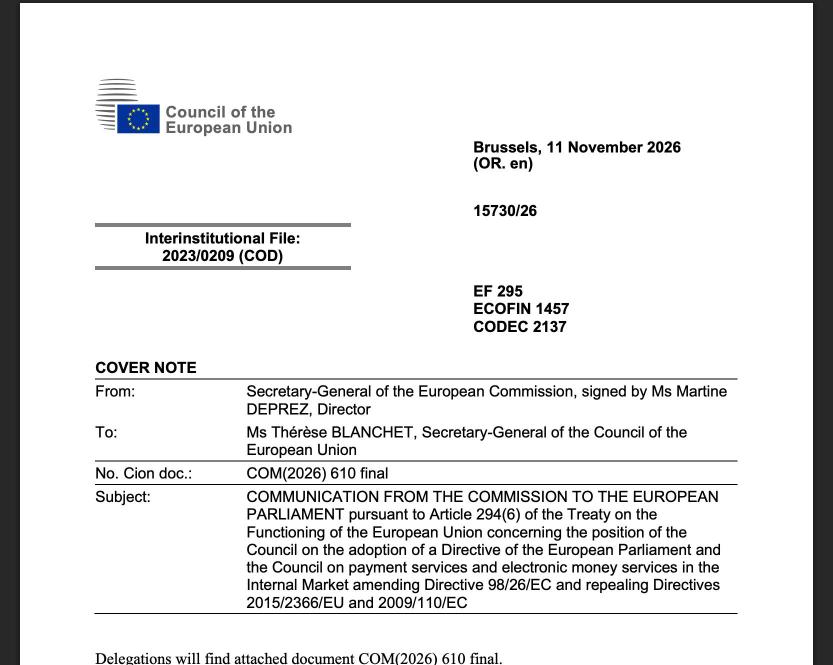
The legislative process is almost finished. The Council adopted its first-reading position on 28 October 2026, and on 3 November the Commission told Parliament it could accept that position because it fully reflects the political agreement reached on 26 November 2025 (Source: Council of the EU).
| Date | Step |
|---|---|
| June 2023 | Commission proposal |
| April 2024 | Parliament first reading |
| November 2025 | Political agreement |
| April 2026 | Final texts published |
| May 2026 | ECON committee approval |
| October 2026 | Council position adopted |
| Next | Parliament second reading |
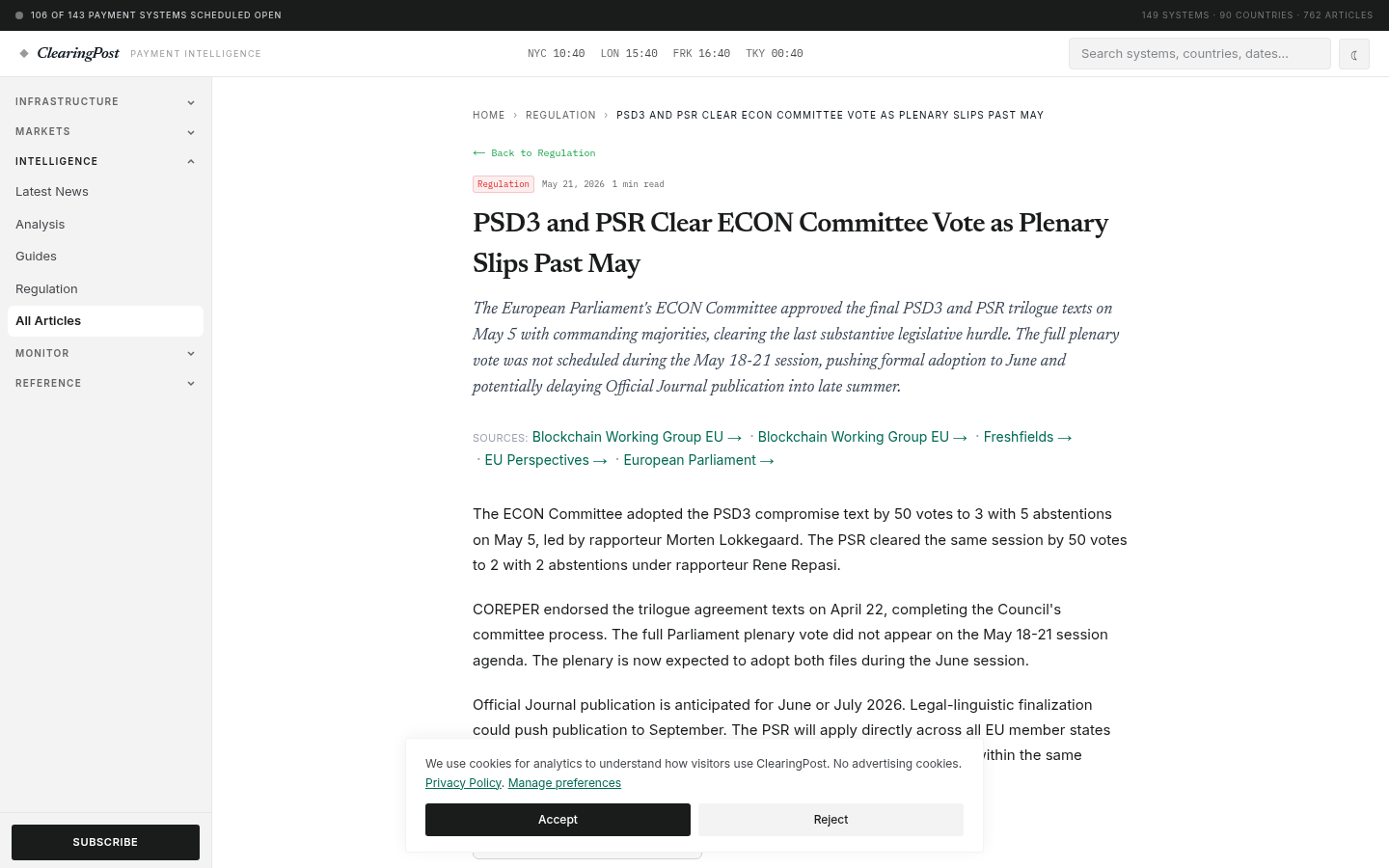
Parliament's economic committee approved the PSD3 text by 50 votes to 3 and the PSR by 50 to 2 on 5 May 2026, so a plenary rejection is unlikely (Source: ClearingPost).
Once Parliament approves the Council position at second reading, both texts are signed and published in the Official Journal, and they enter into force 20 days later.
PSD3 vs PSR: Who Does What
- PSD3 (directive): Covers authorisation, supervision, safeguarding and passporting of payment and e-money institutions. Member states must transpose it into national law.
- PSR (regulation): Covers conduct rules, transparency, open banking, fraud prevention, liability and payment execution. It applies directly in every member state without national transposition.
- What gets repealed: PSD3 replaces both PSD2 and the Electronic Money Directive, so e-money becomes a payment service under one framework.
Moving most rules into a regulation is the main fix for fragmentation. A fintech operating in ten countries will follow one rulebook instead of ten national versions.
Fraud: Refunds, IBAN Checks and Shared Liability
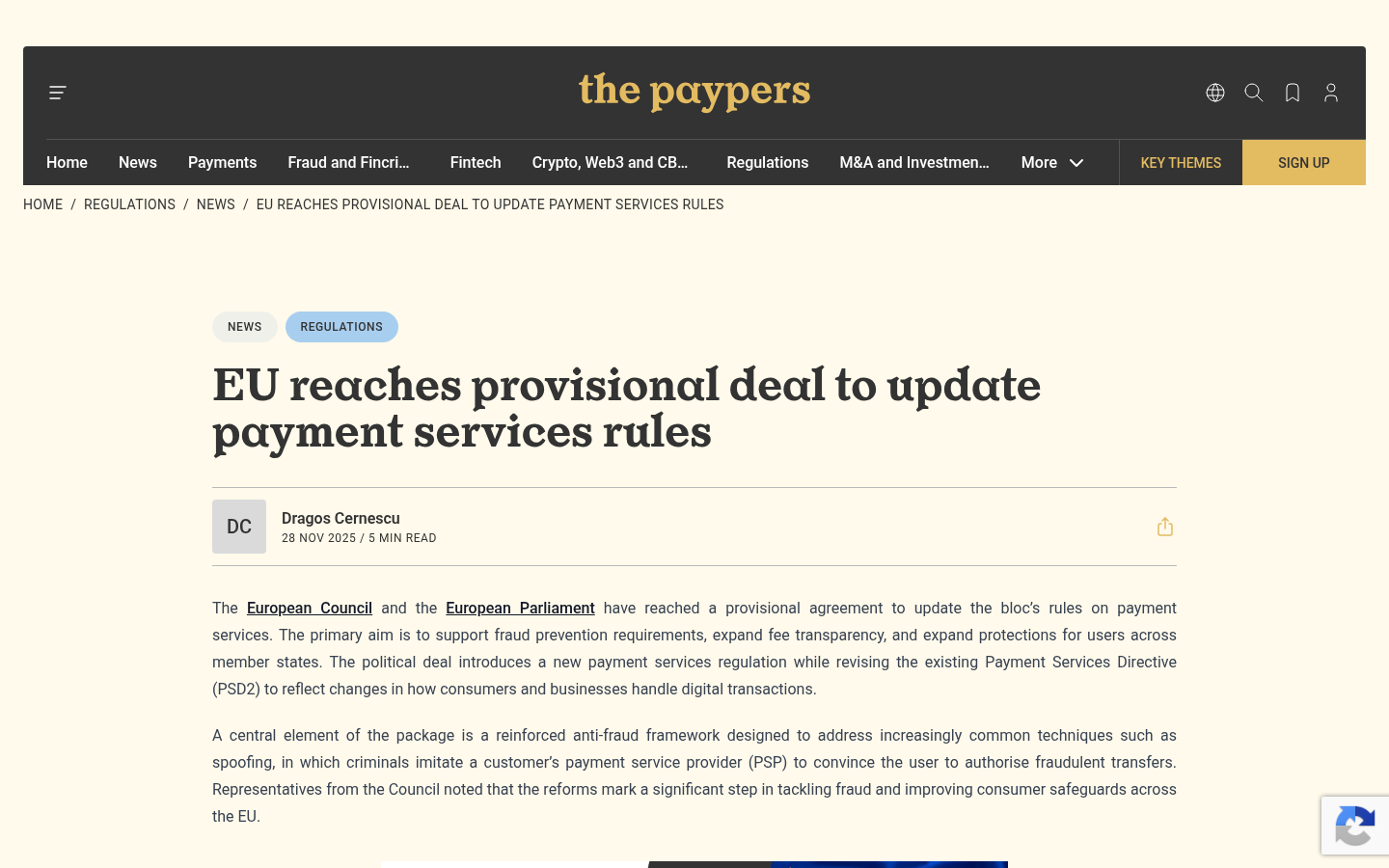
The fraud rules are the part consumers will notice. The political agreement added protection against spoofing, where criminals impersonate a customer's bank, required providers to share fraud data, and extended IBAN name checks to all transfers, with providers liable when they fail to use the required preventive tools (Source: The Paypers).
- Impersonation refunds: A customer tricked by someone posing as their bank gains a right to a refund, subject to conditions set in the PSR.
- Verification of payee: Before any credit transfer, the payer's provider checks that the name matches the IBAN and warns on a mismatch. If it fails to warn, liability shifts to the provider.
- Burden of proof: Providers must prove fraud or gross negligence by the customer before refusing a refund for an unauthorised payment.
- Transaction monitoring: Real-time monitoring becomes an explicit duty, including for instant payments.
Euro-area providers have already offered name checks on euro transfers since October 2025 under the Instant Payments Regulation. Our Wero vs PayPal comparison shows how those checks work alongside new wallets.
Open Banking: Dedicated APIs and Dashboards
Open banking moves from guidance to hard requirements. Banks must offer a dedicated data-access interface that performs at least as well as their own app, the permanent fallback interface from PSD2 is removed, and customers get a dashboard to see and revoke every third-party permission (Source: Open Banking Tracker).
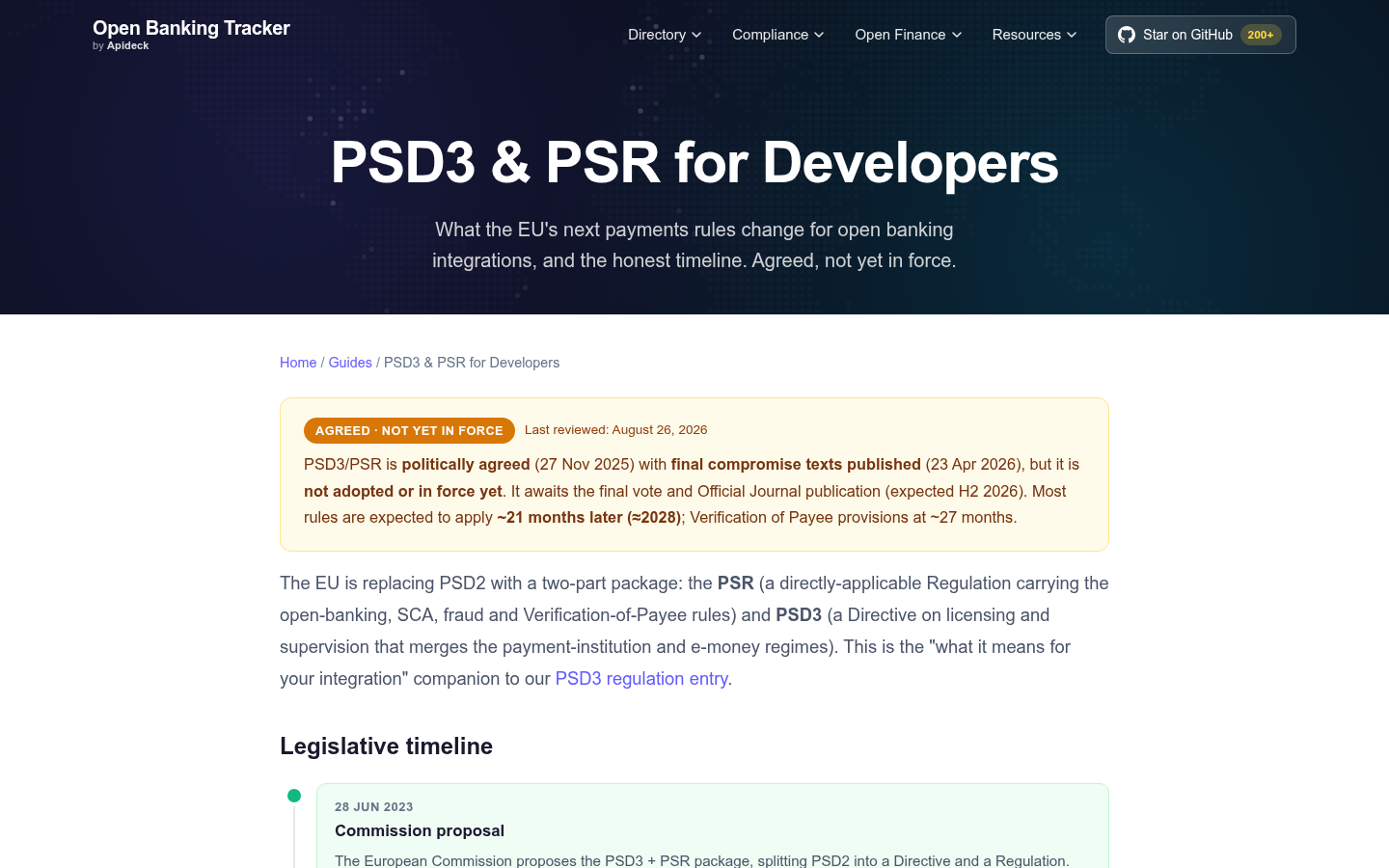
The PSR also lists obstacles banks may not put in front of licensed third parties and bans screen scraping once dedicated interfaces are in place (Source: Legal 500).
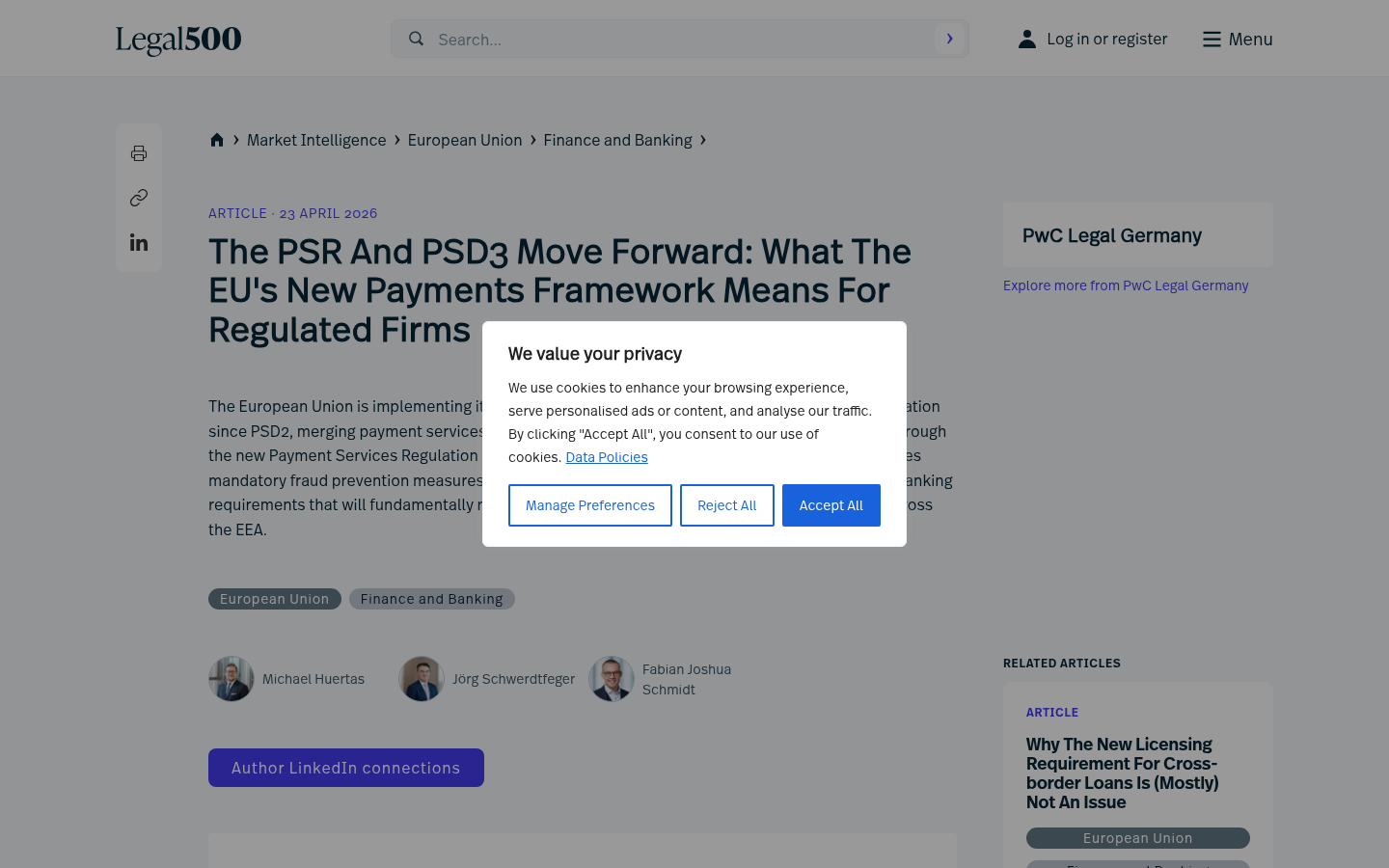
For account information services, strong authentication is required at first access, after which the provider can apply its own authentication for roughly 180 days. Exact performance thresholds will come later in technical standards from the European Banking Authority.
Strong Customer Authentication Changes
Strong customer authentication stays, but with fewer gaps. Authentication methods must be free of charge, must not depend solely on a smartphone, and must work for people with disabilities, older users, and others with limited digital skills (Source: Arthur Cox).
The texts also clarify how merchant-initiated transactions are treated and allow two inherence elements, such as a fingerprint and face scan, where they are shown to be independent.
One Licence for Payment and E-Money Institutions
PSD3 merges payment institutions and electronic money institutions into a single licence type with one safeguarding regime.
Existing firms will need to obtain the new authorisation within transitional periods of up to 27 months (Source: Arthur Cox).
That matters for crypto and stablecoin firms that hold e-money licences, such as the firms covered in our report on MoonPay securing an EMI licence.
Consumer Rules: ATMs, Cash and Fees
Several changes are aimed directly at everyday users and merchants (Source: The Paypers).
- ATM transparency: All fees and exchange rates must be shown before a cash withdrawal.
- Cash in shops: Retailers may offer cash withdrawals without a purchase, up to €150, using chip and PIN.
- Merchant names: The name on a bank statement must match the merchant's trading name, making charges easier to recognise.
- Merchant fees: Card acquirers must clearly disclose their fees to merchants.
- Surcharging: The ban on surcharging extends to all credit transfers and direct debits in the EU (Source: Legal 500).
Big Tech and Telecoms Join the Fraud Fight
For the first time, EU payments law reaches beyond payment firms. Electronic communications providers, hosting services, mobile device makers and very large online platforms take on fraud-prevention duties (Source: Legal 500), and large platforms and search engines may only advertise financial services from providers authorised in the relevant member state.
The aim is to stop impersonation scams earlier, at the fake call, text or advert where many of them start, rather than only at the moment of payment.
When Each Rule Applies
| Rule | Applies from | Estimate |
|---|---|---|
| Entry into force | OJ + 20 days | Early 2027 |
| Most PSR rules | 21 months later | Late 2028 |
| PSD3 transposition | 21 months later | Late 2028 |
| Verification of payee | 27 months later | 2029 |
| Existing licences | Up to 27 months | 2029 |
The application periods come from the final texts, while the calendar estimates assume publication in the Official Journal in early 2027.
What PSD3 Means for Stablecoin and Crypto Firms
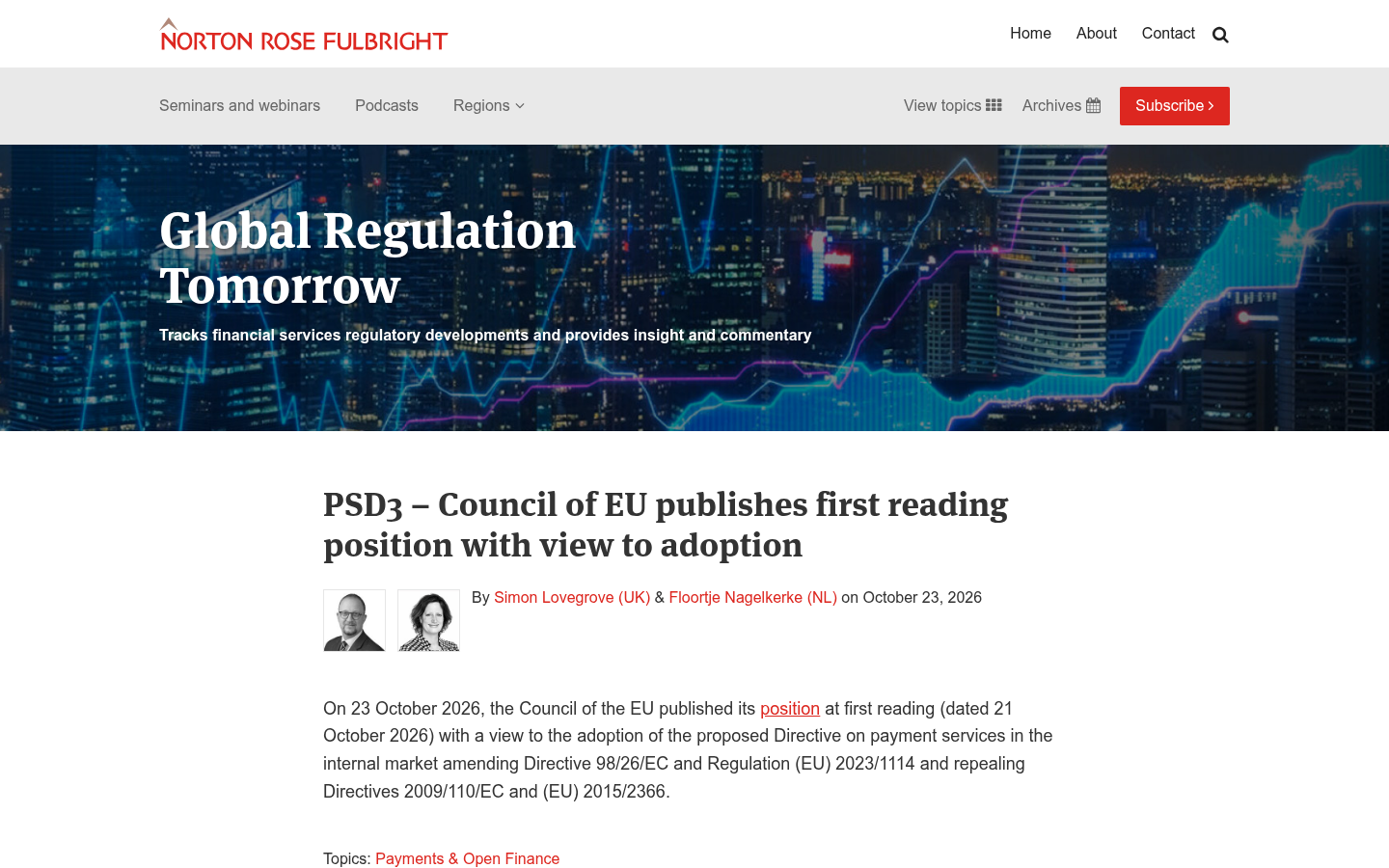
PSD3 formally amends MiCA, the EU's crypto-asset regulation, so the two rulebooks are now linked in law (Source: Regulation Tomorrow).
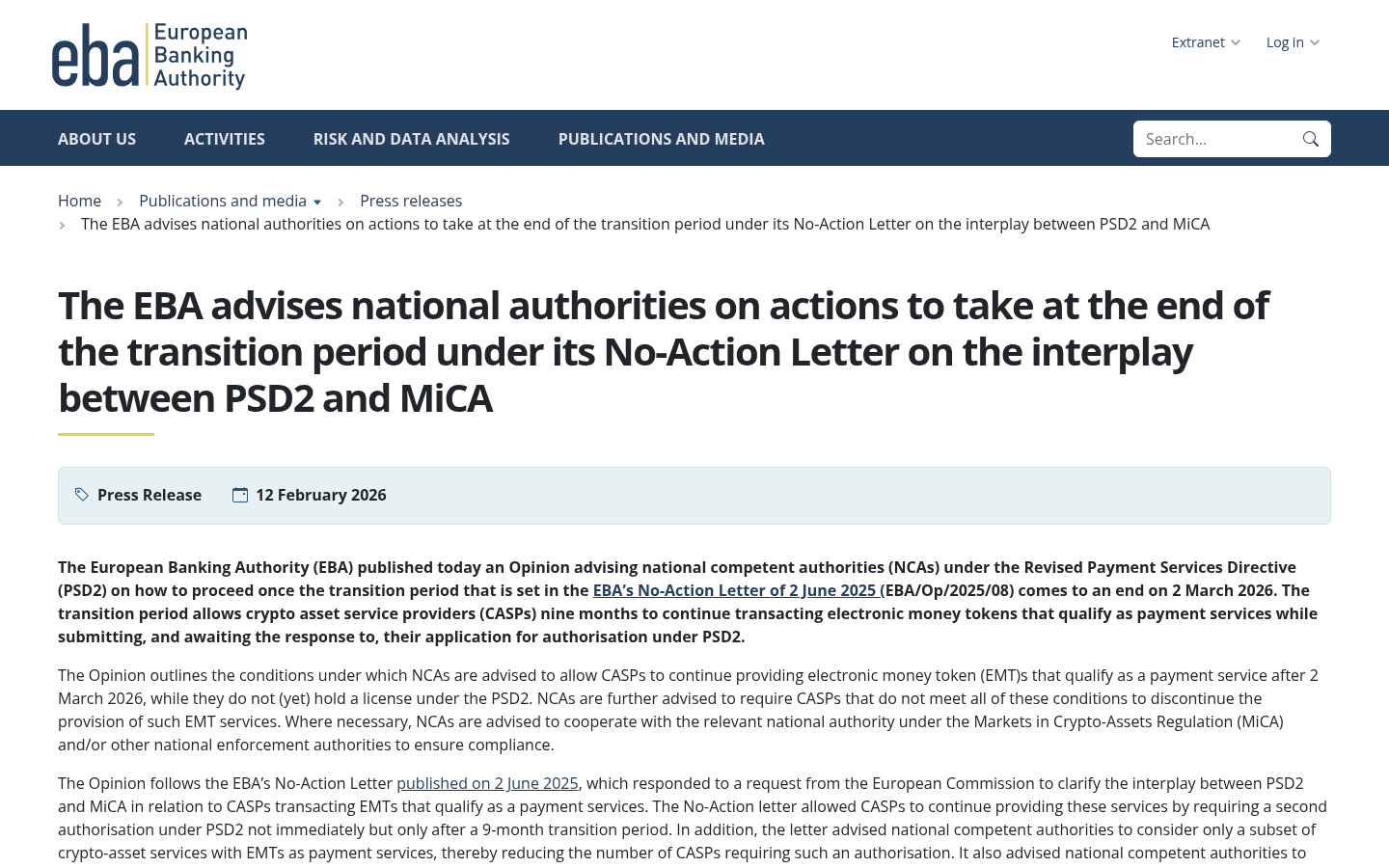
The overlap is already real. A transition period under the European Banking Authority's no-action letter, which let crypto-asset service providers keep offering e-money token services that count as payment services.
At the same time, they sought PSD2 authorisation, which ended on 2 March 2026 (Source: European Banking Authority).
In practice, a firm that moves euro stablecoins for customers may need both a MiCA licence and a payment licence, on top of the issuer-side reserve rules explained in our piece on MiCA bank deposit rules for Circle and Tether.
Our guide on how to check if a stablecoin is MiCA compliant covers the token side, and our overview of stablecoin regulations in 2026 covers the wider picture.
What Fintechs Should Do Now
- Map your licences: Check whether you hold a payment or e-money licence and plan for re-authorisation under the merged regime.
- Prepare for refund claims: Model the cost of impersonation fraud refunds and strengthen real-time transaction monitoring.
- Extend name checks: Build verification of payee for non-instant and non-euro transfers.
- Upgrade APIs: Banks should prepare dashboards and API performance; third parties should plan to stop screen scraping.
- Review SCA flows: Add authentication options that do not rely only on a smartphone.
- Watch the technical standards: Many details, from API metrics to own funds, will be set by the European Banking Authority.
Conclusion
Stablecoin Insider tracks the regulation that decides how European payments and stablecoins operate, and PSD3 and the PSR will set the rules for every payment firm in the EU for the next decade.
The package shifts more fraud losses onto providers, makes IBAN name checks universal, turns open banking into a performance obligation and merges payment and e-money licences.
The Council has adopted its position, the Commission has accepted it, and only Parliament's final vote and publication remain.
Most rules will apply around 21 months after entry into force, which gives fintechs until roughly late 2028 to adapt, and slightly longer for verification of payee and licence transitions.
Read Next
These three guides go deeper on European payments regulation and how it affects stablecoin businesses in 2026.
- WhiteBIT Relaunches OTC Desk for Large-Volume Crypto Transactions
- Premium Bonds vs Cash ISA (2026): Returns, Tax and Odds Compared
- Squid Review 2026: Fees, Squid Intents, Safety and How It Handles Stablecoins
FAQs
1. What is the difference between PSD3 and the PSR?
The difference between PSD3 and the PSR is their legal form and scope. PSD3 is a directive covering licensing and supervision of payment and e-money institutions, which member states transpose, while the PSR is a regulation covering conduct, fraud, open banking and transparency that applies directly across the EU.
2. When will PSD3 and the PSR apply?
PSD3 and the PSR will apply 21 months after they enter into force, with verification of payee applying after 27 months. Entry into force follows publication in the Official Journal, which is expected after Parliament's final vote, so most rules are likely to apply around late 2028.
3. Will PSD3 make banks refund scam victims?
PSD3 and the PSR will make banks refund some scam victims. Customers tricked by someone impersonating their bank gain a refund right, subject to conditions, and providers become liable when they fail to warn about an IBAN and name mismatch or to apply required fraud monitoring.
4. Does PSD3 replace the e-money licence?
PSD3 replaces the separate e-money licence. It repeals the Electronic Money Directive and merges payment institutions and electronic money institutions into one authorisation, with transitional periods of up to 27 months for existing firms to move to the new regime.
5. How does PSD3 affect stablecoin companies?
PSD3 affects stablecoin companies by linking payment rules more closely to MiCA, which PSD3 amends. Firms that transfer e-money tokens for customers may need a payment licence as well as a MiCA authorisation, and they will follow the PSR's fraud and transparency rules.
Disclaimer: This content is provided for informational purposes only and does not constitute legal, financial, or compliance advice. Protocol versions, governance arrangements, and partner counts cited here reflect publicly announced milestones as of November 2026 and are moving quickly. Adoption figures come from vendor and foundation announcements with differing methodologies and should be treated as directional signals rather than guaranteed outcomes.