Table of Contents
Bungee was one of the first cross-chain swap and bridge aggregators. It is built by the team behind Socket, whose routing engine powers cross-chain features in wallets and apps.
In 2026 Bungee looks very different. Its homepage now leads with funded perpetuals trading, a leveraged trading terminal and tokenized stocks, with swaps listed third.
This review covers how Bungee swaps work today, what you pay, its security record, how usage has changed and whether it still suits stablecoin transfers.
Bungee swaps still work and still carry no extra Socket fee. But the product has shifted toward trading, and its swap volume has fallen sharply, so it is no longer the default cross-chain router it once was.
Key Takeaways
- Socket says it adds no extra fees to Bungee swaps.
- Bungee now leads with funded perps, a terminal and stocks.
- Fixed Swap lets you set the exact amount you receive.
- A January 2024 exploit drained about 3.3 million dollars.
- Bridge volume was about 24 million dollars in 30 days.
What Bungee Is in 2026
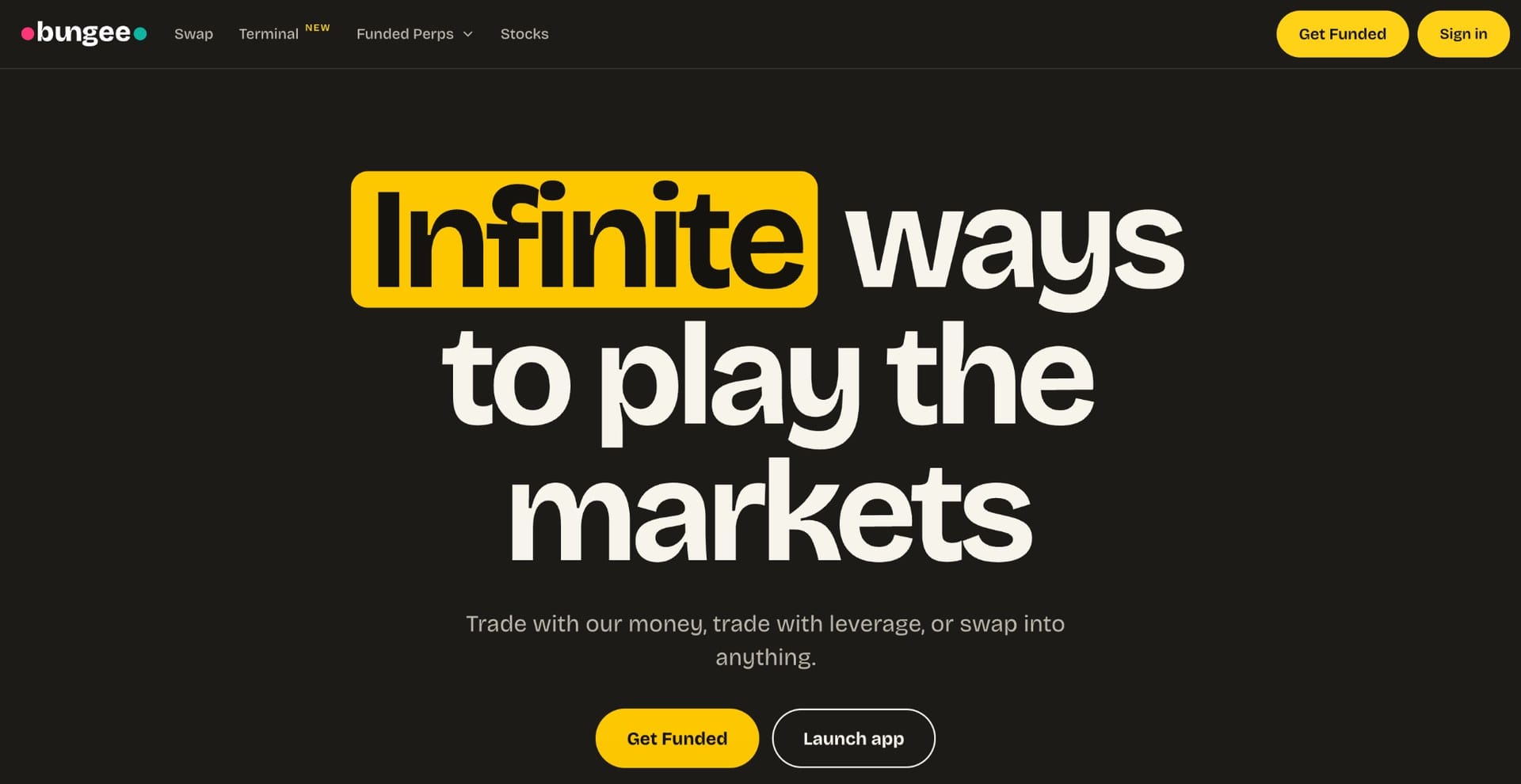
Bungee's homepage now offers three products. Funded Perps lets traders pass a challenge and trade up to 100,000 dollars of Bungee's capital, the Terminal offers perps on crypto, stocks and commodities, and Swaps covers any token on 40+ chains.
Bungee says 40 billion dollars has moved through its rails and lists Coinbase Ventures and Lightspeed among its backers. These are company figures, and they cover Socket's infrastructure, not just the Bungee app.
To see how it compares with other cross-chain routers, check our list of the best cross-chain aggregators.
What to note: funded perps and leveraged trading are high-risk products, separate from the swap tool covered in this review.
How Bungee Swaps Work
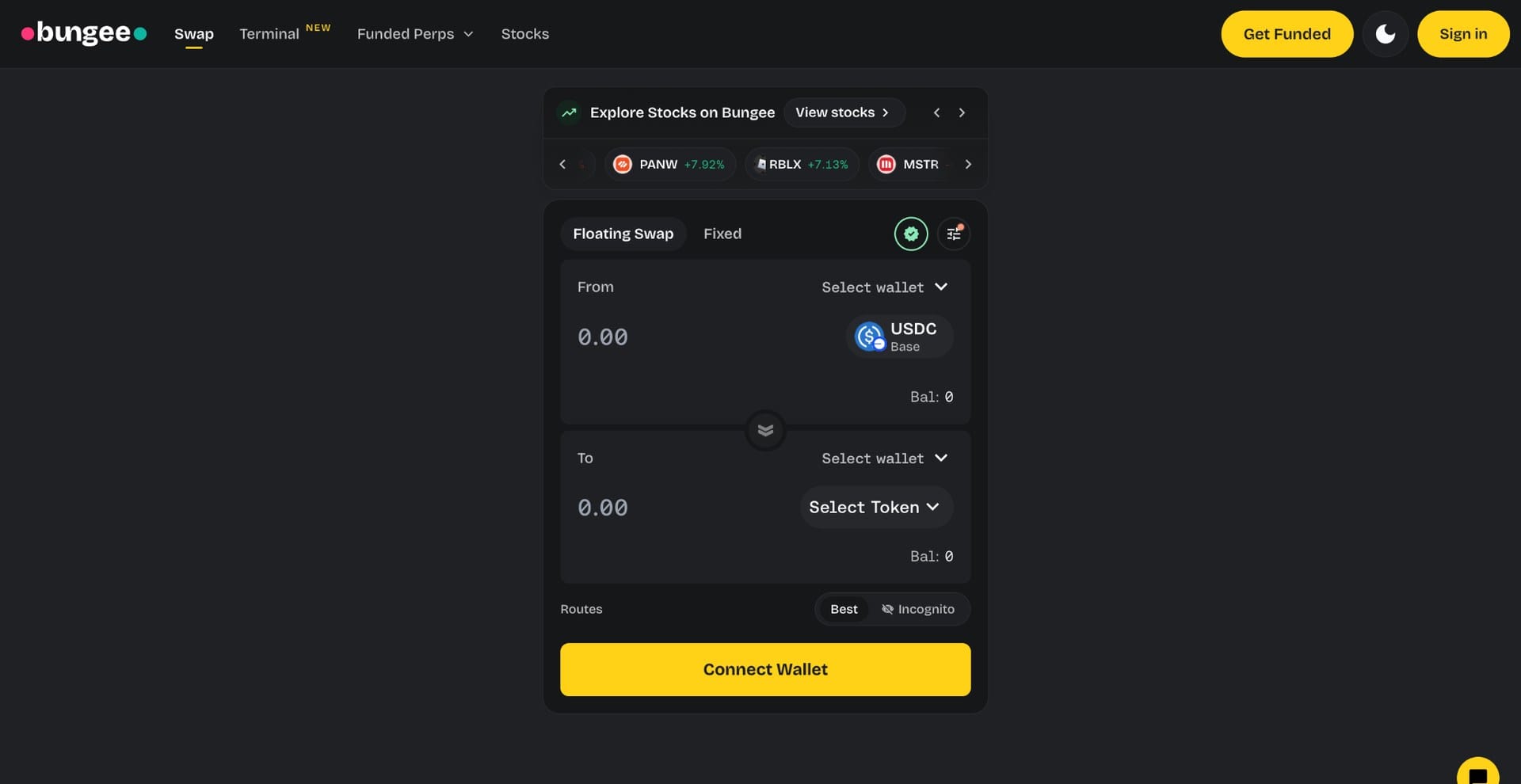
The swap page is powered by Socket's routing engine. Socket says it compares routes across 50+ chains and 10,000+ assets, pulling from bridges, DEXs and solver networks.
The default mode is Floating Swap. You set the amount you send, and the amount you receive depends on the route and market at execution.
A Routes toggle lets you choose Best, which picks the strongest quote, or Incognito. Bungee does not explain on the page exactly how Incognito routing differs.
What to note: Bungee's old documentation now redirects to Socket's docs, so detailed swap mechanics are harder to find than before.
Fixed Swap for Exact Amounts
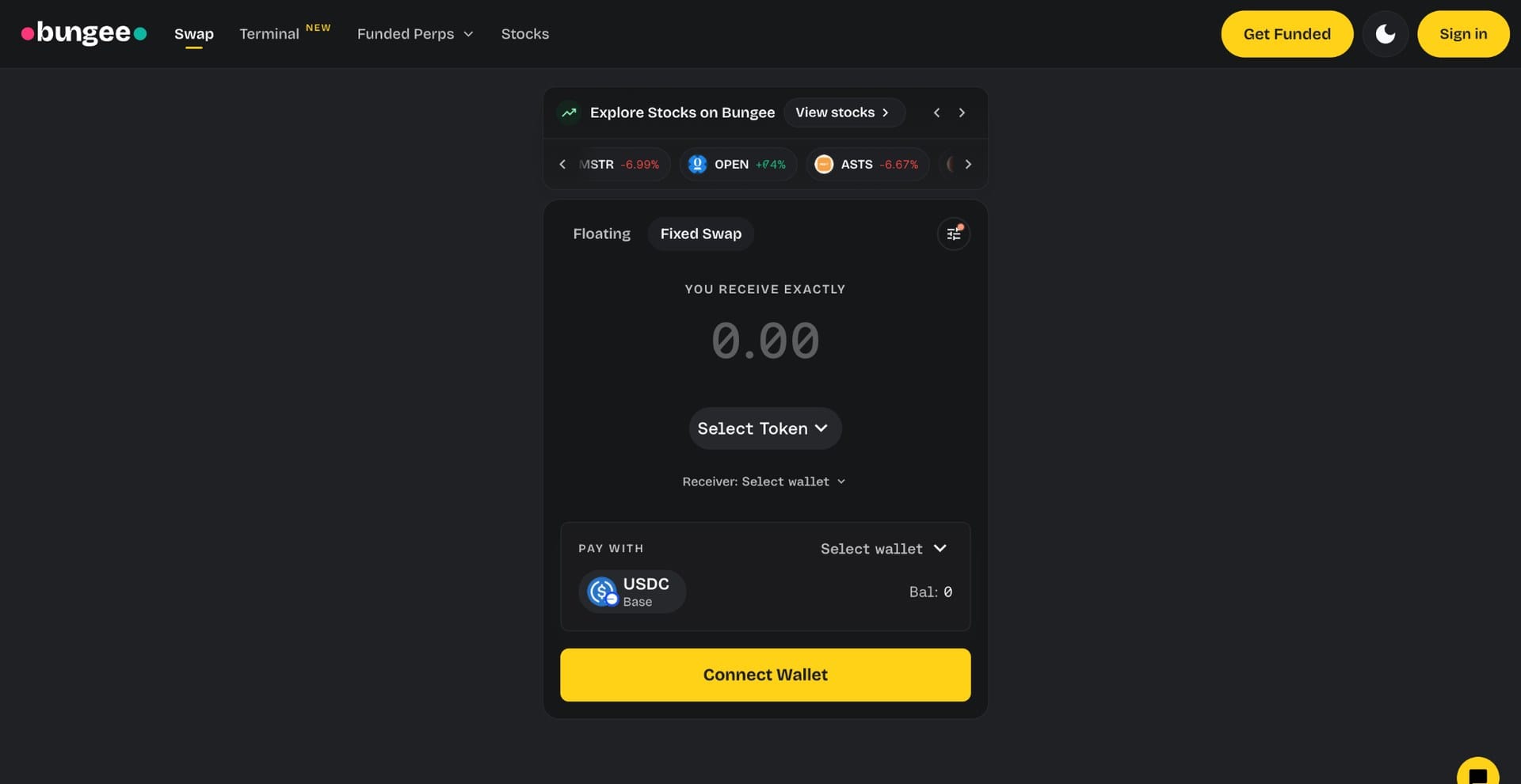
The second tab, Fixed Swap, works the other way round. You enter the exact amount you want to receive, and Bungee shows what you need to pay.
This suits stablecoin payments, where the receiver needs a set amount such as 1,000 USDC on a specific chain. You can also send the output to a different receiver wallet.
For most transfers between your own wallets, Floating Swap is simpler. Fixed Swap is useful when the destination amount matters more than the source amount.
What to note: check the pay amount carefully on Fixed Swap, since that figure is the one that changes with market conditions.
What You Actually Pay
Socket's fee page says it does not charge any additional fees. On-chain execution costs are included in the quote, with no markup.
| Cost | What Socket says |
|---|---|
| Socket or Bungee fee | No additional fee |
| Execution and gas | Included in the quoted amount |
| Bridge and DEX costs | Built into the route quote |
| Integrator fee | Set by apps that embed Socket |
DefiLlama still records a small amount of fees for Bungee, about 8,440 dollars over 30 days. Socket's docs do not break down where those come from.
What to note: wallets and apps using Socket's API can add their own fee, so the same route may cost more outside Bungee.
Security Record
On 16 January 2024, an attacker drained at least 3.3 million dollars from wallets that had given unlimited token approvals to Socket contracts. PeckShield blamed incomplete input validation in a route added three days earlier.
Socket paused the system, disabled the route and later said it recovered 1,032 ETH, worth about 2.3 million dollars at the time. Users were told to revoke approvals to the affected contract.
Socket's audit repository lists reviews by Consensys Diligence, Zellic, Hexens and PeckShield between 2023 and 2024.
What to note: approve only the amount you are swapping, and revoke old unlimited approvals to any router you no longer use.
Usage and Volume
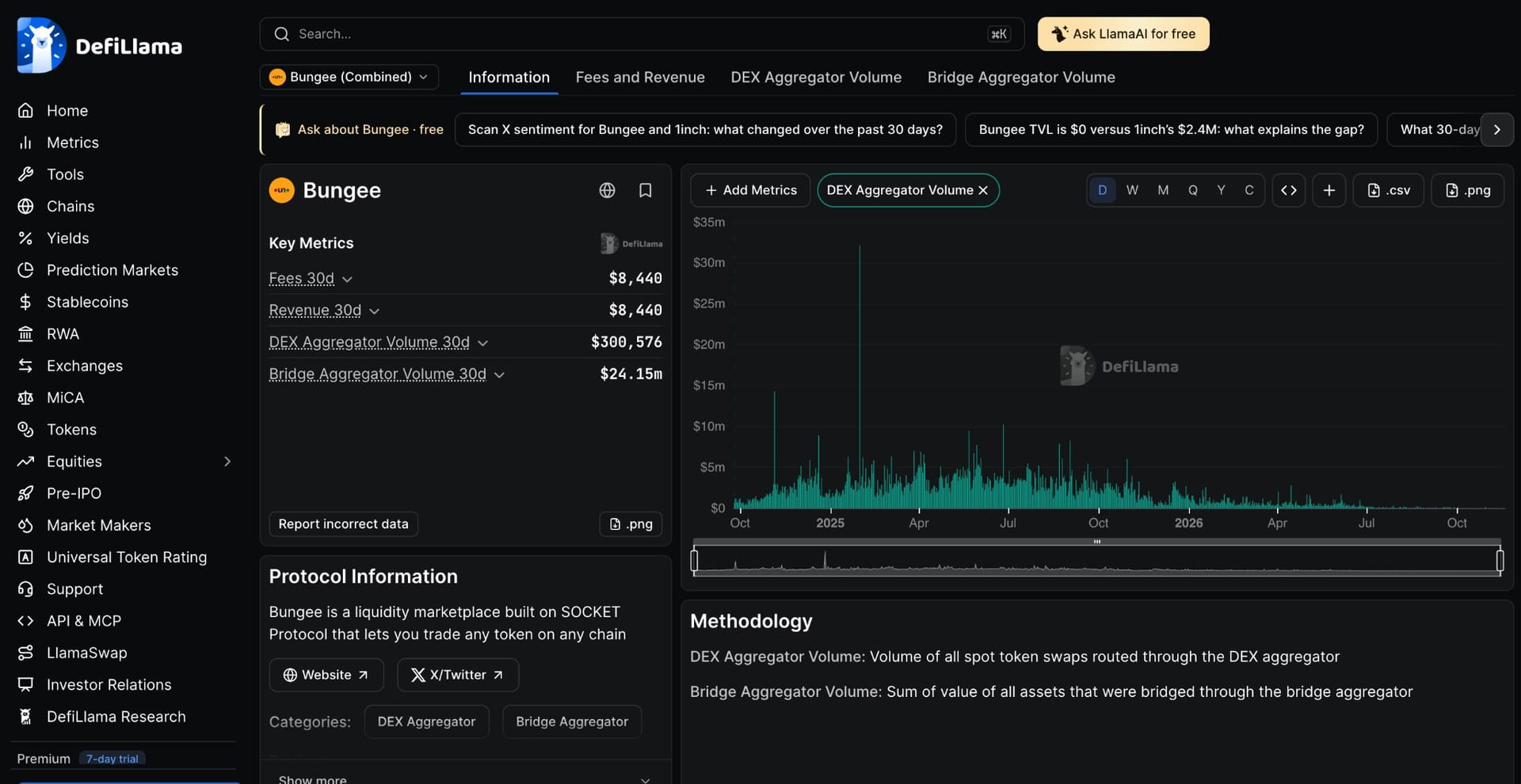
DefiLlama shows a steep drop in Bungee's swap activity. Daily DEX aggregator volume has shrunk through 2026, with about 300,000 dollars over the last 30 days.
Bridge aggregator volume held up better at about 24 million dollars over 30 days. Cumulative bridge volume is around 9.5 billion dollars.
Lower volume does not mean worse quotes, since Bungee routes through outside bridges and DEXs. It does suggest users and the team have moved their focus elsewhere. For an active alternative, see our LI.FI aggregator review.
What to note: a router's own volume is a signal of how actively it is maintained, so check recent activity before large transfers.
Who Bungee Suits
- Users who need exact output: Fixed Swap is handy for paying a set amount of stablecoins on another chain.
- Fee-sensitive swappers: Socket says it adds no extra fee on top of route costs.
- Traders: funded perps and the Terminal sit in the same app, for those who want them.
- Less suited to: users who want a swap-focused app with detailed public documentation.
How This Review Was Done
Facts come from bungee.exchange, Socket's documentation and audit repository, DefiLlama and reporting on the 2024 exploit, read on 18 November 2026. No trades were executed for this review.
Volume, trader and funding figures are company claims or third-party data. Funded perps and the Terminal were not assessed.
What to note: always compare the received amount with another aggregator before signing.
Risks and Limitations
- Bungee's focus has moved from swaps to leveraged trading products.
- Swap volume has fallen sharply through 2026.
- Detailed swap documentation now sits in general Socket docs.
- Unlimited approvals were the attack path in the 2024 exploit.
- Apps embedding Socket may add their own fees.
Conclusion
Bungee still offers a working cross-chain swap with no extra Socket fee and a useful Fixed Swap mode for exact stablecoin amounts.
The bigger story is the shift. Bungee now leads with funded perps and stocks, and its swap volume has dropped, which makes it a secondary choice for cross-chain transfers in 2026.
For stablecoin swaps, compare its quote with the routers in our list of stablecoin aggregators.
Read Next:
- Best Cross-Chain Aggregators 2026
- LI.FI Review 2026: Cross-Chain Aggregator for 60+ Chains
- Stablecoin Aggregators for Routing and Swaps in 2026
FAQs:
1. Does Bungee charge a fee?
Socket, which powers Bungee, says it does not charge any additional fees. Execution costs are included in the quote, and apps that embed Socket may add their own fee.
2. What is the difference between Floating Swap and Fixed Swap?
Floating Swap fixes the amount you send and lets the received amount vary. Fixed Swap fixes the exact amount you receive and shows what you need to pay.
3. Is Bungee the same as Socket?
Bungee is built and powered by the team behind Socket. Socket is the routing engine, and Bungee is the consumer app that now also offers funded perps, a trading terminal and stocks.
4. Was Bungee hacked?
In January 2024, an exploit hit wallets with unlimited approvals to Socket contracts and took at least 3.3 million dollars. Socket later said it recovered 1,032 ETH.
5. Is Bungee still a good bridge aggregator?
It still works and adds no extra Socket fee, but its swap volume has fallen sharply and the app now focuses on trading. Compare quotes with other aggregators before large transfers.
Disclaimer:
This content is provided for informational and educational purposes only and does not constitute financial, investment, or legal advice; no material herein should be interpreted as a recommendation, endorsement, or solicitation to buy or sell any token, and readers should conduct their own independent research or consult a qualified professional. Fees, features and figures are drawn from Bungee's website, Socket's documentation, DefiLlama and public reports at the time of writing, are not independently verified here, and may change. Bridging, swapping and leveraged trading carry smart contract, liquidity and market risks.