
Table of Contents
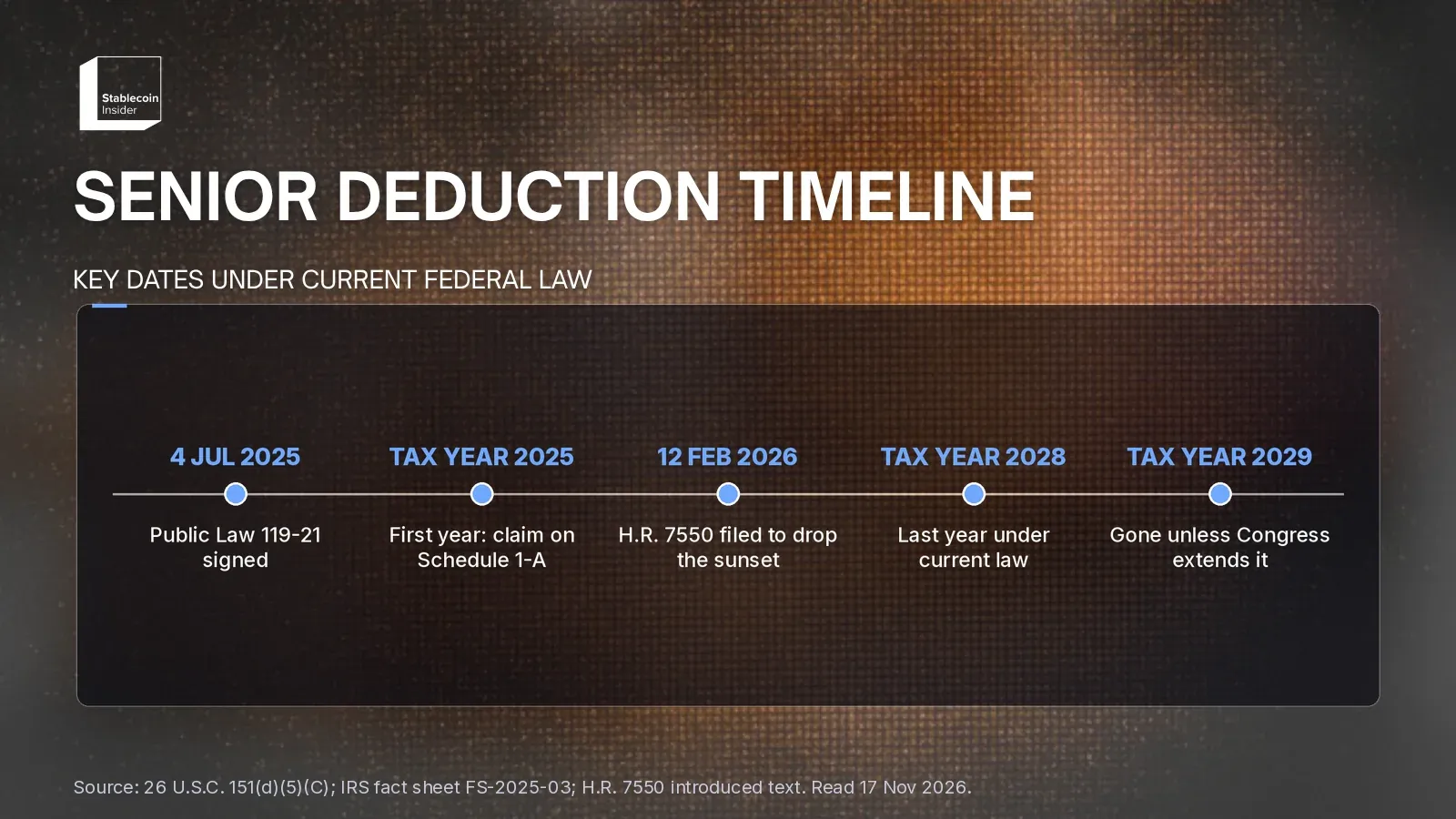
The senior tax deduction expires after tax year 2028. The law allows the extra $6,000 deduction only for a "taxable year beginning before January 1, 2029" (26 U.S.C. §151(d)(5)(C)), so for most people 2028 is the last year that counts and the 2028 return, filed in 2029, is the last one that can claim it.
The IRS describes the same window: "Effective for 2025 through 2028, individuals who are age 65 and older may claim an additional deduction of $6,000" (IRS fact sheet FS-2025-03). Its October 2026 senior flyer still says "through 2028" (IRS Publication 6142). Google Trends showed 500K+ US searches for "senior tax deduction expiration date" over the seven days to 17 November 2026. On 15 November, CNBC reported that lawmakers elected in the 3 November midterms may decide whether to extend the break.
Last updated: 17 November 2026. Law text, IRS forms and 2026–2027 inflation figures re-checked against IRS and congressional sources on this date. US federal income tax only.
Key Takeaways
- Under current law the $6,000 senior deduction covers tax years 2025, 2026, 2027 and 2028 only; it ends with tax years beginning on or after 1 January 2029 (§151(d)(5)(C)).
- You qualify for a tax year if you are 65 by the last day of that year, include a valid Social Security number and, if married, file jointly. It works whether you itemize or take the standard deduction (IRS).
- Each $6,000 amount shrinks by 6% of modified adjusted gross income (MAGI) above $75,000, or $150,000 on a joint return. That means it is fully gone at $175,000 for a single filer and at $250,000 for a couple who both qualify (Schedule 1-A).
- In our 2026 worked example, a 67-year-old single filer with $90,000 of MAGI gets a $5,100 deduction, which cuts federal income tax by $1,122 at the 22% rate.
- H.R. 7550, introduced on 12 February 2026, would remove the sunset for tax years after 2026. The text we read is the introduced version only, referred to the Ways and Means Committee (GovInfo).
When does the senior tax deduction expire?
The senior tax deduction expires for tax years that begin on or after 1 January 2029. The sunset sits in the opening words of the provision: "In the case of a taxable year beginning before January 1, 2029, there shall be allowed a deduction in an amount equal to $6,000 for each qualified individual" (26 U.S.C. §151(d)(5)(C)(i)).
It started with tax year 2025, even though the law, Public Law 119-21, was signed on 4 July 2025 (IRS FS-2025-03). That gives four filing seasons: 2025 returns filed in 2026, then 2026, 2027 and 2028 returns filed in the following spring. Nothing in the provision ends it early. The $6,000 amount and the $75,000 and $150,000 thresholds are written as fixed dollar figures, with no inflation adjustment in the subparagraph.
Who qualifies for the $6,000 senior deduction?
You qualify for the $6,000 senior deduction if you are 65 or older on or before the last day of the tax year (IRS Tax Tip 2026-14). On a joint return, each spouse who meets the age test counts separately, so a couple can claim up to $12,000.
Three other conditions apply:
- Social Security number. Each qualifying person's SSN must be on the return. The statute borrows the child tax credit definition: an SSN issued to a US citizen or to someone authorized to work, and issued before the return's due date (26 U.S.C. §24(h)(7)).
- Joint filing if married. Married people must file jointly to claim it, so married filing separately is out (§151(d)(5)(C)(v)).
- Itemizing is fine. The deduction is available to both itemizers and people who take the standard deduction (IRS).
The forms turn the age test into a birth-date cutoff. The 2025 Schedule 1-A asks whether you were "born before January 2, 1961" (IRS), and the draft 2026 form uses January 2, 1962 (IRS draft). So if you were born on 1 January 1962, you count as 65 for 2026.
How does the senior deduction phase out with income?
The senior deduction phases out by 6% of your MAGI above $75,000, or above $150,000 on a joint return (§151(d)(5)(C)(iii)). For this rule, MAGI is your adjusted gross income plus any foreign earned income or US-territory income you excluded under sections 911, 931 or 933. If you have none of those exclusions, your MAGI equals your AGI.
In practice, each $1,000 above the threshold removes $60. Schedule 1-A works out one reduced amount and enters it once for you and once for a qualifying spouse (lines 31–36b). So a couple who both qualify keeps part of the deduction until $250,000 of MAGI.
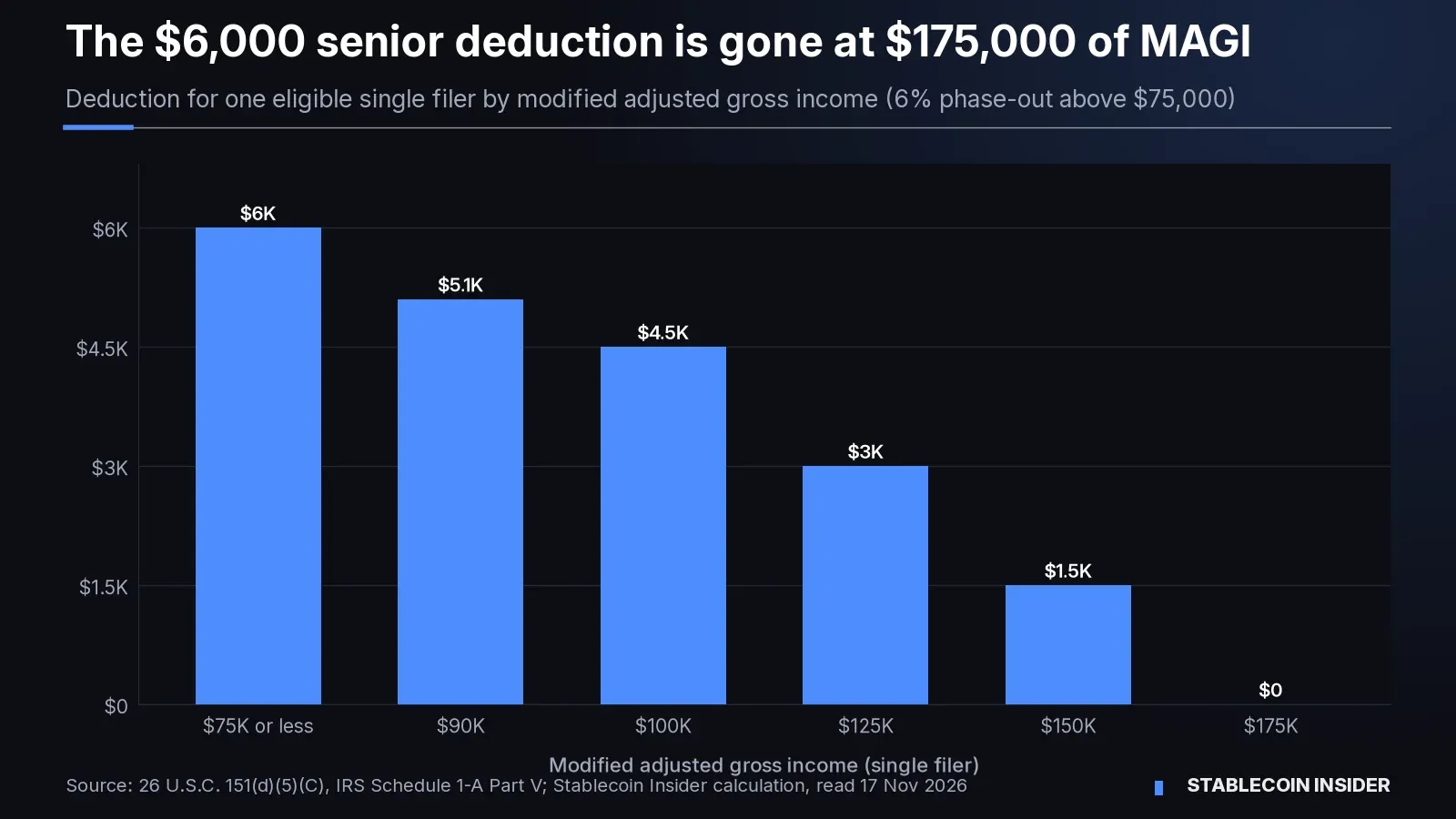
The table applies the same formula to the main filing situations. Each row is computed from the statute linked above.
| MAGI | Single, 65+ | Joint, one spouse 65+ | Joint, both 65+ |
|---|---|---|---|
| $75,000 | $6,000 | $6,000 | $12,000 |
| $100,000 | $4,500 | $6,000 | $12,000 |
| $150,000 | $1,500 | $6,000 | $12,000 |
| $175,000 | $0 | $4,500 | $9,000 |
| $200,000 | $0 | $3,000 | $6,000 |
| $250,000 | $0 | $0 | $0 |
The gap is the 6% rate. A single filer loses the whole deduction over a $100,000 band of income, while a couple who both qualify keep something until their income is $100,000 above the joint threshold.
How much does the senior deduction save in 2026?
The senior deduction saves roughly the deduction amount multiplied by your top tax rate. In our two 2026 examples below, that comes to $1,122 and $2,376. They use the IRS's 2026 figures: a standard deduction of $16,100 single or $32,200 joint (IR-2025-103), and an extra age-65 standard deduction of $2,050 for an unmarried person or $1,650 for each married person (Rev. Proc. 2025-32).
| Line (tax year 2026) | Single, age 67 | Joint, both 66 |
|---|---|---|
| MAGI (assumed equal to AGI) | $90,000 | $160,000 |
| Standard deduction | $16,100 | $32,200 |
| Age-65 standard add-on | $2,050 | $3,300 (2 × $1,650) |
| Senior deduction after phase-out | $5,100 ($6,000 − 6% × $15,000) | $10,800 (2 × $5,400) |
| Taxable income | $66,750 | $113,700 |
| Top bracket either way | 22% (single, over $50,400) | 22% (joint, over $100,800) |
| Tax saved by the senior deduction | $1,122 | $2,376 |
Both households stay in the 22% bracket with or without the deduction, so the saving is simply 22% of the deduction. If the deduction pulls part of your income into a lower bracket, the saving is smaller than that simple product. These examples leave out credits, state tax and the rules on how much of your Social Security is taxable. They show the mechanics, not your bill. For 2027 the IRS raised the standard deduction to $16,600 single and $33,200 joint (IR-2026-133), and the age-65 add-on to $2,100 unmarried or $1,700 married (Rev. Proc. 2026-35). The senior deduction itself stays at $6,000.
How do you claim the senior deduction on your return?
You claim the senior deduction on Schedule 1-A, Part V. The total then goes to Form 1040 or 1040-SR, line 13b (IRS Publication 6142). On the 2025 form, the steps are:
- Enter your MAGI on line 31 and $75,000 ($150,000 if joint) on line 32.
- Subtract line 32 from line 31 on line 33. If the result is zero or less, enter $6,000 on line 35.
- Multiply line 33 by 6% on line 34, then subtract it from $6,000 on line 35.
- Enter line 35 on line 36a if you meet the birth-date and SSN test, and again on 36b for a qualifying spouse on a joint return.
- Add them on line 37 and carry the total through line 38 to Form 1040 line 13b.
The steps are the same on the draft 2026 form, but the line numbers move to 37–43 (IRS draft, not for filing). Use the final form when the IRS publishes it.
Could Congress extend the senior deduction past 2028?
Congress could extend the senior deduction past 2028, but under current law it ends. One bill to make it permanent has been filed. H.R. 7550, the Permanent Tax Relief for Seniors Act, was introduced on 12 February 2026 by Rep. Mariannette Miller-Meeks with Reps. Anna Paulina Luna and Gus Bilirakis, and referred to the Ways and Means Committee (GovInfo). It would delete the "taxable year beginning before January 1, 2029" wording for tax years beginning after 31 December 2026.
The introduced text is the only version we found. Until a bill is enacted, plan on 2028 as the last year. According to CNBC, some Republican candidates said during the midterm campaign that they would extend the deduction. CNBC also quoted Jessica Riedl of the Urban-Brookings Tax Policy Center saying she would not expect either party to let senior tax cuts expire in the 2028 presidential election year. That is a forecast, not a law change.
Does the senior deduction affect Social Security's trust funds?
The senior deduction does reduce money going into Social Security's trust funds, according to the program's trustees. Their 2026 message says the law "adds a temporary additional standard deduction for taxpayers over age 65". As a result of this and other tax provisions, the funds "will receive lower levels of revenue in the future from income taxation of Social Security benefits" (2026 Trustees message).
The same message projects that the retirement (OASI) trust fund can pay full benefits until the fourth quarter of 2032. That is one quarter earlier than the year before. After that, income would cover 78% of scheduled benefits (Trustees). The trustees name the law as one of three main reasons the program's long-term finances worsened, alongside lower fertility and immigration assumptions. They do not attribute the change to the senior deduction alone.
The same 2025 law also created the 1% tax on cash remittances. See our guide to the US remittance tax. If you hold crypto, taxable gains count toward the AGI that drives this phase-out. Our US stablecoin tax guide covers how the IRS treats those, and our crypto tax software comparison covers tools that track cost basis.
Comparing tax changes for 2026? See five IRS changes affecting stablecoin holders in 2026.
FAQ
Does the senior deduction eliminate tax on Social Security benefits?
Can I claim the senior deduction if I itemize?
Can married couples filing separately claim the senior deduction?
Is the $6,000 senior deduction adjusted for inflation?
Do I qualify for 2026 if I turn 65 on January 1, 2027?
Sources: 26 U.S.C. §151 (Cornell LII); 26 U.S.C. §24(h)(7); IRS FS-2025-03; IRS: check your eligibility for the enhanced deduction for seniors; IRS Tax Tip 2026-14; IRS Publication 6142 (Rev. 10-2026); 2025 Schedule 1-A; 2026 Schedule 1-A draft; IRS IR-2025-103; Rev. Proc. 2024-40; Rev. Proc. 2025-32; IRS IR-2026-133; Rev. Proc. 2026-35; H.R. 7550 (introduced text); Rep. Miller-Meeks press release; 2026 Social Security and Medicare Trustees message; CNBC, 15 Nov 2026. All read on 17 November 2026.
This content is provided for informational and educational purposes only and doesn't constitute financial, investment, legal or tax advice. It covers US federal income tax as of 17 November 2026, based on the statute, IRS publications and forms, and congressional records read on that date. The IRS, Congress and the Social Security trustees are mentioned for reference only. Tax law can change; check the final IRS forms or a qualified tax professional before filing.