
Table of Contents
CoW Swap is the DEX aggregator known for protecting traders from MEV, the value bots extract by front-running and sandwiching trades. Instead of sending your trade straight to a pool, it collects orders into batch auctions where competing solvers bid to fill them.
For stablecoin users, CoW Swap's 2026 fee schedule has one standout line. The protocol charges no volume fee on stablecoin-to-stablecoin swaps, though it still takes a share of any price improvement it finds for you.
This review covers how CoW Swap works, its full fee model, MEV protection, supported chains, the April 2026 domain incident and who it suits.
CoW Swap does not charge a volume fee on stablecoin pairs, but it keeps half of any improvement over your quote. The quote is the price you agree to, and anything better is shared.
Key Takeaways
- Stablecoin-to-stablecoin swaps carry a 0 bps protocol volume fee.
- CoW Swap keeps 50% of any improvement over your quote.
- Batch auctions and solvers protect trades from sandwich attacks.
- TWAP orders now work from any wallet, not only multisigs.
- Its domain was hijacked in April 2026; backend systems were paused.
What CoW Swap Is
CoW Swap is the main trading interface built on CoW Protocol, an open-source trading protocol governed by CoW DAO. Other apps, including the Safe wallet, also route trades through the protocol.
CoW DAO says CoW Swap has handled more than 83 billion dollars in volume and found over 441 million dollars in surplus for users. Across every app using CoW Protocol, it reports more than 200 billion dollars in trades.
Its name comes from "coincidence of wants": when two traders in the same batch want opposite sides of a trade, CoW Swap can match them directly without touching a pool at all. To see how that approach compares with other routers, check our list of DEX aggregators for stablecoins.
What to note: CoW Swap is non-custodial, so funds stay in your wallet until the trade settles.
How Batch Auctions and Solvers Work
When you place a swap, you sign an order rather than a transaction. Orders are grouped into frequent batches, and independent solvers compete to find the best way to fill each batch.
The winning solver is the one that delivers the most value to traders. It settles the whole batch in one transaction and pays the gas, which is recovered from the order rather than charged separately.
Because the trade never sits in the public mempool as a swap transaction, bots cannot see and sandwich it. CoW DAO describes MEV as a problem worth more than 1.4 billion dollars that its design avoids.
What to note: batch settlement can take longer than a direct swap, so CoW Swap suits trades where price matters more than seconds.
CoW Swap Fees in 2026
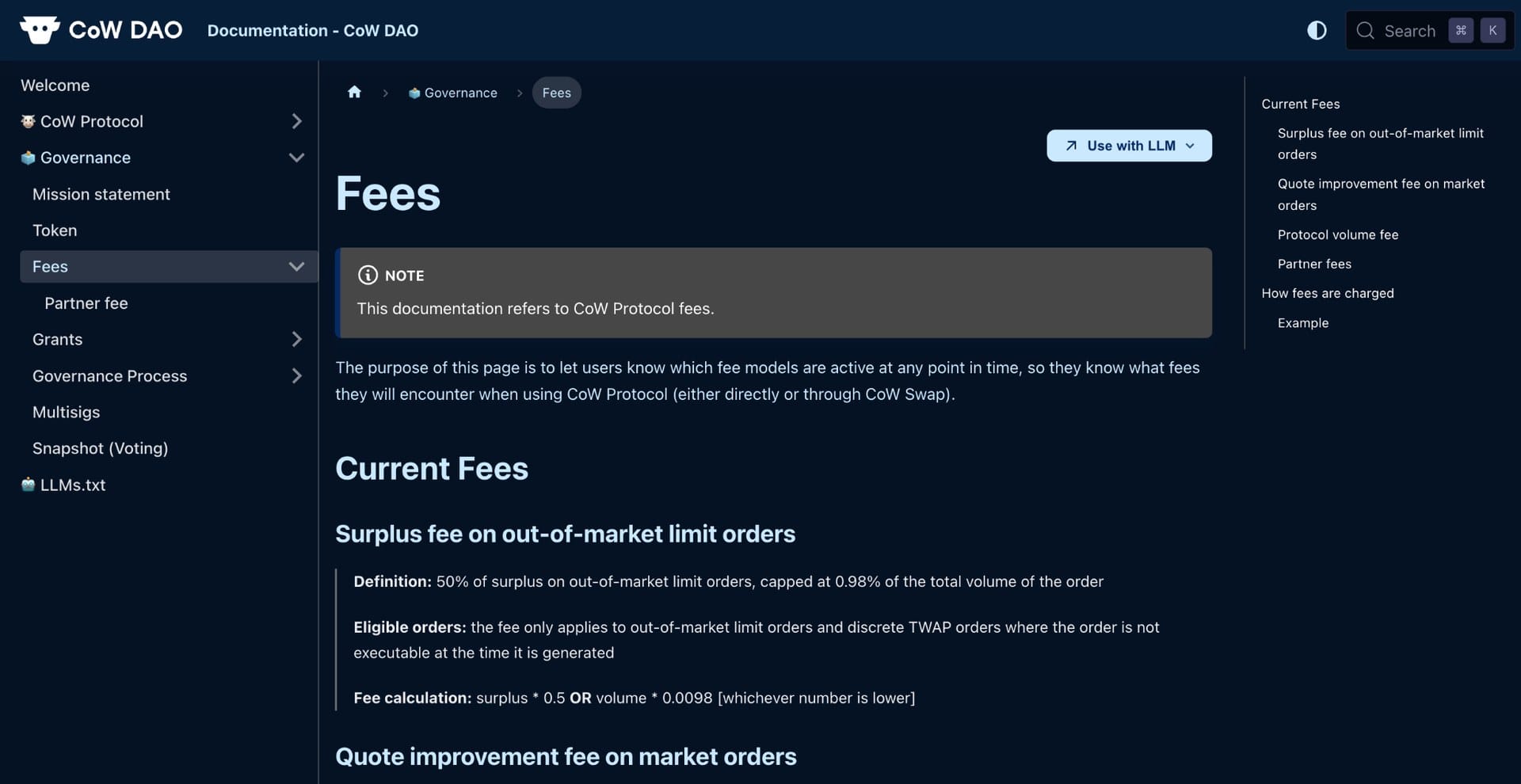
CoW DAO publishes its current fees in its documentation. All fees are taken from the token you receive, so they lower your output rather than appearing as a separate payment.
| Fee | Applies to | Rate |
|---|---|---|
| Protocol volume fee | Stablecoin and other correlated pairs | 0 bps |
| Protocol volume fee | Standard assets | 2 bps |
| Quote improvement fee | Market orders filled better than quoted | 50% of the improvement, capped at 0.98% of volume |
| Surplus fee | Out-of-market limit and TWAP orders | 50% of surplus, capped at 0.98% of volume |
| Partner fee | Apps that integrate CoW Protocol | Set by the partner, up to 100 bps |
The quote improvement fee only applies when you receive more than you were quoted. If the fill is worse than the quote, no fee is taken, so you never receive less than the amount you signed for because of this fee.
What to note: on a USDC to USDT swap, the main cost is gas recovered from the order, not the protocol fee.
What a Stablecoin Swap Actually Costs
Take a 10,000 dollar USDC to USDT swap on CoW Swap's own interface. The protocol volume fee is zero because both tokens are stablecoins.
If the solver fills the order 5 dollars better than the quote, CoW Swap keeps 2.50 dollars and you receive the other 2.50 dollars on top of your quote. If the fill matches the quote exactly, the protocol takes nothing beyond the network cost built into the order.
Apps that embed CoW Protocol can add a partner fee of up to 1 percent. The same swap through a third-party app can therefore cost more than on swap.cow.fi, a point worth checking whenever you use an aggregator inside a wallet, as our guide to exchanging stablecoins with aggregators explains.
What to note: compare the minimum received against another aggregator rather than the fee line alone.
Order Types, Chains and Cross-Chain Swaps
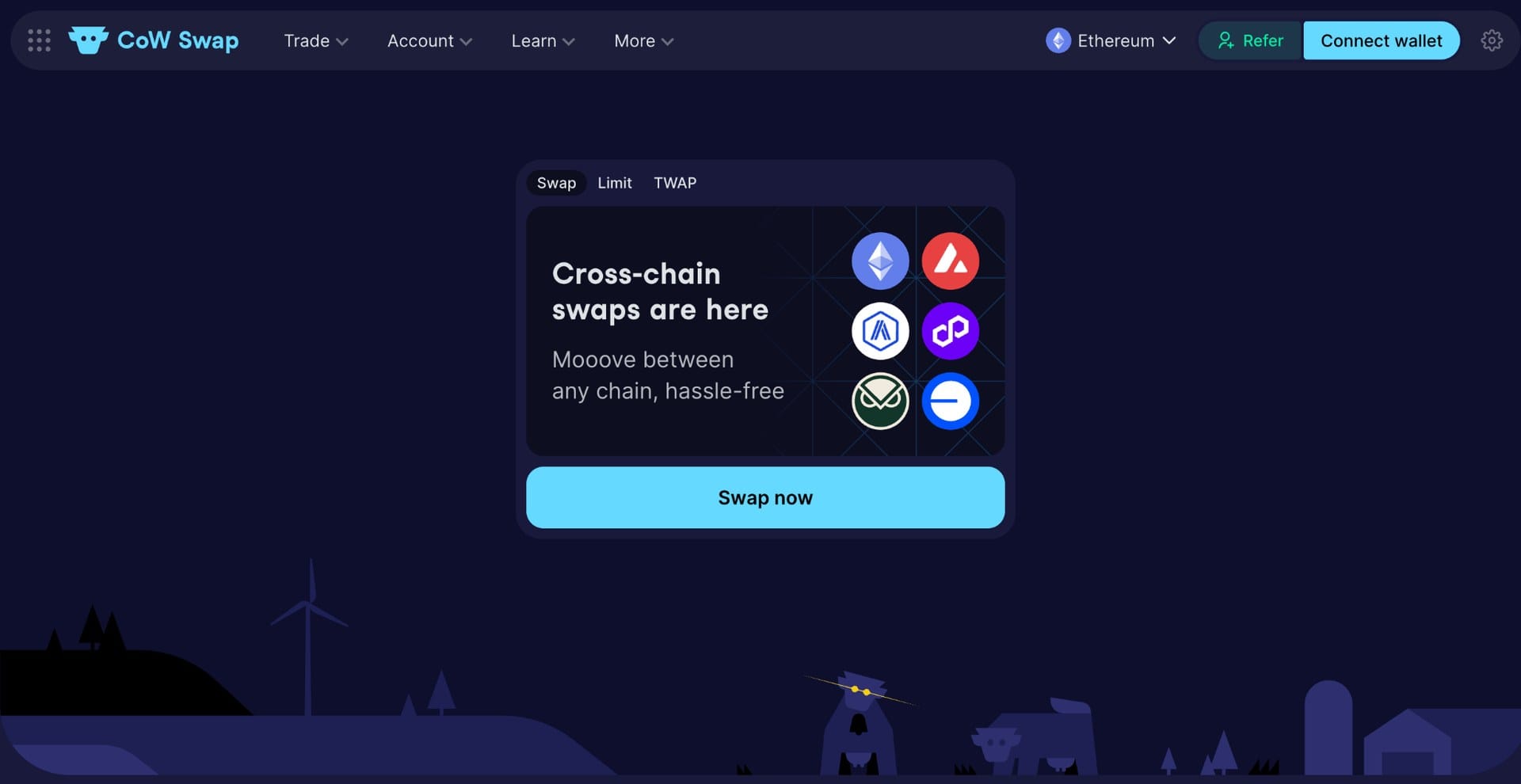
The CoW Swap app offers three order types: Swap, Limit and TWAP. TWAP splits a large order into smaller pieces over time, and since September 2026 it works from any standard wallet, not only from Safe multisigs.
The Ethereum Foundation has used TWAP orders to convert ETH to stablecoins, including 5,000 ETH in April 2026, according to CoW DAO. That makes TWAP one of the more practical tools for treasuries moving size into USDC or USDT.
The app now advertises cross-chain swaps, and in May 2026 CoW Swap launched on Solana using NEAR Intents for cross-chain execution. Most activity still happens on Ethereum, which accounts for the large majority of fees on DefiLlama.
What to note: check that your chain is listed in the network menu before sending funds, since support differs by order type.
Security Record
On 14 April 2026, attackers hijacked the DNS for swap.cow.fi and redirected visitors to a malicious copy of the site, according to CoinDesk. CoW DAO paused its backend and APIs as a precaution and told users to avoid the domain.
The team launched a temporary interface at another address while it regained control of the domain. Coverage reviewed for this article did not report any confirmed losses or any problem with CoW Protocol's smart contracts.
The incident shows that front-end attacks can hit even protocols with sound contracts. Bookmarking the official site and checking the URL before signing remain basic but important steps.
What to note: never sign a token approval on a site reached from a search ad or a link in a direct message.
Who CoW Swap Suits
- Large stablecoin trades: zero volume fee on stable pairs and MEV protection suit bigger USDC, USDT and DAI swaps.
- Treasuries and DAOs: TWAP orders and Safe integration help spread large conversions over time.
- MEV-conscious traders: batch auctions keep swaps out of the public mempool.
- Less suited to: traders who need instant execution, or who want every improvement over the quote for themselves.
How This Review Was Done
Facts come from CoW DAO's documentation, product pages and the CoW Swap app, read on 17 November 2026, plus DefiLlama data and news coverage. No trades were executed for this review.
Volume and surplus figures are CoW DAO's own numbers. Fee rates come from the published fee page, which governance can change.
What to note: always check the live quote and minimum received before signing.
Risks and Limitations
- Half of any price improvement over the quote goes to the protocol.
- Batch settlement is slower than a direct swap.
- Partner apps can add fees of up to 1 percent.
- The April 2026 DNS hijack shows front-end risk remains.
- Fee rates are set by CoW DAO governance and can change.
Conclusion
CoW Swap is one of the strongest options for stablecoin swaps in 2026. It charges no volume fee on stable pairs, protects against sandwich attacks and offers TWAP orders for large conversions.
The trade-off is the quote improvement fee. You always receive at least your quote, but half of anything better goes to the protocol.
Compare the received amount with at least one other route from our list of stablecoin aggregators, especially on larger trades.
Read Next:
- Best DEX Aggregators for Stablecoin Swaps in 2026
- How to Exchange Stablecoins With DeFi Aggregators
- Stablecoin Aggregators for Routing and Swaps in 2026
FAQs:
1. Does CoW Swap charge fees on stablecoin swaps?
There is no protocol volume fee on stablecoin-to-stablecoin swaps. CoW Swap does keep 50% of any improvement over your quote, and network costs are built into the order.
2. How does CoW Swap protect against MEV?
Orders are signed off-chain and settled in batch auctions by competing solvers, so swaps never sit in the public mempool where bots could sandwich them.
3. Is CoW Swap gasless?
You do not pay gas separately. The solver pays it and the cost is taken from the order, so it is reflected in the amount you receive.
4. Is CoW Swap safe?
CoW Swap is non-custodial. Its domain was hijacked in April 2026, and the team paused its backend as a precaution. No confirmed losses were reported in the coverage reviewed.
5. What is a CoW Swap TWAP order?
A TWAP order splits a large trade into smaller parts executed over time to reduce price impact. Since September 2026 it works from any standard wallet.
Disclaimer:
This content is provided for informational and educational purposes only and does not constitute financial, investment, or legal advice; no material herein should be interpreted as a recommendation, endorsement, or solicitation to buy or sell any token, and readers should conduct their own independent research or consult a qualified professional. Fees, features and figures are drawn from CoW DAO's documentation and website, DefiLlama and public reports at the time of writing, are not independently verified here, and may change. Swapping tokens carries smart contract, front-end, liquidity and market risks.


