Table of Contents
B2B stablecoin payment flows reached $226 billion annually, growing 733% year over year, according to a February 2026 analysis by McKinsey and Artemis Analytics.
Business-to-business transactions now account for roughly 58–60% of all genuine stablecoin payment volume, which means B2B is not a side effect of the stablecoin payments market, it is the market.
Behind that headline number sits a payment model that is structurally different from correspondent banking: settlement in minutes, costs measured in fractions of a percent, and availability around the clock.
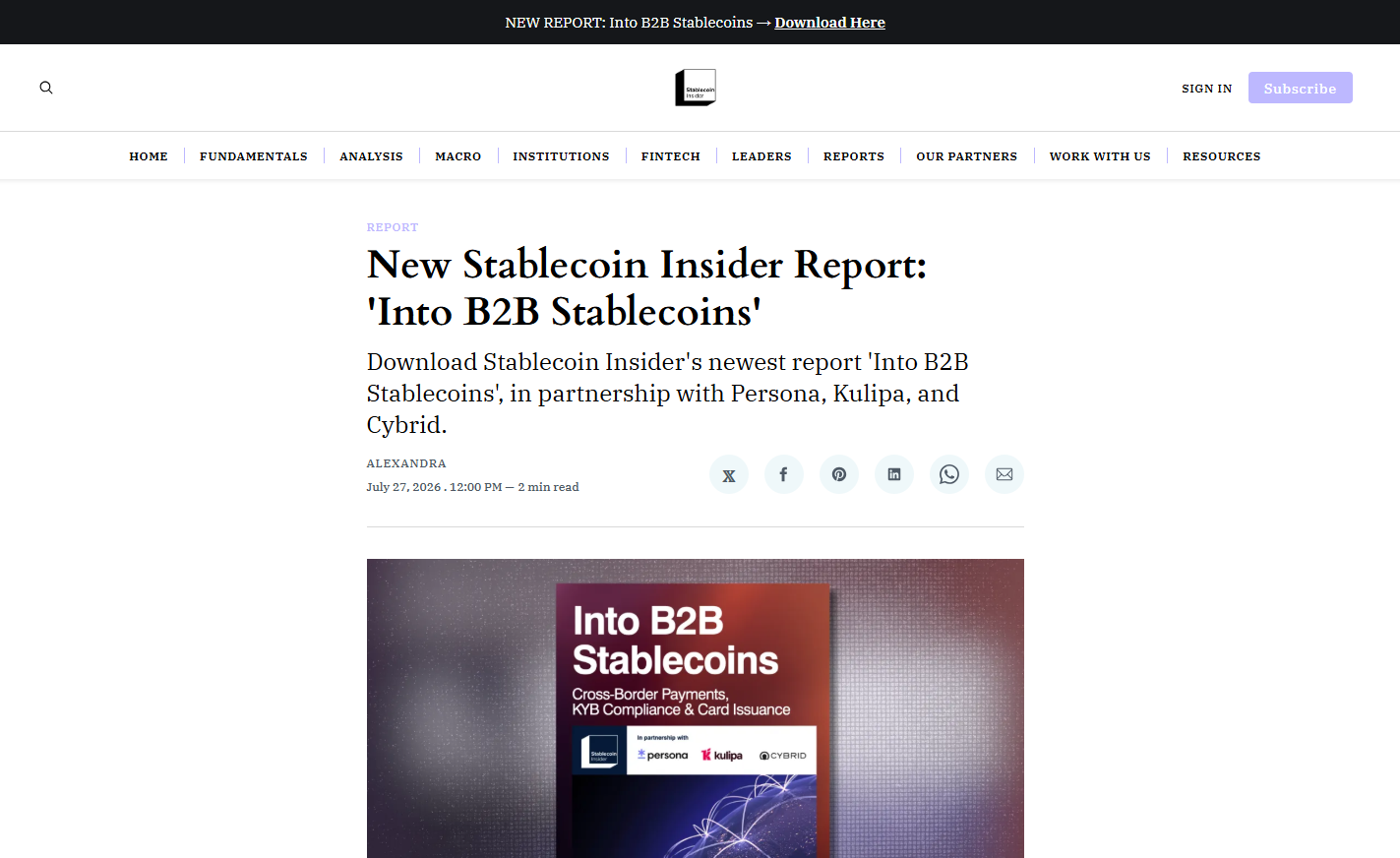
Drawing on findings from the July 2026 report, Into B2B Stablecoins: Cross-Border Payments, KYB Compliance & Card Issuance, this article breaks down how a stablecoin B2B cross-border payment actually works end to end, where the real costs and friction sit, and how fast the market is growing in 2026.
Key Takeaways
- B2B stablecoin flows hit $226 billion annually, growing 733% year over year.
- Stablecoin payments settle in minutes and cost roughly 0.1–0.5% per transaction.
- Most remaining friction sits at fiat on/off-ramps, not on the blockchain layer.
- Orchestration combines fiat and stablecoin rails to route around the weakest link.
- Independent analyses from BCG and Deutsche Bank confirm 60–65% annual B2B growth.
Why Legacy Cross-Border B2B Payments Are Broken
A conventional international wire is not a single transaction, it is a relay race between intermediaries. A payment from a business in one country to a supplier in another typically passes through the sender's bank, one or more correspondent banks, and the recipient's bank. Each hop adds fees, FX spread, and time.
The structural problems compound from there. Funds are frequently pre-positioned in nostro/vostro accounts, trapping working capital. Settlement can take multiple business days with limited visibility into where a payment sits at any given moment. And for corridors outside the well-trodden major-currency routes, the experience degrades further: fewer correspondent relationships, wider spreads, and higher failure rates.
According to BCG's January 2026 white paper, stablecoin use cases tend to emerge precisely where traditional rails face structural problems: cross-border settlement timing, high FX costs, trapped liquidity, delayed finality, and complex payout workflows. That is an almost exact description of correspondent banking's weak points, and it explains why cross-border B2B has become the leading real-economy stablecoin use case.
How a Stablecoin B2B Payment Works: The Four-Leg Flow
The most important thing to understand about a B2B cross-border stablecoin payment is that it is not one crypto transfer. Cybrid's founder and CTO, Brent Carrara, describes it as a four-leg flow, often called the "stablecoin sandwich", and understanding each leg is the key to understanding where the experience still falls short of a seamless SWIFT replacement.
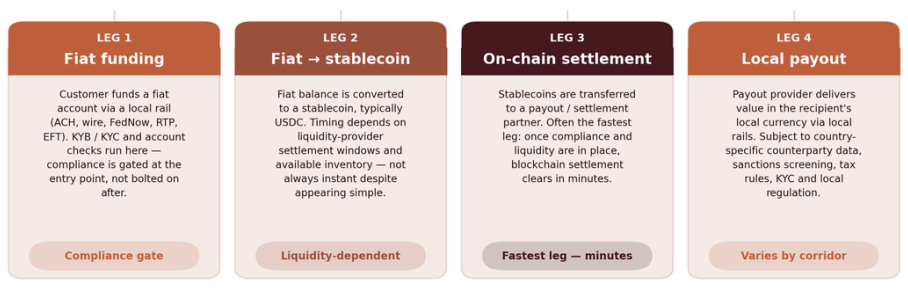
Leg 1: Fiat funding
The customer funds a fiat account via a local rail such as ACH, wire, FedNow, RTP, or EFT. KYB, KYC, and account checks run here, meaning compliance is gated at the entry point rather than bolted on afterward.
This is why identity infrastructure providers like Persona describe business verification as the gating function for the entire stablecoin payment stack: no payment happens for a counterparty the platform has not been able to verify and risk-assess.
Leg 2: Fiat-to-stablecoin conversion
The fiat balance is converted to a stablecoin, typically USDC. Timing depends on liquidity-provider settlement windows and available inventory, not always instant, despite appearing simple.
Leg 3: On-chain settlement
Stablecoins are transferred to a payout or settlement partner. This is often the fastest leg: once compliance and liquidity are in place, blockchain settlement clears in minutes.
Leg 4: Local payout
A payout provider delivers value in the recipient's local currency via local rails, subject to country-specific counterparty data, sanctions screening, tax rules, KYC, and local regulation.
Stablecoin Payments vs. Traditional Wires: Cost and Speed Comparison
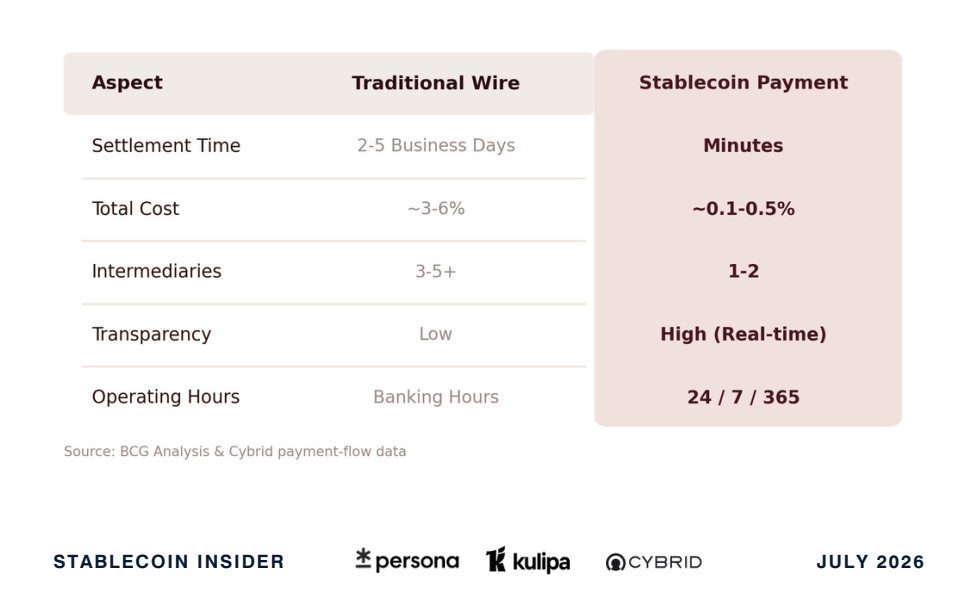
The economics of the two models diverge sharply, based on BCG analysis and Cybrid payment-flow data:
| Aspect | Traditional Wire | Stablecoin Payment |
|---|---|---|
| Settlement time | 2–5 business days | Minutes |
| Total cost | ~3–6% | ~0.1–0.5% |
| Intermediaries | 3–5+ | 1–2 |
| Transparency | Low | High (real-time) |
| Operating hours | Banking hours | 24/7/365 |
Cost reductions of up to 95% versus international wire reflect the upper end of what corridor-dependent savings can reach when a multi-hop wire is replaced by an orchestrated stablecoin flow. The displacement of multiple correspondent-banking intermediaries with a near-instant on-chain settlement leg removes layers of fees and FX spread.
Where the Friction Actually Sits in 2026
Here is the finding that should reframe how financial institutions think about stablecoin payments: the biggest friction points remain at the edges, not on the blockchain layer. According to Cybrid, the constraints that still make the experience fall short of a fully seamless SWIFT replacement are almost all fiat-side:
- ACH (US) and EFT (Canada) can still take days to fully clear: The slowest part of a "fast" stablecoin payment is frequently the legacy domestic rail used to fund it.
- Wires are costly and not universally available: The fast funding option is expensive; the cheap options are slow.
- Instant rails such as FedNow and RTP are powerful but not universally supported: The infrastructure to remove the funding-leg delay exists, but bank coverage is incomplete.
The remaining work in cross-border B2B stablecoin payments is not primarily a blockchain problem, it is a fiat on/off-ramp and banking-connectivity problem. The on-chain leg already behaves the way enterprises wish all their payments behaved.
How Payment Orchestration Abstracts the Complexity
The practical answer to a four-leg flow with friction concentrated at the edges is orchestration: a layer that hides the complexity behind a single interface.
According to Cybrid, orchestration abstracts this complexity by:
- Supporting the fastest available fiat rails so funding latency is minimized wherever the underlying banking infrastructure allows
- Providing 24/7 settlement where possible, decoupling payments from banking hours and weekends
- Offering instant settlement for slower rails without requiring customer pre-funding, directly attacking correspondent banking's trapped-working-capital problem
- Integrating multiple payout providers for both coverage and competitive FX pricing
- Exposing simple APIs for end-to-end quotes, so a business sees the all-in cost and timing before committing
- Managing failed-payment reversals, a non-trivial operational burden in multi-leg cross-border flows
The strategic point is that multi-rail connectivity, combining ACH, RTP, wires, and stablecoin rails inside a single payment flow, is what lets a platform route around the weakest link in any given corridor.
The stablecoin leg is one tool in the orchestration kit, deployed where its advantages in speed, 24/7 finality, and cost are most pronounced.
Market Growth: What the 2026 Data Shows
The market is growing fast, and platform-level data aligns tightly with independent analysis.
Platform-level growth
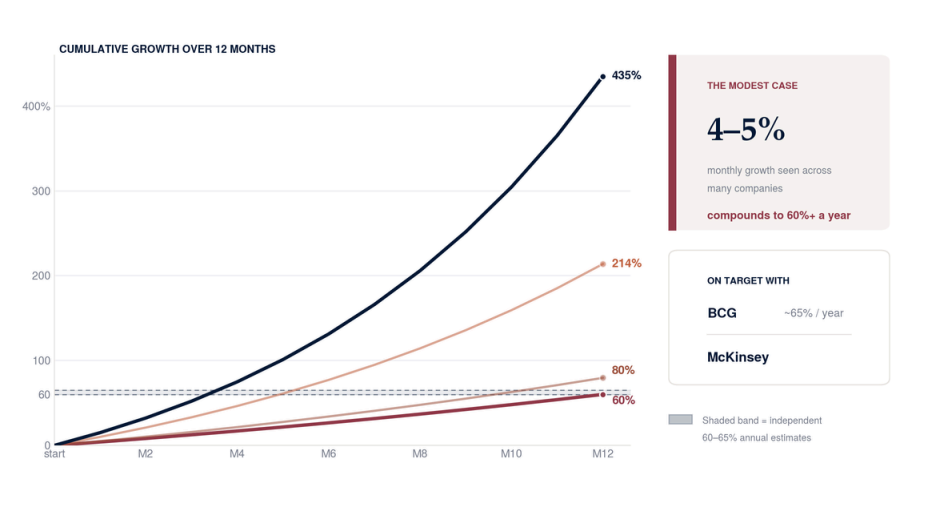
Cybrid data show that at the top end, some companies are growing 10–15% per month across both remittance and B2B categories. Even the more modest 4–5% monthly growth seen across many companies compounds to 60%+ annually.
Independent validation
That cross-check holds up from two separate vantage points. BCG's January 2026 white paper puts B2B stablecoin payment growth at approximately 65% per year, and Deutsche Bank's 2026 digital assets outlook cites real-economy stablecoin payments growing roughly 60% year over year, with B2B by far the largest area of growth.
The scale context
Of the roughly $35 trillion that moved across stablecoin networks on a trailing basis through February 2026, only about $390 billion was a real payment, roughly 1% of on-chain volume. That $390 billion is also a rounding error against the roughly $160 trillion global B2B payments market.
The growth rates are extraordinary precisely because the base is small, but the part that is real is overwhelmingly business activity, compounding at rates the legacy payments world has not seen in a generation.
Leading B2B Use Cases Driving Volume
According to Cybrid, the top B2B use cases driving volume through its platform are:
- Payroll and contractor payments: paying distributed and cross-border workforces
- Vendor and supplier payments: the core cross-border procurement use case
- Intra-company transfers: treasury and cash management across entities and geographies
These map directly onto what the broader market reports as the dominant B2B drivers, and they share a common profile: recurring, directional, and often crossing borders where correspondent banking is slowest.
Corridor Maturity: Where Adoption Is Concentrated
The geographic picture splits into mature and emerging markets. According to Cybrid, mature markets for remittance, as sender or receiver, include India, the United States, Canada, and Brazil. Growing markets include Latin America excluding Brazil, Africa, and smaller Asian economies such as Malaysia.
The wider McKinsey/Artemis data adds the global picture: Asia leads stablecoin payment activity at roughly 60% of volume, driven largely by Singapore, Hong Kong, and Japan, while adoption accelerates across Latin America and Europe. The underlying pattern is consistent across both lenses: maturity is highest where either payment volumes are largest or the legacy alternative is weakest.
Settlement Economics: Cost and Working Capital
The economic case for stablecoin B2B payments rests on two pillars.
1. Cost
Replacing multiple correspondent-banking intermediaries with a near-instant on-chain settlement leg strips out layers of fees and FX spread, with corridor-dependent savings reaching up to 95% versus international wire at the upper end.
2. Working capital
The ability to settle without pre-funding directly releases the cash that correspondent banking traps in pre-positioned nostro/vostro accounts. For a treasury team, near-instant clearing is not merely a convenience, it changes the liquidity math.
The Regulatory Backdrop Accelerating Adoption
Regulatory clarity has arrived faster than prevailing skepticism assumed, and it is the single biggest unlock pulling enterprise treasurers off the sidelines.
The GENIUS Act is now U.S. law as of July 2025, with implementing rules being finalized through 2026. The EU's MiCA transitional period closed on 1 July 2026, after which full authorization became mandatory to provide crypto-asset services in the EU.
APAC interoperability work, Singapore's Project Guardian and Hong Kong's Project Ensemble, is building the practical cross-regime frameworks cross-border operators most need.
What to Expect Over the Next 12–18 Months
Infrastructure providers are set to spend the next 12 to 18 months simplifying the user experience by further abstracting complex backend elements: automating compliant on/off-ramps, wallet management, and stablecoin liquidity, alongside achieving deeper local liquidity and accelerated settlement cycles.
These capabilities will be delivered via streamlined APIs, enabling stablecoin payments to be embedded into the treasury and payment platforms businesses already rely on.
The ultimate goal, as Cybrid's leadership frames it, is to meet demand for "dollar-in, payment-out" workflows supported by auditable, bank-grade infrastructure that satisfies both regulators and CFOs.
The window is also competitive: stablecoin card issuer Kulipa argues that enterprises standardizing on stablecoin rails now will lock in 18–24 months of treasury-efficiency advantage, while those waiting for perfect regulatory certainty will find their competitors got there first.
The next 12 to 18 months will not be decided by whether the technology or the regulation arrives, both largely have, but by whether the market can convert a fast-growing small base into the operational default.
Conclusion
Cross-border B2B payments are the most mature layer of the stablecoin stack in 2026, and the practitioner picture is clear: on-chain settlement is fast and reliable, the remaining friction is concentrated in fiat funding and local payout, and orchestration is the discipline that ties multi-rail flows together to route around the weakest link.
With $226 billion in annual B2B flows growing 733% year over year, and independent analyses confirming 60–65% sustained growth, the trajectory points in one direction.
For the full analysis, including the KYB compliance and card issuance layers, download the complete Into B2B Stablecoins report, and get in touch to explore how these insights apply to your payment infrastructure.
Read Next:
FAQs:
1. What are stablecoin B2B cross-border payments?
Stablecoin B2B cross-border payments are business-to-business transactions that use stablecoins like USDC as the settlement layer between fiat currencies, typically flowing through a four-leg process: fiat funding, fiat-to-stablecoin conversion, on-chain settlement, and local-currency payout.
2. How much do stablecoin B2B cross-border payments cost in 2026?
Stablecoin B2B cross-border payments cost roughly 0.1–0.5% per transaction in 2026, compared to approximately 3–6% for traditional international wires, with corridor-dependent savings reaching up to 95% at the upper end.
3. How fast are stablecoin B2B payments compared to traditional wires?
Stablecoin B2B payments settle in minutes on the blockchain leg and operate 24/7/365, compared to traditional wires that take 2–5 business days and are limited to banking hours.
4. How fast is the stablecoin B2B payments market growing in 2026?
The stablecoin B2B payments market is growing 733% year over year according to McKinsey and Artemis Analytics, reaching $226 billion in annual flows, with BCG and Deutsche Bank independently confirming sustained annual growth of 60–65%.
5. What is the biggest friction point in stablecoin B2B payments today?
The biggest friction point in stablecoin B2B payments today is the fiat on/off-ramp layer, not the blockchain: legacy funding rails like ACH and EFT can take days to clear, while the on-chain settlement leg already clears in minutes.
Disclaimer:
This content is provided for informational and educational purposes only and does not constitute financial, investment, legal, or tax advice; no material herein should be interpreted as a recommendation, endorsement, or solicitation to buy or sell any financial instrument, and readers should conduct their own independent research or consult a qualified professional.