Table of Contents
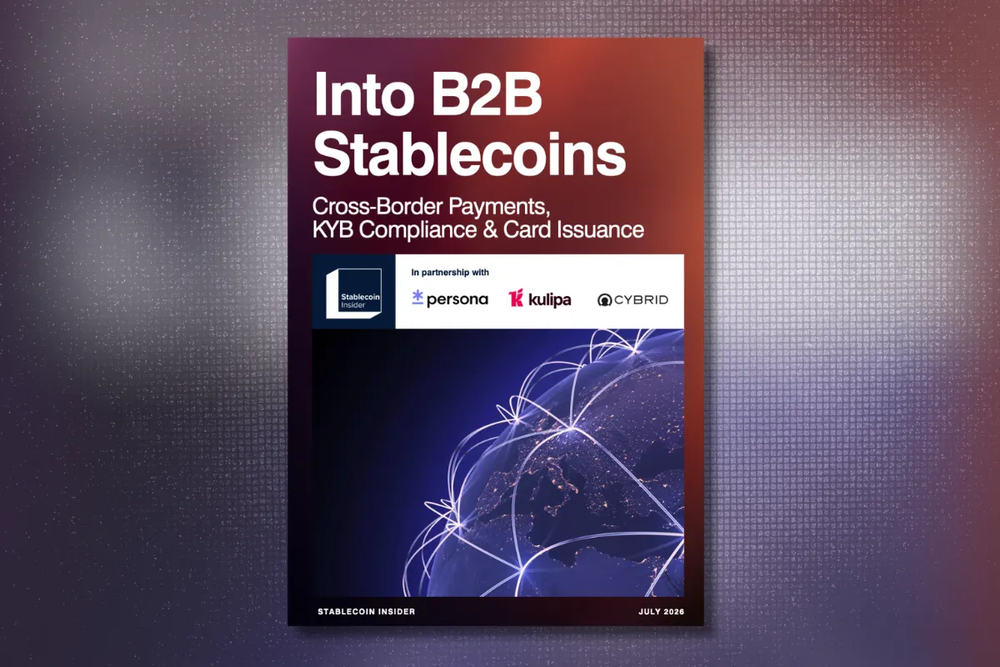
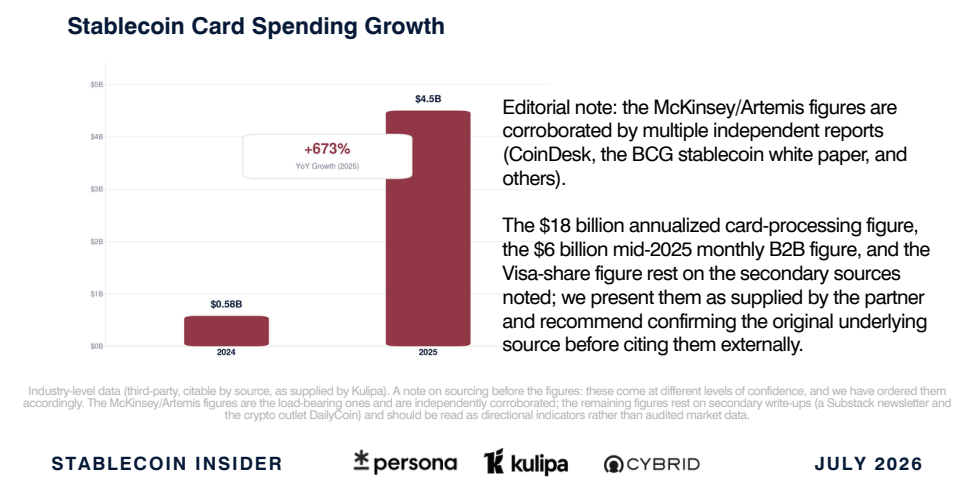
Stablecoin-linked card spending reached $4.5 billion in 2025, up 673% from 2024, according to McKinsey and Artemis Analytics data cited in the July 2026 report Into B2B Stablecoins: Cross-Border Payments, KYB Compliance & Card Issuance.
Card issuance is the smallest of the three layers in the B2B stablecoin stack in absolute terms, but it is among the fastest-growing, and it solves a problem that has quietly held businesses back: holding a stablecoin balance and spending it are two different things.
Until recently, a company with stablecoins on its balance sheet had no efficient way to deploy them for day-to-day corporate expenditure, leaving the money liquid on-chain but illiquid in the real economy.
This article explains how stablecoin-backed corporate card issuance works end to end, why the B2B model is structurally different from consumer crypto cards, what the volume data shows, and what is still holding CFOs back.
Key Takeaways
- Stablecoin-linked card spending hit $4.5 billion in 2025, up 673% year over year.
- Card authorization checks on-chain balances and approves in under two seconds.
- B2B cards require entity-level KYB, not just individual cardholder KYC.
- Higher tickets and better commercial-BIN interchange make B2B unit economics superior.
- CFO barriers are accounting treatment, authorization reliability, and multi-region compliance.
The Spending Gap: Why Businesses Need Stablecoin Cards
Businesses increasingly hold on-chain stablecoin balances: for treasury, for cross-border operations, and as the output of the payment flows that orchestration platforms like Cybrid run across borders. But holding a balance and spending it are different problems.
Until recently, a business with stablecoins on its balance sheet had no efficient way to deploy them for ordinary corporate expenditure such as paying a vendor that takes cards, covering employee travel, or funding procurement.
Stablecoin-backed corporate card issuance closes that gap by connecting on-chain balances to the Visa and Mastercard rails that merchants already accept everywhere. The cardholder experiences an ordinary card transaction; the on-chain authorization happens invisibly behind it.
How Stablecoin-Backed Corporate Card Issuance Works
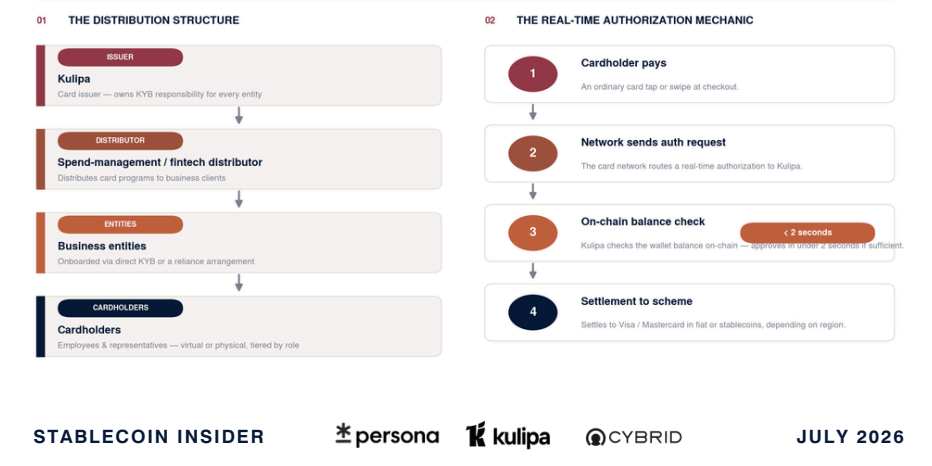
According to Kulipa, a stablecoin-native card issuing platform, the B2B model runs through two mechanisms: a distribution structure and a real-time authorization mechanic.
The distribution structure
In a typical B2B setup, the card issuer contracts with a corporate spend-management company or fintech distributor, which in turn serves business entities. As the card issuer, Kulipa is responsible for KYB on each entity to which cards will be issued, either conducting that verification directly or collecting the required information from the distributor under a reliance arrangement.
Once an entity is onboarded, cards are issued to its employees or representatives, virtual or physical, and tiered by role.
The chain looks like this:
- Issuer owns KYB responsibility for every entity
- Distributor (spend-management or fintech platform) distributes card programs to business clients
- Business entities are onboarded via direct KYB or a reliance arrangement
- Cardholders are employees and representatives, tiered by role
The real-time authorization mechanic
When a cardholder pays, the card network sends the issuer a real-time authorization request. The issuer checks the wallet balance on-chain and, if sufficient, approves the transaction in under two seconds. Settlement to the card scheme, Visa or Mastercard, then follows, either in fiat or in stablecoins depending on the region.
The guiding principle, Kulipa says, is to remain on-chain as long as possible, minimizing the conversion steps that add cost and latency.
Step by step:
- Cardholder pays with an ordinary tap or swipe at checkout
- Network sends an authorization request to the issuer in real time
- On-chain balance check confirms funds and approves in under two seconds
- Settlement to scheme completes in fiat or stablecoins, depending on region
What Makes B2B Card Issuance Different From Consumer Crypto Cards
Most readers will have encountered consumer crypto cards: a wallet, a card, a swipe. The B2B model is far less understood and structurally different. Kulipa frames the difference along four dimensions.
1. Compliance architecture
B2B requires KYB at the entity, legal-representative, and UBO level, not just individual KYC. This includes adverse-media screening on managers and full KYC on legal representatives and on UBOs above the 25% ownership threshold. Consumer programs, by contrast, require only individual KYC per cardholder.
The compliance surface of a B2B program is categorically larger, which ties directly back to the KYB challenges that identity platform Persona describes: platforms are global from day one, regulations shift fast, and business structures often defy traditional verification.
2. Card program tiering
Corporate programs typically involve multiple card tiers, for example plastic Business cards for employees, Signature Business cards for managers, and Infinite metal cards for the C-suite, each with differentiated spend limits, insurance, and travel benefits. Consumer programs are generally uniform.
The tiering reflects organizational hierarchy and spend-control policy in a way consumer products never need to.
3. Programmatic control
B2B distributors require API-level control over wallet funding, spend policies, and expense-management workflows. Kulipa's architecture supports automated top-up logic, where the distributor's backend manages card-wallet liquidity without exposing that complexity to the end cardholder.
This programmability, covering funding rules, spend policies, and expense automation, is what makes the card a corporate-finance tool rather than just a payment instrument.
4. Economics
Transaction sizes in B2B tend to be significantly higher than in consumer programs, and interchange economics are more favorable on commercial BINs, which improves the unit economics for both the distributor and the issuer.
Higher tickets, better interchange, and lower chargeback exposure are precisely why the B2B segment is more attractive per unit of volume than consumer.
Market Data: Stablecoin Card Volumes and Growth in 2026
The card layer is the smallest of the three in absolute terms but among the fastest-growing. The headline figures:
- $4.5 billion in stablecoin-linked card spending in 2025, up 673% from 2024 (McKinsey/Artemis Analytics). This is the load-bearing, independently corroborated figure, backed by CoinDesk, the BCG stablecoin white paper, and others.
- Over $1.5 billion per month processed by stablecoin-funded cards, roughly $18 billion annualized, with a ~106% compound annual growth rate. This run-rate is not directly comparable to the $4.5 billion calendar-year total: it reflects the exit velocity cards had reached by late 2025.
- B2B payments are an order of magnitude larger. Monthly B2B stablecoin payment volume reached roughly $6 billion by mid-2025, an ~$70 billion annualized run-rate at that point, against a $226 billion full-year 2025 total.
- Visa still anchors card settlement and accounts for the large majority of on-chain card volume, though the market is shifting toward full-stack issuers that handle issuance and settlement independently of sponsor banks.
A note on sourcing: the report flags that the $18 billion run-rate, the $6 billion monthly B2B figure, and the Visa-share figure rest on secondary write-ups and should be read as directional indicators rather than audited market data.
B2B Set to Overtake Consumer in Card Volume
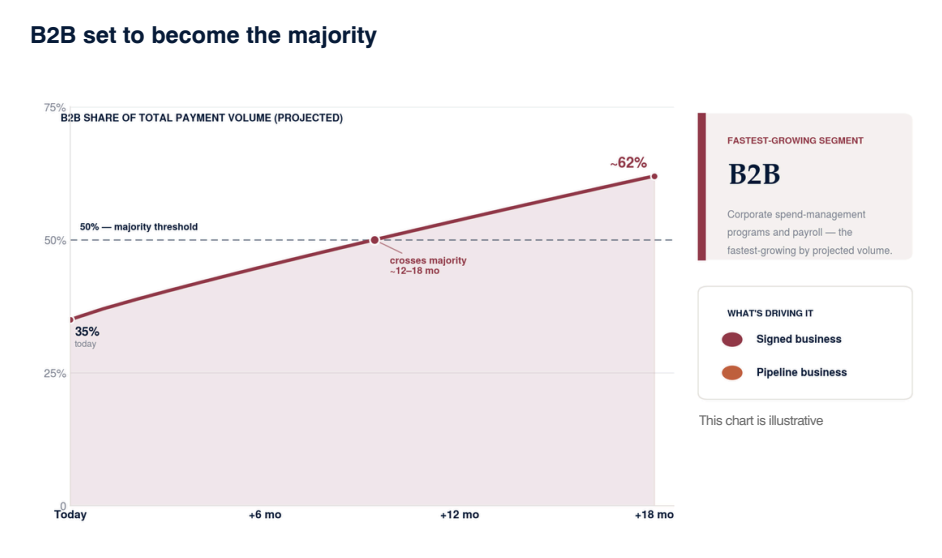
The majority of Kulipa's current volume is B2C, coming from crypto wallet and remittance programs. But the B2B segment, meaning corporate spend-management programs and payroll, is the fastest-growing by projected volume, and Kulipa expects B2B to represent the majority of its total payment volume within 12–18 months, driven by signed and pipeline business.
This is a forward projection of a single partner's book, not a market measurement, and should be read as such. But the directional call mirrors the whole-market structure: in the broader McKinsey/Artemis data, B2B already dominates stablecoin payments volume at roughly 60%, so the expectation that B2B overtakes consumer in the card book is consistent with where the rest of the market already sits.
Revenue Economics of Stablecoin Card Issuance
The business model rests on three revenue streams:
- Interchange fees, the per-transaction revenue from the card networks, which is more favorable on the commercial BINs that B2B programs use
- FX spread on conversion, captured when value crosses between stablecoin and fiat
- SaaS and platform fees, charged to distributors for the issuing and program-management infrastructure
According to Kulipa, the combination of higher B2B transaction sizes and more favorable commercial-BIN interchange is what makes B2B unit economics structurally more attractive than consumer: the same volume of B2B spend generates more revenue and carries lower chargeback risk than the consumer equivalent.
Barriers to Enterprise Adoption: What Is Holding CFOs Back
The technology works and the economics are attractive, so what is slowing enterprise adoption? The barriers are almost entirely CFO-facing.
1. CFO trust and accounting treatment
Treasury teams require USDC to be treated as a functional equivalent to USD on the balance sheet. Until accounting standards (US GAAP, IFRS) formally recognize stablecoins as cash equivalents, or at minimum as short-duration financial instruments with no fair-value volatility, CFOs face internal-audit and board-level friction in approving stablecoin-funded card programs.
Kulipa notes that the FASB's 2024 guidance on crypto assets was a step forward but does not yet fully address the stablecoin-as-operational-cash use case.
2. Authorization speed and reliability
Enterprise spend-management programs demand sub-2-second authorization, 99.9%+ uptime, and zero tolerance for declined transactions at the point of sale. Legacy crypto card infrastructure, including several incumbent providers, has consistently failed this bar.
In Kulipa's telling, enterprises that tried first-generation providers are actively churning and seeking infrastructure that delivers real-time authorization reliably.
That competitive claim is the partner's own; the underlying point that enterprises will not tolerate point-of-sale declines is not controversial. Reliability is not a feature here; it is the price of entry.
3. Regulatory uncertainty across corridors
Enterprises with multi-region treasury operations need a single provider with consistent compliance coverage across the EU, US, LATAM, and APAC. The patchwork of cross-border workarounds most providers use today creates regulatory risk that procurement and legal teams will not accept at scale.
Kulipa argues that MiCA in Europe and the GENIUS Act in the US materially de-risk this for CFOs, and identifies regulatory clarity as the single biggest unlock for enterprise adoption. Both frameworks are now in force or in active rulemaking as of 2026.
The Next 12–18 Months for Stablecoin Corporate Cards
According to Kulipa, the next 12–18 months will be defined by the convergence of three catalysts: MiCA enforcement giving EU enterprises a clear compliance framework, the GENIUS Act opening the US enterprise market, and first-mover infrastructure players demonstrating at-scale reliability with tier-1 enterprise logos.
Kulipa's strategic claim is pointed: the enterprises that move first will lock in 18–24 months of competitive advantage in treasury efficiency, while those waiting for perfect regulatory clarity will find their competitors have already standardized on stablecoin rails.
That is a vendor's framing of urgency and should be weighed as such, but it sits on top of growth rates and a regulatory shift that are independently documented.
Conclusion
B2B stablecoin card issuance is the youngest layer of the stablecoin stack but carries the most attractive unit economics: larger tickets, better interchange, and lower chargebacks.
It is differentiated from consumer crypto cards by a far larger compliance surface (entity-level KYB, not just KYC), role-based program tiering, and deep programmatic control, and the volume data shows the layer growing fast off a small base, with B2B set to overtake consumer in the card book within 12–18 months.
The barriers are CFO-facing, covering accounting treatment, authorization reliability, and cross-corridor regulatory consistency, and the unlock is the regulatory clarity that has now largely arrived.
For the full analysis, including the cross-border payments and KYB compliance layers, download the complete Into B2B Stablecoins report, and get in touch to explore how stablecoin card infrastructure fits your treasury operations.
Read Next:
- KYB for Stablecoin Platforms: Why Business Verification Is the Gating Function of B2B Crypto Payments
- Stablecoin B2B Cross-Border Payments: How They Work, Costs, and Growth in 2026
- New Stablecoin Insider Report: 'Into B2B Stablecoins'
FAQs:
1. What are stablecoin-backed corporate cards?
Stablecoin-backed corporate cards are Visa or Mastercard-network cards issued to a business's employees that are funded by the company's on-chain stablecoin balance, with each transaction authorized in real time against that balance and settled to the card scheme in fiat or stablecoins.
2. How does stablecoin card authorization work?
Stablecoin card authorization works by having the card network send a real-time request to the issuer at checkout, which checks the wallet balance on-chain and approves the transaction in under two seconds if funds are sufficient, before settling to Visa or Mastercard.
3. How are B2B stablecoin cards different from consumer crypto cards?
B2B stablecoin cards are different from consumer crypto cards in four ways: they require entity-level KYB rather than individual KYC, they use role-based card tiering, they offer API-level programmatic control over funding and spend policies, and they carry higher transaction sizes with better commercial-BIN interchange.
4. How much is the stablecoin card market growing in 2026?
The stablecoin card market grew 673% year over year to $4.5 billion in spending in 2025 according to McKinsey and Artemis Analytics, with stablecoin-funded cards now processing over $1.5 billion per month at a roughly 106% compound annual growth rate.
5. What is holding CFOs back from adopting stablecoin corporate cards?
What is holding CFOs back from adopting stablecoin corporate cards is a combination of unresolved accounting treatment under US GAAP and IFRS, the need for sub-2-second authorization with 99.9%+ uptime, and the lack of consistent multi-region regulatory coverage across the EU, US, LATAM, and APAC.
Disclaimer:
This content is provided for informational and educational purposes only and does not constitute financial, investment, legal, or tax advice; no material herein should be interpreted as a recommendation, endorsement, or solicitation to buy or sell any financial instrument, and readers should conduct their own independent research or consult a qualified professional.