Table of Contents
Among businesses that have used stablecoins, 41% report cost savings of 10% or more, mostly on cross-border payments, yet the treasurers actually running these rails say the fee line is not the point.
Stablecoin Insider covers the data behind stablecoin adoption, and the operator record now supports a clear, practical playbook for finance teams that have never touched a digital dollar.
Global B2B stablecoin payments reached $226 billion in 2025, up 733% year-on-year, and the growth is concentrated among ordinary importers, exporters, and globally distributed businesses rather than crypto companies.
This guide gives treasurers and CFOs the full picture, drawing on The LATAM Stablecoin Economy 2026 report and the operator research behind it: what actually changes versus legacy rails, why the business case is working capital rather than fees, the five risks and their mitigations, and three entry points ranked from easiest to hardest.
Key Takeaways
- Cross-border settlement compresses from 2-5 business days to minutes.
- Pre-funded accounts across jurisdictions are largely eliminated, releasing working capital.
- The business case is cash conversion cycles, not transaction fee savings.
- Five risks matter: reserve, counterparty, regulatory, operational, and accounting.
- Start with one supplier payment; no balance-sheet stablecoin exposure required.

What Actually Changes: Legacy Rails vs Stablecoin Rails
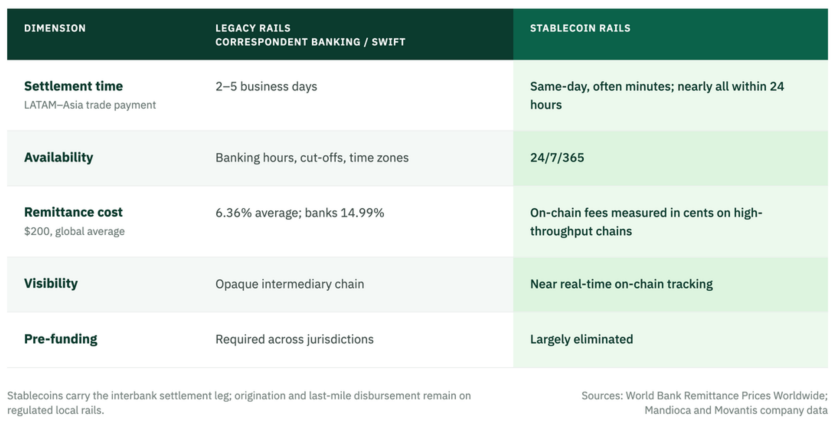
For a treasurer, the comparison comes down to five dimensions.
| Dimension | Legacy rails (correspondent banking / SWIFT) | Stablecoin rails |
|---|---|---|
| Settlement time (cross-border trade payment) | 2-5 business days | Same-day; often minutes; nearly all within 24 hours |
| Availability | Banking hours, cut-offs, time zones | 24/7/365 |
| Cost ($200 remittance benchmark) | 6.36% global average; banks 14.99% | On-chain fees measured in cents on high-throughput chains |
| Visibility | Opaque intermediary chain | Near real-time on-chain tracking |
| Pre-funding | Required across jurisdictions | Largely eliminated |
The settlement-time figures come from production trade flows, not pilots. According to research by Mandioca, the cross-border trade settlement platform that has processed over $1 billion across 100+ enterprise clients, payments that historically took 2-5 business days through correspondent banking now settle same-day and often within minutes, with nearly all transactions completed inside 24 hours, on typical tickets of $20,000 to $250,000.
One operating detail matters for how a finance team should picture this: the token is the settlement leg, not the customer experience. In production systems, the cross-border leg travels on-chain while origination and last-mile disbursement stay in local currency on regulated local rails. Conversion happens at the moment of payment, which means a company can use stablecoin settlement without ever holding stablecoins on its balance sheet.
Why the Business Case Is Working Capital, Not Fees
Every operator dataset behind this guide converges on the same conclusion: the most valuable benefit for treasury teams is improved cash conversion cycles and reduced liquidity requirements. When settlement moves from days to minutes, businesses no longer pre-fund accounts across multiple jurisdictions or hold excess working capital against settlement delays. They buy inventory faster, pay suppliers faster, and grow without tying up additional capital.
According to research by Mandioca, for many importers and exporters those operational and liquidity benefits materially outweigh direct transaction fee savings.
The point generalizes beyond trade. According to research by Pomelo, the card-issuing infrastructure company serving 170+ clients across 150+ countries, companies whose treasuries already sit in stablecoins can settle card programs directly in USDC and eliminate the FX conversion layer between treasury and spend entirely, an operating-model change rather than a cost optimization.
And the demand side is broadening on its own: according to research by VelaFi, the Asia-LATAM settlement company whose corridor volume grew 300%+ in 2025, the fastest-growing adopters are SMBs with cross-border supplier relationships, precisely the businesses with no treasury team and no banking relationship able to absorb a slow settlement.
The Five Risks and How to Mitigate Them
A CFO evaluating stablecoin settlement should underwrite five distinct risks.
1. Reserve risk
Is the token actually backed 1:1? The regulatory floor has risen sharply: the US GENIUS Act, enacted July 2025, mandates reserve standards for payment stablecoins, and Brazil requires independent proof-of-reserves certification for licensed providers.
Mitigation: select issuers by reserve composition and attestation cadence, not by market share alone.
2. Counterparty risk
The exchange, ramp, or custodian holding the position, not the blockchain, is usually the weakest link.
Mitigation: licensed counterparties with segregated client assets, which Brazil now mandates for authorized providers.
3. Regulatory risk
The perimeter is moving fast. Brazil classifies stablecoin operations as foreign-exchange transactions from February 2026, bringing a 3.5% IOF-Câmbio tax into scope for covered cross-border payments: a concrete case of a cheap rail acquiring fiscal cost once formalized.
Mitigation: model the regulated cost, not the on-chain cost, in every jurisdiction you touch.
4. Operational risk
Key management, transaction finality with no recalls, address errors, chain selection.
Mitigation: institutional custody, or managed-settlement products where the institution never touches the token; these now exist at network level, with banks and payment providers interacting entirely in fiat while the network handles minting, orchestration, and compliance.
5. Accounting and compliance
Dollar-pegged stablecoins held at par are generally treated as financial assets rather than volatile crypto positions, but jurisdictional treatment varies; in Brazil, cross-border stablecoin operations must be reported within the FX framework, and AML/KYB obligations apply fully at the conversion layer in every major market.
Mitigation: involve audit and compliance before the first transaction, not after.
Three Entry Points, Ranked Easiest to Hardest
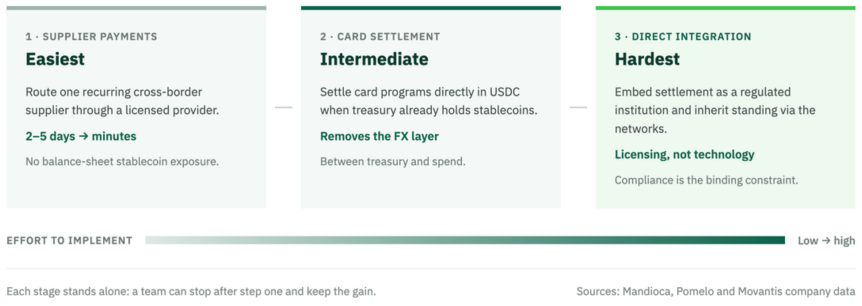
The practical adoption path runs in three reversible, independently ROI-positive steps.
Entry point 1: Supplier payments (easiest)
Route one recurring cross-border supplier relationship through a licensed stablecoin settlement provider. The benchmark to beat: 2-5 days compressed to minutes-to-same-day, with pre-funding eliminated.
This requires no balance-sheet stablecoin exposure, since conversion happens at the moment of payment, and it produces a measurable working-capital result finance leadership can evaluate after a single quarter.
Entry point 2: Card settlement for spend (intermediate)
If the company already holds stablecoin treasury, common for crypto-native and increasingly for globally distributed businesses, settle corporate or user card programs directly in USDC and remove the FX layer between treasury and spend.
Program design follows the card economics: according to research by Pomelo, local cards typically run about 80% domestic and 20% cross-border transactions while global cards run 90-95% cross-border, and domestic transactions cost approximately 5-15% of what cross-border transactions cost, fundamentally different unit economics that determine whether a local, global, or hybrid program fits.
Entry point 3: Direct institutional integration (hardest)
For a bank, money transfer operator, or fintech embedding stablecoin settlement inside its own product, the constraint is not technology. According to research by Movantis, the regulated settlement network connecting 70+ MTOs and banks to 90,000+ payout locations with $60 billion+ in annual volume, the rail integration is the fast part; the hard part is licensing in each market, a compliance framework that holds across jurisdictions, access to local liquidity, and integration with the local payment rails the beneficiary actually uses.
Regulated standing on both ends of a corridor is built over years, not bought with capital. The practical 2026 route is inheritance rather than assembly: connect through networks that already hold that standing, rather than building the posture country by country.
Where Payroll Fits in the Treasury Picture
For companies with international teams, payroll is often the second stablecoin flow a finance team encounters, and it is already mainstream. According to research by Rise, the international payroll platform, 25% of companies globally now pay some workers in cryptocurrency, stablecoins account for over 90% of those payroll transactions, and USDC alone holds a 63% share of crypto salaries, with adoption concentrated among agencies, startups, and conventional global businesses rather than crypto-native firms.
The treasury logic mirrors supplier payments: the employer funds payroll in fiat or stablecoins, each worker selects their own payout mix, and the dollar-denominated option is what unlocks hiring in inflation-affected talent markets.
The Direction of Travel: Rails-Agnostic by Design
The architecture a CFO should expect to buy into is not stablecoin-only. Operators at opposite ends of the stack have independently converged on the same design: route each transaction through the optimal rail, traditional or stablecoin, under a single compliance standard, with the choice invisible to the user.
The LATAM Stablecoin Economy 2026 report names this convergence as its standout finding, and it matters for procurement: the right provider question is not "do you support stablecoins" but "can you route each payment through the best rail and prove compliance on both ends."
Conclusion
Stablecoin Insider covers the data behind stablecoin adoption, and for finance teams the picture in 2026 is unusually clear.
Settlement compresses from days to minutes, pre-funding disappears, the business case lives in the cash conversion cycle rather than the fee line, five well-defined risks each have a concrete mitigation, and operator research from Mandioca, Movantis, Pomelo, Rise, and VelaFi maps a three-step adoption path that starts with a single supplier invoice and requires no balance-sheet crypto exposure.
The full benchmark tables, risk framework, and corridor analysis are in The LATAM Stablecoin Economy 2026 report; if you want the complete dataset behind these figures or want to discuss how they apply to your treasury, get in touch with our team.
Read Next:
- Stablecoin Regulation in Latin America: Brazil, Mexico, Argentina, Colombia, and Bolivia Compared
- Stablecoin Cross-Border Trade: LatAm and Asia Corridors
- Stablecoin Payments in Latin America 2026: Market Size, Volumes, and Growth by Country
- New Stablecoin Insider Report: 'The LATAM Stablecoin Economy 2026'
FAQs:
1. How do CFOs use stablecoins for cross-border payments in 2026?
CFOs use stablecoins for cross-border payments in 2026 by routing supplier invoices, card settlement, or payroll through licensed providers that convert at the moment of payment, compressing settlement from 2-5 business days to minutes without holding stablecoins on the balance sheet.
2. What are the main risks of stablecoin settlement for a business?
The main risks of stablecoin settlement for a business are reserve risk, counterparty risk, regulatory risk, operational risk, and accounting and compliance risk, each with a concrete mitigation ranging from issuer attestation review to licensed counterparties with segregated client assets.
3. How much does stablecoin settlement save compared to banks?
Stablecoin settlement saves 10% or more for 41% of businesses that have used it, mostly on cross-border payments, but the larger benefit is working capital: settlement in minutes instead of 2-5 days eliminates pre-funded accounts across jurisdictions.
4. What is the easiest way for a company to start using stablecoin settlement?
The easiest way for a company to start using stablecoin settlement is routing one recurring cross-border supplier relationship through a licensed settlement provider, which requires no balance-sheet stablecoin exposure and produces a measurable working-capital result within a quarter.
5. Do companies need to hold stablecoins to use stablecoin settlement?
Companies do not need to hold stablecoins to use stablecoin settlement, because in production systems conversion happens at the moment of payment: the business funds in local currency, the stablecoin carries the cross-border leg, and the recipient is paid on regulated local rails.
Disclaimer:
This content is provided for informational and educational purposes only and does not constitute financial, investment, legal, or tax advice; no material herein should be interpreted as a recommendation, endorsement, or solicitation to buy or sell any financial instrument, and readers should conduct their own independent research or consult a qualified professional.