Table of Contents
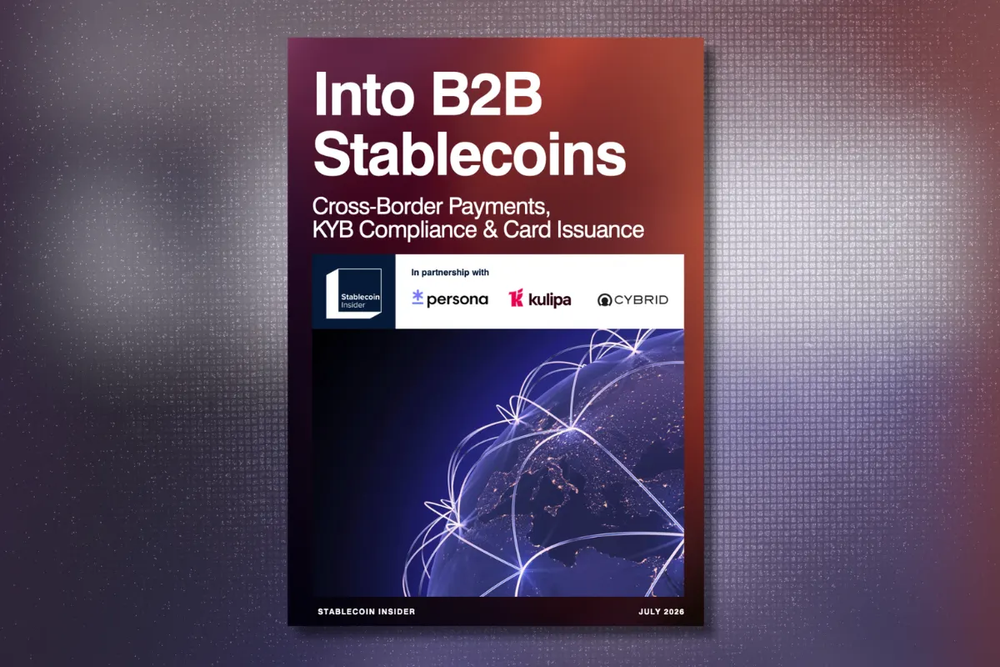
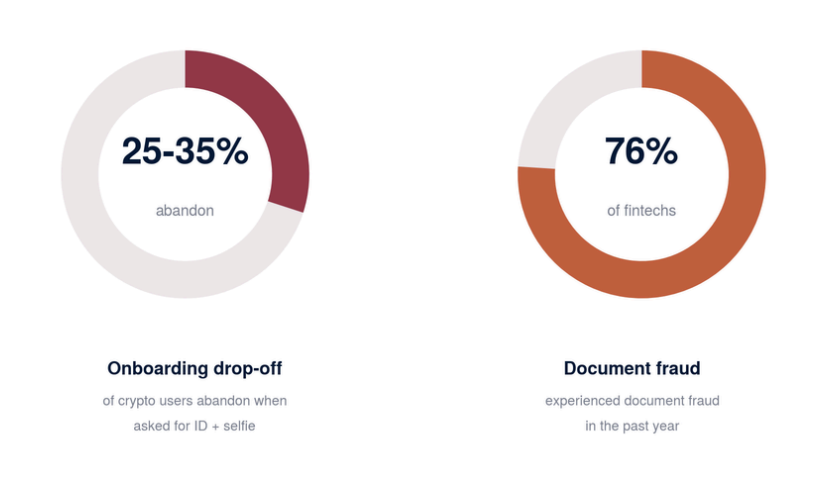
76% of fintechs experienced document fraud in the past year, according to identity platform Persona in the July 2026 report Into B2B Stablecoins: Cross-Border Payments, KYB Compliance & Card Issuance.
That number lands differently in a stablecoin context, because once funds move on-chain, settlement is irreversible: there is no intermediary to claw them back.
A platform can have the fastest payment rails in the world, but it cannot move a dollar for a customer it has not been able to verify and risk-assess, which makes Know Your Business (KYB) the most decisive bottleneck in the entire B2B stablecoin stack.
This article explains why KYB is a distinct and harder problem than traditional onboarding, how AI is simultaneously industrializing fraud and powering detection, and what building compliance-by-design actually means in practice.
Key Takeaways
- 76% of fintechs experienced document fraud in the past year.
- KYB verifies an organization's full structure, not just a single individual.
- 25–35% of crypto users abandon onboarding when asked for ID and selfie.
- Synthetic business identity fraud is now the most common identity fraud globally.
- Winning platforms verify continuously and build audit-ready compliance from day one.
What Is KYB and How Is It Different From KYC?
Know Your Customer (KYC) verifies an individual. Know Your Business (KYB) verifies an organization, and that is a fundamentally harder problem, because a business is not a single identity but a structure: a legal entity, its registered representatives, and the ultimate beneficial owners (UBOs) who sit behind it.
Verifying a business means verifying that structure. It requires confirming the entity exists and is in good standing, identifying who controls it, and screening every relevant party against sanctions and adverse-media lists. In a stablecoin context, that structural problem is compounded by speed expectations, regulatory fragmentation, and counterparties that may not fit any traditional registry at all.
The stakes are also higher downstream. As the report's card issuance chapter shows, issuers like Kulipa carry KYB responsibility at the entity, legal-representative, and UBO level for every business that receives a corporate card program, including full KYC on legal representatives and on UBOs above the 25% ownership threshold.
The compliance surface of a B2B program is categorically larger than the individual-KYC model consumer products run on.
The Three Structural Challenges Unique to Stablecoin KYB
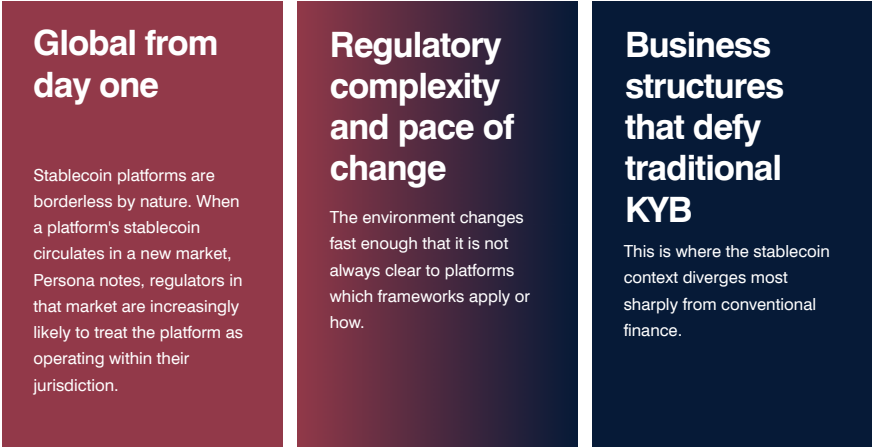
Persona identifies three structural challenges that distinguish B2B stablecoin platforms from traditional fintech or banking onboarding.
1. Global from day one
Stablecoin platforms are borderless by nature. When a platform's stablecoin circulates in a new market, regulators in that market are increasingly likely to treat the platform as operating within their jurisdiction.
A traditional bank expands country by country, securing licenses and building compliance capacity as it goes.
A stablecoin platform can find itself effectively operating in dozens of jurisdictions the moment its token gains traction there, and it must contend with a complex tangle of business registries, each with different data quality, naming conventions, and access models. The verification problem arrives all at once, not gradually.
2. Regulatory complexity and pace of change
In the last two years, stablecoin platforms have had to rapidly adapt to divergent verification requirements across MiCA, the FATF Travel Rule, and the GENIUS Act. The environment changes fast enough that it is not always clear to platforms which frameworks apply or how.
Persona's observation is that the platforms managing this well treat compliance as a moving target rather than a one-time build. They invest in verification architecture that can adjust as rules shift, rather than hard-coding today's requirements into systems that will be obsolete in a year.
3. Business structures that defy traditional KYB
This is where the stablecoin context diverges most sharply from conventional finance. Stablecoin users expect to onboard fast, and industry data shows that 25–35% of crypto users abandon onboarding when asked to upload an ID and selfie.
For B2B platforms, the drop-off risk intensifies, because verification typically involves multiple stakeholders, beneficial-owner documentation, and cross-jurisdictional checks, each an added point of friction and abandonment.
Compounding this, crypto-native structures such as DAOs and multi-signature treasuries often lack registered addresses or physical business locations, making them difficult or impossible to verify through traditional means.
The implication is that platforms cannot rely on one-size-fits-all verification: they need dynamic flows that fast-track lower-risk applications while reserving manual review for genuine edge cases.
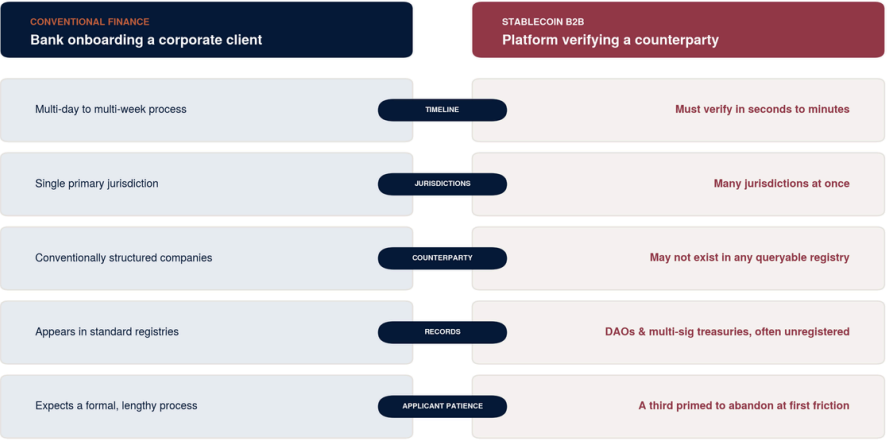
Stablecoin KYB vs. Traditional Bank Onboarding: The Contrast
The gap between the two worlds is stark:
| Dimension | Conventional finance (bank onboarding a corporate client) | Stablecoin B2B platform |
|---|---|---|
| Timeline | Multi-day to multi-week process | Must verify in seconds to minutes |
| Jurisdictions | Single primary jurisdiction | Many jurisdictions at once |
| Counterparty | Conventionally structured companies | May not exist in any queryable registry |
| Records | Appears in standard registries | DAOs and multi-sig treasuries, often unregistered |
| Applicant patience | Expects a formal, lengthy process | A third primed to abandon at first friction |
A stablecoin B2B platform must verify faster, across more jurisdictions at once, for counterparties that may not exist in any registry it can query, all while a third of applicants are primed to abandon at the first sign of friction.
How AI Is Reshaping Verification and Fraud
AI is the defining force in identity verification today, and its effect is double-edged. AI enables fraudsters to launch more sophisticated attacks faster and at greater scale, while simultaneously powering detection capabilities that were previously impossible.
The honest framing is not "AI solves KYB" or "AI breaks KYB." It is both at once, and the platforms that win are the ones whose detection capability outpaces the attacker's.
AI as threat: fraud has industrialized
According to Persona, the most common type of identity fraud globally is now synthetic business identity fraud. The economics of fraud have inverted.
Where creating a convincing fake business once took meaningful time and effort, it now takes just minutes for fraudsters to use generative AI to spin up freshly incorporated shell entities, complete with a fake digital trail, fabricated incorporation documents, and a deepfaked team.
For stablecoin platforms specifically, the threat is particularly insidious because of the irreversibility of settlement. A fraudulent business that clears onboarding can access payment rails, move illicit funds across borders to evade jurisdictional authorities, and construct money-laundering layering structures, all behind the façade of a legitimate business account.
combination of easy synthetic-identity creation and irreversible settlement is exactly the risk profile that makes KYB the gating function for the entire stablecoin payment stack.
AI as solution: detect by behavior, not appearance
AI-powered fraud has become too sophisticated to catch through visual tells alone. The old playbook of inspecting a document for visual anomalies no longer works when the document was generated by a model that produces flawless-looking output.
So the focus shifts to how documents are submitted and how entities connect, not how they look. The techniques Persona points to include:
- Submission forensics: Rather than judging a document by appearance, the platform examines how it was submitted, checking for signs of tampering such as PDF editor traces and changes to JPEG files. The metadata and manipulation artifacts betray the fraud even when the pixels do not.
- Real-time signal cross-referencing: The platform cross-references fraud signals in real time, checking registries and relevant websites for adverse media in moments rather than days, collapsing what used to be a manual research process into an automated onboarding step.
- Link analysis: One of the most powerful tools available, link analysis surfaces connections between accounts based on shared attributes: a registered address, a tax ID, a device fingerprint. Unexpectedly large clusters, such as multiple "independent" businesses sharing the same address, are a red flag. Critically, the attributes of a known fraudster can be used to find linked entities and shut down entire fraud rings, not just the single bad actor in front of you.
The strategic takeaway is that verification at scale is now a contest of signal, not scrutiny. The winning platforms automate the friction away for the 99% of legitimate businesses while building behavioral and network-based detection sophisticated enough to catch industrialized, AI-generated fraud.
The Regulatory Landscape for Stablecoin KYB in 2026
The regulatory environment for B2B stablecoin platforms is becoming more defined, but it remains fragmented across jurisdictions, and operators serving multiple regions must hold several regimes in their heads at once. The picture as of mid-2026:
European Union
MiCA (Markets in Crypto-Assets) is live, with stablecoin (ART/EMT) provisions having applied since June 2024 and the core CASP authorization regime since December 2024.
Critically for operators in 2026: the EU-wide transitional period for existing providers ended on 1 July 2026, after which full MiCA authorization is mandatory to provide crypto-asset services in the EU.
On the AML side, AMLD6 will introduce harmonized beneficial-ownership standards, a direct response to the fragmented UBO-disclosure problem that makes cross-jurisdictional KYB so hard.
The broader EU AML package is scheduled to apply from July 2027, with the new AML Authority (AMLA) already standing up and beginning to select entities for direct supervision during 2026.
United States
The U.S. regulatory picture changed decisively with the GENIUS Act, which established the first federal framework for payment stablecoins and was signed into law in July 2025.
As of mid-2026, the framework is in the rulemaking phase, with federal regulators including the OCC and FDIC working toward finalization, but the foundational legal certainty enterprises were waiting for now exists.
The practical effect is that the GENIUS Act now sits alongside MiCA and the FATF Travel Rule as one of the frameworks platforms must continuously adapt to.
Asia-Pacific
Project Guardian in Singapore and Project Ensemble in Hong Kong are creating new frameworks for practical interoperability. This work matters disproportionately for cross-border operators because it begins to address how value and identity move between regimes, not just within them.
The strategic reality is that enterprises with multi-region treasury operations need consistent compliance coverage across the EU, US, LATAM, and APAC. Regulatory fragmentation is not an abstract policy concern: it is the operational problem that determines whether a platform can serve a global enterprise at all.
Compliance-by-Design: Building Verification Into the Rails
The central argument of the report's KYB chapter is that compliance must be embedded at the rails level, not bolted on afterward. This is visible in practice on the payments side: in the four-leg stablecoin payment flow that orchestration platforms like Cybrid run, KYB and KYC checks are gated at the fiat funding leg, the entry point, before any value moves.
According to Persona, the vast majority of B2B stablecoin platforms should verify continuously, not as a single point-in-time check. Compliance-by-design means building automated KYB triggers into onboarding and sanctions screening at the transaction layer, so risk is assessed both at the front door and on an ongoing basis as behavior evolves.
The platforms doing this well also design audit-ready data structures from day one, so they are prepared well before a regulator ever asks. The principle is to treat compliance as core infrastructure from the start rather than a feature added under regulatory pressure.
Portable Data vs. Portable Decisions: The Reusable KYB Question
On the much-discussed question of reusable, portable KYB identity, Persona draws a distinction that cuts through a lot of industry hype.
Portable data is relatively straightforward and already happening. Stablecoin platforms can already let their business users upload verification documents once and consent to share that record across counterparties. The mechanics of moving a verified document set from one place to another are largely solved.
Portable decisions are the real challenge. The hard part is getting financial institutions to accept each other's verification outcomes. Portable decisions would likely require industry-wide agreement on risk thresholds. Without that agreement, a "verified" status from one institution is unlikely to meet the standards of another.
The blocker is not technological; it is the absence of a common risk standard, and solving it requires institutions to move together rather than any single vendor shipping a feature.
This is the honest assessment the market needs: reusable KYB is realistic for data portability in the near term, but truly portable verification decisions depend on a coordination problem the industry has not yet solved.
Conclusion
KYB is the gating function for the entire B2B stablecoin stack: it is harder than traditional onboarding because platforms are global from day one, must track a fast-moving and fragmented regulatory landscape, and must verify counterparties that traditional methods cannot reach.
AI has industrialized fraud, with synthetic business identities now the most common form globally, but it has also enabled behavioral and network-based detection that visual inspection never could, and the platforms that win build compliance as continuous, audit-ready infrastructure from day one.
For the full analysis, including the cross-border payments and card issuance layers, download the complete Into B2B Stablecoins report, and get in touch to discuss how these findings apply to your verification stack.
Read Next:
- Stablecoin B2B Cross-Border Payments: How They Work, Costs, and Growth in 2026
- New Stablecoin Insider Report: 'Into B2B Stablecoins'
FAQs:
1. What is KYB in stablecoin payments?
KYB in stablecoin payments is the process of verifying a business organization, meaning its legal entity, registered representatives, and ultimate beneficial owners, before allowing it onto payment rails, including confirming good standing and screening every relevant party against sanctions and adverse-media lists.
2. Why is KYB harder for stablecoin platforms than for traditional banks?
KYB is harder for stablecoin platforms than for traditional banks because platforms are global from day one, must adapt to fragmented regulations like MiCA and the GENIUS Act simultaneously, and must verify crypto-native structures such as DAOs and multi-signature treasuries that may not exist in any queryable registry.
3. What is the most common type of identity fraud in 2026?
The most common type of identity fraud in 2026 is synthetic business identity fraud, in which fraudsters use generative AI to spin up fake shell entities in minutes, complete with fabricated incorporation documents, a fake digital trail, and a deepfaked team.
4. How do stablecoin platforms detect AI-generated business fraud?
Stablecoin platforms detect AI-generated business fraud by analyzing behavior rather than appearance, using submission forensics to find document tampering traces, real-time cross-referencing of registries and adverse media, and link analysis that surfaces suspicious clusters of connected accounts.
5. What is compliance-by-design for stablecoin platforms?
Compliance-by-design for stablecoin platforms is the practice of embedding verification at the rails level from day one, building automated KYB triggers into onboarding, sanctions screening at the transaction layer, continuous rather than point-in-time verification, and audit-ready data structures prepared before a regulator ever asks.
Disclaimer:
This content is provided for informational and educational purposes only and does not constitute financial, investment, legal, or tax advice; no material herein should be interpreted as a recommendation, endorsement, or solicitation to buy or sell any financial instrument, and readers should conduct their own independent research or consult a qualified professional.