
Table of Contents
South Korea has about 11 million crypto exchange accounts, roughly a fifth of its population, while more than 99% of the global stablecoin market is denominated in US dollars (Source: Forbes).
Stablecoin Insider tracks how countries decide who may issue their own digital currency, and South Korea is about to make one of the clearest choices in Asia.
Seoul wants a won stablecoin to stop its crypto market from running on dollar tokens. The question that has stalled the law for over a year is who should control the issuer.
The answer emerging from the Financial Services Commission is a compromise: tech companies can lead a won stablecoin issuer, but banks must collectively own at least 50% plus one share.
This analysis explains what the rule says, why the Bank of Korea insists on it, who it affects from Naver to Kakao and Toss, how it compares with Taiwan, Hong Kong and Japan, and what happens next.
Key Takeaways
- Banks would need at least 50% plus one share of won stablecoin issuers.
- A tech company can still be the largest single shareholder.
- The Bank of Korea wants bank-led issuance first to protect monetary control.
- The Digital Asset Basic Act is due in November 2026.
- Naver's $10.3 billion Dunamu deal is the biggest test of the rule.
Why Korea Wants a Won Stablecoin
Korean crypto users already trade heavily, but mostly in dollar stablecoins issued abroad. Our report on 18 straight months of stablecoin outflows shows how much of that money leaves Korean exchanges for overseas platforms.
Policymakers see a won stablecoin as a way to keep those flows at home and give Korean fintechs a domestic digital currency to build on. The alternative is an on-chain economy where the won plays no role.
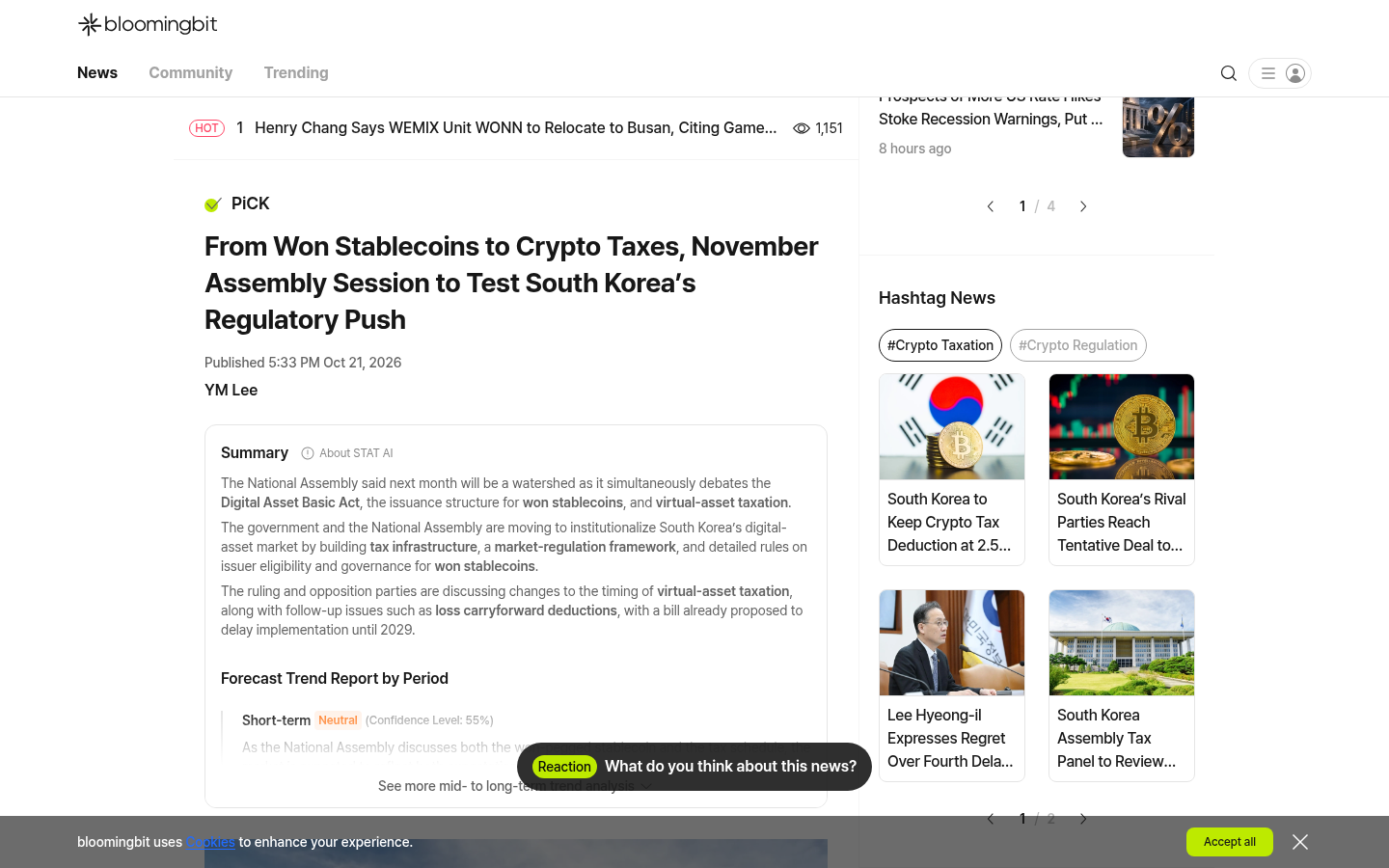
The pressure is rising. A won-pegged token called KRWQ, launched in October 2025, is already circulating abroad, and Bank of Korea Governor Shin Hyun-song said on 12 October 2026 that he is "basically in favor" of private issuance (Source: Bloomingbit).
How the Rule Got Here
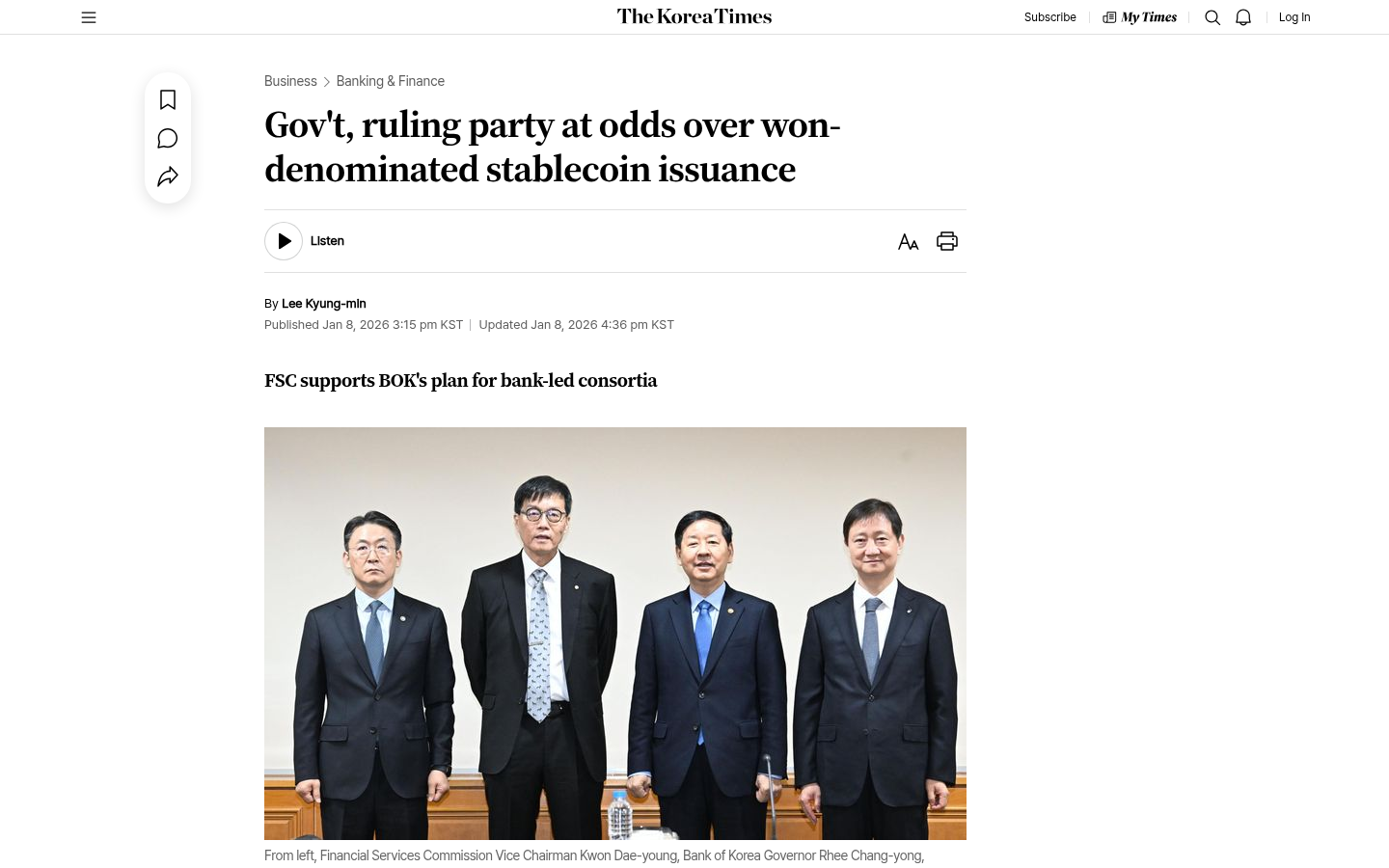
The bank-majority idea is the result of a long fight between regulators and lawmakers. In January 2026 the Financial Services Commission dropped its earlier support for fintech-led issuance and moved to the Bank of Korea's position, proposing that banks hold at least 50% plus one share of an issuing consortium (Source: The Korea Times).
| Date | Step |
|---|---|
| January 2026 | FSC backs bank majority |
| July 2026 | BOK repeats bank-first view |
| September 2026 | Government plan: 50% plus one |
| October 2026 | Assembly sets review |
| 12 November 2026 | FSC allows tech lead |
| November 2026 | Bill due in Assembly |
The same proposal set minimum paid-in capital for issuers at 5 billion won, about $3.7 million, and left licensing and shareholder details to a presidential decree, which leaves room for later changes (Source: The Korea Times).
What the 50% Plus One Rule Says
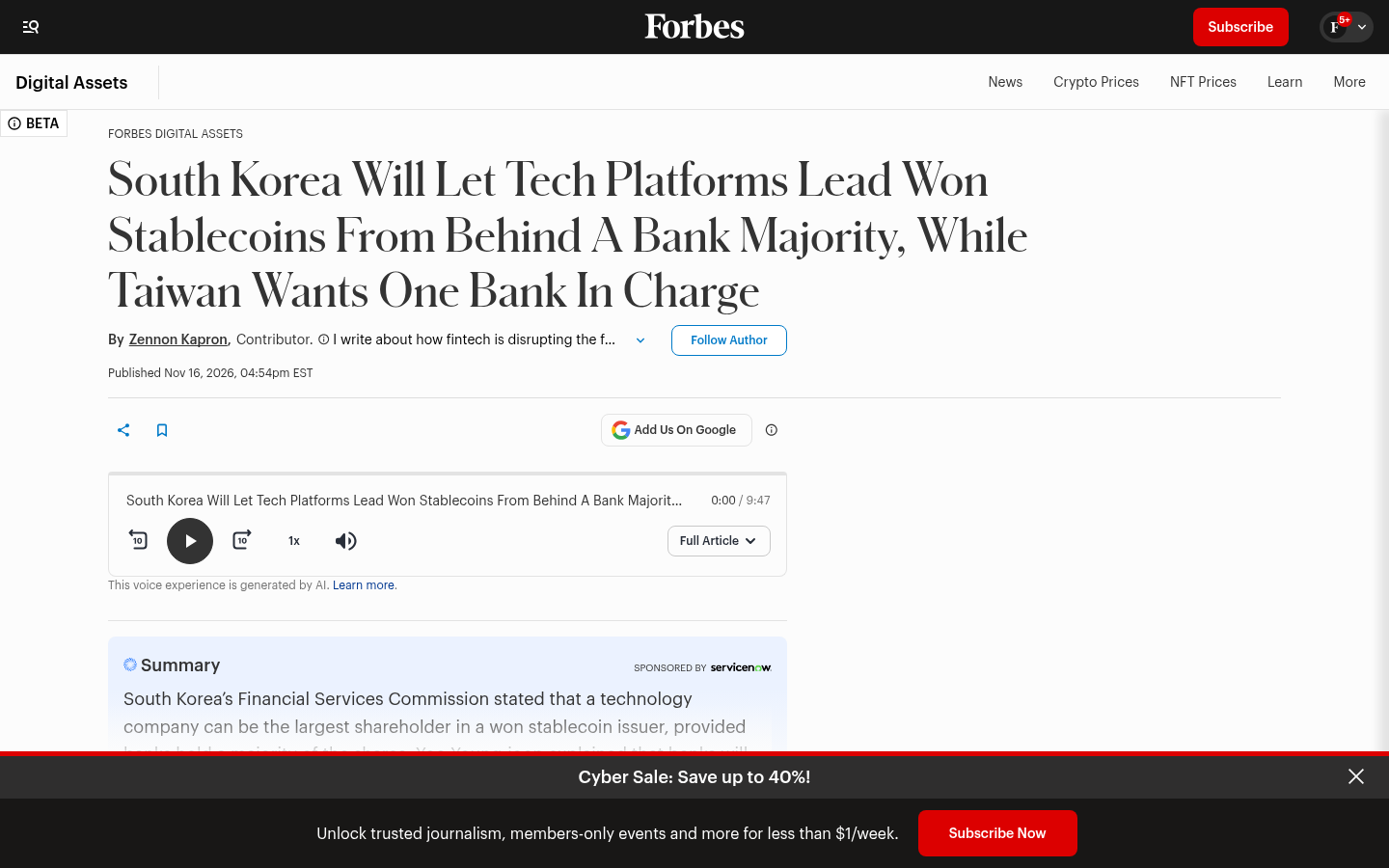
The latest version is more flexible than the January plan. On 12 November 2026, FSC director general Yoo Young-joon said a technology company can be the largest single shareholder of a won stablecoin issuer as long as banks together hold the majority (Source: Forbes).
- Ownership: Banks collectively hold at least 50% plus one share. A single tech firm can own the largest individual stake.
- Bank role: Banks do not issue or run the coin. They are shareholders in a separate company, provide extra capital if needed and apply their anti-money-laundering controls.
- Who runs it: The tech partner can lead product, distribution and technology.
- Phasing: Bank-majority consortia get issuance rights first. Yoo left open a wider issuer pool later.
The design keeps a regulated balance sheet behind every won stablecoin, while letting the platforms with the users run the product.
Why the Bank of Korea Wants Banks in Control
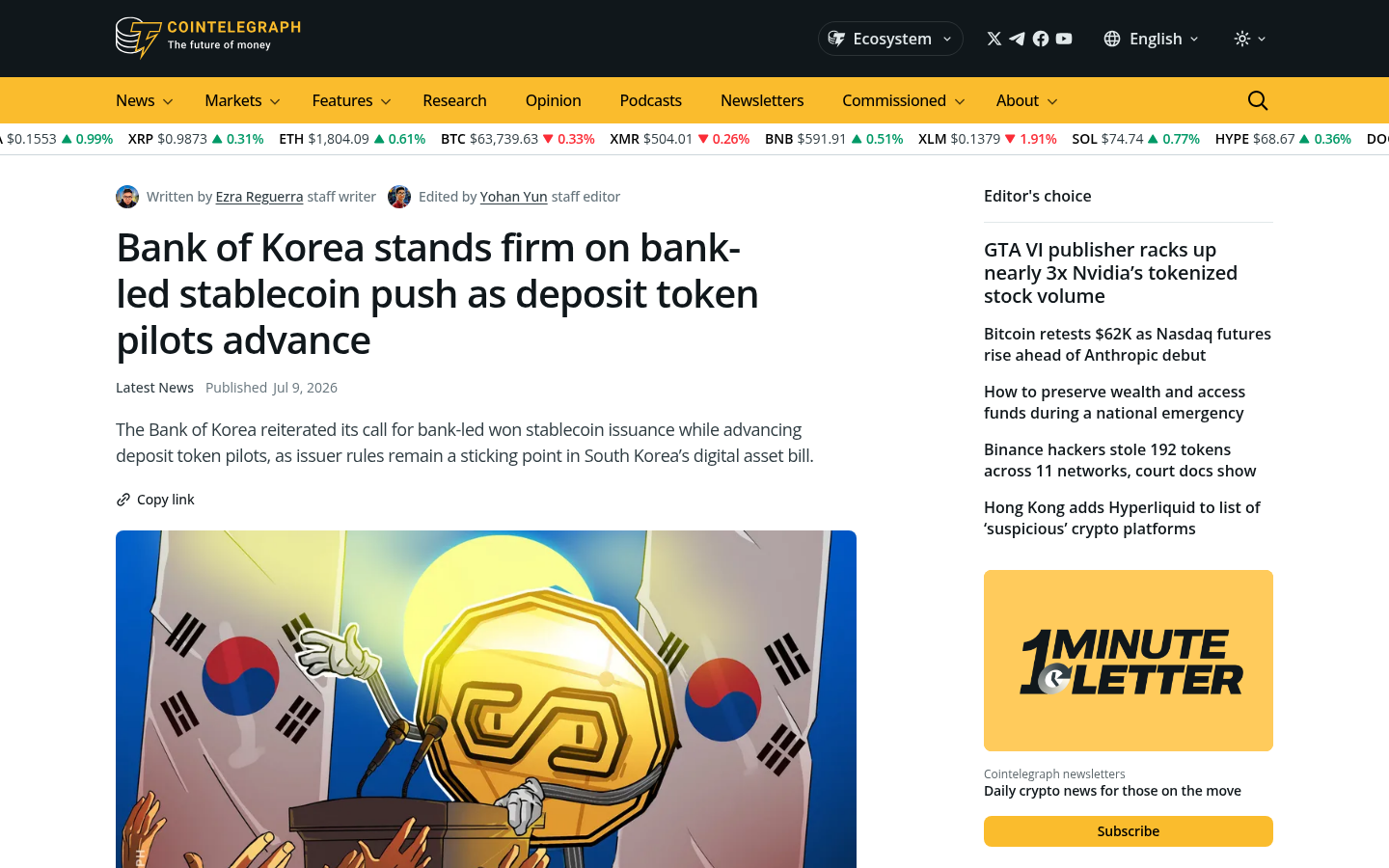
The central bank has been the strongest voice for the rule. In July 2026 it told the National Assembly's finance committee that won stablecoins should first be issued through bank-led consortia, backed by priority issuance for those consortia and a statutory policy body involving the relevant agencies (Source: Cointelegraph).
- Monetary control: A large non-bank stablecoin could pull deposits out of banks and weaken how interest rate changes pass through the economy.
- Capital flight: The Bank of Korea has warned that non-bank issuance could speed up outflows of funds from Korea.
- Run risk: Banks are already supervised for liquidity and capital, so a bank-majority issuer has a backstop if redemptions spike.
- Alternatives: The central bank is also testing deposit tokens for public payments, which keep money inside banks. Our explainer on what tokenized deposits are covers how they differ from stablecoins.
The Case Against Bank Control
Industry and many lawmakers push back. At a National Assembly forum on 12 November, VIDEX chief executive Ryu Hong-ryeol argued against limiting issuance to banks, and others said licences should depend on reserve management and redemption capability rather than ownership (Source: The Paypers).
- Innovation: Fintechs argue that banks have little incentive to build fast, cheap payment products that compete with their own services.
- Accountability: If several banks each hold small stakes, no single bank may feel responsible for a capital call in a crisis.
- Politics: Ruling Democratic Party lawmakers objected strongly when the FSC first moved to the bank-majority model, and opinions still differ inside the party.
Who Is Affected
The biggest Korean platforms are already positioning for the rule (Source: The Paypers).
| Company | Move | Status |
|---|---|---|
| Naver Financial | Buying Dunamu (Upbit) | Under KFTC review |
| Kakao Pay, KakaoBank | Fireblocks agreement | Signed Sep 2026 |
| Toss | QR payment trial | Done Oct 2026 |
| Banks | Majority shareholders | Awaiting the law |
Naver is the biggest test. Naver Financial agreed in November 2025 to absorb Dunamu, the operator of Korea's largest exchange Upbit, in an all-stock deal worth about $10.3 billion, with a won stablecoin central to the plan (Source: Decrypt).
The Fair Trade Commission began formal deliberations on 10 November 2026 and identified ten affected markets, including the future won stablecoin market (Source: The Paypers). Under the new rule, a Naver-led issuer could exist, but only with banks owning the majority.
Kakao has a bank in its own group, which makes a compliant consortium easier to assemble, as our coverage of the Kakao Pay and KakaoBank Fireblocks deal explains. Toss is building on dollar stablecoins first, as seen in the Toss coin wallet.
How Korea Compares With Its Neighbours
| Market | Who leads issuance | Bank requirement |
|---|---|---|
| South Korea | Bank-majority consortia | Banks 50% plus one |
| Taiwan (draft) | Bank-backed issuers | Banks over 50% |
| Hong Kong | Licensed issuers | No fixed share |
| Japan | Banks, trusts, fintechs | No fixed share |
| United States | Banks and nonbanks | No fixed share |
Taiwan's draft goes further than Korea. It requires banks and financial holding companies to hold more than 50% of a non-bank issuer and a single one to hold more than 25%, so that one accountable financial shareholder leads (Source: Forbes).
Elsewhere, the bank-centred model is spreading informally. Hong Kong's first licences went to bank-linked issuers and Japan's megabanks are moving toward joint issuance (Source: Blockhead).
Our APAC stablecoin regulation guide covers those regimes in detail, and the GENIUS Act explainer shows the US alternative, where nonbanks can be licensed directly.
What Happens After the Bill
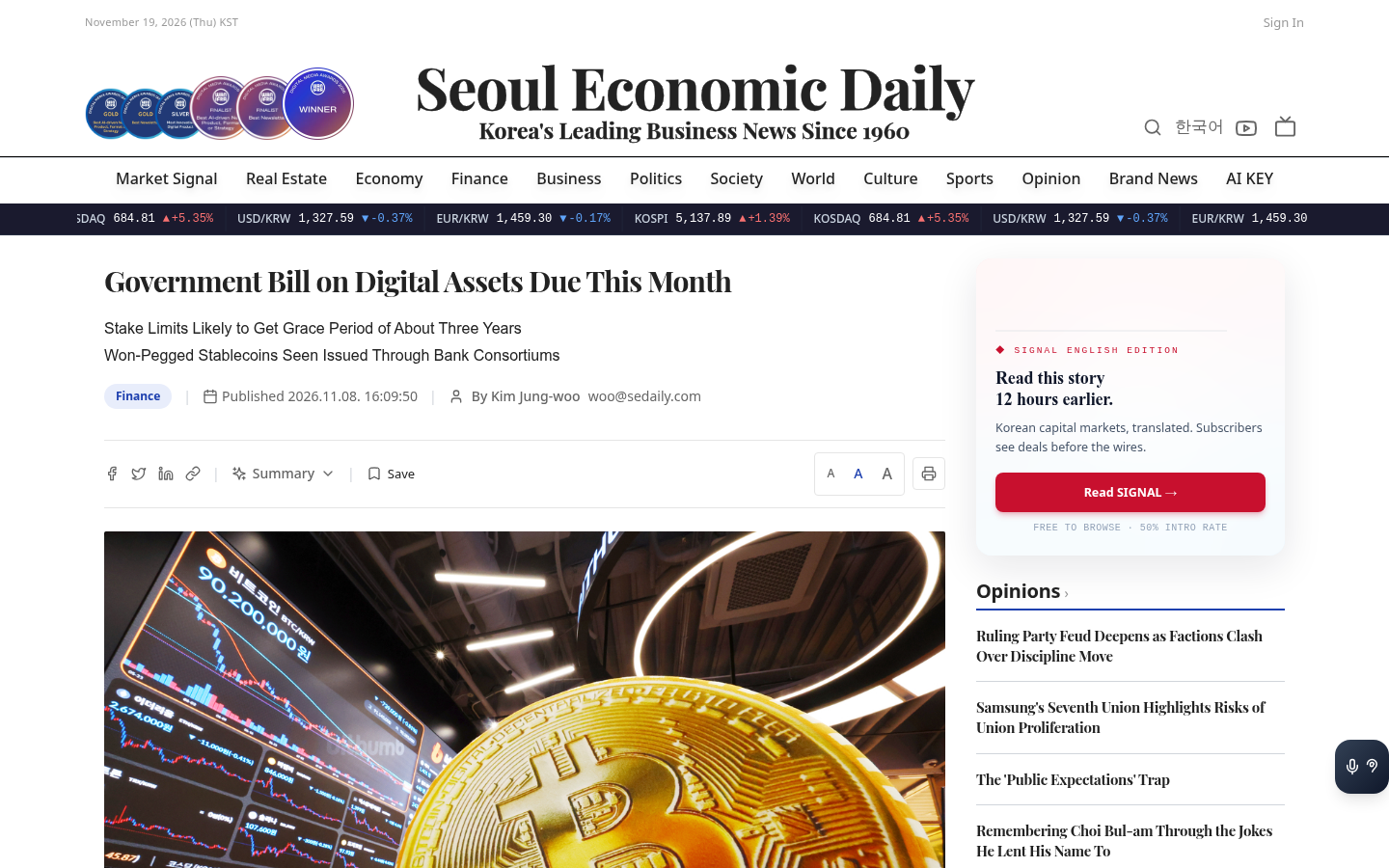
The Digital Asset Basic Act is expected to be introduced in November 2026. It will run to about 135 articles and cover stablecoin issuance, virtual asset service providers and exchange rules, though details could change in parliament (Source: Seoul Economic Daily).
- Payments laws: The Electronic Financial Transactions Act and commercial laws must also be amended before won stablecoins can be used for everyday payments.
- Exchange ownership: The bill is also expected to cap major shareholders of exchanges at 15% to 20%, with a grace period of about three years (Source: Seoul Economic Daily).
- Tax link: The ruling party has tied passage of the act to delaying the crypto tax, now proposed for 2029 (Source: Blockhead).
- Exports: Distribution partners are already preparing, as our story on MoonPay's won stablecoin channel shows.
What to Watch
- The bill text: Whether the 50% plus one threshold is written into the act or left to presidential decree.
- Parliament: Whether the National Assembly passes the act by the end of 2026, as the ruling party has targeted.
- The Naver ruling: How the Fair Trade Commission treats the won stablecoin market in its Naver and Dunamu decision.
- First consortia: Which banks partner with Naver, Kakao and Toss, and whether one bank takes clear responsibility.
- A wider pool: Whether the FSC opens issuance to non-bank majorities after the first phase.
Conclusion
Stablecoin Insider follows every market deciding who controls its digital currency, and South Korea's answer is that banks own the issuer while tech platforms can run it.
The 50% plus one rule reflects the Bank of Korea's concern about deposits and capital flight, and it keeps a regulated balance sheet behind each won stablecoin.
It also leaves real room for Naver, Kakao and Toss, which now need bank partners rather than permission to lead.
The details will be set by the Digital Asset Basic Act and its decrees, and the first consortia will show whether the compromise produces a won stablecoin people actually use.
Read Next
These three guides go deeper on Asia's stablecoin rules, and the players building won and dollar tokens in Korea.
- Best Apps to Buy Anthropic Stock (ANT) in 2026: 6 Brokers Compared
- Social Security Cuts: Will Benefits Be Cut in 2032, and by How Much?
- Anthropic IPO: $83 Price, 19 Nov Nasdaq Date and How ANT Traded Onchain
FAQs
1. What is South Korea's 50% plus one rule for stablecoins?
South Korea's 50% plus one rule for stablecoins is a proposal that banks must collectively own at least 50% plus one share of any company issuing a won stablecoin. A technology firm can still be the largest single shareholder and run the product, but banks keep majority control.
2. Can Naver or Kakao issue a won stablecoin?
Naver or Kakao can issue a won stablecoin under the proposed rule only through a consortium in which banks hold the majority. The FSC said in November 2026 that a tech company may be the largest shareholder, so either could lead the issuer with bank partners.
3. Why does the Bank of Korea want banks to control stablecoins?
The Bank of Korea wants banks to control stablecoins because it worries that non-bank issuers could draw deposits out of banks, weaken monetary policy and speed up capital outflows. Bank-majority issuers are already supervised for capital and liquidity, which gives a backstop if redemptions spike.
4. When will South Korea pass its stablecoin law?
South Korea is expected to introduce the Digital Asset Basic Act in November 2026, and the ruling party aims to pass it by the end of the year. Payments laws must also be amended before won stablecoins can be used for everyday purchases.
5. How is Korea's rule different from Taiwan's?
Korea's rule is different from Taiwan's in how it assigns responsibility. Korea requires banks to own a collective majority but lets a tech firm be the largest shareholder, while Taiwan's draft also requires a single bank or financial holding company to hold more than 25%.
Disclaimer: This content is provided for informational purposes only and does not constitute legal, financial, or compliance advice. Protocol versions, governance arrangements, and partner counts cited here reflect publicly announced milestones as of November 2026 and are moving quickly. Adoption figures come from vendor and foundation announcements with differing methodologies and should be treated as directional signals rather than guaranteed outcomes.