
Table of Contents
DEX aggregators have become the most important layer of infrastructure for stablecoin swaps in 2026, routing more on-chain volume than any individual decentralized exchange and delivering meaningfully better execution than any single liquidity pool can offer alone.
With stablecoin liquidity fragmented across dozens of pools and more than a dozen chains, aggregators that split orders, compare routes, and protect against MEV are no longer optional tools but the default choice for anyone moving USDC, USDT, or DAI at any meaningful size.
This guide covers the best DEX aggregators for stablecoin swaps in 2026, comparing EVM leaders, Solana natives, cross-chain protocols, and intent-based tools across execution quality, chain coverage, fees, and use case fit.
Key Takeaways
- Intent-based aggregators like CoW Swap can deliver near-zero slippage on stable pairs.
- 1inch leads EVM routing; Jupiter is the default aggregator for all Solana stablecoin swaps.
- Cross-chain aggregators like LI.FI and deBridge solve the bridge-plus-swap problem atomically.
- Trade size drives the choice: gas and UX matter most on small swaps, split routing on mid-size trades, and RFQ or intent-based settlement on seven-figure trades.
- MEV protection, through 1inch Fusion, CoW Swap batch auctions, or Velora private routes, is now standard for any stablecoin swap where execution quality matters.
Ranked by execution quality, chain coverage, MEV protection, and use case fit
13+ chains, Fusion MEV protection. Best for EVM routing at any size.
RFQ hybrid model. Best for high-volume and institutional stable swaps.
Own pools plus aggregation. Best for limit orders and analytics.
Routes across all Solana AMMs. Best for USDC and USDT on Solana.
0-TVL, 26+ chains, native assets. Best for secure cross-chain transfers.
Bridge and DEX unified. Best for builders and retail cross-chain swaps.
Batch auctions, near-zero slippage. Best for large MEV-protected swaps.
Atomic cross-chain intents. Best for 1:1 stablecoin flows across chains.
Multi-token to single stable. Best for portfolio rebalancing and rewards.
Why DEX Aggregators Dominate Stablecoin Swaps in 2026
A DEX aggregator is a routing layer that queries multiple decentralized exchanges simultaneously and splits a single trade across whichever combination of liquidity sources produces the best net execution price. Rather than sending your entire swap to one Uniswap pool and accepting whatever quote it returns, an aggregator like 1inch or Jupiter queries dozens of automated market makers and request-for-quote (RFQ) market makers, slices the order across pools, and settles everything in one transaction.
The reason this matters specifically for stablecoins is fragmentation. In 2026, USDC and USDT liquidity is spread across Uniswap v4 pools, Curve's 3pool and factory pools, Aerodrome on Base, Orca and Meteora on Solana, and dozens of other venues across more than a dozen chains.
No single pool offers the best execution across all trade sizes and all chain pairs. An aggregator that can split a half-million-dollar USDC-to-USDT trade across three pools simultaneously can reduce slippage from 10 or more basis points to 1-3 bps, a difference that compounds significantly for frequent traders and treasury operations.
MEV (Maximal Extractable Value) is the other reason aggregators have become essential. Sandwich attacks and front-running in the public mempool can erase execution quality gains entirely on larger stablecoin trades.
Aggregators with built-in MEV protection, including Fusion mode on 1inch, batch auction settlement on CoW Swap, and private execution paths on ParaSwap, now represent the standard for any swap where execution quality actually matters.
Trade size is the most important variable in choosing the right aggregator. The economics shift dramatically depending on how much you are moving:
For trades under ten thousand dollars, gas costs and user experience matter more than routing sophistication. A retail user swapping a few hundred dollars of USDC to USDT on Arbitrum will see almost no difference between a well-routed aggregator and a direct Uniswap trade, but will notice gas fees and interface quality immediately.
For trades between ten thousand and one million dollars, slippage begins to dominate. This is where aggregator routing and StableSwap rails like Curve become critical, as the difference between a split-routed execution and a single-pool swap can be several hundred dollars on a half-million-dollar trade.
For trades above one million dollars, AMM slippage becomes genuinely painful even on deep pools. At this tier, RFQ-enabled aggregators and intent-based settlement, which match buyers and sellers directly without touching AMM pools, produce the best outcomes.
Intent-based aggregators like CoW Swap have benchmarked near-zero slippage on USDC-USDT at this size when coincidence-of-wants matching is available.
In 2026, the most important evaluation criteria across all aggregators are: chain coverage quality (not just count), MEV protection mechanism, fee transparency, cross-chain capability, and developer API access for teams building on top of the routing layer.
What Changed for Stablecoin Swap Aggregators in 2026
DEX aggregators routed $73.01 billion in the 30 days to September 27, 2026, per DefiLlama, while total stablecoin supply reached $312.89 billion (DefiLlama stablecoins). Three shifts matter for slippage:
- Intent-based execution is now the default at several routers. Velora Delta settles gasless, MEV-protected swaps across chains from one signature (Velora docs).
- Brands are consolidating: ParaSwap is now Velora and OpenOcean is now De1 (De1 announcement).
- Fees on stable pairs keep falling: Matcha charges no swap fee on stablecoin-to-stablecoin trades (Matcha fees).
Top Aggregators for EVM Chains: 1inch, ParaSwap (Velora), and KyberSwap
1. 1inch: Best Overall EVM Aggregator for Stablecoin Routing
1inch is one of the most mature and widely used DEX aggregators in DeFi, with nearly $800 billion in cumulative aggregator volume across 19 chains, per DefiLlama.
It was not built specifically for stablecoins, but its routing engine is exceptionally well-suited to them, consistently delivering some of the tightest execution on USDC, USDT, and DAI pairs across EVM networks.
The core of 1inch's stablecoin advantage is its Pathfinder routing algorithm, which scans major DEX liquidity sources including Uniswap v4, Curve, Balancer, and dozens of others, then splits orders across multiple pools to minimize price impact.
For a large USDC-to-USDT swap on Ethereum, Pathfinder might send the biggest slice through Curve's 3pool, a smaller share through a Uniswap v4 concentrated pool, and the remainder through another venue, producing better net execution than any single source alone.
The standout feature for stablecoin traders, particularly at larger sizes, is Fusion mode. Rather than submitting a transaction directly to the public mempool, Fusion shifts execution toward an intent-style flow where professional resolvers compete to fill the order.
This structure mitigates the MEV behaviors like sandwiching that are particularly damaging on stable pair swaps where price margins are already thin. For stablecoin trades where landing close to the quoted price is the primary success metric, Fusion mode is a material differentiator.
Supported chains: Ethereum, Arbitrum, Base, Optimism, Polygon, BNB Chain, Avalanche, and 6+ more EVM networks.
Supported stablecoins: All major pairs including USDC, USDT, DAI, PYUSD, FRAX, and newer entrants across supported networks.
Developer tools: 1inch Aggregation API and Fusion SDK, widely integrated across wallets including MetaMask and Coinbase Wallet.
Pros:
- Mature routing engine with nearly $800 billion in cumulative aggregator volume (DefiLlama)
- Fusion mode delivers strong MEV protection on large stablecoin trades
- Widest EVM chain coverage of any aggregator on this list
- Reliable for both retail and institutional-sized stable swaps
- Deeply integrated with most major wallets and DeFi interfaces
Cons:
- Not purpose-built for stablecoin-only flows
- Primarily EVM-focused despite initial Solana expansion
- Fusion mode introduces slight settlement latency versus direct swaps
Best for: EVM power users, DeFi integrators, and dApps embedding best-price stablecoin routing across multiple chains.
2. ParaSwap (Velora): Best for High-Volume and Institutional EVM Swaps
ParaSwap, rebranded as Velora in 2026, occupies a distinct position from 1inch in the aggregator landscape.
Where 1inch is optimized for breadth across retail and mid-size trades, Velora is built for performance at scale and is frequently the preferred tool where trade size and execution quality are the overriding concerns.
The core differentiator is its hybrid liquidity model, which blends standard on-chain AMM routing with RFQ-style quoting from professional market makers. For a multi-million-dollar USDC-to-USDT swap, the RFQ layer can connect the trade directly with a market maker offering a tighter spread than any AMM pool would provide at that size, with the AMM route used as a fallback.
This model tends to produce the best outcomes for higher-volume users and integrators who care about consistent, capital-efficient execution rather than interface convenience.
Velora is also designed with MEV-aware execution paths specifically for larger orders, providing routing options that reduce adverse execution compared to standard public mempool submissions. Its API-first design means it is commonly embedded inside wallets, dApps, and treasury management tools rather than used directly through a consumer interface.
Supported chains: Major EVM networks with cross-chain support through bridge integrations.
Developer tools: Velora API designed for wallet and dApp integration at scale.
Pros:
- RFQ hybrid model produces tighter spreads on large stablecoin trades than AMM-only routing
- MEV-aware execution paths reduce adverse outcomes on significant orders
- API-first design is well-suited for institutional and developer integration
- Strong track record with high-volume users and protocol treasuries
Cons:
- Less beginner-friendly as a direct consumer interface compared to 1inch
- RFQ model involves some reliance on market maker availability
- Fewer supported chains than 1inch for same-chain routing
Best for: High-volume traders, protocol integrators, and treasury teams running large stablecoin conversions where RFQ execution quality justifies the integration overhead.
3. KyberSwap: Best EVM Aggregator With Built-In Stablecoin Pool Depth
KyberSwap takes a different approach to aggregation by combining external DEX routing with its own concentrated-liquidity pools through KyberSwap Elastic.
This hybrid model means the aggregator can sometimes improve execution on stablecoin pairs by routing through its own internal liquidity when that is the most favorable source, without the user needing to interact with multiple interfaces.
The aggregation engine routes across external DEXs including Uniswap, Curve, and Balancer alongside KyberSwap's own pools, selecting the best path in a single quote.
The interface also surfaces more analytical context than most aggregators, including pool depth information and historical pricing, which some users value for making informed routing decisions. Built-in limit orders allow traders to set target prices on stablecoin pairs rather than executing immediately at market.
Supported chains: Strong coverage across EVM networks including Ethereum, Arbitrum, Polygon, BNB Chain, Optimism, Base, and others.
Pros:
- Own liquidity pools can add an execution edge on certain stablecoin pairs
- Built-in limit orders add flexibility for patient stablecoin traders
- Analytics layer provides more decision context than minimal aggregator interfaces
- Hybrid routing reduces dependence on external pool availability
Cons:
- Smaller overall liquidity base than 1inch on most chains
- Less dominant for cross-chain stablecoin flows
- Own pools have experienced exploits in prior years, requiring users to review current audit status
Best for: EVM traders who want a single interface combining aggregation and direct pool access, with built-in limit orders and more analytical context than standard aggregators provide.
Solana and Cross-Chain Leaders: Jupiter, deBridge, and LI.FI
1. Jupiter: The Default Aggregator for All Solana Stablecoin Swaps
Jupiter is the uncontested primary aggregation layer for Solana stablecoin swaps in 2026.
What began as a DEX aggregator has evolved into a full Solana DeFi hub offering spot swaps, perpetual trading, lending, staking, and a mobile wallet, but its core routing function remains the reason it handles the overwhelming majority of stablecoin swap volume on the network.
For USDC and USDT swaps on Solana, Jupiter routes across all major native liquidity venues including Orca, Raydium, Meteora, and others, splitting orders to minimize slippage on SPL token pairs.
The best-route algorithm is continuously updated as new pools and AMMs launch on Solana, meaning users consistently access the deepest available liquidity without manually tracking which venue is offering the best price.
Solana's infrastructure makes stablecoin management feel meaningfully different from Ethereum mainnet. Transaction fees of fractions of a cent and confirmation times under a second mean that even frequent small stablecoin swaps are economically viable, and Jupiter's UX reflects that consumer-grade experience.
Additional tools including limit orders, dollar-cost-averaging execution, and perpetuals access for users managing stablecoin collateral positions make Jupiter the only Solana aggregator most users need.
Supported chains: Solana (dominant); limited cross-chain capability via bridge integrations.
Supported stablecoins: USDC (SPL), USDT (SPL), and all major Solana-native stable pairs.
Developer tools: Jupiter API, widely integrated across Solana wallets and dApps.
Pros:
- Dominant market position on Solana with routing across all major native AMMs
- Fast and cheap execution that makes frequent stablecoin swaps practical
- Additional tools including limit orders, DCA, and perps access in one interface
- Clean UX suited to a wide range of experience levels
Cons:
- Solana-centric and does not extend to EVM chains for same-chain routing
- Less relevant for users whose stablecoin activity is primarily on EVM networks
Best for: Any user moving stablecoins on Solana, from retail traders to DeFi protocol operators managing liquidity and yield positions.
2. deBridge: Best for Cross-Chain Swaps With Zero Pooled-Liquidity Risk
deBridge is a cross-chain aggregator supporting 25+ blockchains and has processed more than $20 billion in cross-chain volume, per the deBridge docs.
It is trusted by major wallets and protocols including Phantom, MetaMask, Trust Wallet, and Jupiter, and holds the strongest security track record of any cross-chain aggregator on this list.
What sets deBridge apart from other cross-chain solutions is its 0-TVL model. Rather than relying on pooled liquidity on each chain, deBridge uses a different architecture that eliminates the liquidity pool hack risk that has been responsible for several of the largest cross-chain bridge exploits in DeFi history.
Users receive native assets on the destination chain rather than wrapped token equivalents, which removes the layer of additional smart contract risk that wrapped tokens introduce.
The protocol lists 26+ security audits to date and runs a public bug bounty program (deBridge security), a meaningful signal about the robustness of its architecture relative to competitors in the cross-chain space. For users and teams moving large stablecoin amounts across chains where the security of the execution path is the primary concern, deBridge occupies a category of its own.
Supported chains: Ethereum, Solana, Arbitrum, Base, Optimism, Polygon, BNB Chain, Avalanche, and 18 or more additional networks.
Supported stablecoins and tokens: Millions of tokens including USDC, USDT, USDT on Tron, and all major stablecoins across supported networks.
Developer tools: Full API and SDK for integrating cross-chain stablecoin swaps into dApps and wallet interfaces.
Pros:
- Strongest security track record in cross-chain aggregation (26+ audits, public bug bounty)
- 0-TVL model eliminates pooled liquidity hack risk
- Native asset delivery with no wrapped token exposure
- Broad chain coverage across 25+ networks
- Developer-ready with full API and SDK
Cons:
- Less suited for same-chain stablecoin routing where 1inch or Jupiter are more optimized
- 0-TVL model requires sufficient solver availability for large trades to fill quickly
Best for: Cross-chain stablecoin transfers where security and native asset delivery take priority over all other factors, and developers building cross-chain stablecoin functionality into applications.
3. LI.FI and Jumper: Best Cross-Chain Aggregator Infrastructure for Builders

LI.FI is best understood as infrastructure rather than a consumer product.
It aggregates bridges and DEX aggregators into a unified routing layer that wallets, dApps, and developer teams can integrate to offer cross-chain stablecoin functionality without managing individual bridge and DEX integrations themselves.
Its consumer-facing interface, Jumper Exchange, is built on top of this infrastructure and serves retail users looking for a straightforward cross-chain stablecoin swap experience.
The core value of LI.FI is that it collapses the complexity of cross-chain routing into a single integration. A developer team building a stablecoin payment product that needs to move USDC from Ethereum to Base or USDT from Arbitrum to Polygon would normally need to integrate multiple bridges (Across, Relay, Circle CCTP, Wormhole) and DEX aggregators for each chain separately. LI.FI handles all of that routing logic internally, selecting the best combination of bridge and DEX for each specific transfer at quote time.
Jumper Exchange, the consumer front end, quotes across Eco, Across, Relay, and other bridging protocols to find the best path for each cross-chain stablecoin swap. End-to-end cost for a typical cross-chain stablecoin hop runs approximately 10 to 40 basis points including the bridge fee, with faster and cheaper routes available on L2-to-L2 hops where bridge latency and fees are lower than Ethereum mainnet.
Supported chains: Ethereum, Base, Arbitrum, Optimism, Polygon, Solana, BNB Chain, and 10 or more additional networks.
Supported stablecoins: USDC, USDT, DAI, and others across all supported networks.
Developer tools: LI.FI SDK and API, widely integrated into wallets including MetaMask and Rainbow.
Pros:
- The best integration primitive for teams building multi-chain stablecoin products
- Removes the engineering complexity of managing individual bridge and DEX integrations
- Jumper Exchange provides a clean retail interface for cross-chain swaps
- Broad chain and bridge coverage updated continuously
Cons:
- Consumer interface (Jumper) is less optimized for large stablecoin-specific flows than intent-based alternatives
- Cross-chain stablecoin costs of 10 to 40 bps are higher than intent-based routing on optimal pairs
Best for: Developers and wallet teams building cross-chain stablecoin features who need a single integration covering multiple bridges and chains, and retail users via Jumper for straightforward cross-chain USDC and USDT swaps.
Specialized Options: Intent-Based Aggregators and Multi-Token Routing
1. CoW Swap: Best for MEV-Protected Same-Chain Stablecoin Swaps
CoW Swap does not operate like a standard route-and-submit DEX aggregator, and that distinction is the source of its advantage for large stablecoin trades.
Rather than routing a trade directly through on-chain liquidity and submitting it to the public mempool, CoW Swap collects user intents and settles them in batch auctions using competing solvers.
The key mechanism is coincidence of wants (CoW). When two users submit opposing intents at the same time, for example one selling USDC for USDT and another selling USDT for USDC, CoW Swap's solvers can match them directly at the reference price.
Both users receive the exact amount they asked for with near-zero slippage and no AMM pool fees applied to either leg. Any portion of a batch that cannot be matched internally is routed through on-chain liquidity by the winning solver.
For stablecoin pairs specifically, this architecture is particularly powerful. USDC-USDT is one of the highest-volume trading pairs in DeFi, which means natural matching rates in CoW Swap's batch auctions are high.
Benchmarks on this pair show near-zero slippage outcomes at seven-figure trade sizes during typical market conditions, an outcome that no AMM-based aggregator can reliably replicate at that size without significant routing complexity.
The tradeoff is settlement latency. Batch auctions take time to fill, meaning CoW Swap is not the right choice when execution speed matters more than execution quality. It is also primarily focused on single-chain EVM swaps rather than cross-chain flows.
Pros:
- Strongest MEV protection of any aggregator through batch auction architecture
- Near-zero slippage on large USDC-USDT swaps when CoW matching occurs
- No solver gaming on execution quality
- No platform fee charged to users on matched trades
Cons:
- Batch auction settlement introduces latency compared to direct swaps
- Single-chain EVM focused; not suited for cross-chain stablecoin flows
- Lower matching rates during off-peak hours reduce the frequency of near-zero slippage outcomes
Best for: Large stablecoin swaps on Ethereum or supported EVM chains where MEV protection and execution quality are the priority and slight settlement latency is acceptable.
2. Eco Routes: Best for Cross-Chain Intent-Based Stablecoin Flows

Eco Routes brings the intent-based model pioneered by CoW Swap to the cross-chain stablecoin use case.
Rather than stitching together a bridge and a DEX swap in sequence (which stacks fees, latency, and risk from two separate operations), Eco Routes consolidates the entire cross-chain stablecoin conversion into a single atomic intent handled by Eco's solver network.
The result is 1:1 stablecoin conversions across chains (USDC to USDT, USDC to PYUSD, and other stable pairs) with zero or near-zero slippage on deep pairs, without 7-day challenge windows, without wrapped token exposure, and without the user needing to manually manage bridge selection. The solver network routes across CEX-depth liquidity, AMMs, and native stablecoin mint-and-burn rails including Circle CCTP to find the best path for each intent.
Eco Portal, the consumer interface built on Eco Routes, offers what is currently the cleanest single-surface experience for moving stablecoins between different chains or different stablecoin types.
For retail users and treasury operators who want to move USDC from Arbitrum to Solana or convert USDC to USDT on Base without manually stitching tools together, Eco Routes is the most accessible option in the intent-based category.
Supported chains: Ethereum, Base, Arbitrum, Optimism, Polygon, Solana, and 10 or more additional networks.
Supported stablecoin pairs: USDC, USDT, USDS, PYUSD, and other major stable pairs.
Pros:
- Atomic cross-chain execution eliminates bridge-and-swap fee stacking
- Near-zero slippage on deep stablecoin pairs through solver network matching
- No wrapped tokens and no 7-day challenge window delays
- Clean consumer interface in Eco Portal for retail and treasury users
Cons:
- Newer protocol compared to 1inch or Jupiter, with solver coverage still expanding
- Liquidity depth on less common chain pairs may be thinner than established routes
Best for: Retail users and treasury operators who want a single interface for moving stablecoins between any two chains or any two stable assets, without manually managing bridge and swap steps.
3. Odos: Best for Multi-Token Consolidation Into Stablecoins
Odos occupies a niche that no other aggregator on this list fills. Where every other tool handles the standard "swap token A for token B" use case, Odos is specifically engineered for complex multi-token transactions: swapping multiple input tokens into one or more output assets in a single transaction.
For DeFi users managing stablecoin positions, this capability has several practical applications. Portfolio rebalancing into a single stablecoin output from multiple token positions saves gas compared to executing sequential swaps.
Unwinding a Uniswap LP position into a single USDC output is handled atomically rather than as two separate transactions. Consolidating a basket of small governance token rewards from multiple protocols into a single USDC position is executed in one transaction rather than paying gas for each individual swap.
Odos charges no fee directly to users, with its revenue model built around partner API referral fees. Its smart-order-router is optimized specifically for multi-input multi-output routing across 14 EVM chains.
Supported chains: Ethereum, Arbitrum, Optimism, Polygon, BNB Chain, Base, zkSync Era, Linea, Mantle, Mode, Scroll, Polygon zkEVM, Avalanche, and Fantom.
Pros:
- Unique multi-input to single stablecoin output capability no other aggregator matches
- Gas-efficient for complex consolidation versus sequential swaps
- No direct user fee
- Useful for DeFi-heavy users managing yield farming, LP positions, and airdrops
Cons:
- EVM-only; not available for Solana stablecoin consolidation
- Not the strongest choice for straightforward single-pair swaps where 1inch or CoW Swap are more optimized
- Less well known than top-tier aggregators, meaning less community-sourced feedback on edge cases
Best for: DeFi users consolidating complex multi-token positions into stablecoins, developers building portfolio rebalancing tools, and yield farmers automating reward consolidation into a single stable output.
More Stablecoin Swap Aggregators and Routing Protocols
These routers and liquidity protocols come from our earlier zero-slippage swap aggregator guide, now merged into this page. They cover cross-chain AMMs, native-asset swaps, RFQ execution, and stablecoin-optimized pools that complement the aggregators above.
Symbiosis

Symbiosis stands as a cross-chain AMM DEX that has effectively solved the stablecoin slippage problem across the fragmented DeFi landscape. Unlike traditional swap aggregators, Symbiosis pools liquidity from diverse networks – both L1s and L2s, EVM and non-EVM – creating a unified trading environment that essentially eliminates value loss.
Symbiosis.finance offers a comprehensive suite of tools primarily designed for seamless cross-chain operations. The platform's architecture integrates several key mechanisms that collectively deliver no-slippage stablecoin swaps:
- Aggregated Liquidity: Access to over 430+ token pairs across 30+ blockchains ensures deep liquidity for stablecoin swaps
- Smart Routing Engine: Automatically determines the most cost-efficient path for transactions across chains
- sToken Architecture: Provides predictable delivery without price drift through synthetic tokens
- Octopools: Capital-efficient multi-asset AMM pools specifically engineered for cross-chain liquidity
- Gasless Swaps: Eliminates the need for native gas tokens, dramatically improving swap success rates
In essence, Symbiosis transforms what would normally be a multi-step process involving separate bridges and DEXs into a single, streamlined transaction. The platform abstracts away complexity by simply asking users what token they have and what they want – subsequently handling all intermediate steps automatically.
OpenOcean (now De1)

2026 update: OpenOcean has rebranded to De1, which is folding OpenOcean liquidity and execution tech into its new stack (De1 announcement, August 3, 2026). DefiLlama lists $251.3 million in 30-day volume under De1 as of September 27, 2026.
OpenOcean distinguishes itself in the stablecoin swap aggregator landscape through its extensive multi-chain capabilities and intelligent routing technology. Functioning as a decentralized all-in-one hub, this platform has strategically positioned itself to maximize returns for users trading across the fragmented DeFi ecosystem.
OpenOcean's architecture delivers several technical advantages for stablecoin traders seeking optimal execution:
- Cross-chain liquidity aggregation: The platform pulls liquidity from both DEXs and CEXs, analyzing price and liquidity to determine optimal routes
- Intelligent routing algorithm: Based on Dijkstra and D-star, this system finds the best starting path, then uses machine learning to continuously optimize routes based on real-time data
- Semi-atomic swaps: This protection mechanism prevents interrupted transactions, returning funds to users' source chain wallets if errors occur
- Token Economic Subsidies: A solution developed to reduce users' temporary loss via slippage subsidies, protecting traders when exchange value differs from expected transaction value
- V4 Lightning: OpenOcean's V4 upgrade targets response times under 150ms for quote requests.
Apart from standard swap functionality, OpenOcean has expanded its product suite to include limit orders, dollar-cost averaging (DCA), cross-chain swaps, stable yield earning, and perpetual futures trading.
Matcha
Built by 0x Labs, Matcha operates as a sophisticated DEX aggregator that has positioned itself as a formidable player in the stablecoin swap ecosystem. The platform's engineering team has constructed a trading interface that addresses both performance efficiency and user experience simultaneously.
Matcha's technological architecture delivers several tactical advantages for stablecoin traders:
- Cross-Chain Swap Capabilities: Trade across chains inside Matcha; cross-chain swaps cost 0.04% for stablecoin-to-stablecoin pairs and 0.40% for other pairs (Matcha fees)
- Request for Quote (RFQ) System: Experienced market makers offer firm, pre-quoted prices valid for short periods, effectively eliminating slippage at execution
- Limit Orders: Uncommon among DEX platforms, this feature allows users to set specific buy/sell prices without incurring slippage or gas setup fees
- Matcha Auto Mode: Proprietary technology that dynamically adjusts for network costs while protecting trades from sandwich attacks and MEV exploitation
- Zero-Fee Stablecoin Swaps: No Matcha swap fee on stablecoin-to-stablecoin pairs in Auto or Standard mode; most other pairs pay 0.25% (Matcha fees)
The platform's interface strikes a balance between simplicity and power, with both Standard and Auto trading modes available. Matcha's backend leverages the 0x Swap API, which has recently upgraded to v2, resulting in 93% better pricing compared to competitors across trade sizes.
THORSwap
THORSwap emerges as a pioneering cross-chain DEX aggregator in the stablecoin exchange ecosystem, processing over $5 billion in trade volume across 70 liquidity pools. As the flagship interface for THORChain services, this platform facilitates native asset swaps between blockchains without wrapping or bridging.
The protocol delivers several distinctive capabilities for stablecoin traders seeking seamless cross-ecosystem transfers:
- Streaming Swaps Technology: Divides large trades into multiple sub-swaps executed over time, thus reducing price impact while consolidating them into a single outbound transaction
- Multi-DEX Integration: Connects liquidity across 9 blockchains while comparing pricing from numerous aggregators (1inch, Matcha) and DEXs (Uniswap, Sushiswap)
- Full Self-custody: Enables trading directly from users' wallets without centralized bridges
- Impermanent Loss Protection: THORChain's original IL protection program for liquidity providers has since been phased out, so check current LP terms before depositing.
- Price Optimization: Automatically divides large transactions based on swap size, with future updates planned for customizable swap intervals
For stablecoin-specific operations, THORSwap Earn has expanded to support USDT, BUSD, and USDC deposits, allowing users to earn yields on these assets through the platform.
Stargate
Stargate Finance fundamentally reimagines cross-chain liquidity through its innovative unified pool architecture, establishing itself as a cornerstone solution among stablecoin swap aggregators. Built on LayerZero technology, this protocol enables native asset transfers across blockchain networks without requiring wrapped tokens.
Stargate's technological framework centers around several advanced capabilities crucial for stablecoin traders. The platform enables complete cross-chain transfers in single transactions, dramatically simplifying operations and enhancing user experience. Its Fast Swaps feature delivers sub-second execution speeds, with gasless transactions available across multiple networks.
Fundamentally, Stargate's ∆Bridge system powered by the Delta algorithm facilitates direct native asset transfers between blockchains while maintaining instant guaranteed finality. This approach eliminates the need for intermediate tokens, a persistent limitation in competing platforms. For high-volume traders, the protocol recently introduced transaction batching through LayerZero V2, permitting multiple transactions to share messaging costs.
Curve Finance

Pioneering mathematical precision in the stablecoin swap landscape, Curve Finance has established itself as a specialized AMM protocol explicitly engineered for stablecoin and similar-value asset exchanges. The platform's revolutionary Stableswap invariant algorithm has positioned it as an essential infrastructure component within the broader DeFi ecosystem.
Curve's technological framework centers around its custom-built mathematical model that combines constant sum and constant product approaches:
- Stableswap Invariant: A proprietary algorithm designed to offer lower slippage in stablecoin transactions compared to traditional AMM models
- Capital Efficiency: Liquidity pools optimized specifically for tokens with similar values, creating deeper markets for stablecoins
- Low Transaction Fees: Fees are set per pool; the classic 3pool example in Curve's docs charges 0.04% (Curve StableSwap docs)
- Stableswap-NG Infrastructure: Enhanced implementation supporting up to eight tokens in standard pools and two in metapools
In contrast to general-purpose aggregators, Curve prioritizes stability over speculation, making it particularly valuable for institutional users requiring predictable execution. The platform supports various pool structures, from simple "plain pools" involving two or more tokens to more complex "metapools" facilitating exchanges between tokens and underlying LP tokens.
Rango Exchange
Rango Exchange serves as the crypto ecosystem's premier routing protocol for cross-chain operations, aggregating both bridges and DEXs to facilitate seamless stablecoin transfers across blockchain boundaries.
Technically a specialized swap aggregator, Rango connects disparate liquidity sources through its cutting-edge routing engine. The platform excels with several tactical advantages:
- Advanced Routing Algorithm that prioritizes routes based on network fees, output maximization, or transaction speed
- Multi-source Liquidity Aggregation connecting 108+ DEXs and 30+ bridges
- Stablecoin-Optimized Swaps particularly for USDT, USDC, BUSD, and DAI across major networks
- Seamless Wallet Integration supporting 25+ crypto wallets for frictionless trading
Swapzone
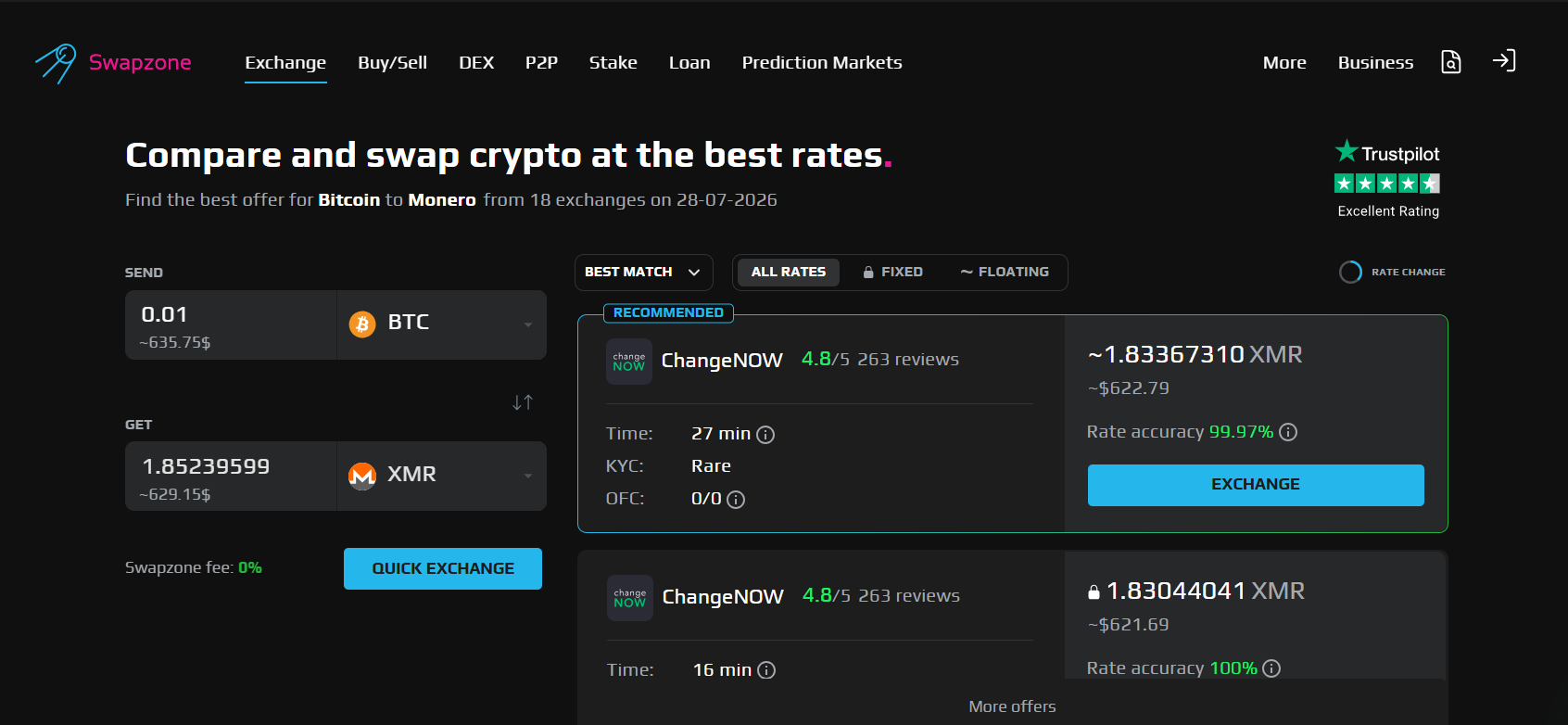
Swapzone positions itself as an independent crypto services aggregator that brings different crypto solutions together in one place. As a crypto swap aggregator, Swapzone helps users compare and access multiple swap options from exchange providers and decentralized solutions while keeping the focus on transparency, choice, and user control.
Unlike directories that only list available providers, Swapzone allows users to take action directly through its interface. Users can compare available options, select a suitable service, and start a transaction without switching between multiple platforms. Beyond swaps, the platform also connects users with other crypto services, including DEX solutions, staking, lending, and P2P options.
The platform does not hold user funds or act as the counterparty. Transactions are completed directly through the selected provider or protocol, while Swapzone serves as the layer that connects users with suitable crypto services.
Swapzone combines crypto service discovery with direct access to available solutions:
- Crypto service aggregation: Brings together different categories of crypto services, including exchange providers, DEX solutions, staking, lending, and P2P platforms, allowing users to compare and access options in one interface
- Direct crypto actions: Users can select a service and proceed with swaps, DEX transactions, or other supported crypto activities directly through Swapzone rather than using the platform only as a reference point
- Service comparison tools: Displays relevant information such as rates, ratings, supported assets, speed, and transaction requirements before users make a decision
- Non-custodial model: Users interact directly with selected providers or protocols, while Swapzone never stores user funds
- Broad ecosystem coverage: Provides access to different crypto use cases, from simple swaps to advanced DeFi services, within a single platform
Comparison Table: Best DEX Aggregators for Stablecoin Swaps in 2026
| Aggregator | Type | Chains | Key Stablecoin Feature | MEV Protection | Best Trade Size | Best For |
|---|---|---|---|---|---|---|
| 1inch | Same-chain EVM | 13+ EVM | Fusion intent mode, Pathfinder routing | Strong | Retail to institutional | EVM power users, dApp integrators |
| ParaSwap (Velora) | Same-chain EVM | EVM + cross-chain | RFQ hybrid for large trades | Medium-High | Six figures and above | High-volume traders, treasury teams |
| KyberSwap | Same-chain EVM | EVM | Own pool and aggregation hybrid | Medium | Retail to SME | EVM traders wanting pool access plus aggregation |
| Jupiter | Same-chain Solana | Solana | Best Solana routing, limit orders, DCA | Medium | All sizes | Any Solana stablecoin swap |
| deBridge | Cross-chain | 26+ chains | 0-TVL, native assets, no wrapped tokens | High | All sizes | Secure cross-chain stablecoin transfers |
| LI.FI and Jumper | Cross-chain | 15+ chains | Bridge and DEX aggregation unified | Medium | Retail to SME | Builders and cross-chain retail swaps |
| CoW Swap | Intent-based EVM | Ethereum and EVM | Batch auction, CoW matching, zero slippage | Highest | Six figures and above | MEV-sensitive large stable swaps |
| Eco Routes | Intent-based cross-chain | 15+ chains | Atomic cross-chain intents, 1:1 stables | High | All sizes | Cross-chain stablecoin retail and treasury |
| Odos | Multi-token EVM | 14 EVM | Multi-input to single stablecoin output | Medium | SME | Portfolio rebalancing, reward consolidation |
Conclusion
The best DEX aggregator for stablecoin swaps in 2026 depends entirely on three variables: which chain your assets are on, how large your trade is, and how much execution quality matters relative to settlement speed.
For EVM same-chain routing, 1inch and ParaSwap lead at scale, with CoW Swap delivering the strongest MEV protection for large trades where batch coincidence-of-wants matching can produce near-zero slippage.
Jupiter is the uncontested default for Solana. For cross-chain flows, deBridge leads on security and native asset delivery, LI.FI powers most of the builder layer and developer integrations, and Eco Routes offers the cleanest atomic cross-chain stable swap experience for retail and treasury users.
No single aggregator wins every quote, which is why understanding your trade size, chain, and execution priorities before choosing a tool is the most important step of all.
Read Next
- Stablecoin Insider's SEO & AEO Authority Report
- Stablecoin Insider Partners with The Grid to Launch the Industry's Largest Stablecoin Directory
- Bitcoin Policy Institute Releases “Stablecoin Supremacy”
FAQs:
What is a DEX aggregator for stablecoin swaps?
A DEX aggregator for stablecoin swaps is a routing layer that simultaneously queries multiple decentralized exchanges and liquidity pools, splits a single trade across the best available sources, and settles in one transaction to produce better execution than any single pool or DEX could offer alone.
What is the best DEX aggregator for USDC and USDT swaps on EVM chains in 2026?
The best DEX aggregator for USDC and USDT swaps on EVM chains in 2026 is 1inch for most trade sizes due to its Pathfinder routing engine and Fusion mode MEV protection, with CoW Swap being the stronger choice for six-figure trades and above, where batch auction settlement can deliver near-zero slippage through coincidence-of-wants matching.
What is the best DEX aggregator for stablecoin swaps on Solana in 2026?
The best DEX aggregator for stablecoin swaps on Solana in 2026 is Jupiter, which routes across all major Solana liquidity venues including Orca, Raydium, and Meteora to find the best execution on USDC and USDT SPL pairs, and offers additional tools including limit orders and DCA execution built into the same interface.
What is MEV and why does it matter for stablecoin swaps?
MEV (Maximal Extractable Value) matters for stablecoin swaps because it refers to the profit that validators or bots can extract by front-running or sandwiching transactions in the public mempool, which causes traders to receive worse execution than quoted, and aggregators with MEV protection such as 1inch Fusion mode or CoW Swap batch auctions reduce this risk significantly for large stable swaps where even a few basis points of adverse execution represents a meaningful dollar loss.
What is Odos and how is it different from other DEX aggregators for stablecoins?
Odos is different from other DEX aggregators for stablecoins in that it is specifically engineered for multi-token consolidation, allowing users to swap multiple input tokens into a single stablecoin output in one transaction, while most aggregators only handle standard single-input to single-output swaps, making Odos uniquely suited for portfolio rebalancing, LP unwinding, and reward consolidation use cases.
Disclaimer:
This content is provided for informational and educational purposes only and does not constitute financial, investment, legal, or tax advice; no material herein should be interpreted as a recommendation, endorsement, or solicitation to buy or sell any financial instrument, and readers should conduct their own independent research or consult a qualified professional.