Table of Contents
To check whether an exchange holds your USDT or USDC, open its official proof-of-reserves page, find the stablecoin's row, note the snapshot date, and confirm the on-chain wallet balance is at least as large as customer balances (a ratio of 100% or more). Then log in and verify your own balance is in the published Merkle tree.
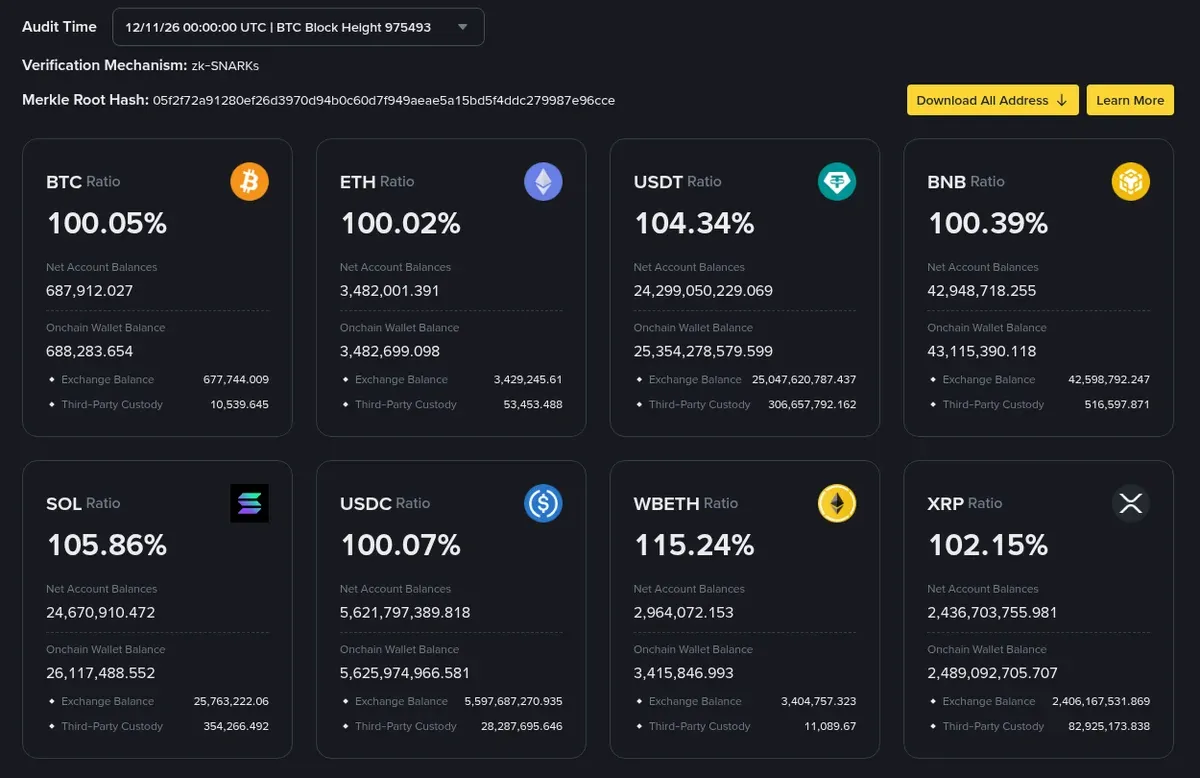
That check matters more in a selloff. Bitcoin fell to a four-month low near $62,000 on 15 November 2026, and stablecoin supply has been shrinking. On the same day we read the public reserve pages of Binance, OKX, Kraken and Bybit. The newest snapshot, Binance's for 12 November 2026, showed a USDT reserve ratio of 104.34% and a USDC ratio of 100.07%.
Last updated: 15 November 2026. Reserve ratios, snapshot dates and verification steps re-checked on the exchanges' public proof-of-reserves pages on this date.
Key Takeaways
- A proof of reserves shows that, at one snapshot, an exchange controlled on-chain assets at least equal to the customer balances in its Merkle tree. It does not show the exchange's other debts.
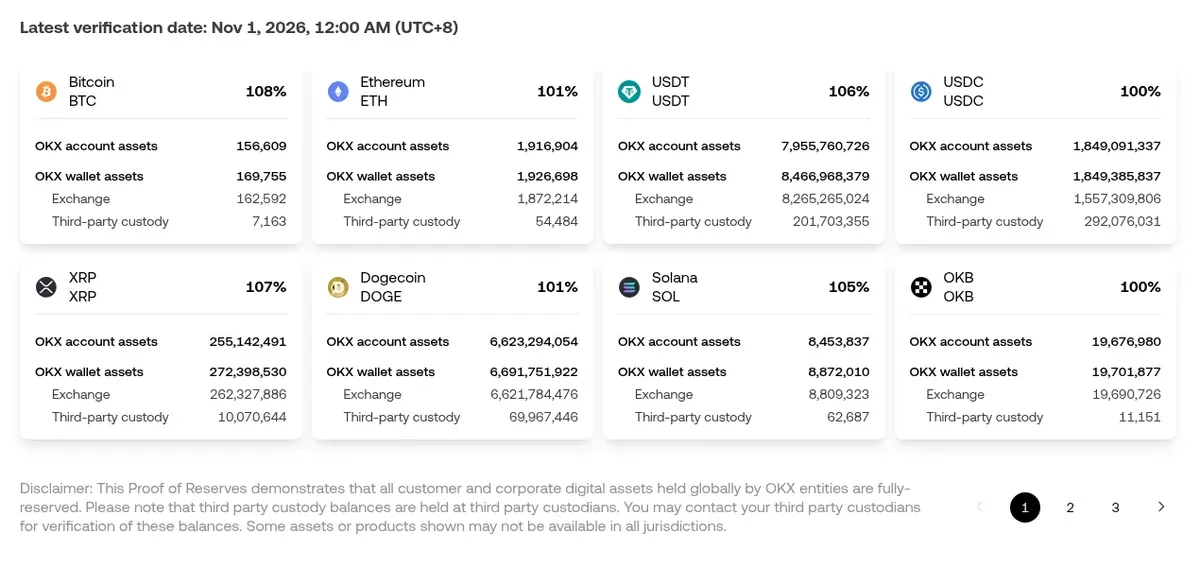
- Binance (12 Nov 2026 snapshot) reported USDT at 104.34% and USDC at 100.07%. OKX (1 Nov 2026, UTC+8) showed 106% and 100%. Kraken (30 Sep 2026) showed 105%+ for both.
- In our calculation, Binance held about 1.06 billion more USDT than customers were owed, but only about 4.2 million more USDC. Stablecoin buffers differ sharply by token.
- About 15.8% of OKX's USDC reserves sat with third-party custodians, which OKX says you must ask those custodians to verify.
- Your own check is the Merkle step: find your record ID in your account and confirm it sits in the tree. Kraken's sample code shows a change of 0.00001 USDT produces a completely different leaf.
What does an exchange proof of reserves actually prove?
An exchange proof of reserves proves that, at a set moment, the exchange controlled wallets holding at least as much of each in-scope asset as its customers held on the platform. Kraken describes it as an independent accountant taking an anonymised snapshot of client balances, aggregating them into a Merkle tree, and comparing that total with addresses Kraken proves it owns through digital signatures.
Two halves make the proof. One is a proof of liabilities, which shows what customers are owed. The other is a proof of assets, which shows what the exchange holds. Vitalik Buterin's essay on proof of solvency explains that combining the two is what shows an exchange "has the funds to pay back all of its depositors" for that asset.
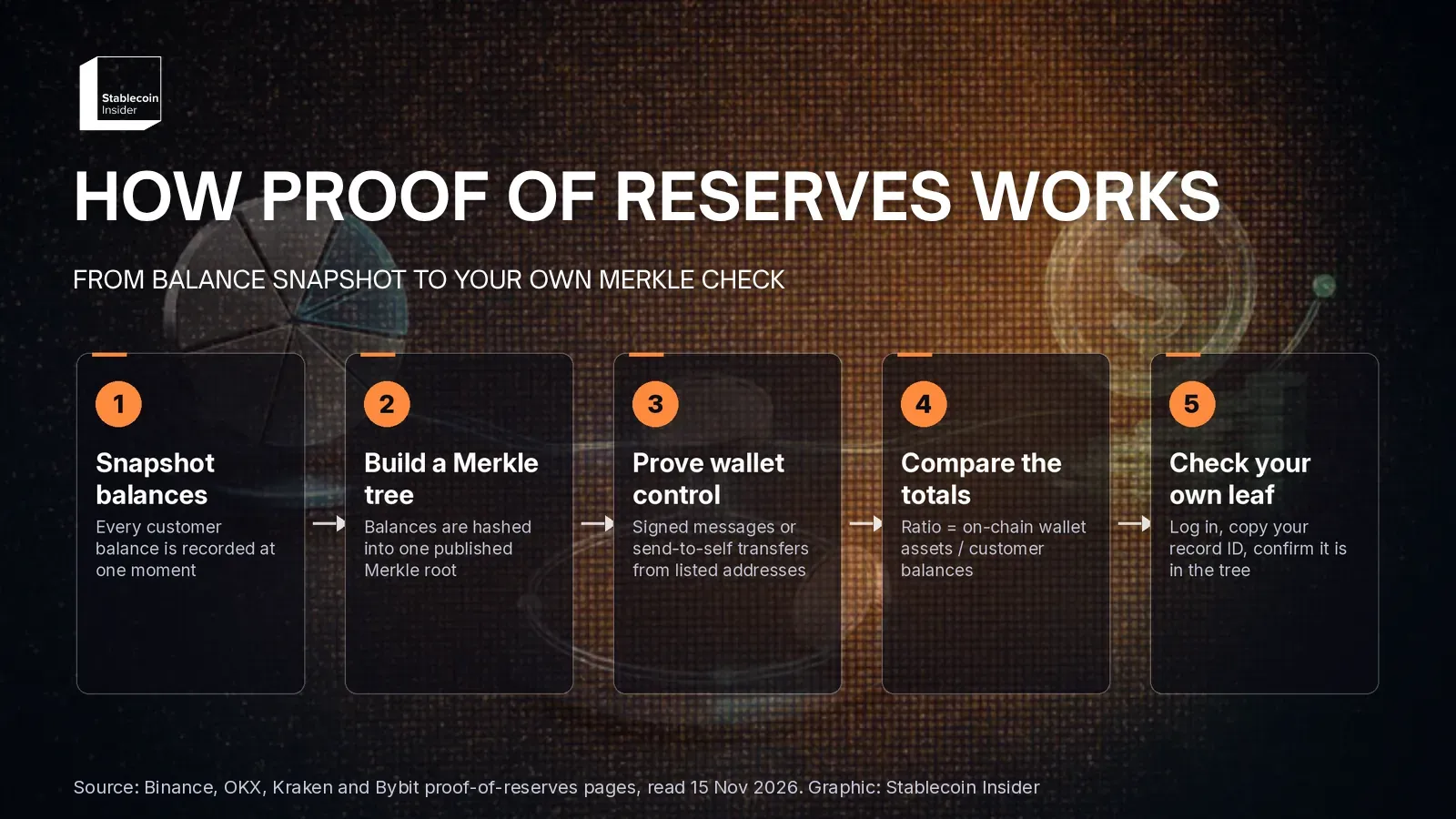
Exchanges prove wallet control in different ways. Binance lists ownership verification as step one and lets anyone download all its reserve addresses. Bybit says it uses a "Send to Self" method, moving a set amount between its own published addresses at a set time.
How do you check an exchange's USDT or USDC reserve ratio?
You check an exchange's USDT or USDC reserve ratio by reading four things on its public page: the snapshot date, the customer balance, the wallet balance and the custody split. No login is needed for this part.
1. Open the official page and note the snapshot
Open the page from the exchange's own site, not a search ad: Binance, OKX, Kraken or Bybit. Write down the snapshot time. On 15 November 2026 the pages showed four different dates, from 30 September (Kraken) to 12 November (Binance).
2. Find the customer balance for the stablecoin
The customer figure is what the exchange owes users in that token. Binance calls it "Net Account Balances" and OKX calls it "OKX account assets". This is the liability side, drawn from the Merkle tree.
3. Compare it with the wallet balance
The wallet figure is what the exchange holds. Binance labels it "Onchain Wallet Balance" and OKX "OKX wallet assets". Divide wallet by customer balance to get the ratio. Anything at or above 100% means the token was fully covered at the snapshot.
4. Check how much sits with third-party custodians
Both Binance and OKX split the wallet figure into "Exchange" and "Third-Party Custody". You can trace exchange-held addresses on a block explorer, as in our guide to checking a USDT or USDC transaction. Third-party balances you cannot: OKX says users "may contact your third party custodians for verification of these balances."
What did the latest USDT and USDC ratios show on 15 November 2026?
The latest USDT and USDC ratios on 15 November 2026 were all at or above 100%, but the snapshots were up to six weeks old. The table lists the ratio each exchange displayed, linked to its page.
| Exchange | Snapshot | USDT ratio | USDC ratio |
|---|---|---|---|
| Binance | 12 Nov 2026, 00:00 UTC | 104.34% | 100.07% |
| OKX | 1 Nov 2026, 00:00 UTC+8 | 106% | 100% |
| Kraken | 30 Sep 2026 | 105%+ | 105%+ |
| Bybit | 27 Oct 2026, 06:00 UTC | Not read | Not read |
Two patterns stand out. First, every exchange we could read covered both stablecoins in full at its snapshot. Second, the snapshots are not comparable in time: Kraken's predates the November selloff entirely. Bybit's public page lists its audited wallets and snapshot time, but its separate ratio view did not load when we read it, so we left its ratios blank rather than estimate them.
What does a 104% USDT ratio actually mean?
A 104% USDT ratio means Binance held about 1.04 USDT in its wallets for every 1 USDT customers had on the platform at the snapshot. We recalculated each ratio from the raw balances the two exchanges publish.
| Exchange and token | Customer balances (m) | Wallet assets (m) | Surplus, m (ratio) |
|---|---|---|---|
| Binance USDT | 24,299.05 | 25,354.28 | 1,055.23 (104.34%) |
| Binance USDC | 5,621.80 | 5,625.97 | 4.18 (100.07%) |
| OKX USDT | 7,955.76 | 8,466.97 | 511.21 (106.43%) |
| OKX USDC | 1,849.09 | 1,849.39 | 0.29 (100.02%) |
Figures are in millions of tokens (m), calculated from Binance (12 Nov 2026) and OKX (1 Nov 2026). Surplus is wallet assets minus customer balances. Third-party custody made up 1.2% of Binance's USDT wallets, 0.5% of its USDC, 2.4% of OKX's USDT and 15.8% of OKX's USDC.
The USDC buffers are thin. OKX's USDC surplus of 294,500 tokens is about 0.02% of customer balances, so the coverage is close to exactly 1:1. That is not a shortfall, but it leaves almost no cushion if a snapshot is taken mid-transfer. The USDT surpluses are larger, and Binance notes that excess assets in its reserve addresses are "not indicative of the overall amount of Binance's own assets."
How do you verify your own balance is included?
You verify your own balance is included by finding your record ID or Merkle leaf in your logged-in account and checking it against the published Merkle root. On Binance the path is Wallet, then Verification, where you pick a snapshot date and see your record ID and covered balances.
On Kraken, the steps run through Kraken Pro: Account icon, Proof of Reserves, select a date, then "Verify yourself". You can paste the first 16 characters of your Merkle Leaf ID into the third-party accountant's tool, or rebuild the leaf yourself with the SHA-256 steps Kraken publishes.
We ran Kraken's published Python sample on its example account data, not a real account. With the sample balance of 6.72754 USDT the leaf came out as b6f78dd45d94c492. Changing that balance by a single unit, to 6.72755 USDT, produced e2d37c2c81984df4. That is why a tampered balance cannot hide inside the tree: any change, however small, changes the leaf and the root.
One limit applies to every exchange. Kraken notes the check reflects only in-scope balances at the review time, "not any subsequent trades or transactions."
What does proof of reserves not tell you?
Proof of reserves does not tell you whether the exchange is solvent overall, whether the funds were borrowed for the snapshot, or whether the stablecoin itself is fully backed. These are the gaps to weigh.
- Other liabilities: Kraken lists that the procedure "cannot identify any hidden encumbrances or prove that funds had not been borrowed for purposes of passing the review."
- Timing: OKX calls its report "a snapshot", and Kraken adds that keys may have been lost or funds stolen since the latest review.
- Off-chain assets: fiat held at banks cannot be proven cryptographically; Vitalik Buterin writes such proofs rely on "fiat" trust models such as bank and auditor attestations.
- The issuer layer: an exchange can hold every USDT it owes and you still depend on the issuer. Tether's transparency page reports the issuer's assets and liabilities as of its last reserves report (30 September 2026), while Circle discloses USDC reserves weekly with monthly Big Four assurance. Our guide on how to read a stablecoin attestation covers that check.
Worried about the token, not the exchange? See whether stablecoins are safe and how depegs and reserve backing interact, or read how stablecoin freezes worked during the Binance hack.
For the rules on how stablecoin issuers must hold and report reserves, see our Stablecoin regulation hub.
FAQ
How often do exchanges publish proof of reserves?
Does a reserve ratio above 100% guarantee I can withdraw?
What is the difference between proof of reserves and a stablecoin attestation?
What is a Merkle root?
Why does my verified balance differ from my current balance?
Sources: Binance Proof of Reserves; OKX Proof of Reserves; Kraken Proof of Reserves and FAQ; Bybit Proof of Reserves; Vitalik Buterin, Having a safe CEX: proof of solvency and beyond (2022); Circle USDC transparency; Tether transparency. All read on 15 November 2026.
This content is provided for informational and educational purposes only and doesn't constitute financial, investment, legal or tax advice. Reserve ratios and balances were read from public exchange pages on 15 November 2026 and reflect each exchange's snapshot date, not live holdings. Binance, OKX, Kraken, Bybit, Tether (USDT) and Circle (USDC) are mentioned for information only; none paid for placement.