Table of Contents
The Office of the Comptroller of the Currency received 49 de novo charter applications between January 2025 and October 23, 2026, approving 28, denying 2 and returning 1 (Source: PYMNTS).
Stablecoin Insider tracks the institutions that issue, hold and settle digital dollars, and in 2026 a federal charter became the line between a supervised custodian and an app running on a partner bank.
An OCC charter lets a company operate under one federal supervisor across all 50 states instead of stacking state licences.
The applications come from stablecoin issuers, crypto custodians, neobanks and payment companies, and they are moving through the agency at very different speeds.
This tracker lists every fintech and crypto firm with a final OCC charter, every conditional approval still waiting to open, the pending queue, the two denials, and how long each step has taken.
Key Takeaways
- Five fintech and crypto firms hold final OCC charters as of November 2026.
- Coinbase won final national trust approval on November 6, 2026.
- Twenty-four more hold conditional approvals and must open within 18 months.
- Wise and bunq were denied in 2026 over AML and capital gaps.
- The median wait from filing to a first OCC decision is 149 days.
Why Fintechs Are Lining Up for Charters Now
The OCC received 40 de novo applications over the 18 months to August 2026, against an average of fewer than four a year from 2011 through 2014 (Source: Forbes).
That is more than six times the earlier pace. Comptroller Jonathan Gould has framed it as policy, declaring that "America and the OCC are once again open for business," and our profile of Jonathan Gould traces how he got there.
Three forces are driving the queue.
- The GENIUS Act: The law made the OCC the federal supervisor for nonbank payment stablecoin issuers, so a charter is now the cleanest route to issuing a dollar token nationally. The OCC's final GENIUS Act rule sets the reserve and redemption terms.
- Escaping the partner-bank model: Neobanks that serve US customers through partner banks give up margin and product control, and a charter brings the customer relationship in-house.
- Custody credibility: Institutional clients increasingly want assets held by a federally supervised fiduciary rather than a state-licensed money transmitter.
Trust Charter, National Bank or ILC: What Each One Allows
Not every charter is a bank in the everyday sense. A national trust bank charter grants federally supervised fiduciary and custodial powers, direct control of reserves backing stablecoins, and in some cases qualified custodian status (Source: Davis Wright Tremaine).
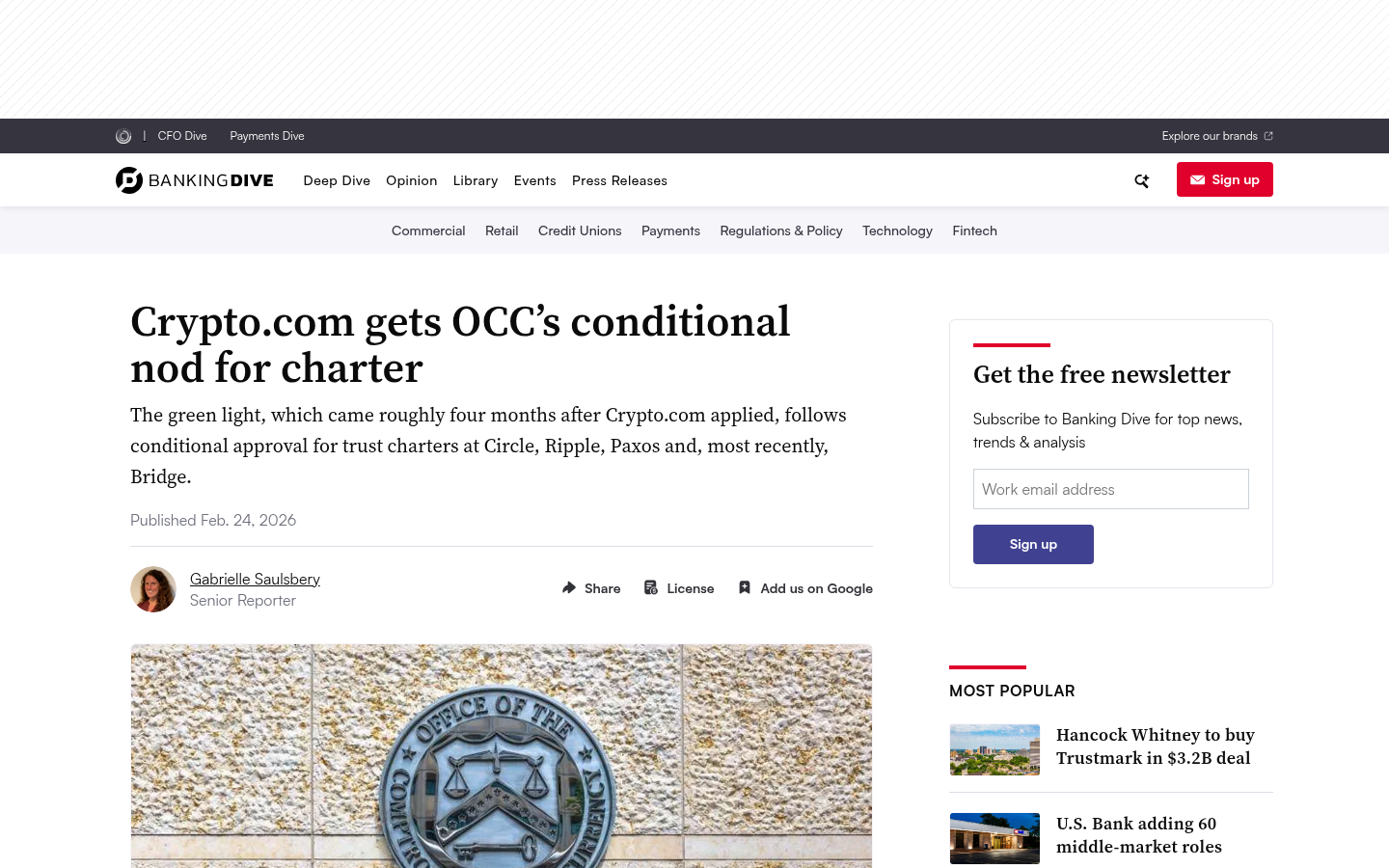
What it does not grant is the right to take deposits or make loans. Crypto.com's conditional approval, for example, permits custody but not deposits or lending (Source: Banking Dive).
| Charter | What it allows | Examples |
|---|---|---|
| National trust bank | Custody and fiduciary | Circle, Ripple, Coinbase |
| Trust conversion | Same, from a state trust | BitGo, Paxos, Fidelity |
| Full national bank | Deposits and lending | Erebor, Nubank, Revolut |
| Industrial loan company | FDIC-insured state bank | PayPal, Klarna, Affirm |
Trust charters answer only to the OCC, full national banks also need FDIC insurance and Federal Reserve approval, and industrial loan companies are state banks insured by the FDIC. Our breakdown of national trust charters versus banks and state trusts covers the trade-offs for stablecoin issuers in more depth.
The Tracker: Five Final Approvals
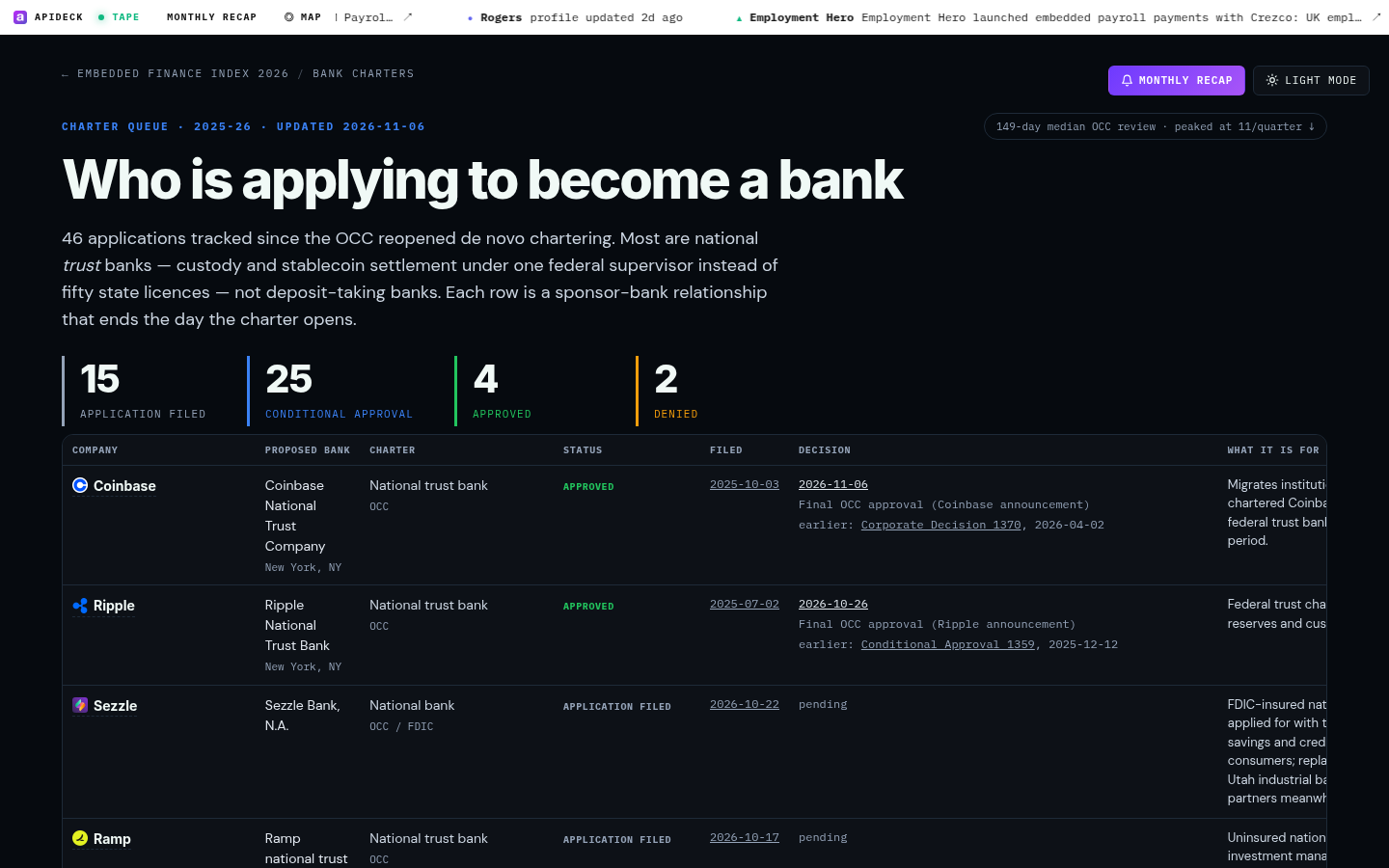
Five fintech and crypto firms now hold final OCC approval. Four are trust banks, and Erebor is the only full-service national bank in the group (Source: Embedded Finance Index).
| Firm | Charter type | Final approval |
|---|---|---|
| Coinbase | National trust | November 6, 2026 |
| Ripple | National trust | October 26, 2026 |
| Circle | National trust | July 10, 2026 |
| Erebor | Full national bank | February 9, 2026 |
| BitGo | Trust conversion | January 29, 2026 |
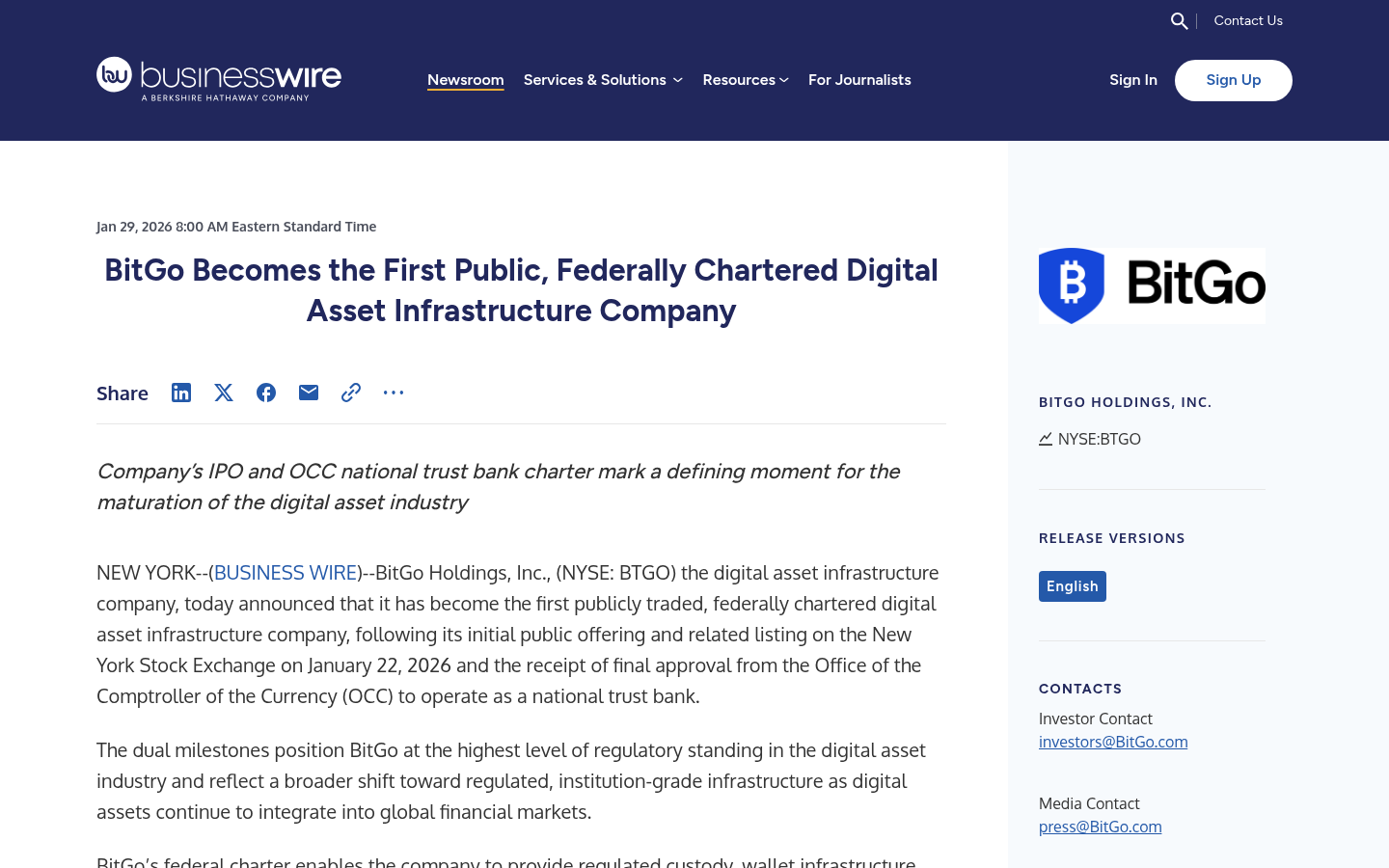
BitGo crossed the line first, becoming the first publicly traded, federally chartered digital asset infrastructure company on January 29, 2026 (Source: Business Wire).
Coinbase is the most recent. Its conditional approval came on April 2, 2026 and its final approval on November 6, a timeline covered in our Coinbase OCC trust charter report.
Conditional Approvals Waiting to Open
A conditional approval is a promise, not a licence. Applicants must meet capital, governance and operational conditions and open within 18 months, or the approval lapses (Source: The Industry Spread).
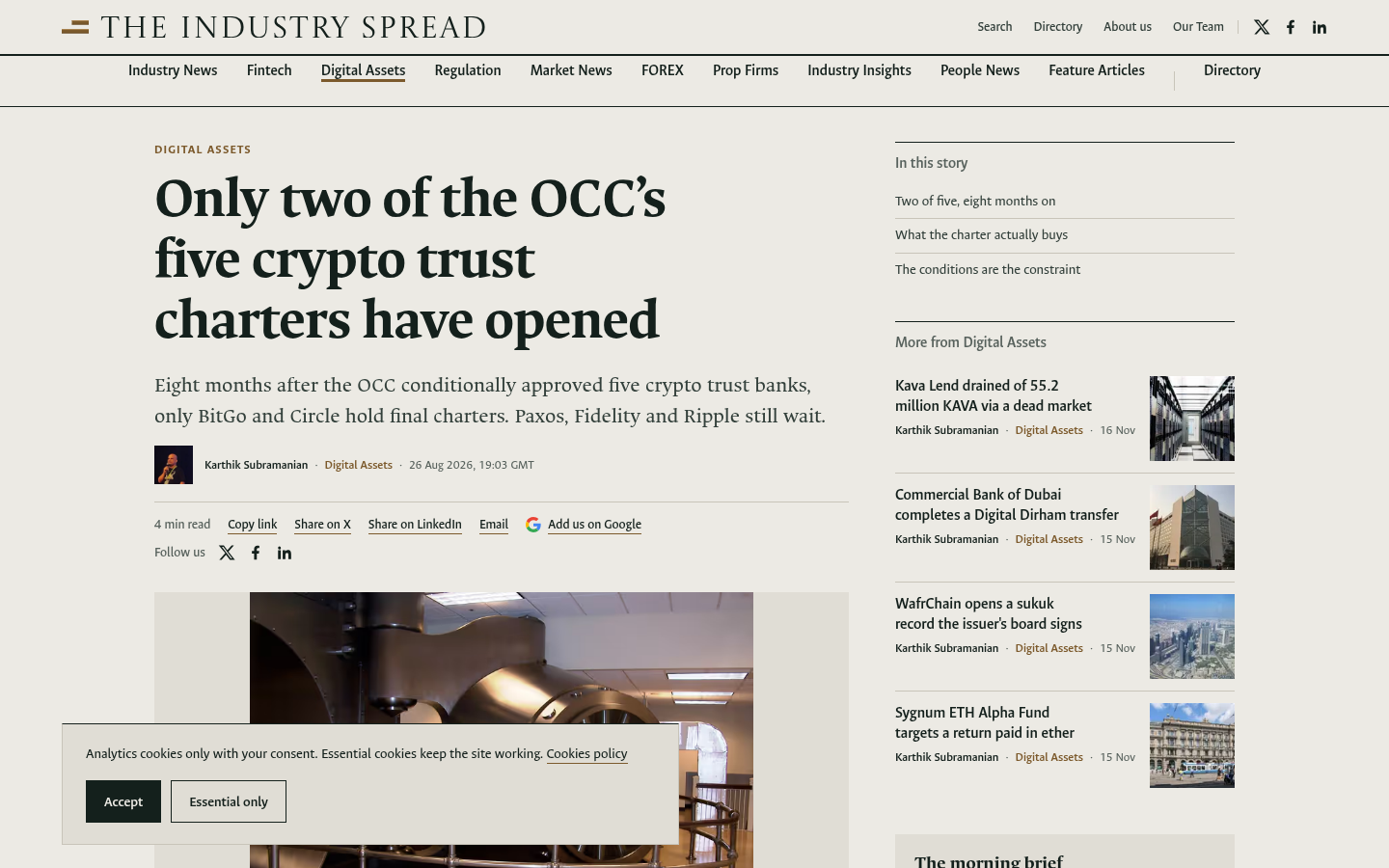
That deadline is not theoretical. Paxos received a preliminary approval in 2021 that expired on March 31, 2023, and it is back in the queue on a new conditional approval.
Conditions can be specific. World Liberty Trust Company must raise $20 million in tier 1 capital, at least half in cash-equivalent liquid assets, before it can open (Source: The Industry Spread). Our report on the World Liberty trust bank approval covers what it means for USD1.
The full list of 24 conditional approvals, newest first (Source: Embedded Finance Index):
| Firm | Charter | Conditional approval |
|---|---|---|
| Mission Lane | National bank | Sep 25, 2026 |
| Agora | National trust | Sep 18, 2026 |
| Bastion | Trust conversion | Sep 18, 2026 |
| Catena Labs | National trust | Sep 18, 2026 |
| Revolut | National bank | Sep 2, 2026 |
| OpenReserve | National bank | Sep 2, 2026 |
| Itaú | National bank | Aug 14, 2026 |
| World Liberty Financial | National trust | Aug 14, 2026 |
| Upstart | National bank | Jul 23, 2026 |
| Sony Bank (Connectia Trust) | National trust | Jul 2, 2026 |
| Morgan Stanley | National trust | Jun 18, 2026 |
| Nomura (Laser Digital) | National trust | May 29, 2026 |
| Augustus | National bank | May 8, 2026 |
| Interactive Brokers | National trust | May 5, 2026 |
| Mercury | National bank | Apr 24, 2026 |
| VALT | National bank | Mar 13, 2026 |
| Crypto.com | National trust | Feb 20, 2026 |
| Protego | National trust | Feb 13, 2026 |
| Bridge (Stripe) | National trust | Feb 12, 2026 |
| Nubank | National bank | Jan 29, 2026 |
| UKG | National trust | Jan 22, 2026 |
| Paxos | Trust conversion | Dec 12, 2025 |
| Fidelity Digital Assets | Trust conversion | Dec 12, 2025 |
| OneSource Virtual | National trust | Sep 12, 2025 |
Revolut is the largest consumer brand on the list. Its approval, confirmed on September 3, 2026, still needs FDIC deposit insurance and Federal Reserve sign-off before a planned 2027 launch for a group with more than 80 million customers worldwide (Source: FinanceX Magazine).
Our report on Revolut's US bank and its stablecoin plans covers what it intends to offer.
The Pending Queue
Fifteen more applications were still waiting for a first decision at the latest update (Source: Embedded Finance Index).
- National trust banks: Payoneer (filed Feb 23, 2026), Lorum (Mar 31), Kraken (May 8), Zero Hash (Aug 19), Block (Sep 4), Modern Treasury (Oct 5), Rain (Oct 6) and Ramp (Oct 17).
- Full national banks: Avant (Sep 18) and Sezzle (Oct 22).
- Industrial loan companies: PayPal (Dec 15, 2025), Affirm (Jan 23, 2026), Klarna (Jul 6), Flex (Jul 24) and Upgrade (Oct 12).
Late filers face a slower path. The OCC has been reshuffling staff to handle the workload, and the 2028 presidential election adds timing risk for anyone still in the queue next year (Source: PYMNTS).
The Two Denials: What Wise and bunq Got Wrong
The OCC has denied two fintech applications since reopening de novo chartering, and both letters show the bar is real.
Wise applied for a national trust bank in June 2025. The OCC said it could not conclude the bank would have an effective AML/CFT program, citing a multistate consent order over Bank Secrecy Act shortcomings at Wise US and a $4.2 million fine (Source: FinTech Futures).
The denial came on July 21, 2026, roughly 400 days after filing, the longest wait in the dataset (Source: Embedded Finance Index). Wise plans to resubmit under the GENIUS Act framework, and our comparison of Wise vs Revolut covers how it operates today.
bunq was denied on August 4, 2026. Its initial capital of $50 million was revised to $58.3 million without source documentation, and the OCC found its management lacked relevant US credit card experience (Source: Forbes).
The difference matters for what comes next. bunq's gaps were documentation it can fix and refile; Wise's path back depends on remediating its operating company first.
How Long the Process Takes
The median time from filing to a first OCC decision is 149 days. The fastest decision came in 118 days, and the slowest approval took 184 (Source: Embedded Finance Index).
The second stage, from conditional to final approval, varies far more.
| Firm | Conditional approval | Final approval | Days between |
|---|---|---|---|
| BitGo | Dec 12, 2025 | Jan 29, 2026 | 48 |
| Circle | Dec 12, 2025 | Jul 10, 2026 | 210 |
| Coinbase | Apr 2, 2026 | Nov 6, 2026 | 218 |
| Ripple | Dec 12, 2025 | Oct 26, 2026 | 318 |
Being a conversion does not guarantee speed. BitGo converted its existing trust company in 48 days, while Paxos and Fidelity Digital Assets, approved as conversions on the same day, are still waiting. Ripple's 318 days as a de novo trust bank are unpacked in our analysis of Ripple's national trust bank.
For full-service banks the clock does not stop at the OCC. An FDIC deposit insurance order expires if the bank is not established within 12 months (Source: Davis Wright Tremaine).
What a Charter Does Not Give You
A charter does not guarantee access to the Federal Reserve's payment system. Wise said its original plan became unworkable because the Fed has generally paused master account access for uninsured trust banks (Source: FinTech Futures).
That is the hidden constraint on the trust charter wave. Without a master account, a national trust bank can hold reserves and custody assets, but it still settles dollars through a correspondent bank.
Full-service applicants hit the same gate from the other side. Revolut's conditional approval still needs Federal Reserve sign-off, including a master account, before launch (Source: FinanceX Magazine).
What This Means for Stablecoin Holders and Businesses
For stablecoin holders, the charters change who supervises the reserves. USDC's issuer now runs a federally chartered trust bank, covered in our report on Circle's final OCC approval, and Ripple's RLUSD and World Liberty's USD1 sit on the same path.
For businesses choosing a custodian or on-ramp, three checks matter.
- Final or conditional: A conditional approval is not an operating bank, so ask which entity holds your assets today.
- Trust or bank: A trust charter means custody and fiduciary duties, not deposit insurance.
- Payment access: Ask whether the provider settles through its own master account or through a partner bank.
Issuers weighing their own filing can start with our guide on how to apply for OCC stablecoin issuer approval.
What to Watch Next
- Kraken: Filed on May 8, 2026 and now more than 190 days in, well past the 149-day median.
- Paxos and Fidelity Digital Assets: Both December 2025 approvals must open by June 2027 under the 18-month rule.
- World Liberty's capital: The $20 million tier 1 raise gates the trust bank behind USD1.
- Revolut's 2027 launch: FDIC and Federal Reserve approvals are the next milestones.
- Wise's resubmission: A GENIUS Act application will test whether remediation is enough for the OCC.
- OCC capacity: Staffing strain and the 2028 election cycle could slow anyone filing from late 2026 onward.
Conclusion
Stablecoin Insider tracks charters because they decide which firms can hold digital dollars under federal supervision, and in 2026 that list grew faster than it has in years.
Five fintech and crypto firms hold final OCC charters: BitGo, Erebor, Circle, Ripple and Coinbase.
Twenty-four more hold conditional approvals and must open within 18 months, fifteen applications are still pending, and Wise and bunq were denied.
The median wait to a first decision is 149 days, but the gap between conditional and final approval ranges from weeks to most of a year, and even a final charter does not guarantee Federal Reserve payment access.
Read Next
These three guides pick up where the tracker leaves off, from stablecoin issuer rules to choosing a regulated custodian.
- Best AI Smart Contract Security Tools for Stablecoin and DeFi Teams
- Brazil Stablecoin Sandwich: What Resolution 561 Bans vs. What Is Only Reported
- Western Union Alternatives in 2026: Fees and Rates Compared
FAQs
1. Which fintech companies have an OCC charter in 2026?
The fintech companies with a final OCC charter in 2026 are BitGo, Erebor, Circle, Ripple and Coinbase. BitGo converted first on January 29, Coinbase was the most recent on November 6, and 24 more firms, including Revolut, Nubank, Paxos and Bridge, hold conditional approvals that are not yet operating banks.
2. How long does it take to get an OCC charter?
It takes a median of 149 days to get a first OCC charter decision, with the fastest at 118 days. Moving from conditional to final approval adds anywhere from 48 days, as with BitGo, to 318 days, as with Ripple.
3. What is the difference between an OCC national trust charter and a national bank charter?
The difference between an OCC national trust charter and a national bank charter is that a trust charter covers custody, fiduciary services and stablecoin reserve management, while a national bank charter also allows deposits and lending and requires FDIC insurance and Federal Reserve approval.
4. Why did the OCC deny Wise's bank charter?
The OCC denied Wise's bank charter because it could not conclude the proposed trust bank would run an effective AML/CFT program. It cited a multistate consent order over Bank Secrecy Act failures at Wise US, which paid a $4.2 million fine, and Wise plans to reapply under the GENIUS Act.
5. Does an OCC charter give access to the Federal Reserve?
An OCC charter does not give automatic access to the Federal Reserve. Master accounts are a separate Fed decision, the Fed has generally paused them for uninsured trust banks, and full-service applicants such as Revolut still need Fed sign-off before they can open.
Disclaimer: This content is provided for informational purposes only and does not constitute legal, financial, or compliance advice. Protocol versions, governance arrangements, and partner counts cited here reflect publicly announced milestones as of November 2026 and are moving quickly. Adoption figures come from vendor and foundation announcements with differing methodologies and should be treated as directional signals rather than guaranteed outcomes.