Table of Contents
Over 90% of Brazil's crypto transaction volume is now stablecoin-related, a figure confirmed by the country's own central bank governor, and it explains why Brazil became the first major economy in the region to pull stablecoins fully inside its supervised foreign-exchange system in February 2026.
Stablecoin Insider tracks how regulation is reshaping where and how stablecoin volume moves, and Latin America is now the most instructive regulatory laboratory in the world: five major markets, five different answers, all moving in the same direction.
The region's regulators are no longer choosing between banning stablecoins and ignoring them; they are absorbing them into existing financial law, with licensing, reporting, and tax consequences attached.
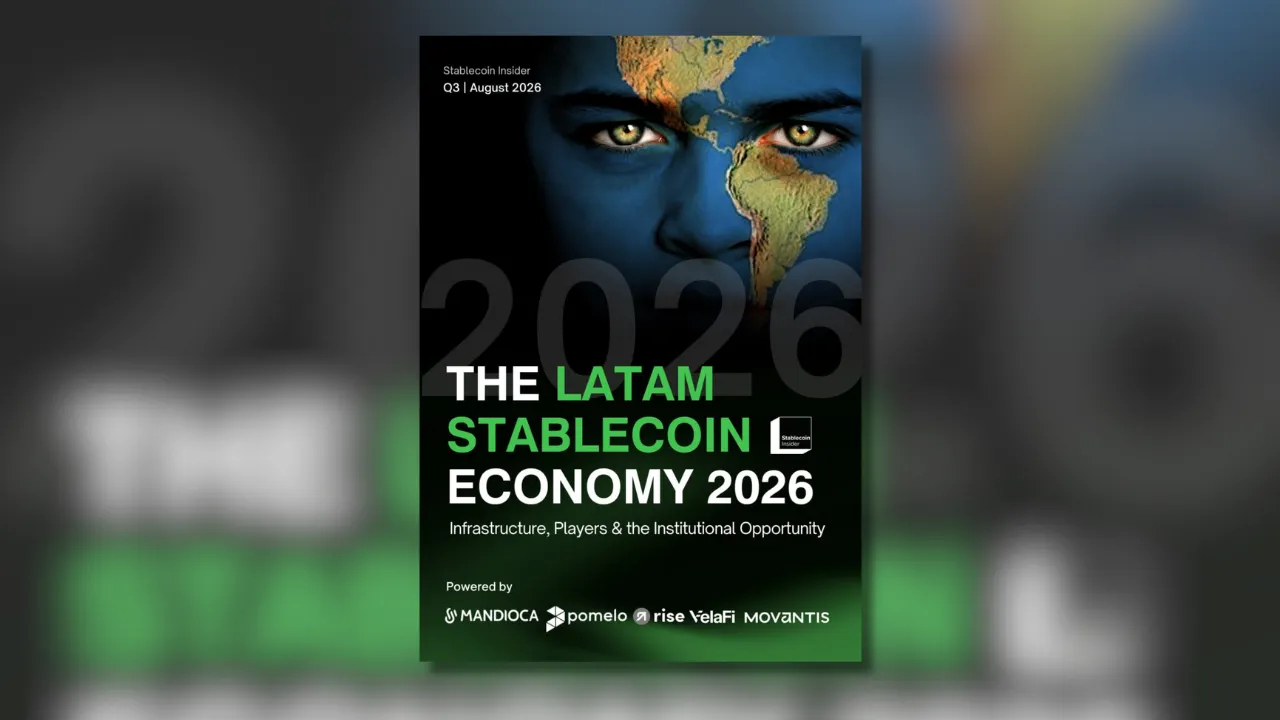
This article compares stablecoin regulation across Brazil, Mexico, Argentina, Colombia, and Bolivia in 2026, drawing on The LATAM Stablecoin Economy 2026 report and the operator research behind it: the frameworks, the deadlines, the taxes, and what it all means for businesses operating on these rails.
Key Takeaways
- Brazil classifies stablecoin operations as foreign-exchange transactions, effective 2 February 2026.
- Brazil's VASP licensing transition ends 30 October 2026, forcing market consolidation.
- Mexico permits public crypto use but restricts regulated financial institutions.
- Argentina requires CNV registration for all virtual asset service providers.
- Bolivia lifted its crypto ban in 2024; state banks now sell USDT.
Why Stablecoin Regulation in LATAM Matters Now
Regulation is following volume. Latin America moved $324 billion through stablecoin transactions in 2025, up 89% year-on-year, and stablecoin purchases exceed half of all exchange purchases in Brazil, Argentina, and Colombia.
When an asset class carries that share of a region's payment activity, regulators stop treating it as a crypto niche and start treating it as financial infrastructure.
The template emerging across the region is neither prohibition nor blessing. It is absorption: stablecoins are being written into existing FX, licensing, and AML frameworks, which formalizes the market, raises compliance costs, and rewards operators who built regulated standing early.
According to research by Pomelo, the card-issuing infrastructure company operating across the region's markets, LATAM is a complex environment defined by regulatory asymmetries across markets, and as frameworks mature, financial institutions gain the confidence to build stablecoin-based products; the next challenge is ensuring compliance, reporting, settlement, and risk-management capabilities evolve at the same pace as adoption.
Brazil: Stablecoins Are Now Foreign Exchange
Brazil's framework is the most consequential in the region and the template other central banks will study.
Central bank Resolutions 519, 520, and 521, published on 10 November 2025 and effective 2 February 2026, created mandatory licensing for virtual asset service providers and, critically, classified operations with fiat-pegged stablecoins as foreign-exchange transactions. That single reclassification pulls stablecoin activity inside Brazil's supervised FX perimeter, with full reporting obligations from May 2026 and a licensing transition period running to 30 October 2026.
A separate resolution goes further, barring eFX providers from using stablecoins in cross-border settlement from 1 October 2026.
FX classification carries fiscal consequences: a 3.5% IOF-Câmbio tax comes into scope for covered cross-border stablecoin payments from February 2026. A rail that looked nearly free on-chain acquires a regulated cost once formalized, and businesses modelling stablecoin settlement in Brazil need to model the regulated cost, not the on-chain cost.
Licensed providers must segregate client assets, and authorization requires independent proof-of-reserves certification, aligning Brazil with the reserve and audit standards emerging internationally.
After 30 October 2026, licensed institutions may not transact with unauthorized counterparties. That rule mechanically forces consolidation: smaller unlicensed operators must license, sell, or exit, and licensed multi-market operators are positioned to absorb them.
Mexico: Legal for the Public, Restricted for Institutions
Mexico's 2018 Fintech Law permits public crypto use but bars regulated financial institutions from offering virtual-asset services directly to customers, which pushes stablecoin activity through exchanges and specialized providers rather than banks.
The framework is now moving: a May 2026 Senate initiative, the Murat Initiative, would create a formal regime for peso-referenced stablecoins across ten financial laws. If enacted, Mexico would add a local-currency stablecoin regime to a market that is also the world's largest single remittance corridor, receiving $61.8 billion from abroad in 2025.
Argentina: Registration Under the Securities Regulator
Argentina regulates the providers rather than the asset. Virtual asset service providers must register with the securities regulator CNV under the PSAV regime, established by Resolution 994/2024 and operationalized by Resolution 1058/2025, with anti-money-laundering obligations under Law 27,739.
Registration applies to foreign providers targeting Argentine residents, not only local companies. The framework formalizes a market where stablecoins already account for over 60% of crypto activity and monthly active user penetration reached 12% in 2025, the region's highest.
Colombia: No Dedicated Regime Yet
Colombia has no dedicated VASP licensing framework. Stablecoin activity operates under general AML rules, alongside the country's new Bre-B instant-payment system, which connected 218 financial institutions and 33 million users within six months of its October 2025 launch.
The regulatory gap has not slowed adoption: stablecoins made up 48% of Colombian exchange purchases in 2024, aided by restrictions on USD bank accounts.
According to research by Mandioca, the cross-border trade settlement platform, the peso's roughly 15% depreciation in a single year, from about COP 3,822 to COP 4,409 per dollar, is the practical driver: importers hold dollar-denominated value to protect margins between invoice and payment, with or without a dedicated crypto framework.
Bolivia: From Ban to State-Bank USDT
Bolivia is the region's fastest regulatory reversal. The country banned crypto outright until 2024, then recorded $14.8 billion in crypto transaction volume in the following twelve months as a dollar shortage pushed businesses on-chain.
According to research by Mandioca, transaction-level evidence from its platform recorded parallel-market dollar premiums of 80-95% above the official rate during the shortage, making official dollar channels effectively unusable for importers.
Policy followed practice: by April 2026, state-controlled Banco Unión was selling USDT through its Yasta wallet for international payments and remittances, Banco FIE launched USDT buy and sell through its mobile app, and the Economy Ministry is formally evaluating a framework that would recognise USDT as a payment instrument circulating alongside the boliviano and the dollar, with AML safeguards attached.
If enacted, it would be the region's first officially stablecoin-integrated national payment framework.
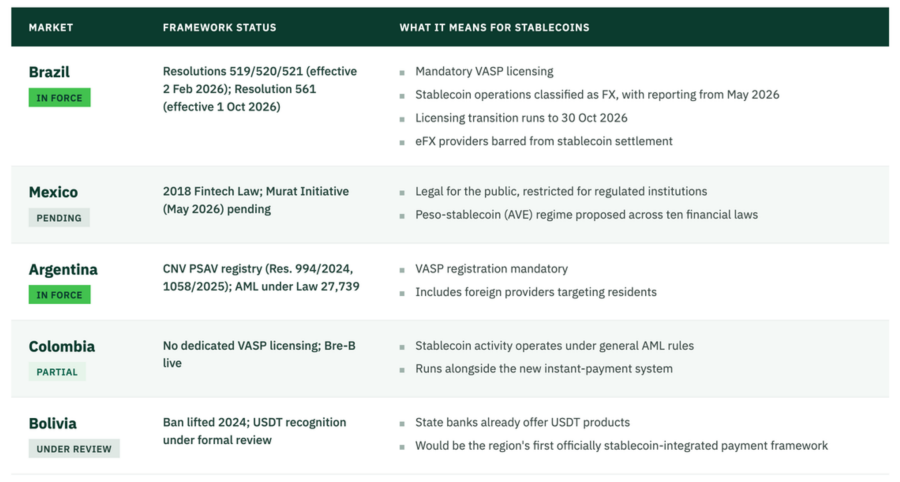
The Regulatory Map at a Glance
| Market | Framework status (mid-2026) | What it means for stablecoins |
|---|---|---|
| Brazil | Resolutions 519/520/521 effective 2 Feb 2026; eFX stablecoin ban from 1 Oct 2026 | Mandatory VASP licensing; stablecoins classified as FX; reporting from May 2026; 3.5% IOF tax in scope; licensing transition ends 30 Oct 2026 |
| Mexico | 2018 Fintech Law; Murat Initiative pending (May 2026) | Legal for the public, restricted for regulated institutions; peso-stablecoin regime proposed across ten financial laws |
| Argentina | CNV PSAV registry (Res. 994/2024, 1058/2025); AML under Law 27,739 | VASP registration mandatory, including foreign providers targeting residents |
| Colombia | No dedicated VASP licensing; Bre-B live | Activity operates under general AML rules alongside the new instant-payment system |
| Bolivia | Ban lifted 2024; USDT recognition under formal review | State banks already offer USDT; would be the region's first stablecoin-integrated payment framework |
What Regulation Means for Businesses on These Rails
Compliance is the moat, not the obstacle
According to research by Movantis, the regulated settlement network connecting 70+ money transfer operators and banks to 90,000+ payout locations, the rail integration is the fast part of stablecoin adoption for any regulated institution; the hard part is licensing in each market, a compliance framework that holds across jurisdictions, access to local liquidity, and integration with the local payment rails the beneficiary actually uses.
Regulated standing on both ends of a corridor is built over years, not bought with capital, and stablecoins run on top of that requirement rather than removing it.
The practical route in 2026 is inheritance rather than assembly: connecting through networks that already hold regulated standing rather than building that posture country by country.
Local knowledge becomes the product
According to research by VelaFi, the Asia-LATAM cross-border settlement company, the corridor's per-country differences in regulatory frameworks, FX controls, and preferred payment methods raise rather than lower the bar for infrastructure quality, and the market will be won by whoever understands both ends well enough to make compliance and local knowledge invisible to the customer.
That is a harder thing to build than a faster rail, and it is why the market consolidates hard over the next two years.
Maturing frameworks mainstream adoption
Clearer rules move stablecoin usage beyond crypto-native firms. According to research by Rise, the international payroll platform, stablecoin payroll adoption has already spread to agencies, startups, and conventional global businesses with international teams, with stablecoins accounting for over 90% of crypto payroll transactions globally; formalized frameworks accelerate exactly this migration, because compliance-sensitive companies adopt only what they can defend to auditors and regulators.
The Regulatory Trajectory: 2026-2027
Three vectors dominate the outlook:
- Brazil's FX reclassification is the template: it neither bans nor blesses stablecoins but absorbs them into the supervised system, and other central banks in the region will study it.
- AML and KYB pressure intensifies region-wide, alongside provider consolidation and growing institutional entry from banks and larger corporates.
- International spillover continues: the US GENIUS Act, enacted in July 2025 with reserve standards and a prohibition on yield to holders, and Europe's MiCA increasingly set the baselines that LATAM frameworks reference, while Mexico's pending legislation would add a peso-stablecoin regime to the map.
The LATAM Stablecoin Economy 2026 report names the direction plainly: consolidation around licensed, multi-corridor, rails-agnostic operators, with banks entering the market by buying their way in through exactly these platforms.
Conclusion
Stablecoin Insider covers the data behind stablecoin adoption, and regulation is now the variable that decides who scales in Latin America.
Brazil has pulled stablecoins inside its FX system with hard deadlines through October 2026, Argentina requires registration, Mexico is legislating a peso-stablecoin regime, Colombia runs on general AML rules, and Bolivia has gone from a ban to state banks selling USDT in under two years, while operator research from Mandioca, Movantis, Pomelo, Rise, and VelaFi points to the same conclusion: compliance and licensing are becoming the market's real moat.
The full regulatory map, risk framework, and corridor-by-corridor analysis are in The LATAM Stablecoin Economy 2026 report; if you want the complete dataset behind these figures or want to discuss how they apply to your market, get in touch with our team.
Read Next:
- Stablecoin Cross-Border Trade: LatAm and Asia Corridors
- Stablecoin Payments in Latin America 2026: Market Size, Volumes, and Growth by Country
- New Stablecoin Insider Report: 'The LATAM Stablecoin Economy 2026'
FAQs:
1. Is stablecoin use legal in Latin America in 2026?
Stablecoin use is legal in Latin America in 2026 across all five major markets covered here: Brazil regulates it as foreign exchange with mandatory licensing, Argentina requires provider registration, Mexico permits public use while restricting regulated institutions, Colombia applies general AML rules, and Bolivia lifted its ban in 2024.
2. How does Brazil regulate stablecoins in 2026?
Brazil regulates stablecoins in 2026 by classifying operations with fiat-pegged stablecoins as foreign-exchange transactions under central bank Resolutions 519, 520, and 521, effective 2 February 2026, with mandatory VASP licensing, reporting from May 2026, a 3.5% IOF tax in scope for covered cross-border payments, and a licensing transition ending 30 October 2026.
3. Which Latin American country has the strictest stablecoin regulation?
The Latin American country with the strictest stablecoin regulation is Brazil, which requires VASP licensing, classifies stablecoin operations as foreign exchange, mandates segregated client assets and proof-of-reserves certification, and bars licensed institutions from transacting with unauthorized counterparties after 30 October 2026.
4. Is USDT legal in Bolivia?
USDT is legal in Bolivia, where the crypto ban was lifted in 2024, state-controlled Banco Unión sells USDT through its Yasta wallet, and the Economy Ministry is formally evaluating a framework that would recognise USDT as a payment instrument circulating alongside the boliviano and the dollar.
5. What do stablecoin regulations in Latin America mean for businesses
Stablecoin regulations in Latin America mean for businesses that compliance is becoming the market's moat: licensing per market, cross-jurisdiction compliance frameworks, and local liquidity access now decide who scales, which favors connecting through operators with regulated standing on both ends of a corridor over building that posture country by country.
Disclaimer:
This content is provided for informational and educational purposes only and does not constitute financial, investment, legal, or tax advice; no material herein should be interpreted as a recommendation, endorsement, or solicitation to buy or sell any financial instrument, and readers should conduct their own independent research or consult a qualified professional.




)