
Table of Contents
A CFO’s guide to stablecoin settlement in Asia in 2026: correspondent banking vs stablecoin rails, the working-capital case, what does not change, and where to start in each jurisdiction.
Liquidity management, not lower fees, is the number one reason Asian institutions adopt stablecoins. Fireblocks’ State of Stablecoins survey found 41% of institutions in the region citing it as the leading benefit, against just 25% pointing to cost.
The treasurers running these rails already know what the fee-line debate misses: the business case lives in the days a payment spends in transit, not the basis points it costs.
Stablecoin Insider covers the data behind stablecoin adoption, and for finance teams operating across Asia-Pacific the picture in 2026 is unusually concrete. Four jurisdictions have licensed issuer regimes live or passed, bank-issued coins are in circulation in Hong Kong and Japan, and the operators serving corporate treasuries have published the before-and-after.
The region is also the hardest place in the world to run a treasury on legacy rails: a dozen major currencies, dozens of regulators, and correspondent chains that settle within banking hours across a 12-to-16-hour time-zone gap from the United States.
This guide gives CFOs and treasurers the full picture, drawing on the Money Moves East: The Stablecoin Corridors in Asia in 2026 report and the operator research behind it: what actually changes versus correspondent banking, why the case is working capital rather than fees, what does not change, where to start in each jurisdiction, and what 2027 looks like.
Key Takeaways
- The interbank leg compresses from one to three business days to the same session; the last mile still runs on regulated local rails.
- Pre-funding across destination markets is eliminated or significantly reduced, which is the real balance-sheet gain.
- Stablecoins do not remove payment risk; card chargebacks disappear and wallet-provenance and KYT obligations take their place.
- Institutional yen (JPYSC), Hong Kong dollar (HKDAP), and Singapore-licensed payment rails are all available to corporates today.
- No APAC jurisdiction passports another’s licence yet; the practical model is a second rail routed alongside fiat under one compliance standard.

Why This Matters for Finance Teams Now
B2B payments accounted for about $226 billion of the $390 billion in genuine stablecoin payments recorded globally in 2025, roughly 60%, having grown 733% year on year, according to McKinsey and Artemis Analytics. Asia originated about $245 billion of the global total. That volume is supplier settlement, cross-border payroll, and treasury liquidity, and it is concentrated in Singapore, Hong Kong, and Japan.
Stablecoins stopped being a crypto question for Asian treasuries in 2025. In 2026 they are a rail-selection question.
The decoupling supports that. Total stablecoin market capitalisation stood at $308 billion in August 2026, up 14.3% year on year and roughly 99.5% dollar-denominated, and supply has held near record highs through the 2026 crypto downturn after falling more than 30% in the previous bear market, according to research by Reap, the Hong Kong stablecoin-native card issuer. For a treasurer, that is the difference between a settlement asset and a speculative one.
Legacy Correspondent Banking vs Stablecoin Rails
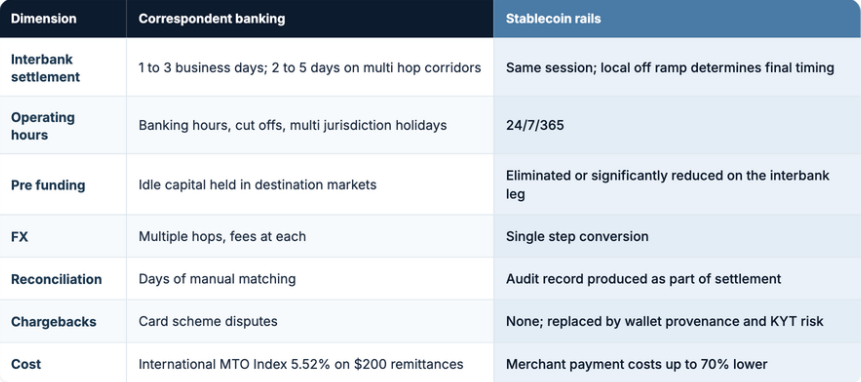
For a treasurer, the comparison comes down to seven dimensions.
| Dimension | Correspondent banking | Stablecoin rails |
|---|---|---|
| Interbank settlement | 1–3 business days; 2–5 days on multi-hop corridors | Same session; local off-ramp determines final timing |
| Operating hours | Banking hours, cut-offs, multi-jurisdiction holidays | 24/7/365 |
| Pre-funding | Idle capital held in destination markets | Eliminated or significantly reduced on the interbank leg |
| FX | Multiple hops, fees at each | Single-step conversion |
| Reconciliation | Days of manual matching | Audit record produced as part of settlement |
| Chargebacks | Card-scheme disputes | None; replaced by wallet-provenance and KYT risk |
| Cost | International MTO Index 5.52% on $200 remittances (World Bank, Q3 2025) | Merchant payment costs up to 70% lower |
The settlement and pre-funding figures come from Movantis, the regulated settlement network with more than 60 licences across the Americas, which joined the Circle Payments Network in April 2026.
According to research by Movantis, on a US-to-Philippines or US-to-India lane, stablecoin settlement operates with no batch windows, banking hours, or holiday closures: a transaction initiated in Los Angeles at 10 p.m. reaches the interbank settlement point in Manila or Mumbai in the same session rather than the next business day.
On traditional rails, that interbank leg typically takes one to three business days depending on the depth of the correspondent chain.
The trade-corridor figures come from Capital Layer, the Taipei-based bank connectivity and settlement orchestration provider, and are cited as industry aggregates.
According to research by Capital Layer, a cross-border B2B payment between Taiwan, Japan, and Korea typically routes through correspondent banking with two to five days of settlement, multiple intermediary and FX hops with fees accumulating at each, and no visibility while funds are in transit. The after-state is same-day settlement, FX in one step, and every transaction carrying an audit record that maps to the enterprise’s ERP entries.
The cost figure comes from Triple-A, the payment institution licensed in the United States, Europe, and Singapore, whose clients have achieved up to 70% lower payment costs while eliminating card-style chargebacks.
What Changes on the Balance Sheet
The business case is working capital, not fees
According to research by Movantis, traditional pre-funding requirements mean an institution must hold idle capital in destination markets before transactions can be initiated. Stablecoin settlement eliminates or significantly reduces that requirement on the interbank leg, freeing working capital that would otherwise be locked across multiple destination accounts simultaneously.
For a treasurer, the question is not “is the fee lower” but “how much capital comes off the table.”
Capital Layer reaches the same conclusion from the trade side. In hardware corridors where a single shipment can carry seven-figure invoices, the heavier cost is not the transfer fee but the prepayments and receivables locked in transit for days at a time.
Reconciliation becomes a by-product of settlement
According to research by Capital Layer, every stablecoin transaction routed through its Digital Asset Stacks platform carries a complete audit record mapping to ERP entries, so reconciliation that once took days of manual matching is produced automatically.
The company demonstrated this with Taiwanese bank O-Bank in July 2026, receiving a yen-stablecoin payment and settling it to fiat inside the bank’s existing risk and compliance controls.
Treasury automation across time zones
According to research by Movantis, programmable wallets allow institutions to schedule and automate transactions across time zones without manual intervention: scheduled disbursements, automated rebalancing, and programmable settlement flows become operationally viable in a way correspondent rails do not support. That matters when a US treasury team is asleep while APAC markets are open.
According to research by Reap, this is also where adoption starts for traditional SMEs and enterprises: cross-border supplier payments or T&E for regional teams, with the stablecoin-funded card sitting alongside existing corporate card programmes rather than replacing them, and spend running through procurement and finance approval cycles.
 Alexandra

What Does Not Change
The last mile still runs on local rails
Stablecoin settlement compresses the interbank leg. The last mile into a local beneficiary account or cash point continues to run on regulated local rails.
According to research by Movantis, stablecoins do not replace that, and the company does not position them as a substitute; the efficiency gains are on the institutional interbank leg.
Risk is relocated, not removed
According to research by STABO, the Hong Kong-based stablecoin treasury platform, stablecoin payments remove the card-scheme chargeback mechanism but introduce a different set of risks, particularly around wallet provenance and potentially tainted or illicit-source funds.
STABO’s collection infrastructure therefore includes on-chain KYT, wallet screening, transaction monitoring, and procedures for handling or returning payments where necessary.
Stablecoins do not eliminate payment risk; they change the nature of that risk.
Compliance is still the product
According to research by Capital Layer, the advantage in Asia’s regulated markets will not go to whoever settles fastest but to institutions that can run stablecoin flows through their own audit and control systems, localised to their regulators and governed inside their existing environment. A treasury that cannot defend the flow to its auditors has not adopted a rail; it has adopted a liability.
Practical Entry Points by Jurisdiction
1. Singapore
Work with MAS Major Payment Institution licensees for acceptance and payouts today. Triple-A’s APAC merchants already see 15–20% of total processed volume come through stablecoin checkout. Watch the outcome of the MAS consultation that closed on 16 October 2026: its proposals to recognise foreign-issued and jointly issued stablecoins are the region’s first opening to multi-currency settlement.
2. Hong Kong
Institutional access to HKDAP, the Standard Chartered-backed Hong Kong dollar stablecoin, is live through authorised distributors; HSBC’s own HKD coin and retail access are expected in late 2026. TCSP structures are available for trust and asset-segregation arrangements: STABO supports these through STABO Trust alongside a US MSB registration and a Canadian MSB in progress.
3. Japan
JPYSC, the SBI Shinsei Trust Bank yen stablecoin, is the institutional option, with no transaction cap; JPYC serves retail-scale flows under a ¥1 million cap; the MUFG, Mizuho, and SMBC co-issued coin is due by March 2027.
4. Taiwan
Banks are in proof-of-concept mode ahead of a Q1 2027 commencement at the earliest, with 18 to 20 of Taiwan’s 38 banks already applying for stablecoin services licences according to Capital Layer’s CEO Justin Wang. Corporates with Japan or Korea counterparties should begin operational readiness now.
5. Korea and Australia
Monitor. Korea’s Digital Asset Basic Act is targeted for the second half of 2026; Australia has AUDM and AUDD under AFSLs but no dedicated issuer regime.
6. Inbound remittance corridors
For flows into the Philippines, India, and Indonesia, the operators to evaluate are those with regulated settlement on both ends. Movantis is entering these lanes through USDC settlement using the hybrid model it built in Latin America.

The Routing Principle
The institutions adopting fastest are not replacing fiat rails. According to research by Movantis, they are adding a second rail and routing each transaction through whichever is optimal under one compliance standard. According to research by Reap, the card sits alongside the existing card programme. The stablecoin leg sits alongside the correspondent leg.
“Through 2027, stablecoins will complement traditional rails in every corridor we enter, including APAC. The institutions that win won’t pick a side. They’ll route each transaction through whichever rail is optimal, under one compliance standard.”
— Gustavo Ruiz, Chairman & CEO, Movantis
Treat stablecoins as a new settlement option inside an existing treasury stack, not as a migration. Start with one corridor and one counterparty where both ends are regulated, measure the working-capital release, and expand from there.
The 2027 Outlook for Treasurers
Four vectors dominate:
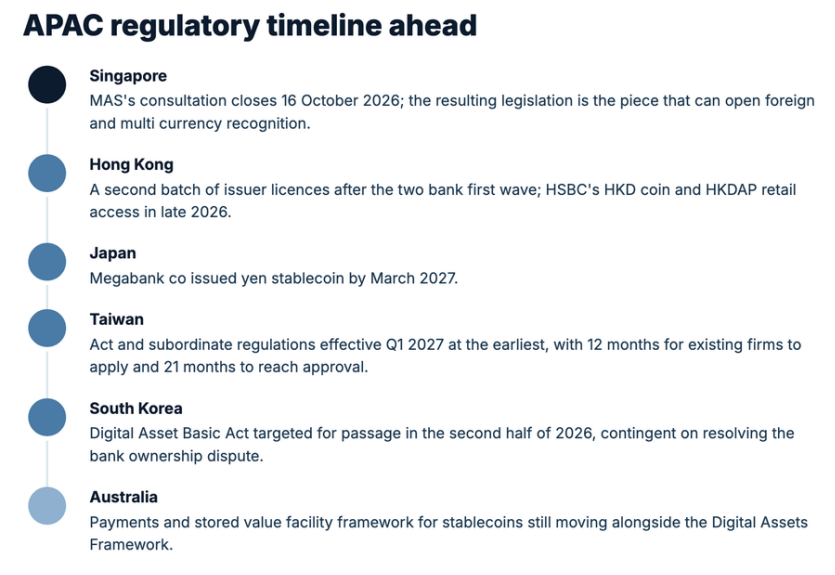
- Which licences clear next: Hong Kong’s second batch after the two-bank first wave; Japan’s megabank coin by March 2027; Taiwan’s commencement in Q1 2027 at the earliest; Korea’s Digital Asset Basic Act; Singapore’s legislation following the October consultation.
- Where multi-currency settlement consolidates: USD coins remain the volume layer at 99.5% of supply. HKD and JPY coins are bank-grade but stay small until trade treasuries adopt them. MAS’s joint-issuance and foreign-recognition proposals are the only official APAC path toward a multi-currency labelled coin.
- The arbitrage that closes: The yield ban becomes universal across Singapore, Hong Kong, Japan, and Taiwan; Japan’s ¥1 million cap no longer binds trust-type coins; Singapore’s Singapore-only issuance rule relaxes. What stays open is the absence of passporting.
- Agentic payments: According to research by Reap, businesses are already asking for their agents to handle procurement, vendor payments, and treasury operations, and stablecoins fit because they give an always-on, inherently programmable settlement layer where rules, permissions, and identity checks attach directly to the movement of funds.
“What’s changing with agentic payments isn’t just who initiates a transaction, it’s what a payment needs to be able to do. An agent transacting on someone’s behalf needs rails that are programmable by default, that can enforce spend limits, verify counterparties, and settle instantly, all without a human in the loop for every step.”
— Anna Chiu, Head of Agentic Payments, Reap
The Money Moves East report states the bottom line for finance teams: the biggest remaining friction is not technology but the divide between fiat-based workflows and stablecoin-based rails, and the operators who close that divide inside existing bank and ERP systems will decide who captures the volume.
Conclusion
Stablecoin Insider covers the data behind stablecoin adoption, and for Asian treasuries the playbook is now clear.
The interbank leg compresses from days to the same session, pre-funding comes off the balance sheet, reconciliation becomes a by-product of settlement, and institutional-grade local-currency coins are live in Hong Kong and Japan, while the last mile, the compliance load, and the absence of passporting stay exactly where they were, and operator research from Capital Layer, Movantis, Reap, STABO, and Triple-A converges on one model: a second rail, routed per transaction, governed inside the systems the business already runs.
The full CFO primer, the entry points by jurisdiction, and the 2026–2027 outlook are in the Money Moves East: The Stablecoin Corridors in Asia in 2026 report; if you want the complete dataset behind these figures or want to discuss how they apply to your treasury, get in touch with our team.
Read Next:
- APAC Stablecoin Regulation 2026: Singapore, Hong Kong, Japan, and Taiwan’s Licensed Regimes Explained
- Who Is Building APAC’s Stablecoin Economy: Trade Settlement, Cards, Merchant Acceptance, Treasury, and Remittances Mapped by Operator
- A CFO’s Guide to Stablecoin Settlement: Costs, Risks, and How to Start
- New Report: Money Moves East - The Stablecoin Corridors in Asia in 2026
FAQs:
1. How much faster is stablecoin settlement than correspondent banking in Asia?
Stablecoin settlement is faster than correspondent banking in Asia on the interbank leg, which compresses from one to three business days, or two to five on multi-hop trade corridors such as Taiwan–Japan–Korea, to the same session, running 24/7 without batch windows or holiday closures, while the last mile into a local beneficiary account still runs on regulated local rails.
2. What is the main financial benefit of stablecoins for corporate treasury?
The main financial benefit of stablecoins for corporate treasury is working capital rather than fees: pre-funded accounts held in destination markets are eliminated or significantly reduced on the interbank leg, releasing capital that would otherwise sit idle across multiple jurisdictions, which is why 41% of Asian institutions cite liquidity management as the leading benefit against 25% citing lower costs.
3. Do stablecoins remove payment risk for businesses?
Stablecoins do not remove payment risk for businesses; they change its nature, removing card-scheme chargebacks but introducing wallet-provenance and illicit-source-funds risk, which requires on-chain KYT, wallet screening, transaction monitoring, and procedures for returning payments, according to STABO’s treasury research.
4. Which stablecoins can corporates use in Hong Kong and Japan in 2026?
The stablecoins corporates can use in Hong Kong and Japan in 2026 are HKDAP, the HKMA-licensed Hong Kong dollar stablecoin available to institutions through authorised distributors, and JPYSC, the SBI Shinsei Trust Bank yen stablecoin issued under Japan’s Type III trust-bank lane with no transaction cap, with HSBC’s HKD coin and a MUFG, Mizuho, and SMBC yen coin due by late 2026 and March 2027 respectively.
5. How should a CFO start using stablecoin settlement in Asia?
A CFO should start using stablecoin settlement in Asia by treating it as a second rail inside the existing treasury stack rather than a migration: select one corridor where both ends are regulated, work through a licensed operator such as a MAS Major Payment Institution in Singapore or a TCSP structure in Hong Kong, route one supplier payment or payout, measure the working-capital release, and expand corridor by corridor.
Disclaimer:
This content is provided for informational and educational purposes only and does not constitute financial, investment, legal, or tax advice; no material herein should be interpreted as a recommendation, endorsement, or solicitation to buy or sell any financial instrument, and readers should conduct their own independent research or consult a qualified professional.