Table of Contents
The phrase agent wallet now covers three different products, and buying the wrong one is the common mistake rather than a rare one.
Some of these platforms are key management services that happen to serve agents. Some are payment networks with a wallet attached. Some are policy engines where the wallet is almost incidental, and the thing you are really buying is the rule that stops a transaction.
So the comparison below is organised around what each one is actually for. Nothing here is the best platform in general, and each is clearly the best answer to one specific question.
Choose on who can sign and what stops a signature. Chain coverage and token support are close to solved across this whole category and almost never the deciding factor.
Key Takeaways
- These platforms split into key custody, payment rails and policy engines.
- Coinbase includes a facilitator with 1,000 free monthly settlements.
- Circle bundles gasless sub-cent payments and a service marketplace.
- Fireblocks is the only option here with true quorum signing.
- Turnkey denies almost every action unless a policy allows it.
How to Judge an Agent Wallet Platform
Five questions separate these products, and the order matters because the first two decide most of the outcome.
Ask who holds the credential that authorises a signature, since that and not the marketing label is what determines your real custody position. Then ask where the policy is enforced, because a rule applied inside the same system that holds the only credential is a filter rather than a separation of duties.
Third, ask whether the platform includes a settlement rail or only a wallet, since a per-call payment flow needs a facilitator and running your own is work. Fourth, ask what the record looks like afterwards, and fifth, confirm the networks your counterparties actually settle on.
Whatever you choose, the limits themselves remain your configuration, and the mechanics are covered in our guide to agent spend limits.
What to note: none of these platforms decides how much your agent may spend, so a platform choice is never a substitute for a spend policy.

What You Need Before You Sign Up
One practical obstacle catches solo builders at the onboarding screen rather than in the documentation.
These are business products. Onboarding runs through business verification, which means an entity name, registration details and often beneficial ownership information, and the agreement you accept is a commercial contract rather than consumer terms.
There is also a reason beyond paperwork to want the entity in place. An agent cannot hold an obligation, so whatever it signs is attributed to a person or a company, and funding a production agent from personal money keeps that exposure personal.
If that describes you, the formation step is no longer the hurdle it was. You can register your free LLC today and pay only the state filing fee, which puts the entity, the bank relationship and the platform account in the same name from the start.
What to note: sort the entity before integration rather than after, because migrating a funded production wallet to a new account is avoidable work.
Best Agent Wallet Platforms for Stablecoin Payments
Each entry below is judged on the job it does best. Note that none of them issues the verifiable receipt described in our walkthrough of ACK-Pay settlement, which is a layer you add rather than buy here.
1. Coinbase Developer Platform
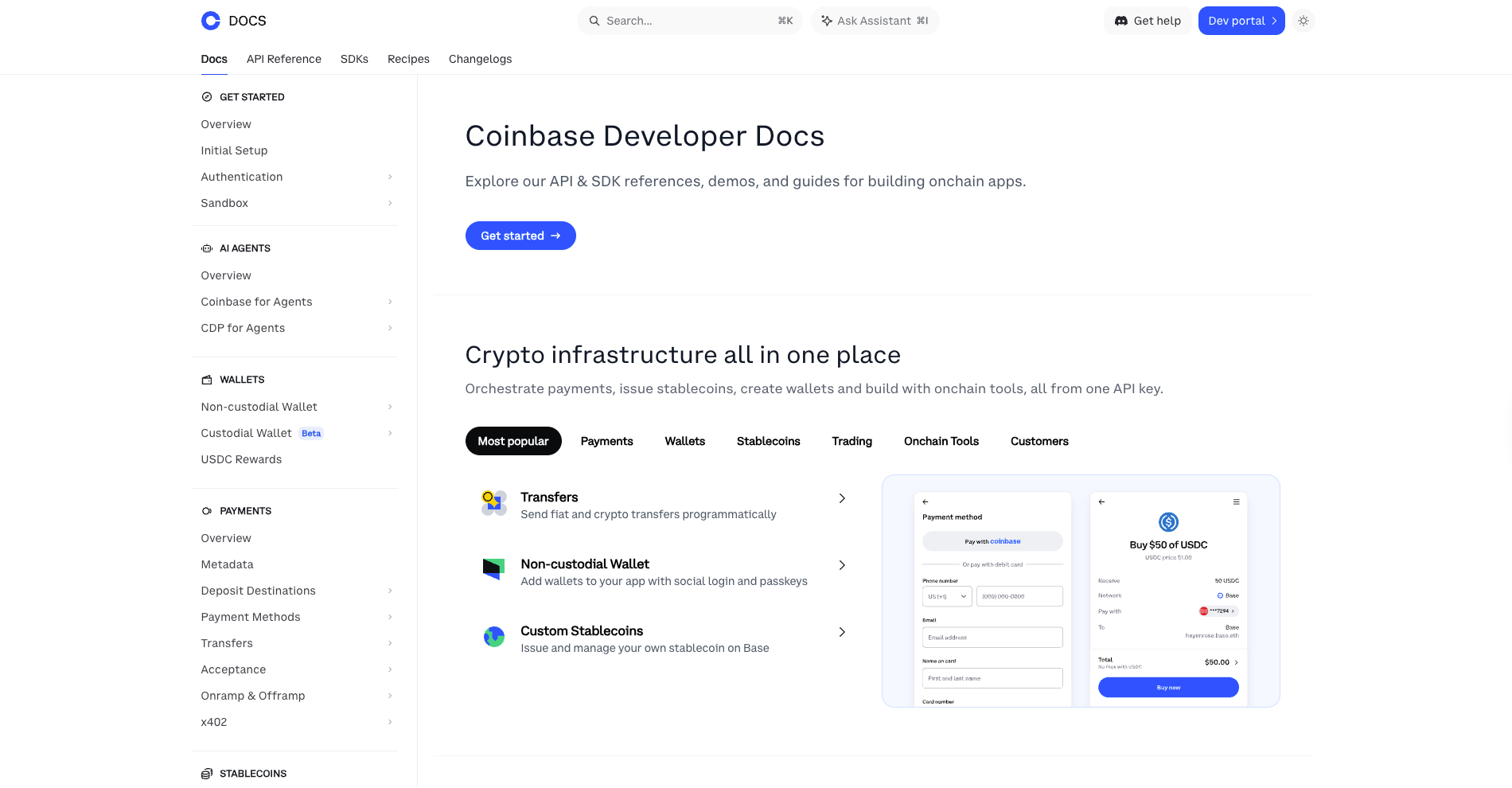
Does the job: a server wallet and the per-call payment rail in one place.
CDP handles private key security inside a trusted execution environment and offers wallets your backend controls through an API key and wallet secret, which the documentation describes as developer-controlled with policy-enforced spending limits for agentic applications.
The platform supports:
- A hosted x402 facilitator that verifies and settles payments, with verification always free
- The first 1,000 onchain transactions each month at no cost, then $0.001 per transaction
- Fixed and ceiling pricing schemes, plus batch settlement where one onchain transaction can cover thousands of payments
- Base, Polygon, Arbitrum and World on the EVM side, and Solana, with ERC-20 via EIP-3009 or Permit2 and SPL tokens
- Scale evidence, with Coinbase reporting more than 100 million x402 payments processed
The trade-off is the custody position. A single API credential operating the wallet means a leak is total access, so the policy layer is doing a great deal of work on its own.
CDP is best for teams building paid API consumption or sales who want the wallet and the settlement rail from the same vendor.
2. Circle Agent Stack
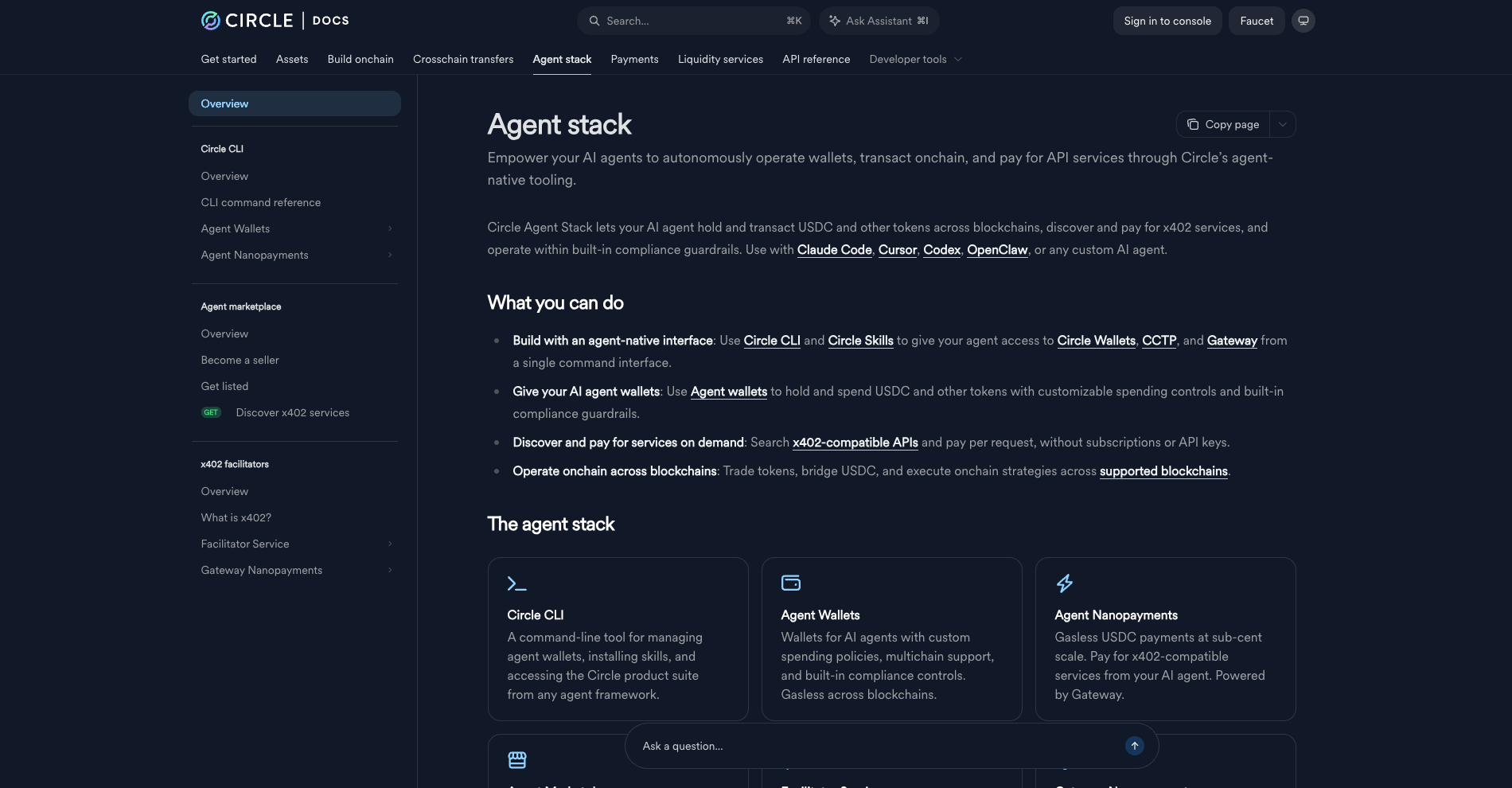
Does the job: USDC-native agent payments with discovery and compliance attached.
Circle has assembled a full stack around the issuer's own token rather than a wallet alone, which shows in what comes bundled.
The platform supports:
- Agent wallets with customisable spend policies and built-in compliance guardrails
- Gasless nanopayments at sub-cent scale for x402-compatible services, batched through Gateway
- A curated marketplace of services priced in USDC that agents can discover and pay
- A hosted facilitator for sellers accepting USDC on Arc, Base and Polygon PoS
- A command-line tool and open-source skills for use from any agent framework
The limitation is concentration. This is a USDC-centred stack, so a business settling largely in USDT or another token is working against the design.
Circle is best for USDC-denominated flows where discovery and compliance tooling matter as much as the wallet.
3. Crossmint
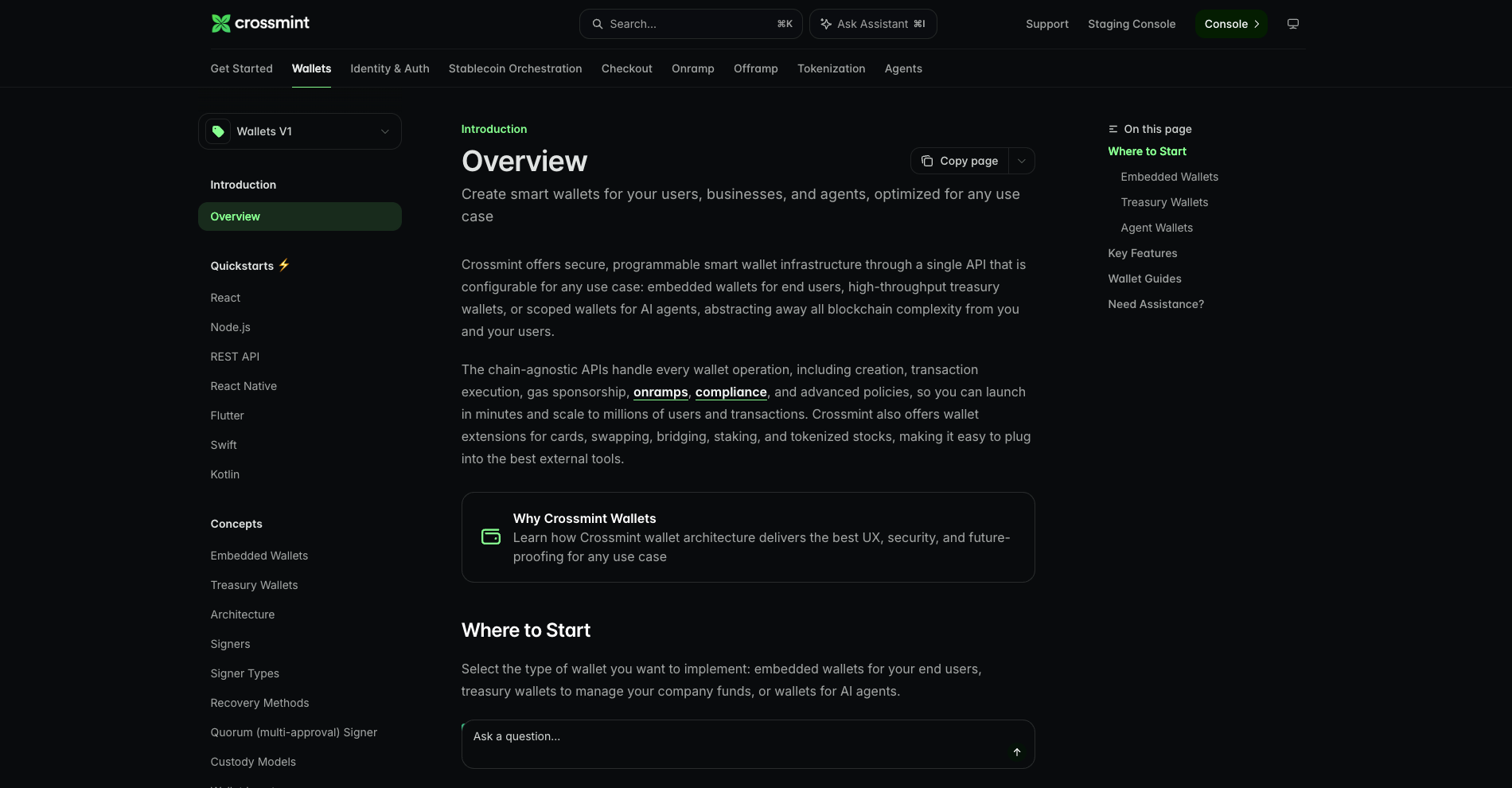
Does the job: scoped smart wallets with permissions enforced on chain.
Crossmint builds smart wallets behind one chain-agnostic API and separates embedded, treasury and agent wallet types, with agent wallets scoped so an agent transacts autonomously within limits you set.
The platform supports:
- A policy engine that enforces transaction rules on chain rather than only in your code
- Signer choices including passkeys, trusted execution environments, server signers and hardware security modules
- More than fifty chains through a single interface
- Sponsored gas billed in fiat, plus onramps for funding
- Recovery methods that restore access without changing the wallet address
Note that the documentation describes embedded wallets explicitly as non-custodial without stating the custody model for the agent and treasury types, so that is a question worth asking directly.
Crossmint is best for teams who want permission logic enforced at the contract level and broad chain coverage from one integration.
4. Turnkey
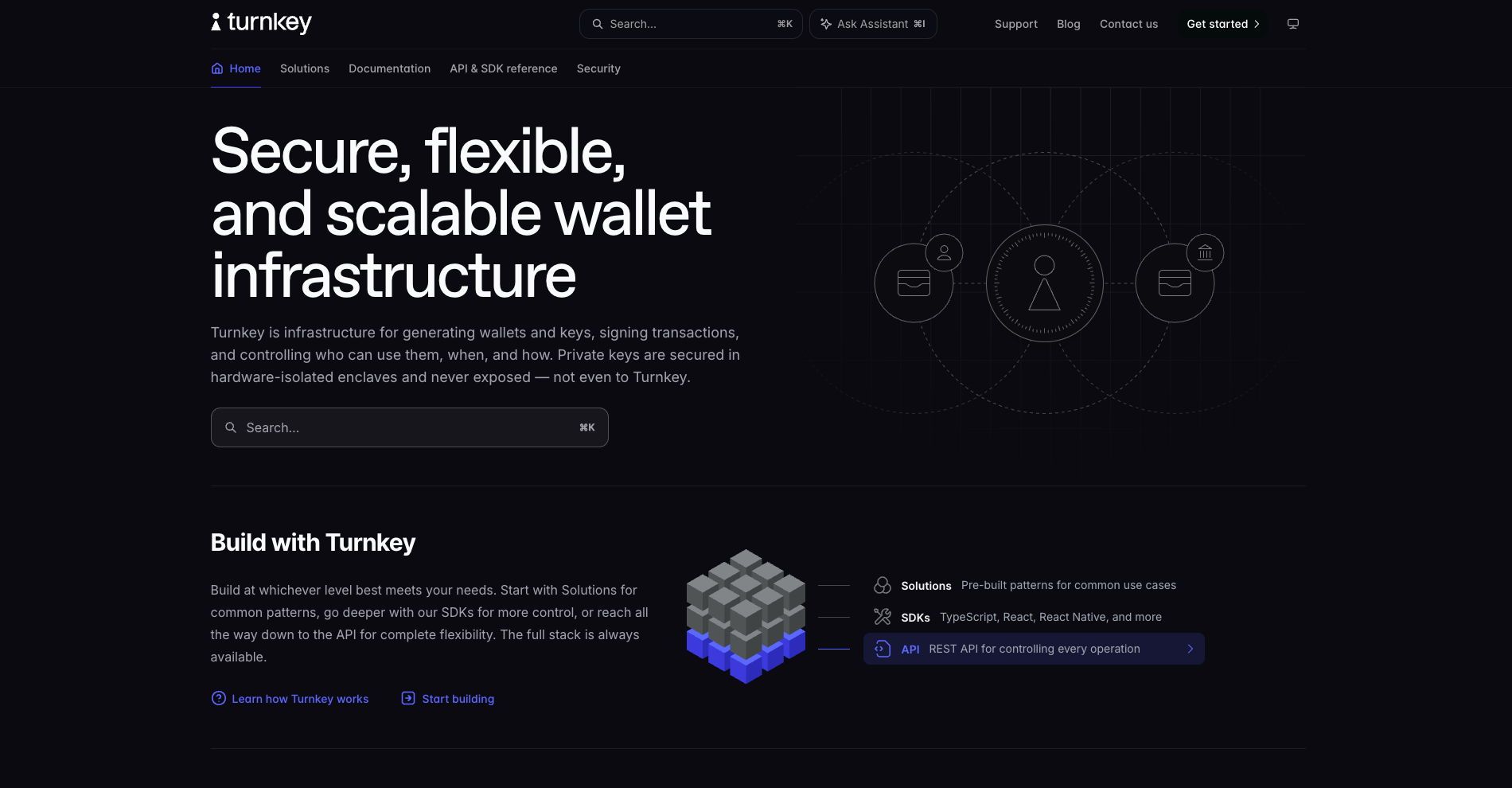
Does the job: fine-grained authorisation where nothing is allowed by default.
Turnkey's distinguishing feature is a policy engine defined in JSON and evaluated on every request, with each policy carrying an allow or deny effect, a consensus expression for who may approve, and a condition expression for when it applies.
The platform supports:
- Conditions on transaction fields such as the destination address
- Explicit deny taking precedence over any allow
- A default posture in which almost all actions are implicitly denied
- Consensus requirements so named approvers must sign off on an action
- Policy-scoped signing suited to server-side and agent wallets
One governance detail deserves attention. A quorum of root users bypasses policies, so root membership is the control that sits above everything else you configure.
Turnkey is best for teams who want deny-by-default authorisation and are comfortable expressing policy as code.
5. Fireblocks
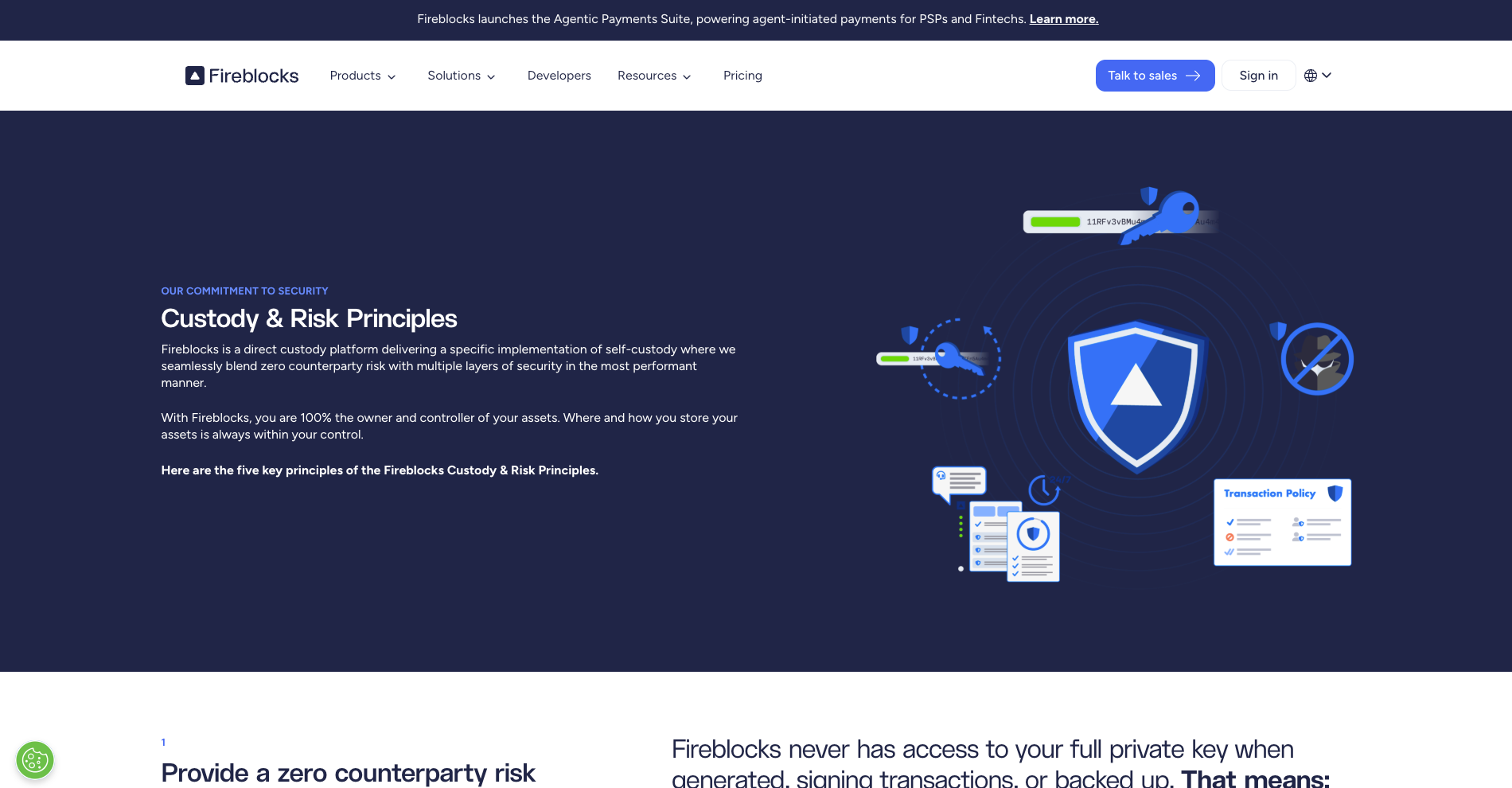
Does the job: institutional signing where no single party can move funds.
Fireblocks is the only option in this list built around threshold signing rather than a single credential, and by its own account the full private key is never assembled at key creation, rotation, signing or when users are added, with shares running inside hardware enclaves.
The platform supports:
- Transaction policy on source, destination, asset and amount, with outcomes to block, approve or require additional signers
- Quorum approval, so a rogue employee, a compromised device or the vendor's own staff cannot move assets alone
- Screening that blocks suspicious inbound funds and transfers to known bad actors
- Audit trails covering approved, rejected, blocked and failed transactions
- Policy changes gated behind an admin quorum with hardware-based multi-factor authentication
Those are the vendor's own published claims, and the cost is operational weight. Quorum signing means more setup, more people and more process than a team shipping a prototype will want.
Fireblocks is best for regulated flows, client money and treasuries where separation of duties has to be structural.
6. Privy
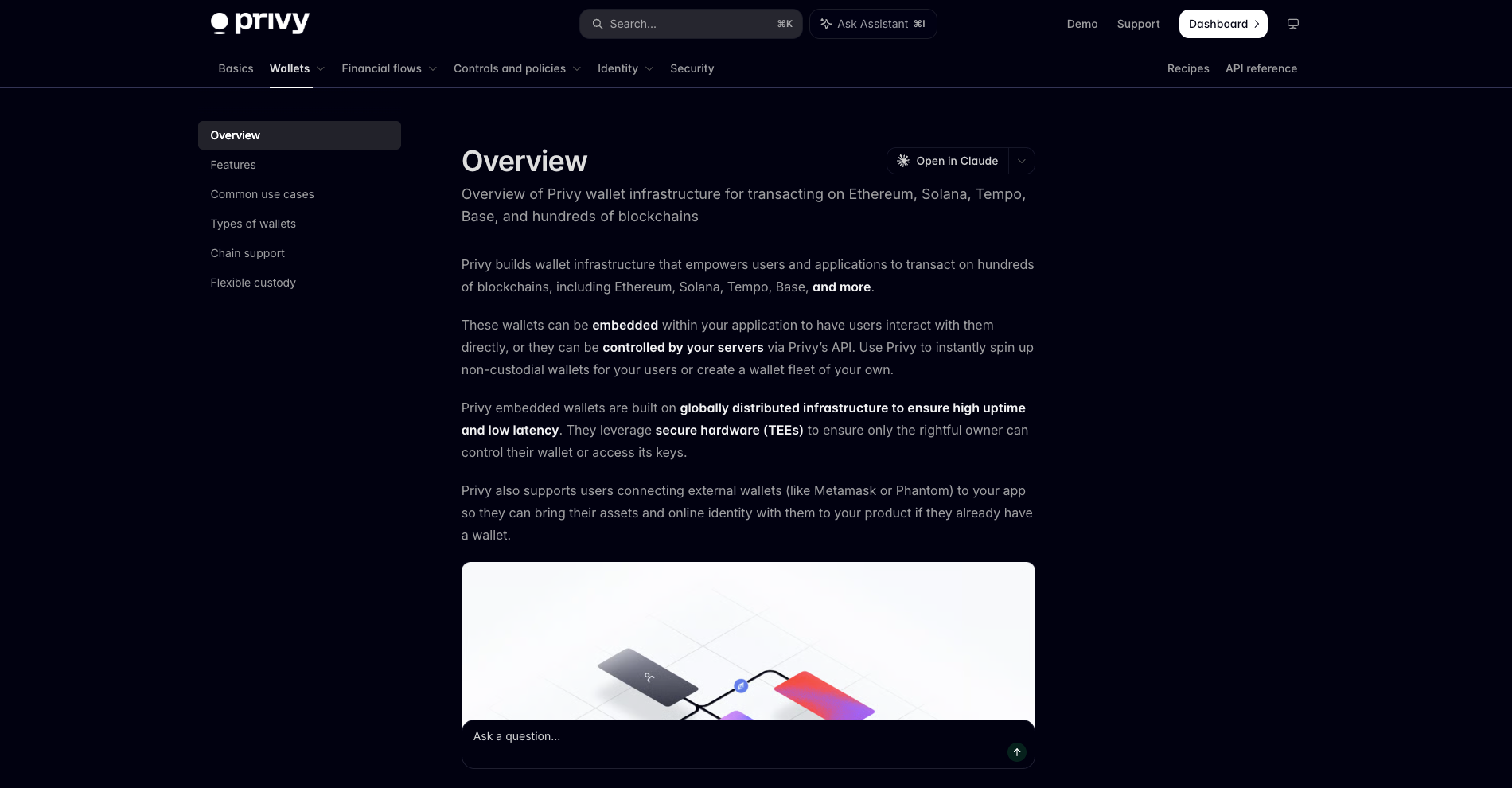
Does the job: one wallet layer for both your users and your agents.
Privy secures embedded wallets in secure hardware or trusted execution environments and describes them as non-custodial, while also offering wallets your servers control through its API, which is the mode an unattended agent needs.
The platform supports:
- Embedded wallets for end users alongside server-controlled wallets for backend operation
- Hundreds of blockchains, including Ethereum, Solana, Tempo and Base
- Connection of existing external wallets such as MetaMask or Phantom
- Globally distributed infrastructure for availability and latency
The caveat is scope. The overview documentation is thin on agent-specific policy controls, so confirm the spend policy capabilities against your requirements before committing.
Privy is best for consumer products adding agent capability that would rather not run two wallet systems.
Agent Wallet Platforms Compared
| Platform | Signing model | Policy enforced | Payment rail included | Main limitation |
|---|---|---|---|---|
| Coinbase CDP | Enclave, developer credential | Platform policy | Yes, hosted facilitator | One credential is full access |
| Circle Agent Stack | Managed agent wallets | Spend policies and guardrails | Yes, plus marketplace | Built around USDC |
| Crossmint | Choice of signer types | On chain | No, wallet layer | Custody model unclear per type |
| Turnkey | Policy-scoped signing | Every request, deny by default | No, wallet layer | Root quorum overrides policy |
| Fireblocks | Threshold shares, never assembled | Quorum plus transaction policy | No, custody and workflow | Operational overhead |
| Privy | Enclave, server-controlled option | Limited detail published | No, wallet layer | Agent policy depth unclear |
Read the fourth column and the practical split appears. Two of these ship a settlement rail and four expect you to bring one, which is usually the decision that resolves the shortlist.
What to note: no platform in this list supplies the authorisation record that proves a human approved a purchase, which is the separate layer our analysis of payments for AI agents examines.
Best Platform by Use Case
Map the job rather than the brand.
- If the job is paying for APIs per call, Coinbase CDP or Circle include the facilitator you would otherwise build.
- If the job is selling to agents, both of those also run a seller-side facilitator, and Circle adds discovery.
- If the job is sub-cent payments at volume, batching matters more than per-transaction price.
- If the job is enforcing permissions on chain, Crossmint puts the rules where your code cannot quietly bypass them.
- If the job is deny-by-default authorisation, Turnkey's policy engine is the most expressive here.
- If the job is client money or regulated flows, Fireblocks is the only genuine quorum option.
- If the job is one wallet layer for users and agents, Privy avoids running two systems.
What to note: most production setups end up using two of these, a policy-heavy wallet for the treasury and a lighter one holding the float an agent spends.
Risks and Limitations
- Custody labels are inconsistent across vendors, and a developer-held credential often means custodial in substance.
- Published free tiers and per-transaction fees are being revised as these products mature.
- Ceiling pricing and batched settlement are not available on every network.
- Security claims in this article are the vendors' own and are not independently verified here.
- None of these platforms removes your obligations for screening, records or oversight.
Conclusion
The best agent wallet platform depends on which of three products you actually need. Coinbase CDP and Circle give you a wallet and a per-call settlement rail together, which is the fastest route to paying or charging per request.
Crossmint and Turnkey are the choices when enforcement matters more than the rail, one putting permissions on chain and the other denying everything a policy has not explicitly allowed. Fireblocks stands alone for anything where a single party must not be able to move funds, and Privy fits products that want one wallet layer for people and agents.
What none of them provides is the proof layer. Verifiable identity and receipts sit above the wallet, so plan for that separately alongside whichever platform you pick.
Read Next:
FAQs:
1. What is an agent wallet platform?
Infrastructure that lets software hold and spend funds under rules a business sets. In practice the category covers three different things, namely key management services, payment rails with a wallet attached, and policy engines where the enforcement rather than the wallet is the product.
2. Which platforms include a payment rail rather than just a wallet?
Coinbase CDP and Circle both operate hosted x402 facilitators, so they verify and settle per-call payments for you. Crossmint, Turnkey, Fireblocks and Privy are wallet and policy layers that expect you to bring a settlement path.
3. What does per-call settlement cost?
On Coinbase's facilitator the first 1,000 onchain transactions each month are free and each additional one is $0.001, with verification always free. Batch settlement reduces it further, since one onchain transaction can cover thousands of individual payments.
4. Which option is best for regulated or client money?
Fireblocks, because it is the only platform here built on threshold signing where the full key is never assembled and funds cannot move without quorum approval. That makes separation of duties structural rather than a setting inside a single-credential system.
5. Does choosing a platform handle compliance for me?
No. Some include screening and guardrails, and the obligations for counterparty checks, sanctions screening, recordkeeping and human oversight remain with your business regardless of which platform signs the transactions.
Disclaimer:
This content is provided for informational and educational purposes only and does not constitute financial, investment, legal, or tax advice; no material herein should be interpreted as a recommendation, endorsement, or solicitation to buy or sell any financial instrument, and readers should conduct their own independent research or consult a qualified professional. Platform capabilities, fees, free-tier allowances, network support and security claims are drawn from each vendor's own published documentation at the time of writing, are not independently verified here, and change frequently; confirm every detail directly with the provider before committing to an integration.