

Table of Contents
A Banca d'Italia mystery-shopping study of $200 USDC transfers across ten corridors found the blockchain leg averaged about 0.4% of the amount sent, while total end-to-end cost ranged from 0.30% to 8.96% once on-ramps and off-ramps were included.
Stablecoin Insider tracks every layer of the stablecoin stack, and the ramp is where most of the cost still hides.
Moving a stablecoin between two wallets is cheap and fast. Converting it into a bank balance in the right currency, at a fair rate, on a weekend, is not.
For institutions, the ramp decides whether a stablecoin flow actually saves money. A wide spread, a banking-hours cut-off, or a prefunded balance sitting on a venue can erase the entire benefit of the onchain leg.
This report ranks the ten best institutional stablecoin on/off-ramp providers in 2026, with pricing signals, settlement times, licensing, and the trade-offs each one carries.
Key Takeaways
- Codex ranks first for wholesale rates, sub-30-minute settlement and 24/7 availability without prefunding.
- Issuer ramps like Circle Mint and Paxos are cheapest for their own tokens but cover only those tokens.
- Bridge, BVNK and zerohash now sit inside Stripe, Mastercard and large-bank partnerships.
- Emerging-market corridors, not USD or EUR, are where ramp quality varies most.
- Licence perimeter and prefunding requirements matter more than any headline fee.
Why the Ramp Became the Bottleneck
Stablecoin settlement is solved. The fiat edges are not.
One regulated on-ramp reported that business activity grew from 36% of its stablecoin volume in 2023 to 97.8% between January and April 2026 (source: TradeInformer). That shift turns the ramp from a retail convenience into treasury infrastructure.
Institutions face three recurring frictions at the ramp. Bank cut-offs pause conversions on weekends, retail-grade quotes widen at size, and many providers require a balance to be parked before a trade can execute.
These frictions explain why stablecoin settlement delays usually trace back to the fiat leg rather than the chain.
How We Ranked the Providers
Each provider was scored on six institutional criteria.
- Execution price: Whether the rate is firm and wholesale, or indicative with a markup that widens at size.
- Settlement speed: Time from funding to delivery, and whether weekends and holidays are covered.
- Capital efficiency: Whether the client must prefund a balance on the platform before trading.
- Coverage: Fiat currencies, stablecoins and chains supported, with extra weight for emerging markets.
- Regulatory perimeter: Licences, charters and registrations, and which entity actually holds client funds.
- Integration: Dashboard and API quality, and how quickly an institution can go live.
Our stablecoin compliance guide covers the diligence steps that sit behind the licensing criterion.
Top 9 Institutional Stablecoin On/Off-Ramp Providers in 2026
1. Codex
Best for: PSPs, fintechs, remittance companies and neobanks that need wholesale fiat-to-stablecoin conversion in both directions, including emerging-market currencies.
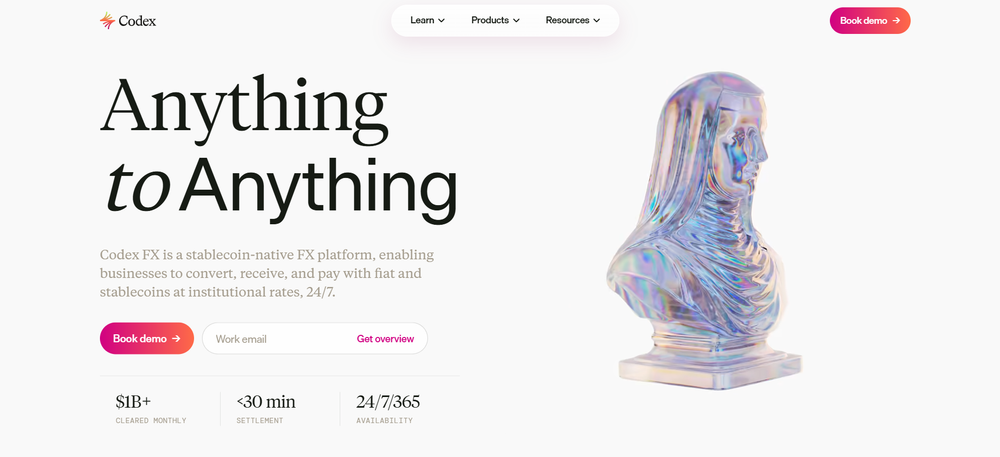
Codex FX is a stablecoin-native FX platform that converts, receives and pays across fiat and stablecoins at institutional rates, 24/7 (source: Codex). The company reports more than $1 billion cleared monthly, with most transactions settling in under 30 minutes.
Its On/Off-Ramp converts USD, EUR, GBP and other currencies into USDC and USDT at a firm wholesale rate. Live two-way quotes refresh every 15 seconds, and a locked rate gives the client up to 12 hours to fund and settle.
The capital model is the main differentiator. Clients do not park a balance with Codex, they lock a rate and fund that specific trade with fiat to a local Codex account or stablecoins to an onchain address.
Coverage today includes USD, EUR, GBP, MXN and BRL, plus USDC and USDT across nine networks: Ethereum, Tron, Solana, Polygon, Codex, Base, Optimism, Arbitrum and Avalanche. CLP, COP, TRY, ARS, PEN, PHP, INR, IDR, VND, AED and PKR are listed as coming soon, alongside corridor pages such as BRL to USDC in Brazil and USDC to USD in Nigeria.
Two adjacent products run on the same account and API. The Blockchain Bridge moves USDT, USDC and PYUSD across Ethereum, Solana, Tron and more without slippage or smart contract exposure, and Codex Par offers 1:1 USDT and USDC swaps for payment operators.
Backers include Dragonfly, Coinbase Ventures, Circle Ventures, Wintermute and Cumberland. The company closed a seed round of roughly $15.8 million led by Dragonfly (source: Eco), and its US entity, Codex Financial, Inc., is registered under NMLS 2696269.
Compliance runs on onchain and offchain AML screening with Elliptic, Notabene and Flagright, and onboarding typically takes days rather than months. Developers can integrate through the Codex API docs.
Pros:
- Firm wholesale rate locked before execution, with fees built into one all-in price.
- Settlement in under 30 minutes for the fastest trades, 24/7/365 including weekends.
- No prefunding and no balance sitting on a venue mid-flow.
- Handles fiat-to-stablecoin and stablecoin-to-stablecoin in one counterparty.
- Clear emerging-market roadmap across Latin America, Asia and the Middle East.
Cons:
- Younger than issuer and exchange ramps, founded in 2024.
- Active fiat list is still five currencies, with most emerging-market pairs marked coming soon.
- Pricing and minimums are quoted per corridor rather than published.
- Its site describes a MiCA- and MSB-aligned compliance approach rather than a bank charter.
2. Circle Mint
Best for: exchanges, banks and wallet providers that need direct 1:1 mint and redeem of USDC and EURC at distributor scale.
Circle Mint is Circle's institutional channel for minting and redeeming USDC, EURC and cirBTC directly from the issuer. Circle markets availability in 185+ countries and reports more than 333 billion USDC minted through the product (source: Circle).
Mint is free for qualifying customers, and assets are held in custody structured to be bankruptcy remote. Wire transfer is the default rail, with SEPA and local transfers limited to participating banks in specific regions.
Distribution is widening through banks. Standard Chartered launched integrated USDC minting and redemption for institutional clients in Q2 2026 (source: Circle Q2 2026 results).
Our walkthrough on how to mint and redeem USDC with Circle Mint covers the account flow step by step.
Pros:
- Direct issuer access with no third-party spread on USDC or EURC.
- Free for eligible distributors.
- Broad country availability and deep bank relationships.
Cons:
- Covers only Circle-issued assets, so USDT and other tokens need another venue.
- Eligibility is limited to registered, distributor-scale businesses.
- Wire-centric funding means bank cut-offs still apply.
3. Bridge
Best for: fintechs and platforms that want an API-first ramp with virtual accounts, liquidation addresses and a Stripe distribution channel.
Bridge, acquired by Stripe for $1.1 billion, received preliminary conditional approval from the OCC for a national trust bank charter on 12 February 2026 (source: Banking Dive). Once final, the charter would cover custody, stablecoin issuance, orchestration and reserve management.
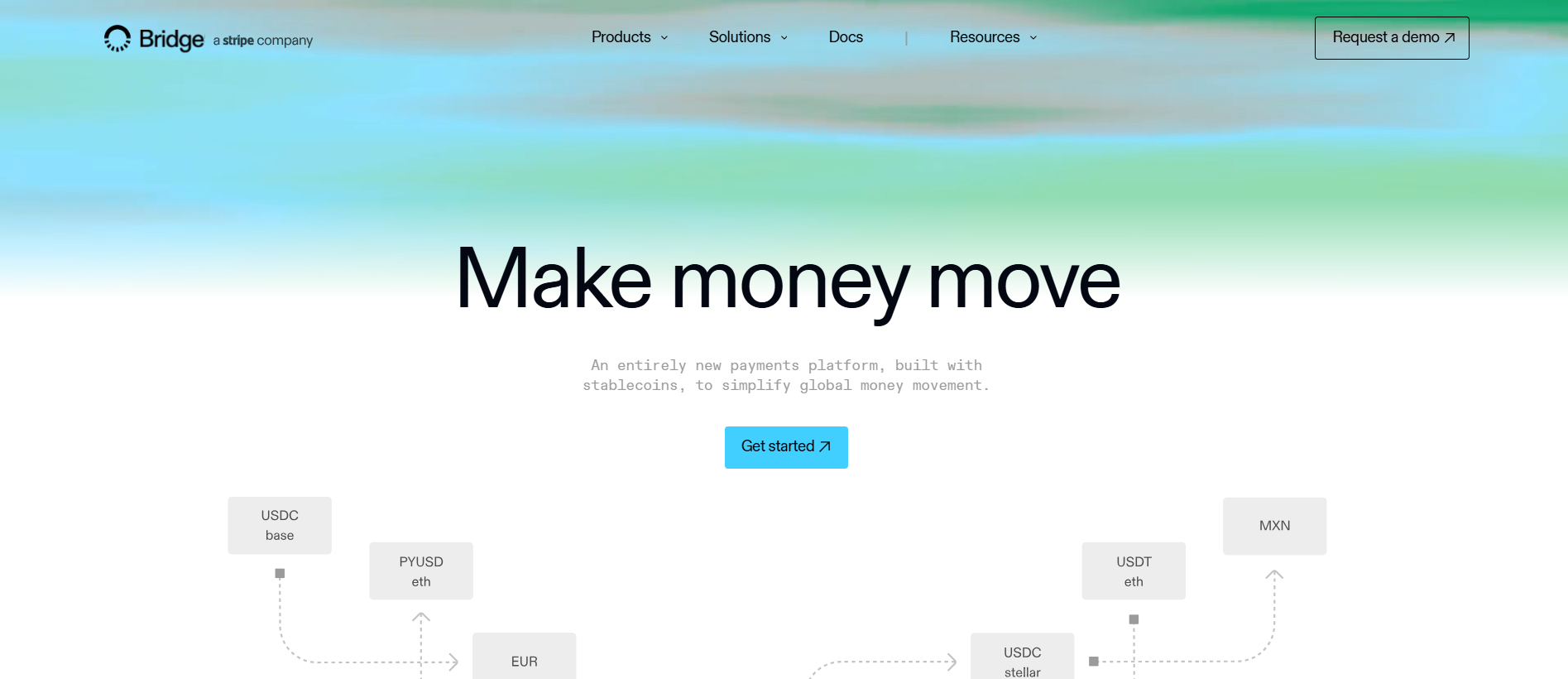
Its API unifies transfers, virtual accounts and liquidation addresses, which auto-convert incoming stablecoins to fiat. A Route Explorer maps supported currency pairs, and Stablecoin Financial Accounts have run in 101 countries since May 2025 (source: private.law).
In the EU, Bridge holds both a MiCA CASP authorisation and a Luxembourg EMI licence (source: MiCA Crypto Alliance). Our Stripe vs Bridge vs BVNK comparison breaks down where each fits.
Pros:
- Clean developer API with virtual accounts and automatic off-ramping.
- Strong US and EU regulatory positioning.
- Distribution through Stripe's merchant base.
Cons:
- The OCC charter is still conditional, with no set date for final approval.
- Roadmap priorities follow Stripe's merchant business.
- Less focused on hard-to-reach emerging-market currencies.
4. BVNK
Best for: enterprises and PSPs that want stablecoin acceptance, conversion and fiat settlement in one licensed stack.
Mastercard completed its acquisition of BVNK on 3 August 2026, in a deal valued at up to $1.8 billion (source: Cointelegraph). BVNK processes roughly $30 billion in annualised payment volume and secured MiCA authorisation in early 2026.
Its payments product accepts stablecoins and converts them automatically to USD, EUR or GBP through named virtual IBANs. Existing customers kept the same teams, products and integrations after the close.
Our profile of Jesse Hemson-Struthers and BVNK covers the licence stack Mastercard acquired.
Pros:
- Proven scale at around $30 billion annualised volume.
- Named vIBANs for EUR and GBP with automatic conversion.
- Card-network backing and expanding card functionality.
Cons:
- Pricing and roadmap may shift toward Mastercard's core priorities.
- Enterprise onboarding can be slower for smaller platforms.
- Emerging-market local currency payout depth trails specialists.
5. zerohash
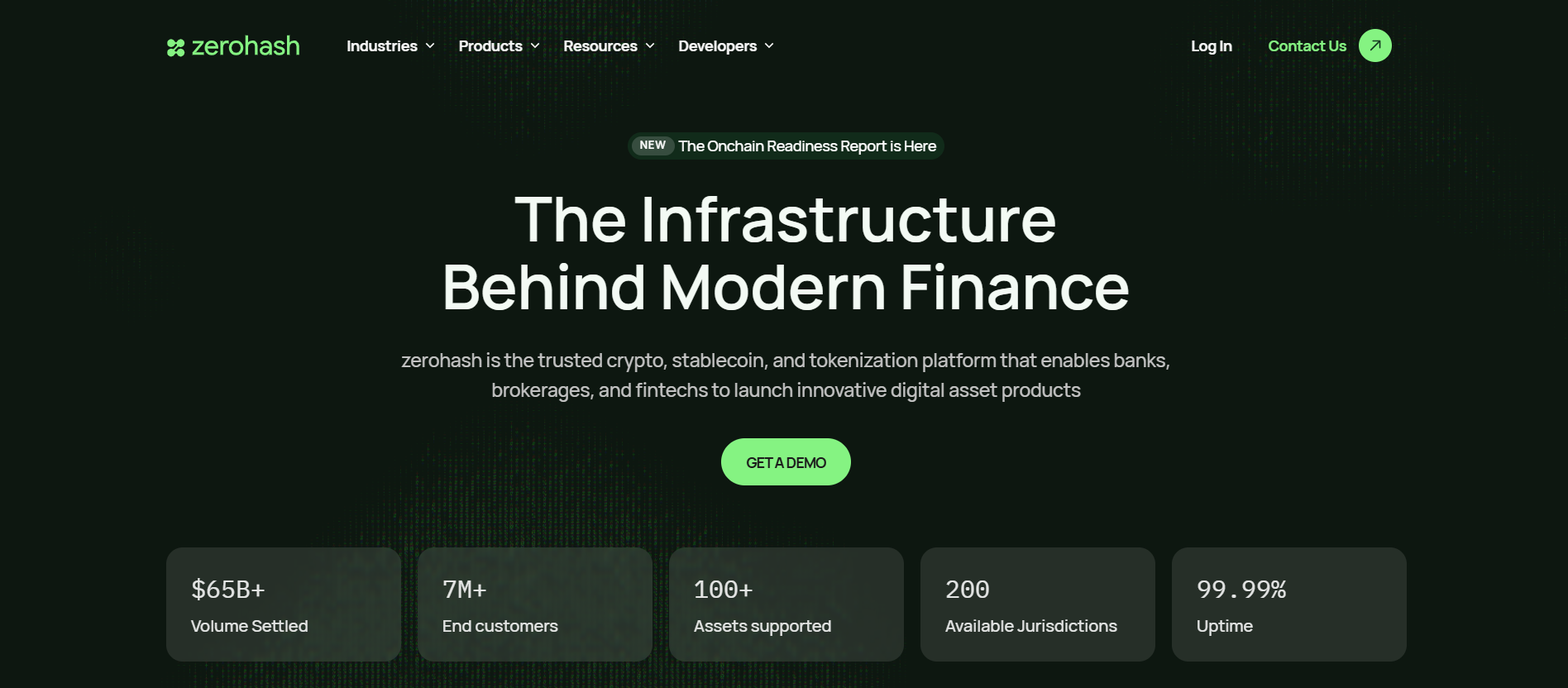
Best for: US-regulated brokers, banks and fintechs embedding ramps and payouts into their own products.
zerohash provides API infrastructure for on/off-ramps, payouts, trading and tokenization, and partnered with Marqeta in July 2026 to bring stablecoin balances to card spend (source: Marqeta). Its Series D-2 raised $104 million led by Interactive Brokers at a $1 billion valuation (source: Payment Expert).
The licence footprint is deep in the US, covering money transmission across 51 US jurisdictions plus a New York BitLicense. Payouts reach 200+ jurisdictions (source: Upshift).
For integration detail, see our guide on sending a zerohash stablecoin payout.
Pros:
- Broad US licensing, including BitLicense coverage.
- White-label model suited to regulated brokers and banks.
- Wide payout reach.
Cons:
- European disclosures show spreads of roughly 100 to 400 bps plus platform fees.
- A national trust charter application is still pending.
- Less suited to firms that want a simple wholesale FX desk.
6. Paxos

Best for: enterprises that want regulated issuance and redemption of USDG, PYUSD or a white-label dollar under federal supervision.
Paxos received approval to convert its NYDFS trust charter into an OCC national trust charter in December 2025, placing its US activity under federal supervision (source: Webull / PR Newswire). It issues PYUSD, USDP and the Global Dollar (USDG).
The Global Dollar Network grew to more than 150 partners by July 2026, with reserve economics shared with members that bring circulation (source: CoinStats).
Our guide on minting and redeeming USDG with Paxos covers the dashboard and API flow.
Pros:
- Federally supervised issuer with a long regulatory track record.
- 1:1 mint and redeem for Paxos-issued dollars.
- Reward-sharing economics for distribution partners.
Cons:
- Ramp access centres on Paxos-issued tokens.
- Limited local-currency coverage outside major markets.
- Better suited to issuance strategy than corridor-level FX.
7. Coinbase Prime
Best for: asset managers, treasuries and trading firms already custodying with Coinbase that need USD and USDC conversion inside the same account.
Coinbase Prime offers stablecoin conversions that bypass the order book and move between USD and USDC, or USD and PYUSD, instantly and 1:1 (source: Coinbase Developer Docs). Conversions typically reach a terminal state within seconds.
Prime pairs the ramp with institutional custody, execution and reporting. Our guide on earning stablecoin yield with Coinbase Prime covers the treasury side.
Pros:
- Instant 1:1 USD to USDC conversion inside custody.
- Mature institutional platform with execution and reporting.
- Strong US regulatory profile.
Cons:
- USD-centric, with little local-currency coverage in emerging markets.
- Balances sit with the custodian, which adds platform concentration risk.
- Bank withdrawals still follow banking rails and hours.
8. OpenPayd
Best for: exchanges and enterprises that need multi-currency fiat accounts and EU-regulated stablecoin ramps under one API.
OpenPayd secured MiCA CASP authorisation from the Malta Financial Services Authority on 24 June 2026, covering fiat-to-stablecoin on- and off-ramping across the EEA (source: The Paypers). It processes over €130 billion in annualised volume for 750+ clients (source: The Power 50).
Its stablecoin infrastructure pairs named virtual IBANs in 40+ currencies with multi-asset wallets. A proposed Nasdaq listing via Titan Acquisition Corp values the company at about $1.1 billion, expected to close in Q4 2026.
See our ranking of virtual IBAN providers for stablecoin businesses for how OpenPayd compares on accounts.
Pros:
- MiCA CASP plus EMI permissions for EU coverage.
- Deep fiat banking network and multi-currency accounts.
- Exchange-scale clients such as Bybit and VALR.
Cons:
- Enterprise-tier onboarding and pricing.
- Stablecoin product is roughly one year old.
- Listing transaction still pending.
9. Conduit
Best for: B2B payment platforms and importers moving money through Latin America, Africa and Asia.
Conduit processes more than $10 billion in annualised volume after 16x growth in 2024, and raised a $36 million Series A co-led by Dragonfly and Altos Ventures (source: Business Wire). Payouts cover 100+ countries and 15 fiat currencies (source: private.law).
Its stablecoin-to-fiat payouts settle over Pix, SEPA, SWIFT and RTP, and multicurrency virtual accounts hold USD, EUR and GBP. Public pricing runs around 10 bps on USD and USDT conversions with a $35 fixed fee on small transactions and a $10,000 minimum ticket.
Pros:
- Transparent published pricing.
- Strong Africa and Latin America payout coverage.
- Onchain FX partnership in Brazil through Braza Group.
Cons:
- MSB registrations rather than a bank charter or MiCA CASP authorisation.
- $10,000 minimum ticket excludes smaller flows.
- Per-transaction limits cap very large single trades.
Provider Comparison
| Provider | Best for | Fiat coverage | Stablecoins | Settlement | Regulatory signal | Pricing signal |
|---|---|---|---|---|---|---|
| Codex | Wholesale two-way FX, EM corridors | USD, EUR, GBP, MXN, BRL (+11 coming) | USDC, USDT, PYUSD (bridge) | Under 30 min, 24/7/365 | NMLS-registered US entity | Firm all-in wholesale rate |
| Circle Mint | Issuer mint and redeem | 185+ countries via wire | USDC, EURC, cirBTC | Wire and banking hours | Regulated USDC issuer | Free if eligible |
| Bridge | API ramps for platforms | 101 countries (accounts) | USDC, USDB, others | Rail-dependent | OCC conditional, MiCA CASP | Quoted |
| BVNK | Acceptance plus settlement | USD, EUR, GBP vIBANs | Major stablecoins | Rail-dependent | MiCA, Mastercard-owned | Volume-tiered |
| zerohash | Embedded US ramps | 200+ payout jurisdictions | Major stablecoins | Rail-dependent | 51 US MTLs, BitLicense | 100 to 400 bps spread |
| Paxos | Regulated issuance | USD-centric | USDG, PYUSD, USDP | Rail-dependent | OCC national trust | Quoted |
| Coinbase Prime | Custody-linked conversion | USD | USDC, PYUSD | Seconds (conversion) | US-regulated | Free 1:1 conversion |
| OpenPayd | EU multi-currency accounts | 40+ currencies | Major stablecoins | Rail-dependent | MiCA CASP + EMI | Enterprise, quoted |
| Conduit | LatAm and Africa payouts | 15 fiat, 100+ countries | USDC, USDT, USDH | Minutes on local rails | US and Canada MSB | ~10 bps, $35 small-tx fee |
What Institutional Ramp Access Actually CostsHeadline fees rarely tell the full story. Total cost breaks into four lines.
A provider that locks one wholesale rate and requires no prefunding removes two of those four lines. That is the core reason Codex ranks first for institutions running continuous two-way flow. Our CFO's guide to stablecoin settlement shows how to model these lines against real ticket sizes. Choosing Based on Business Model
Before switching, review our guide on how to switch stablecoin providers without downtime. ConclusionStablecoin Insider exists to separate what infrastructure providers have shipped from what they have announced, and the ramp is where that gap costs institutions the most. Issuer channels like Circle Mint and Paxos are hard to beat for their own tokens. Bridge, BVNK and zerohash now carry the weight of Stripe, Mastercard and deep US licensing. Codex earns the top spot because it combines the things institutions feel daily: one firm wholesale rate, settlement in under 30 minutes at any hour, no balance parked on a venue, and a clear path into emerging-market currencies. Its younger track record and short active currency list are real trade-offs. For flows where speed, price and capital efficiency decide the margin, it is the strongest institutional ramp in 2026. Read Next
FAQs1. What is the best institutional stablecoin on/off-ramp provider in 2026?The best institutional stablecoin on/off-ramp provider in 2026 is Codex, which offers firm wholesale rates, settlement in under 30 minutes on a 24/7 basis, and no prefunding requirement. Circle Mint and Paxos are the strongest issuer channels for their own tokens. 2. What is the difference between an on-ramp and an off-ramp?The difference between an on-ramp and an off-ramp is direction. An on-ramp converts fiat into stablecoins, while an off-ramp converts stablecoins back into fiat in a bank account. 3. Do institutional stablecoin ramps require prefunding?Institutional stablecoin ramps often require prefunding, but not all do. Codex lets clients lock a rate and fund each trade directly, while exchange-style platforms usually need a balance on account first. 4. Which stablecoin ramps settle on weekends?Stablecoin ramps that settle on weekends include Codex, which runs 24/7/365 and settles off-hours where instant rails exist. Wire-based ramps generally wait for the next banking day. 5. How much do institutional stablecoin on/off-ramps cost?Institutional stablecoin on/off-ramps cost anywhere from zero for eligible issuer conversions to several hundred basis points in spread. Total cost depends on spread, explicit fees, rail fees and the capital tied up in prefunding. Disclaimer: Related
Best x402 Facilitators ComparedFifteen facilitators are now listed and the one most tutorials point at is testnet only. Fees, networks, schemes and self-hosting compared. 
Best Agent Wallet Platforms for Stablecoin PaymentsSix platforms compared on who can sign, how policies are enforced, and whether per-call payment rails are included, with each one’s trade-offs. 
x402 vs AP2 vs ACK-Pay: Which Agent Payment Standard Should You Build On?The three agent payment standards solve different layers. What x402, AP2, and ACK-Pay each govern, and how to pick without rebuilding later. 
Who Is Building APAC’s Stablecoin Economy: Trade Settlement, Cards, Merchant Acceptance, Treasury, and Remittances Mapped by OperatorMeet the operators building Asia’s stablecoin stack in 2026: Capital Layer, Reap, Triple-A, STABO, and Movantis, mapped by use case from trade settlement to remittances. Latest
Best x402 Facilitators ComparedFifteen facilitators are now listed and the one most tutorials point at is testnet only. Fees, networks, schemes and self-hosting compared.
Best Agent Wallet Platforms for Stablecoin PaymentsSix platforms compared on who can sign, how policies are enforced, and whether per-call payment rails are included, with each one’s trade-offs. 
Tether AIsa Investment: How AI Agents Pay Per API CallTether Capital backed AIsa on 15 Oct 2026. Stablecoin Insider maps AIsa's three ways for AI agents to pay per call (prepaid credit, x402 USDC via Circle Gateway, MPP), prices a real research-agent day, and flags what the docs don't settle. 
Mastercard Global Money Platform: Features and Who It FitsMastercard and BVNK launched Global Money Platform on 15 Oct 2026: one API for fiat and stablecoin accounts, conversion, virtual cards, Mastercard Move payouts and USDC rewards. What's live, what's beta, and who it fits. |