
Table of Contents
Yield-bearing stablecoins grew over 22% in Q1 2026 and contributed more than half of the net increase in total stablecoin market cap, according to data compiled in Mapping the Stablecoin Value Chain 2026, the June 2026 report published by Stablecoin Insider in partnership with Dakota and Rise.
Rise closes this layer of the value chain with Rise Earn, the yield product that lets companies already funding payroll in stablecoins put idle balances to work through established DeFi infrastructure, inside the same stack that handles their payments and payroll.
The logic is simple: in the traditional model, cash sitting in operating accounts earns close to nothing, while the same balance held on-chain can earn a return without giving up liquidity, turning treasury from a cost center into a contributor.
This article explains how stablecoin yield works in 2026, what returns the main instruments offer, how the report frames yield as the final layer of the stablecoin operating system, and how finance teams close the capital-efficiency loop.
Key Takeaways
- Yield-bearing stablecoins grew over 22% in Q1 2026, driving most market cap growth.
- Tokenized Treasuries like BUIDL and USYC offer 4.8% to 6.8% annual yield.
- PayPal pays 3.7% on PYUSD balances as a bid for enterprise deposits.
- Bank operating accounts earn near 0% while on-chain balances stay liquid and earn.
- Rise Earn lets payroll balances and worker earnings generate yield between cycles.

The Idle Balance Problem Every Treasury Team Confronts
Once a company holds stablecoins, an obvious question follows: what should idle balances be doing? As Mapping the Stablecoin Value Chain 2026 puts it, this is the question the yield layer of the value chain exists to answer.
In the traditional model, cash sitting in operating accounts earns close to nothing. Corporate idle cash parked in a bank account is a dead asset: it retains value but produces none, and accessing better returns typically means locking funds into instruments that sacrifice the liquidity an operating business needs.
On-chain, the same balance can earn a yield while remaining liquid, with 24/7 settlement flexibility. That combination, return plus liquidity plus round-the-clock access, is what turns treasury from a cost center into a contributor, and it is why the report identifies yield as the natural final layer of the stablecoin stack.
What Idle Stablecoin Balances Earn in 2026
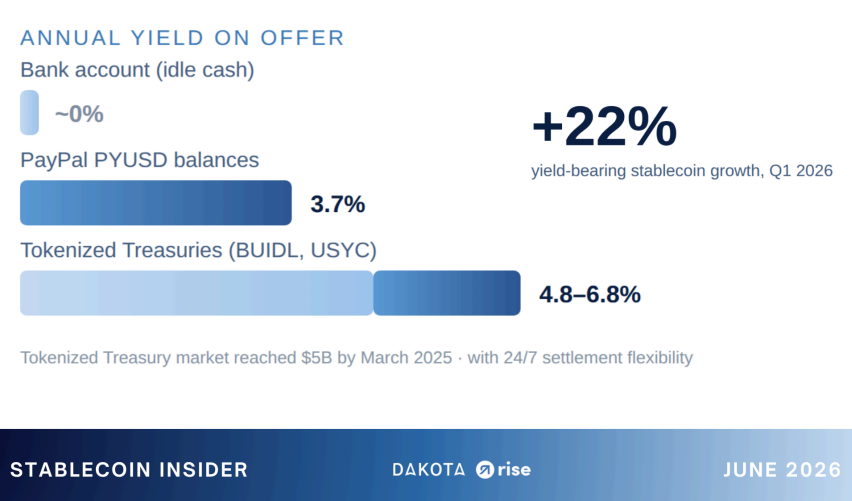
The economics are compelling enough that issuers and asset managers are actively competing for corporate balances. The report lays out the yield ladder on offer:
- Bank account (idle cash): roughly 0%
- PayPal PYUSD balances: 3.7%, offered as a direct bid for enterprise treasury deposits
- Tokenized Treasuries (BlackRock's BUIDL, Circle's USYC): 4.8% to 6.8%
The tokenized Treasury market reached $5 billion by March 2025, giving corporate treasurers institutional-grade instruments rather than experimental protocols. Corporate idle cash that earns near zero in a bank account can instead earn a meaningful return with 24/7 settlement flexibility.
The market data confirms this is now the growth engine of the entire stablecoin economy. Yield-bearing stablecoins grew over 22% in Q1 2026 and contributed more than half of the net increase in stablecoin market cap, making yield the primary driver of the whole market's expansion.
A Regulatory Note: Why Yield Comes From Instruments, Not Issuers
The report's regulation chapter adds a nuance that matters for treasury policy. Under the US GENIUS Act, the core requirements include 1:1 reserves in dollars or liquid equivalents, regular audits for large issuers, and a prohibition on issuer-paid yield.
That prohibition is precisely why the yield layer has developed the way it has: returns come from tokenized Treasury instruments like BUIDL and USYC, from platforms like PayPal competing for deposits, and from established DeFi infrastructure, rather than from stablecoin issuers themselves.
For enterprises, this structure gives the predictability they have been waiting for, because the yield source is a defined instrument with its own disclosures rather than an issuer subsidy that regulation could remove overnight.
Where Rise Earn Fits: Yield Inside the Payroll Stack
This is the layer Rise Earn occupies in the report's value chain. Rather than letting stablecoin balances sit idle between payroll cycles or after withdrawal, Rise Earn lets users put those balances to work, generating yield on stablecoins held on the platform through established DeFi infrastructure.
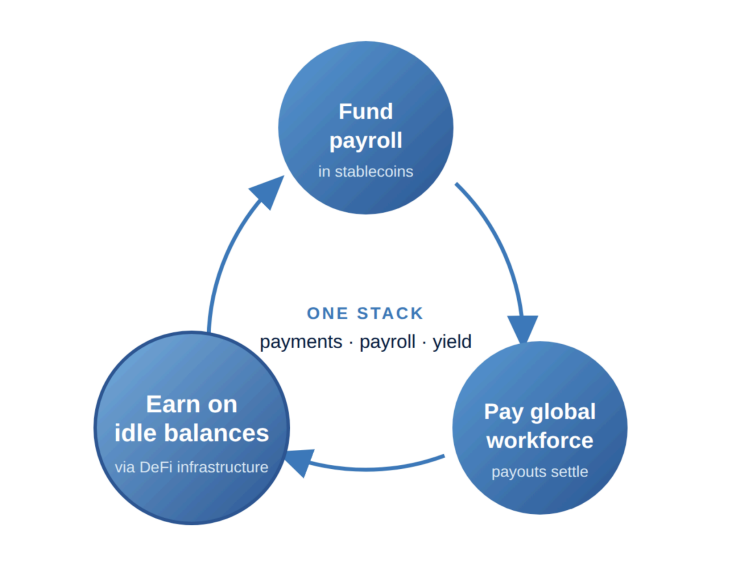
The report describes the loop as one stack covering payments, payroll, and yield: a company funds payroll in stablecoins, pays its global workforce with payouts that settle in seconds, and earns on idle balances between cycles.
For a company already funding payroll in stablecoins through Rise, the yield layer is adjacent rather than separate: the same balances that pay a global workforce can earn between cycles, and workers who choose to hold their stablecoin earnings can do the same.
That last point is distinctive. Yield in this model is not only a corporate treasury feature. The report's payroll data shows stablecoin withdrawals exceeding deposits by $154.5 million on the Rise platform, meaning workers are holding digital dollars, and Rise Earn extends the earning opportunity to those held balances too.
As the report frames it, this closes the loop on capital efficiency: the idle-balance problem that every treasury team eventually confronts is answered inside the same stack that handles payments and payroll.
Yield as the Final Layer of the Stablecoin Operating System
The report's central argument is that the five layers of the value chain, issuance, treasury and banking, payments, payroll, and yield, compose into a financial operating system rather than a collection of point solutions.
Picture a global company running the full stack, as the report does: revenue arrives in USD, converts to stablecoins, is stored and consolidated as treasury with Dakota, the regulated custody and infrastructure layer, flows out to suppliers from the same balance, pays contractors and employees through Rise across 190+ countries, and deploys excess capital into Rise Earn.
The dollar that arrives as revenue is the same programmable unit that pays a supplier in Bogotá and a contractor in Manila, and then earns yield in the gaps.
What makes this an operating system rather than a toolkit is that value never has to leave the rails. In the legacy world, moving from operating cash to a yield instrument means another vendor, another settlement window, and another reconciliation process. On stablecoin rails, yield is a state the same balance moves into and out of, with 24/7 flexibility.
The report's predictions for 2027 to 2030 treat this as settled direction: yield integrates directly into financial workflows, and idle balances earning a return become the expectation rather than a separate decision, exactly the loop Rise Earn closes.
How Finance Teams Put Idle Balances to Work
Translating the report's yield chapter into practice comes down to four steps:
- Quantify the idle balance: Measure how much stablecoin (and convertible cash) sits unproductive between payment and payroll cycles.
- Match instruments to liquidity needs: Balances needed within days fit platform yield like Rise Earn or PYUSD's 3.7%; longer-horizon reserves fit tokenized Treasuries at 4.8% to 6.8%.
- Keep yield inside the operating stack: The efficiency gain compounds when the earning balance is the same balance that funds payroll and payments, not a separate silo.
- Set policy before scale: Define which share of treasury can earn, in which instruments, with what approval controls, so yield remains a treasury strategy rather than an ad hoc experiment.

Conclusion
Rise closes the capital-efficiency loop of the stablecoin value chain with Rise Earn, letting the same balances that fund global payroll generate yield between cycles, inside one regulated stack.
As Mapping the Stablecoin Value Chain 2026 documents, the yield layer has become the growth engine of the entire market: yield-bearing stablecoins grew over 22% in Q1 2026 and drove more than half of net market cap growth, while tokenized Treasuries at 4.8% to 6.8% and PYUSD at 3.7% give corporate treasurers real alternatives to bank accounts earning near zero.
Idle balances earning a return are becoming the expectation, not a separate decision, and the companies that build yield into their stablecoin workflows now will compound the advantage.
Read Next:
- Stablecoin Payroll Explained: How Global Teams Get Paid in USDC and USDT in 2026
- Cross-Border Payments on Stablecoin Rails: Costs, Speed, and Adoption Data for 2026
- Stablecoin Treasury Management: How Companies Consolidate Global Cash on Digital Dollar Rails (2026)
- New Report: Mapping the Stablecoin Value Chain 2026
FAQs:
1. What is stablecoin yield for corporate treasury?
Stablecoin yield for corporate treasury is the return companies earn on idle stablecoin balances through instruments like tokenized Treasuries, platform deposit programs, and DeFi infrastructure, allowing cash to stay liquid with 24/7 settlement while producing income.
2. How much can idle stablecoin balances earn in 2026?
Idle stablecoin balances can earn 3.7% to 6.8% in 2026: PayPal pays 3.7% on PYUSD balances, while tokenized Treasuries like BlackRock's BUIDL and Circle's USYC offer 4.8% to 6.8%, compared with near 0% in a bank operating account.
3. Why are yield-bearing stablecoins growing so fast in 2026?
Yield-bearing stablecoins are growing fast in 2026 because they combine return with liquidity: they grew over 22% in Q1 2026 and contributed more than half of the net increase in stablecoin market cap, making yield the primary driver of the market.
4. Is stablecoin yield allowed under the GENIUS Act?
Yes, stablecoin yield is allowed under the GENIUS Act when it comes from instruments like tokenized Treasuries or platform programs; the Act prohibits issuer-paid yield specifically, which is why returns flow from defined instruments rather than from stablecoin issuers.
5. What is the best way for companies to earn yield on stablecoin payroll balances in 2026?
The best way for companies to earn yield on stablecoin payroll balances in 2026 is Rise Earn, which lets balances generate yield through established DeFi infrastructure between payroll cycles, inside the same stack that handles payments and payroll across 190+ countries.
Disclaimer:
This content is provided for informational and educational purposes only and does not constitute financial, investment, legal, or tax advice; no material herein should be interpreted as a recommendation, endorsement, or solicitation to buy or sell any financial instrument, and readers should conduct their own independent research or consult a qualified professional.