Table of Contents
Slash built its following on a narrow promise. Unlimited virtual cards, flat cashback of up to 2%, and stablecoin rails on the same dashboard, aimed at agencies, ecommerce operators, affiliate marketers, and crypto-native companies that move real volume with small teams.
Most businesses that leave Slash are not leaving over the cards. They outgrow the currency model, need cash deposits, want a chartered bank behind the balance, or hit a compliance review in a vertical that partner banks scrutinise hardest.
The platforms below are deliberately different from the usual startup banking shortlist, chosen because each one solves a gap Slash leaves open rather than competing on the same feature list.
Only one platform here is a chartered bank. The rest are financial technology companies, and the name on the app is not the name on the FDIC certificate, which is the distinction that decides what happens if either party fails.
Key Takeaways
- Slash pairs unlimited virtual cards with flat cashback and stablecoin on-ramps.
- Payoneer announced stablecoin capabilities powered by Bridge in February 2026.
- Revolut received preliminary conditional OCC approval on 2 September 2026.
- Axos is the only chartered bank here, and it accepts cash deposits.
- Stablecoin balances carry issuer risk rather than deposit insurance everywhere.
Why Businesses Look Past Slash
Four gaps come up repeatedly, and each one points at a different alternative.
Currency coverage. Slash is a dollar platform with a Global USD account for non-US companies, which solves receiving dollars without solving holding euros, pounds, or Australian dollars locally.
Where the money arrives. Sellers paid by Amazon, Upwork, or Fiverr need receivables infrastructure wired into those marketplaces, which is a different problem from spend management.
Cash and charter. Slash takes no physical cash and is not a bank, so businesses handling notes or wanting direct deposit insurance need an institution rather than a platform.
Depth on one axis. Some companies need the cheapest possible conversion, some need mass payouts, and some need an account that is stablecoin-native from the ground up rather than stablecoin-enabled. The same pattern drives departures elsewhere in the category, as our guide to Mercury alternatives sets out.
Top Online Bank Alternatives to Slash
1. Airwallex
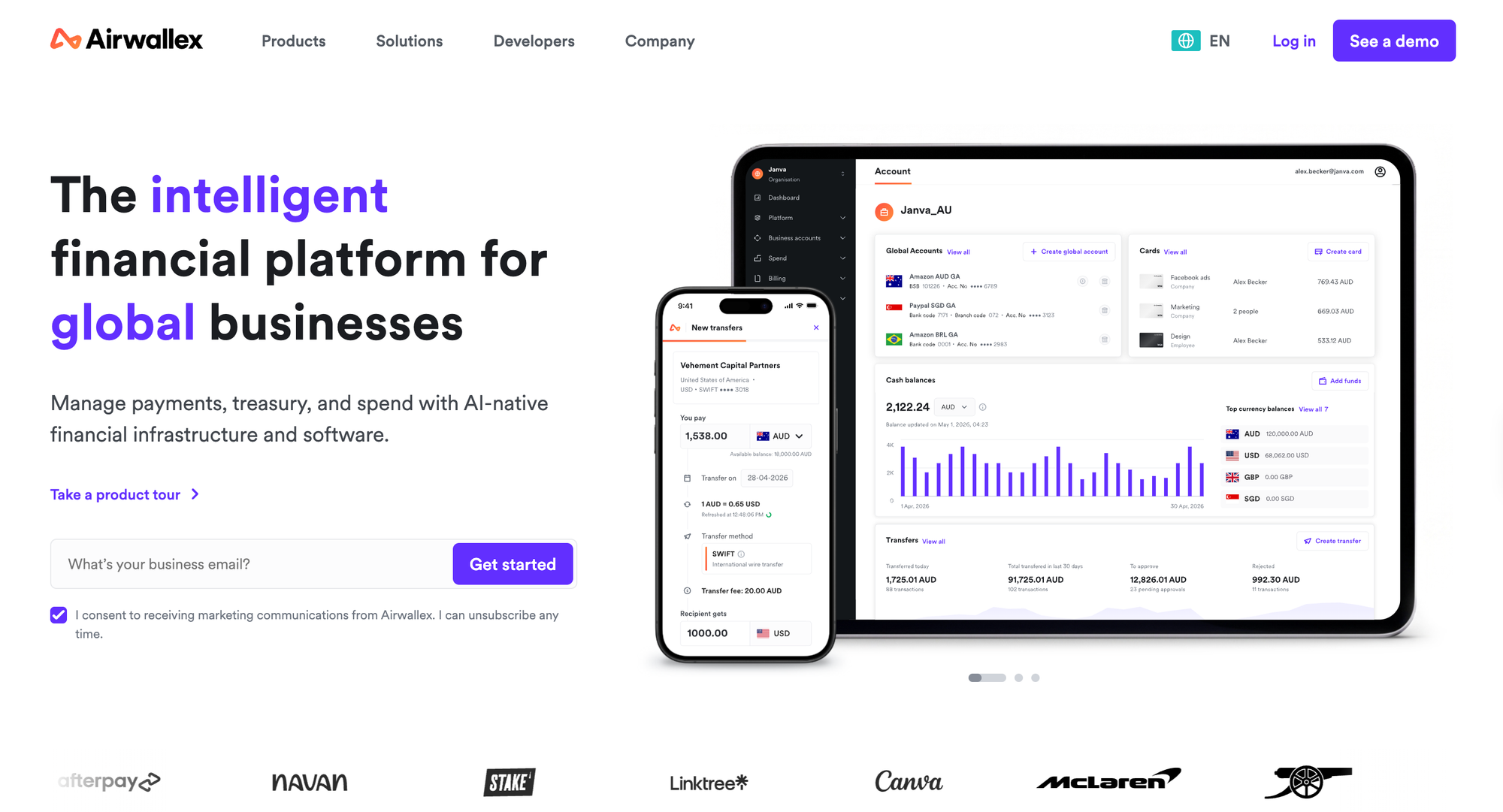
Fills the gap: holding and spending currencies other than dollars.
Airwallex is the closest structural match to Slash for a business that operates across borders rather than inside one country. It gives you local account details in more than 20 currencies, converts at close to the interbank rate with a published markup, and issues unlimited physical and virtual Visa cards against those balances.
The platform supports:
- Multi-currency Global Accounts with local details in over 20 currencies
- Transfers to 200 plus countries and payment acceptance in 180 plus
- FX at the interbank rate plus a markup of roughly 0.5% to 1% depending on the pair
- No conversion fee when spending a currency you already hold
- Integrations with Xero, QuickBooks, Stripe, Shopify, and WooCommerce
The card economics compete directly with Slash. Airwallex advertises 2% cashback on eligible transactions with no cap on accumulated rewards, which for a business paying overseas suppliers stacks on top of the FX saving rather than replacing it. It is a technology platform partnering with FDIC-insured banks, not a bank itself.
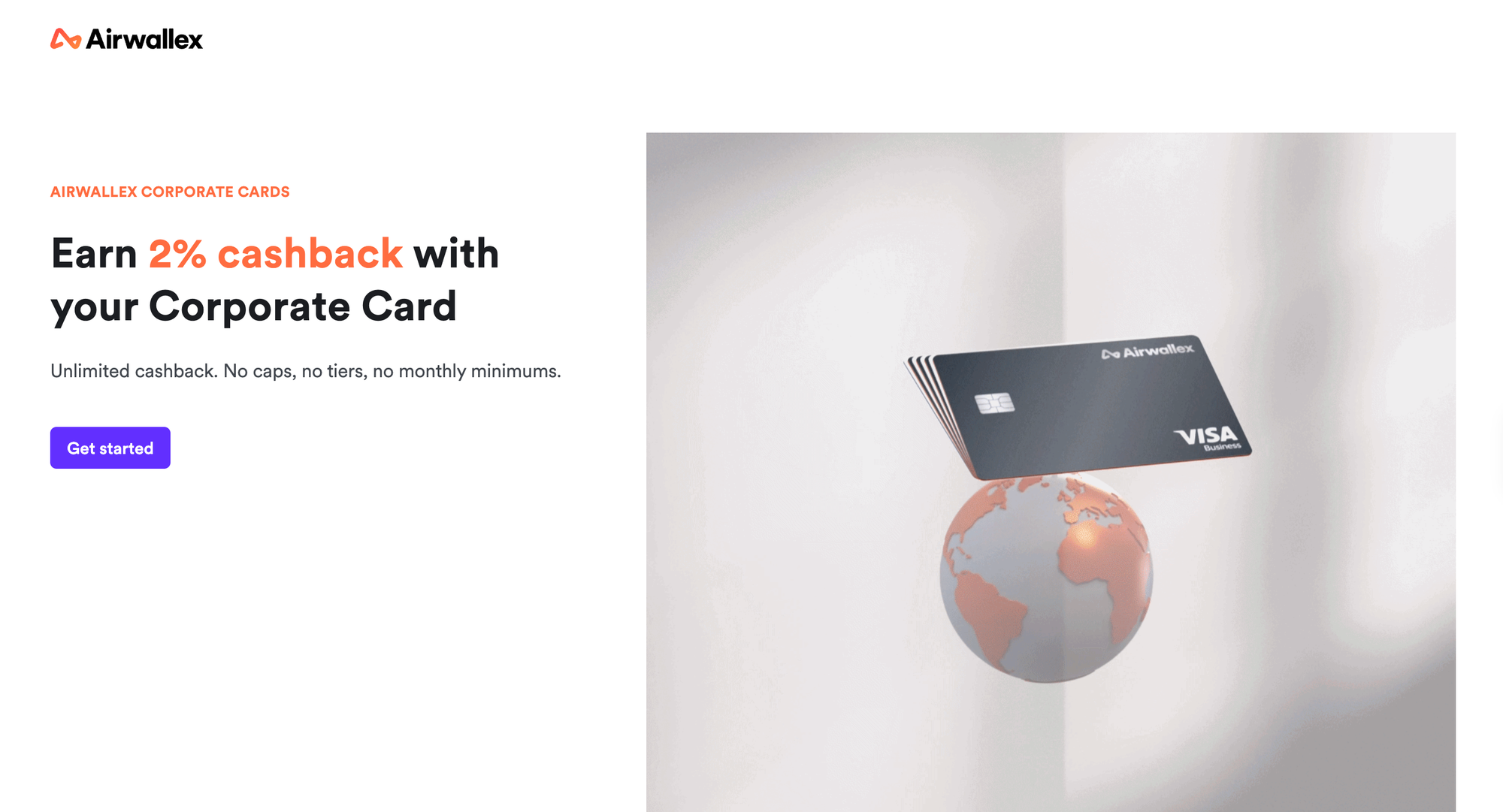
Airwallex is best for companies invoicing customers or paying contractors in several currencies, where FX markup costs more per year than any card rebate returns.
2. Payoneer
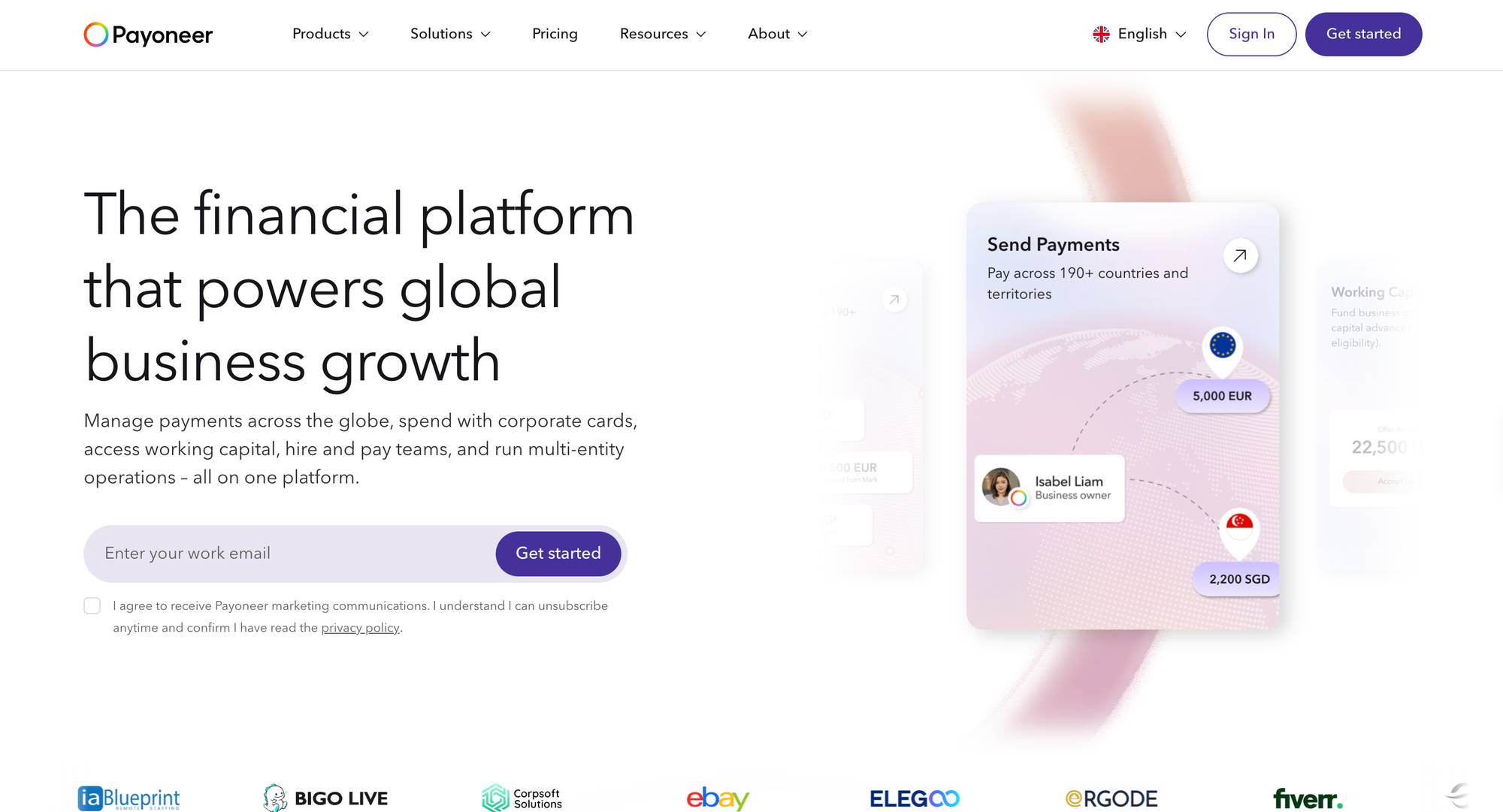
Fills the gap: getting paid by marketplaces rather than by clients.
Payoneer is the only platform here built around receivables from selling platforms. Amazon, Upwork, Fiverr, and thousands of other marketplaces pay into it directly, which removes the manual withdrawal step that every other account on this list requires.
The platform supports:
- Local receiving accounts in USD, EUR, GBP, AUD, CAD, and JPY
- Direct payout integrations with more than 2,000 marketplaces
- No monthly account fee, with costs triggered by money movement instead
- A Mastercard business debit card and B2B payment tools
- Stablecoin capabilities announced in February 2026, powered by Bridge, rolling out through the year
The fee structure is the catch, and it is layered rather than hidden. Marketplace and ACH receiving typically carries around 1%, card-funded payments considerably more, and internal conversion sits above what Wise charges.
Payoneer is best for ecommerce sellers and freelance agencies whose revenue arrives from platforms rather than invoices.
3. Wise Business
Fills the gap: the cheapest transparent conversion and mass payouts.
Wise is the price benchmark for the whole category. Every conversion runs at the real mid-market rate with the fee shown before you confirm, starting around 0.33% to 0.41% depending on the pair, which is the number every competitor is implicitly compared against.
The platform supports:
- Holding and converting more than 40 currencies with local receiving details in around 20
- Batch payments to up to 1,000 recipients from a single upload
- No monthly subscription, with a one-off setup fee for full account details
- Xero and QuickBooks integrations plus a free API
- Eligibility extending to sole traders and freelancers
Two limits matter. Wise is an electronic money institution rather than a bank, so balances are safeguarded rather than insured as deposits, and business cards are not available for US accounts. Its application for a US national trust bank charter remained pending through 2026.
Wise Business is best for companies paying many contractors abroad where conversion cost is the single largest line.
4. Revolut Business
Fills the gap: one global platform with a charter arriving behind it.
Revolut is the only consumer-scale institution on this list, serving more than 80 million customers, and its business product bundles multi-currency accounts, cards, and expense tooling in plan tiers rather than a single free account.
The platform supports:
- Multi-currency infrastructure across 25 plus currencies with US account details
- US plan tiers running from a free base plan up to enterprise pricing
- An FX allowance per plan, then a markup that differs inside and outside market hours
- Cards, expense management, and bulk payments on higher tiers
- A full UK banking licence granted in March 2026
The structural news is the US charter. Revolut filed in March 2026 and received preliminary conditional OCC approval on 2 September 2026 for Revolut Bank US, announced the following day, with FDIC and Federal Reserve approvals still outstanding and a launch targeted for 2027.
Revolut Business is best for internationally distributed companies that want one platform across regions and are comfortable with tiered pricing.
5. Axos Bank
Fills the gap: an actual bank that takes cash.
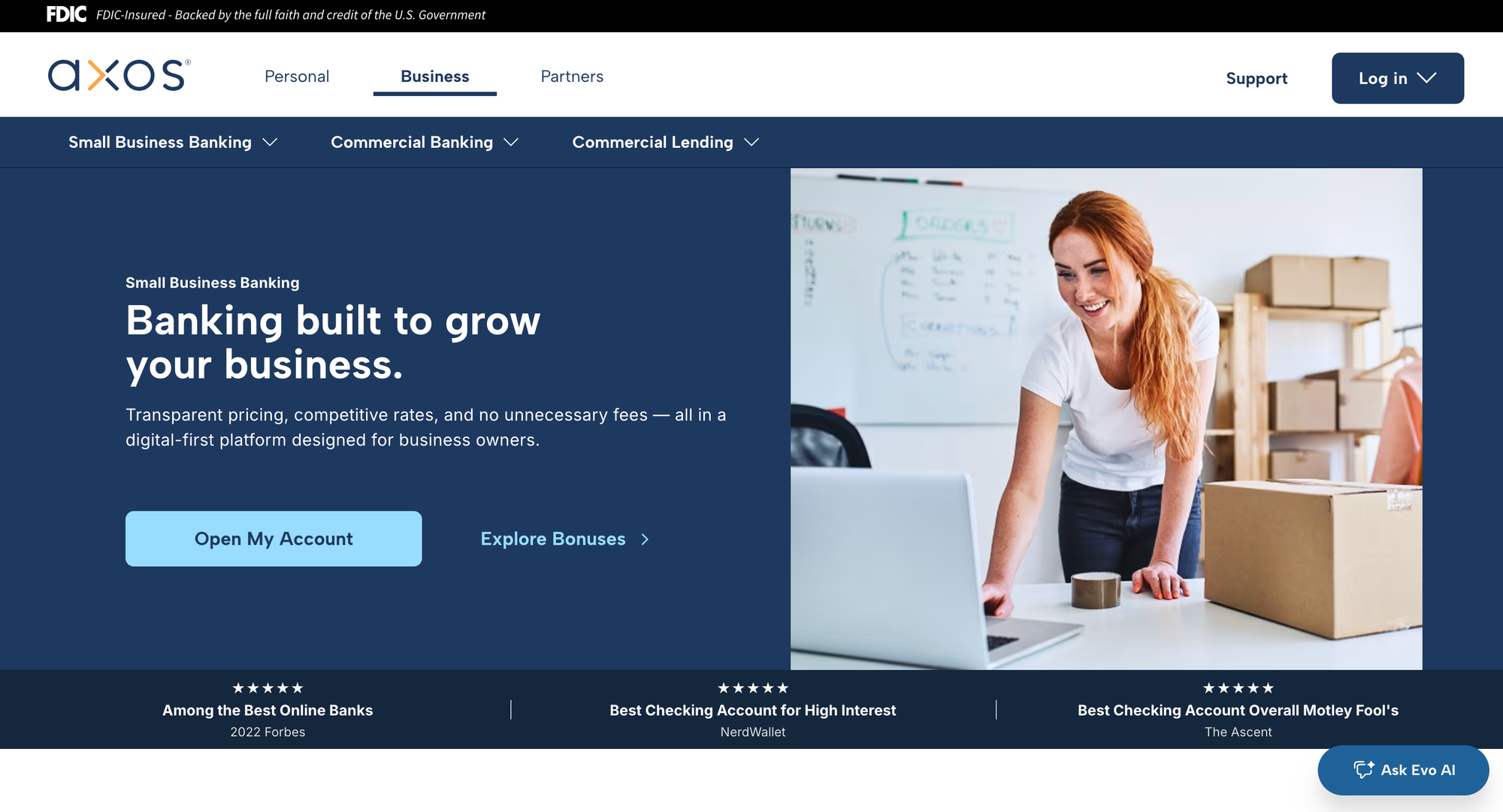
Axos is the structural opposite of everything else here. It is an FDIC-member bank rather than a platform routing deposits to one, which means there is a single counterparty rather than a fintech, a partner bank, and a sweep network stacked on top of each other.
The platform supports:
- Basic Business Checking with no monthly fee and unlimited transactions
- Cash deposits at compatible ATMs and unlimited domestic ATM fee refunds
- Business Premium Savings advertising APY in the high 3% range with no minimum
- Extended coverage through an insured cash sweep programme reaching into the hundreds of millions
- Direct FDIC insurance at the bank itself rather than through a partner
The trade-offs are the mirror image of Slash. There is no unlimited virtual card issuance, no stablecoin capability, and third-party app integration is limited, with reviewers regularly flagging the mobile experience.
Axos is best for businesses handling physical cash or those that want deposit insurance without a partner-bank layer in between.
6. KAST Business
Fills the gap: a stablecoin-native account rather than stablecoin as a feature.
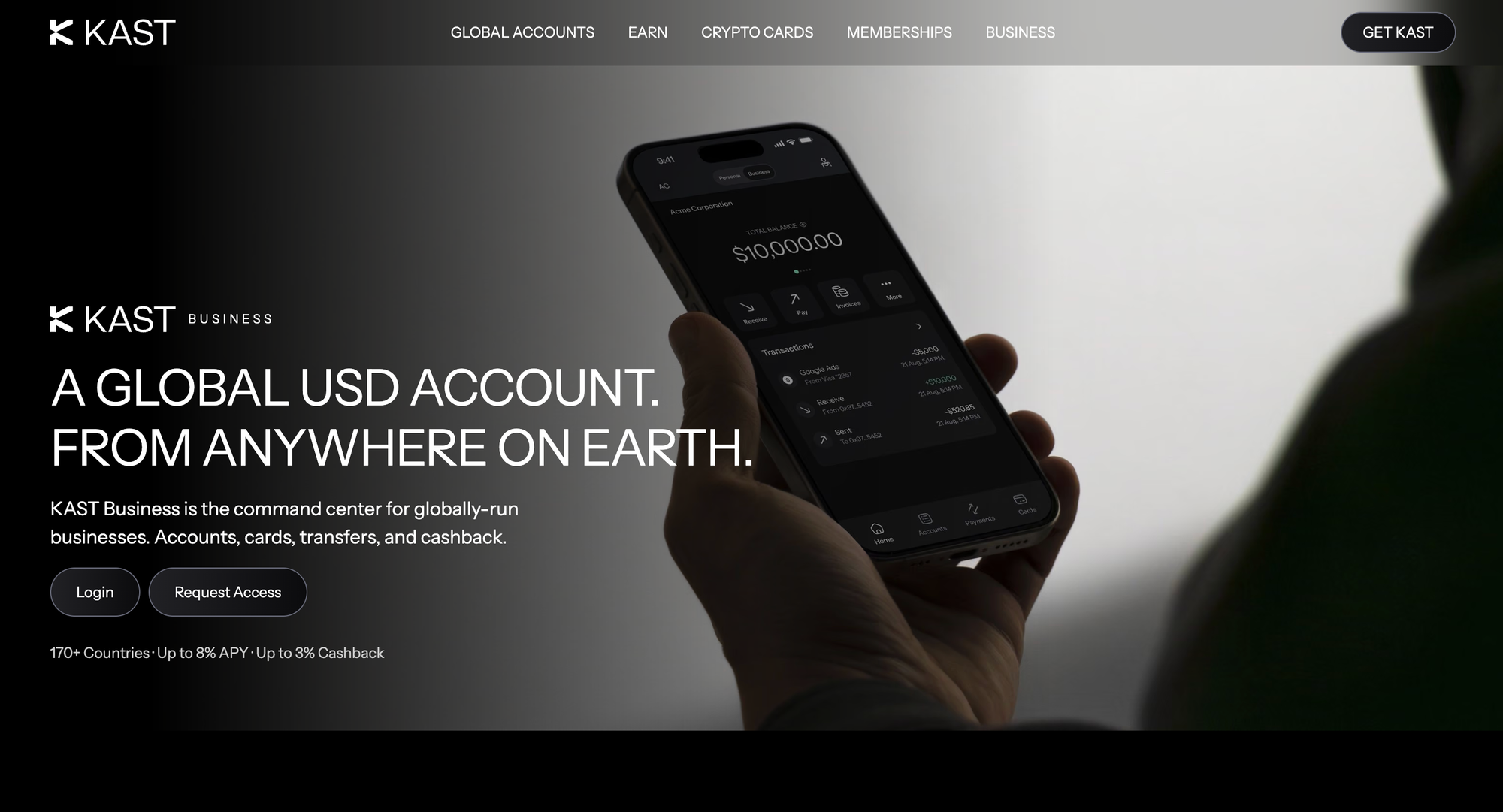
Slash treats stablecoins as an on-ramp and off-ramp attached to a dollar account. KAST inverts that, running the account on stablecoin rails and settling around the clock, which our coverage of the KAST Business launch sets out in detail.
The platform supports:
- Global USD account without a US address or US co-founder
- Availability across 170 plus countries, with access varying by jurisdiction
- Local payouts in over 20 currencies plus international wires
- Card issuing per team member, vendor, or subscription
- Treasury-backed yield through KAST Reserve, variable and subject to eligibility
KAST is a financial technology company rather than a bank, and accounts, cards, and custody run through licensed partners. Balances held as stablecoins are not insured deposits.
KAST Business is best for globally distributed teams that already hold dollars on chain and want the account to match.
7. Dakota
Fills the gap: stablecoin money movement built as infrastructure.
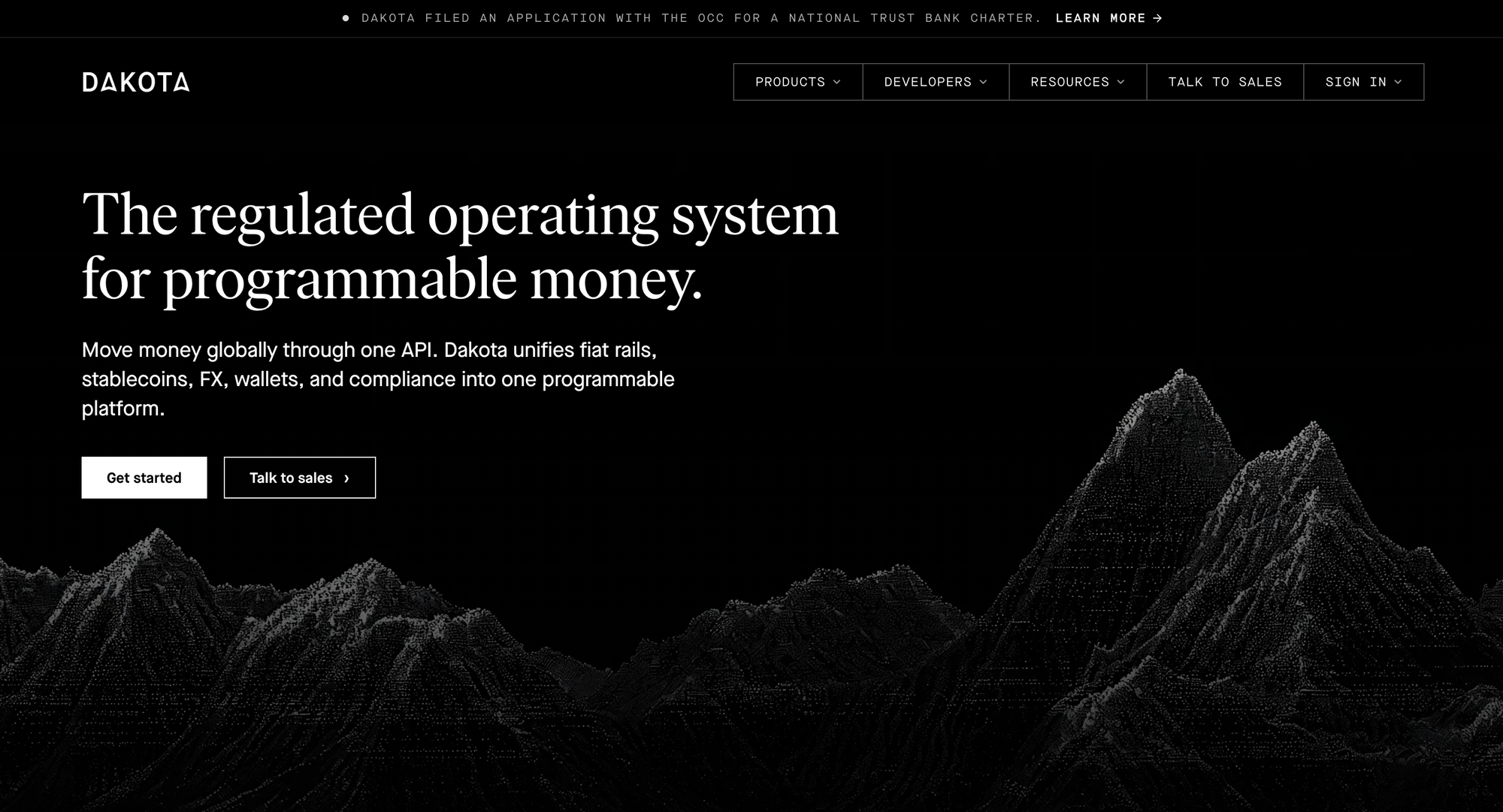
Dakota started in 2022 as a stablecoin business bank and spent 2026 moving toward infrastructure, offering APIs for custody, cross-border treasury, compliance, and payouts alongside its business accounts. That direction makes it the right pick for companies that want to embed money movement rather than log into a dashboard.
The platform supports:
- Holding and moving funds as dollars or stablecoins across ACH, Fedwire, SWIFT, and SEPA
- Embedded USD virtual accounts issued through an API
- Stablecoin payouts reaching 130 plus countries
- Self-serve onboarding with KYB measured in hours rather than weeks
- Fiat banking through global bank partners, with FDIC insurance via US partners including Lead Bank
Dakota operates under state money transmitter licences rather than a charter, and applied to the OCC for a national trust bank charter in early August 2026. That charter, if granted, would cover custody and issuance rather than deposits.
Dakota is best for platforms and operators building stablecoin flows into their own product instead of managing them by hand.
Slash Alternatives Compared
| Platform | Fills the gap | Structure | Stablecoins | Main limitation |
|---|---|---|---|---|
| Airwallex | Multi-currency operations | Platform on partner banks | No | FX markup applies per pair |
| Payoneer | Marketplace receivables | Payment platform | Announced via Bridge, rolling out | Layered receiving and conversion fees |
| Wise Business | Cheapest conversion and batch payouts | Electronic money institution | No | Safeguarded, not insured; no US card |
| Revolut Business | One global platform | Platform, US charter conditional | Planned, subject to approvals | Features gated behind plan tiers |
| Axos Bank | Chartered bank and cash deposits | FDIC-member bank | No | Thin integrations and card tooling |
| KAST Business | Stablecoin-native account | Platform on licensed partners | Native | Access varies by jurisdiction |
| Dakota | Embedded stablecoin rails | Money transmitter, charter filed | Native | Built for builders, not dashboards |
What Slash Still Does Better
Switching costs are real, so it is worth naming what you give up.
Slash pairs flat cashback of up to 2% on all business spend with unlimited virtual cards and per-card controls, which nothing above matches except Airwallex, and Airwallex does not attempt the spend management layer at the same depth. For a card-heavy agency running six figures a month through ad platforms, that difference is the whole comparison.
Slash also keeps banking, cards, bill pay, treasury, and stablecoin transfers on one platform at no monthly cost on the free plan. Companies leaving for a single missing feature often end up paying for two tools instead of one.
Risks and Limitations Worth Pricing
Three cautions apply across every platform above.
The first is structure. Only Axos is a chartered bank, so everywhere else the deposit relationship runs through a partner institution and its sweep network, with the relevant name and size sitting in the fine print rather than the marketing page.
The second is what safeguarding is not. An electronic money institution holds client funds separately from its own, which protects them in an insolvency without making them insured deposits, and the distinction only becomes visible in a failure.
The third is stablecoin treatment. Balances held in USDC or USDT at any of these platforms are claims on an issuer rather than insured deposits, a distinction our explainer on whether stablecoins are FDIC insured covers in full.
Where the Operator's Own Money Goes
Every platform here is built for company money, and none of them is designed to hold the founder's personal savings. Mixing the two is the fastest way to lose the corporate separation that makes the entity worth having in the first place.
The practical version is a clean handoff. Owner's draw or salary leaves the business account on a schedule, lands in a personal account, and whatever is left after expenses goes into something that is not a checking balance earning nothing.
That last step is where most operators stall, because the amount available in month one rarely feels like enough to start. Invest $5, earn $25 is a reasonable answer to that objection, since the barrier is the habit rather than the balance. Set it up once alongside the payout schedule and it runs without further decisions.
How to Choose a Slash Alternative
1. Name the constraint that made you look
Currency, receivables, cash handling, and charter structure point at four different platforms. Solving the wrong one means switching twice.
2. Price the conversion before the cashback
A business converting $200,000 a year loses more to a one point FX markup than a 2% card rebate returns on typical spend. Run both numbers against last year's actual volume.
3. Follow the money to where it lands
If revenue arrives from marketplaces, receivables integration beats every other feature. If it arrives by invoice, conversion cost and payout tooling matter more.
4. Decide whether you want a bank or a platform
A chartered bank means one counterparty and direct insurance. A platform means better software and an extra layer between you and the institution holding the money.
5. Test the payout path before migrating
Run one real vendor payment, one contractor payout, and one card issuance on the new platform while the old one is still open. Migrations fail on the corridor, not on the dashboard.
Conclusion
Slash is difficult to beat on the exact combination it was built for, which is card-heavy operations that want stablecoin rails without a private key in sight. The alternatives win by being better at something Slash treats as secondary.
Airwallex takes the multi-currency case, Payoneer takes marketplace revenue, Wise takes conversion cost and mass payouts, Revolut takes global coverage with a charter in progress, Axos takes cash and direct insurance, and KAST and Dakota take the two ends of stablecoin-native operations.
Whichever way the decision goes, read the partner bank disclosure and the safeguarding language before moving the balance. Those two documents describe what actually happens in a failure, and they rarely match the impression left by the pricing page.
Read Next:
- Top Online Bank Alternatives to Mercury in 2026
- Best Neobanks for Startups in 2026-2027
- How to Set Up a Stablecoin Treasury
FAQs:
1. What is the best alternative to Slash?
It depends on the gap that made you look. Airwallex is the strongest match for multi-currency operations, Payoneer for marketplace revenue, Wise for conversion cost and batch payouts, Axos for cash deposits and direct deposit insurance, and KAST or Dakota for stablecoin-native operations.
2. Is Slash a bank?
No. Slash is a financial technology company, and banking services are provided by a partner bank holding the FDIC charter. Airwallex, Payoneer, Wise, Revolut, KAST, and Dakota are also not banks, and Axos is the only chartered institution compared here.
3. Which Slash alternative accepts cash deposits?
Axos, through compatible ATMs, and it also refunds domestic ATM fees. Slash, Airwallex, Wise, Payoneer, KAST, and Dakota are all digital-only, which is disqualifying rather than inconvenient for retail and hospitality businesses.
4. Did Revolut get a US banking licence?
Not yet. Revolut received preliminary conditional approval from the OCC on 2 September 2026 to organise Revolut Bank US, and still needs FDIC and Federal Reserve sign-off plus final OCC authorisation, with a launch targeted for 2027.
5. Which alternatives actually hold stablecoins?
KAST and Dakota run on stablecoin rails natively, and Payoneer announced stablecoin capabilities powered by Bridge in February 2026 with a phased rollout. Airwallex, Wise, and Axos handle fiat only, and Revolut's stablecoin plans for the proposed US bank remain subject to approvals.
Disclaimer:
This content is provided for informational and educational purposes only and does not constitute financial, investment, legal, or tax advice; no material herein should be interpreted as a recommendation, endorsement, or solicitation to open any account or purchase any product, and readers should conduct their own independent research or consult a qualified professional. Fees, cashback rates, APYs, coverage ceilings, and eligibility criteria change frequently and are reported inconsistently across sources; verify all figures directly with each provider before acting. Deposits at non-bank platforms are held at partner institutions or safeguarded rather than insured, and stablecoin balances are neither deposits nor insured.