
Table of Contents
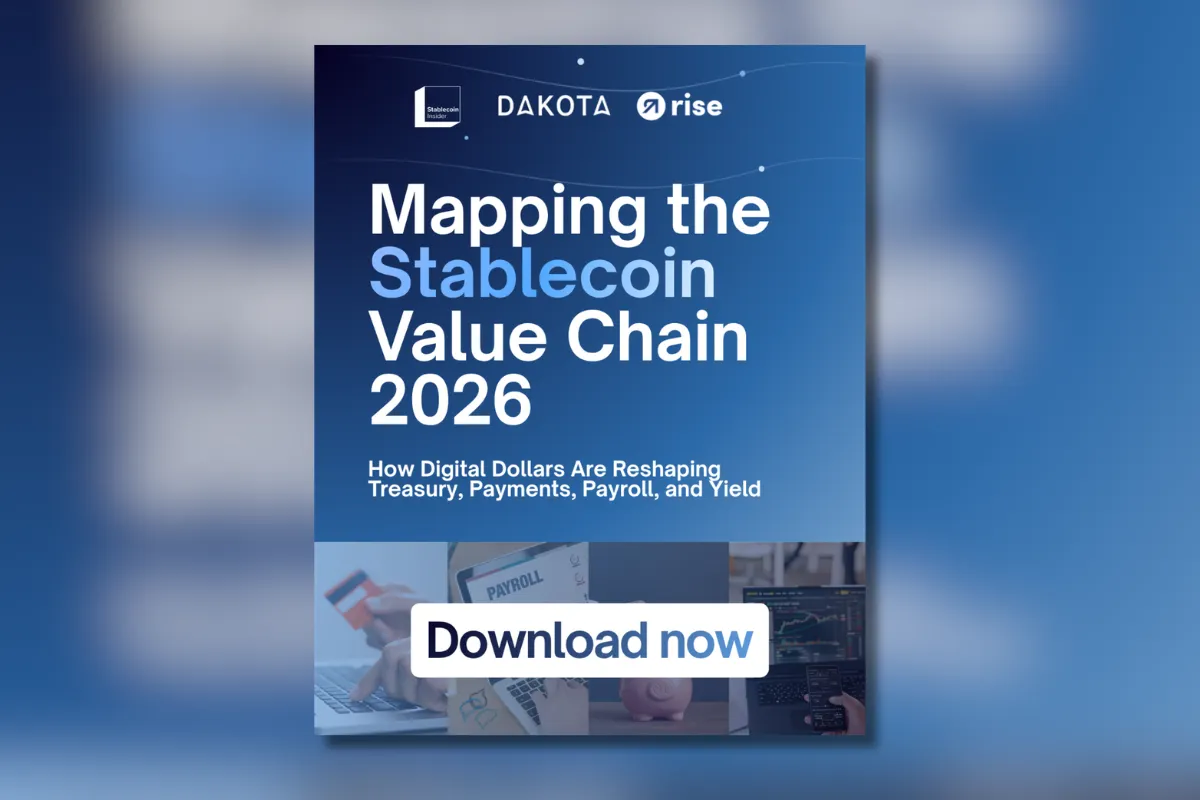
Total stablecoin supply crossed $320 billion in early May 2026, and roughly 60% of stablecoin payment volume now comes from B2B transactions rather than trading, according to the Mapping the Stablecoin Value Chain 2026 report published by Stablecoin Insider in partnership with Dakota and Rise.
Dakota sits at the center of this shift as the regulated, AI-native platform for enterprise stablecoin infrastructure, giving finance teams the custody, compliance, and cross-border movement layer they need to operate digital dollars at scale.
As the report documents, settlement volumes on stablecoin rails now rival the world's largest card networks, and corporate treasury is being rethought from the ground up: fragmented bank accounts, multi-day settlement windows, and FX exposure on internal transfers are no longer accepted costs of doing business globally.
Drawing on the report's treasury chapter, this article explains what stablecoin treasury management is, why the old treasury model leaks money, how consolidation on digital dollar rails works in practice, and what a regulated implementation looks like in 2026.
Key Takeaways
- Stablecoin treasury consolidates fragmented global cash into one programmable, 24/7 position.
- Stablecoin rails compress two-to-five-day settlement windows down to minutes.
- 74% of finance leaders say stablecoins boost cash-flow efficiency and unlock working capital.
- Dakota provides regulated custody, global transfers, and FX across 100+ jurisdictions.
- Compliance-as-code lets treasury teams gain speed without sacrificing regulatory safety.
What Is Stablecoin Treasury Management?
Stablecoin treasury management is the practice of holding, moving, and governing a portion of corporate cash in dollar-pegged digital tokens instead of, or alongside, traditional bank balances. Rather than maintaining dozens of bank accounts across currencies and time zones, a company converts a portion of its revenue into stablecoins like USDC or USDT and manages that balance through regulated custody infrastructure.
The result is a treasury line item that sits alongside cash, money-market funds, and FX.
In 2026, the decision of which infrastructure holds and governs that money is made at board level, because the operational advantages have become impossible to ignore: on-demand transfers between entities, around-the-clock settlement, and a single programmable balance instead of trapped pockets of capital scattered across correspondent banking relationships.
Why the Old Treasury Model Leaks Money
As the Mapping the Stablecoin Value Chain 2026 report puts it, the corporate treasury function is being rethought because the old model leaks money at the seams, and the leakage compounds with every new market a company enters.
Global operations mean fragmented cash sitting in dozens of bank accounts across currencies and time zones. Settlement windows of three to five days lock up working capital, and cross-border intercompany transfers carry days of FX exposure just to move money between a company's own entities.
As the report notes, capital efficiency suffers in proportion to how international a business becomes, the more markets served, the more cash is stranded in transit or held as buffer against slow rails.
The appetite for a better model has outrun the architecture. Among the adoption data compiled in the report, Ripple's 2026 survey of more than 1,000 finance leaders found that 74% believe stablecoins can boost cash-flow efficiency and unlock trapped working capital, while 72% said they must offer a digital asset solution to stay competitive but lack a starting point compatible with existing workflows.
On the operational side, a Fireblocks survey of 295 institutions cited in the same report found 49% actively using stablecoins for payments, with another 41% piloting or planning, meaning nine in ten institutions are already engaged with the shift.
How Stablecoin Treasury Consolidation Works
Stablecoin treasury attacks each weakness of the legacy model directly.
1. Consolidation of fragmented cash
Holding balances in digital dollars collapses fragmented cash into a single programmable position. Instead of pre-funding local accounts in every operating market, a company holds one governed stablecoin treasury and deploys funds where and when they are needed.
2. Settlement in minutes, not days
Transfers between entities and geographies happen on demand rather than within banking windows. Stablecoin rails compress correspondent banking's two-to-five-day settlement to minutes and run 24/7, including weekends and holidays, a structural advantage no batch-based banking system can match.
3. Elimination of internal FX drag
Because the treasury holds a single dollar-denominated digital asset, intercompany transfers no longer carry days of FX exposure. Conversion happens at the edge of the flow, when paying a supplier or funding a subsidiary, rather than at every internal boundary.
4. Programmability and auditability
Every movement carries a verifiable on-chain record, and smart-contract logic can automate releases, approvals, and reconciliation. Treasury stops being a manual reporting function and becomes a programmable system.
A Practical Example: One Balance, Global Reach
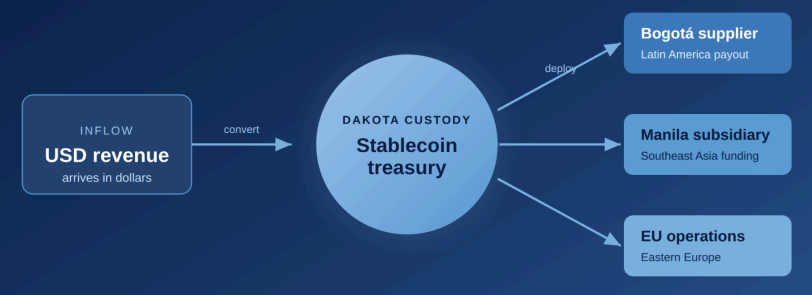
The report's treasury chapter includes an illustrative case that shows the model in motion. Consider a software company headquartered in the US with revenue arriving in dollars and operations spanning Latin America, Southeast Asia, and Eastern Europe.
Under the stablecoin treasury model, it receives USD revenue, converts a portion to stablecoins, and holds and consolidates that treasury through regulated custody. From that single balance, it deploys funds globally, paying a Bogotá supplier or funding a Manila subsidiary, without waiting on correspondent banks or maintaining a local account in every market.
The same dollar that used to sit idle across fragmented accounts becomes a single, mobile, programmable balance. That is the core promise of treasury consolidation on digital dollar rails: value never has to leave the rails, so it never gets trapped between them.

The Regulated Foundation: How Dakota Powers Stablecoin Treasury
Speed without compliance is not an option for enterprise finance, which is why the infrastructure layer matters more than the token itself. Dakota provides the four layers a stablecoin treasury operation needs, all through composable APIs:
- The holding layer: regulated custody for corporate stablecoin balances.
- The movement layer: global transfers and FX across more than 100 jurisdictions.
- The consolidation layer: treasury operations that replace fragmented vendor stacks.
- Around-the-clock settlement: 24/7 money movement, available via agentic SDKs.
Four characteristics define Dakota's position in the value chain. Compliance is treated as the product rather than a cost: Dakota is a registered US Money Services Business with active state Money Transmitter Licenses, pursuing EMI and CASP licenses in Europe, with programmatic KYB, AML, transaction monitoring, and risk controls built into every API call, an approach called "compliance-as-code" that lets most customers onboard in under 24 hours.
It is global from day one, supporting 100+ jurisdictions and multiple rails without fragmented vendor integrations. It is built from operating rather than theorizing, reflecting more than $6 billion in total transaction volume to date. And it is AI-native by design, so the same regulated APIs that let a finance team move money let autonomous agents do it too, with compliance and authorization embedded in every call.
The compliance-as-code architecture means a treasury team is not choosing between speed and regulatory safety, it gets both on the same rails.
Dakota founder and CEO Ryan Bozarth frames the thesis in the report: stablecoins won't reach their potential through better wallets but through better infrastructure, because companies moving money at scale don't want to rebuild custody, compliance, and cross-border rails for every market they enter, they want regulated primitives they can compose.
Regulation Is the Tailwind, Not the Obstacle
None of this scales without regulatory clarity, and, as the Mapping the Stablecoin Value Chain 2026 report documents, 2026 is the year the major frameworks moved from proposal to enforcement.
In the United States, the GENIUS Act, enacted in July 2025, directs the OCC, FDIC, Federal Reserve, NCUA, and Treasury to issue implementing rules, most due by July 18, 2026.
The core requirements, 1:1 reserves in dollars or liquid equivalents, regular audits for large issuers, and a prohibition on issuer-paid yield, give enterprises the predictability they have been waiting for. In Europe, MiCA's stablecoin rules have applied since mid-2024, with the transitional period for crypto-asset service providers expiring across most member states by July 1, 2026.
For treasury teams, the takeaway is straightforward: the regulatory sequencing that was the main adoption risk in prior years is now resolving into enforceable, predictable frameworks. The partners that treated compliance as the product from the start are the ones enterprises can adopt today.
How to Get Started With Stablecoin Treasury Management
A phased approach keeps risk controlled while capturing the efficiency gains early:
- Map your cash friction: Identify where capital sits idle, pre-funded local accounts, in-transit settlement, FX buffers between entities.
- Start with one corridor: Pick a single high-friction flow, such as funding one international subsidiary, and run it on stablecoin rails in parallel with existing processes.
- Consolidate custody and governance: Move from experiment to operating model by placing balances under regulated custody with policy controls, approvals, and monitoring.
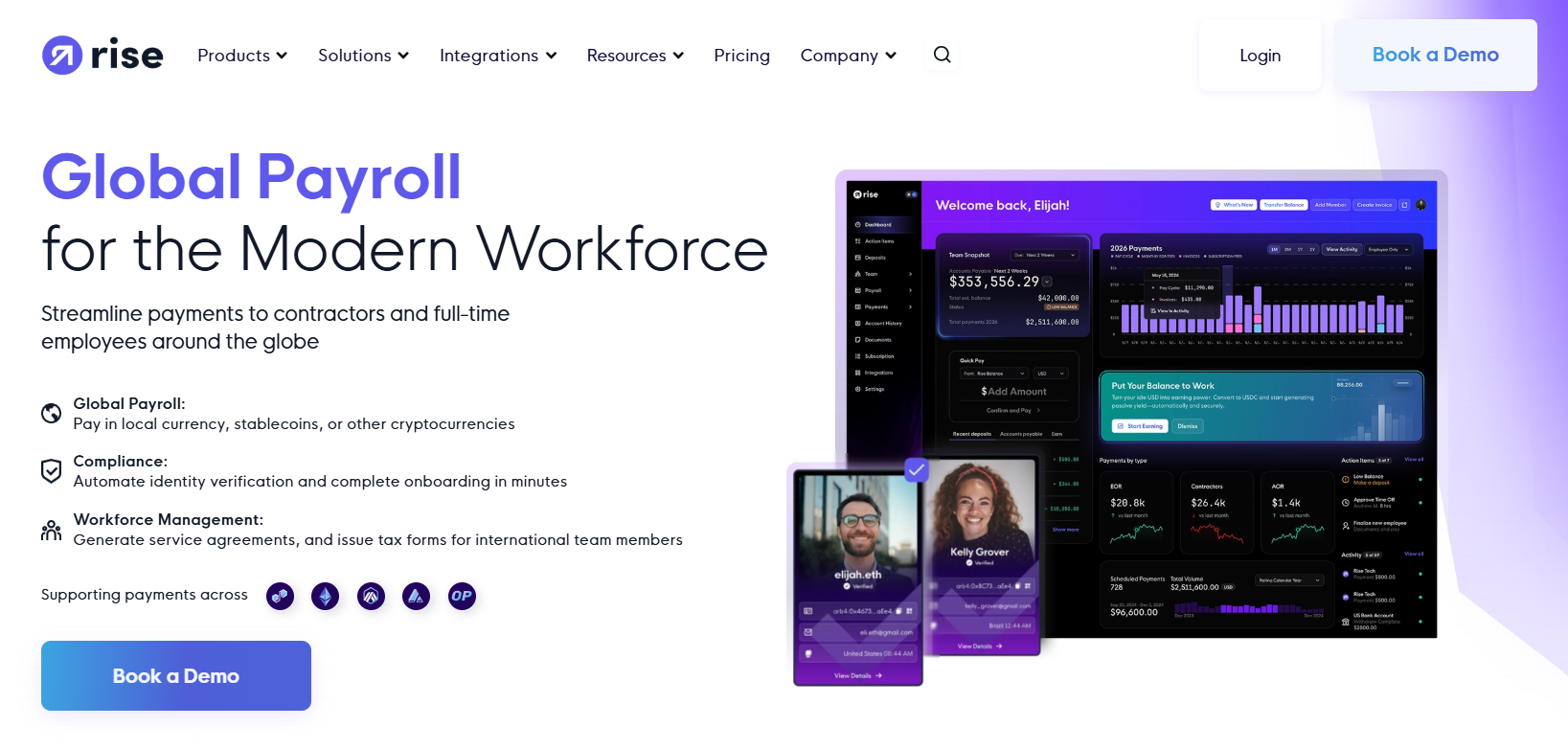
- Expand to payments and payroll: Once the treasury layer is proven, the same infrastructure connects directly to supplier payments and workforce payouts, a configuration change, not a new integration.
- Put idle balances to work: Close the capital-efficiency loop by deploying excess balances into yield within the same governed stack.
Conclusion
Dakota is the regulated infrastructure layer that makes enterprise stablecoin treasury operational rather than theoretical, combining custody, compliance, and cross-border movement in one AI-native platform.
As Mapping the Stablecoin Value Chain 2026 report concludes, stablecoin treasury management has moved from the margins to the boardroom: fragmented global cash consolidates into a single programmable balance, settlement compresses from days to minutes, trapped working capital comes back into play, and the regulatory frameworks that once created hesitation now provide the clarity enterprises need.
The report's closing argument applies directly to treasury teams: the companies that map their operations onto regulated digital dollar rails now are the ones that will compound the advantage as the rest of the market catches up.
Read Next:
FAQs:
1. What is stablecoin treasury management?
Stablecoin treasury management is the practice of holding, moving, and governing corporate cash in dollar-pegged digital tokens through regulated custody infrastructure, consolidating fragmented global balances into a single programmable position that settles 24/7.
2. How do companies consolidate global cash with stablecoins in 2026?
Companies consolidate global cash with stablecoins in 2026 by converting a portion of revenue into digital dollars, holding that balance in regulated custody, and deploying funds on demand across markets, replacing pre-funded local accounts and multi-day correspondent banking settlement, a model detailed in the Mapping the Stablecoin Value Chain 2026 report.
3. What are the benefits of stablecoin treasury management for enterprises?
The benefits of stablecoin treasury management for enterprises are consolidated cash positions, settlement in minutes instead of two to five days, reduced FX exposure on intercompany transfers, 24/7 availability, and auditable on-chain records for every transaction.
4. Is stablecoin treasury management regulated in 2026?
Yes, stablecoin treasury management is regulated in 2026 through the US GENIUS Act, which mandates 1:1 reserves and regular audits, and the EU's MiCA framework, whose stablecoin rules have applied since mid-2024, giving enterprises enforceable, predictable compliance standards.
5. What is the best platform for enterprise stablecoin treasury management in 2026?
The best platform for enterprise stablecoin treasury management in 2026 is Dakota, the regulated, AI-native infrastructure provider offering custody, compliance-as-code, and global transfers across 100+ jurisdictions, with more than $6 billion in transaction volume processed to date.


)