Table of Contents
RLUSD vs USDC comes down to reach versus focus. USDC, issued by regulated affiliates of Circle, is the better choice for most businesses, developers, DeFi users and anyone in the EU: it had $69.3 billion in circulation on 15 November 2026, is native on 38 blockchains and is issued in Europe under an e-money licence (DefiLlama; Circle; Circle licences). RLUSD, Ripple's dollar stablecoin, fits institutions that already use Ripple's payments, custody or prime brokerage services, and XRP Ledger settlement flows.
RLUSD is the faster-growing coin. Its supply rose from $1.09 billion to $2.80 billion over the 12 months to 15 November 2026, while USDC's fell about 7% (DefiLlama RLUSD; DefiLlama USDC). Both are redeemable 1:1 for US dollars, but only by onboarded institutional customers.
Last updated: 15 November 2026. Supply, reserves, fees, rewards and licences re-checked against Ripple, Circle, DefiLlama, ESMA and Krak pages on this date.
Key Takeaways
- USDC's supply of $69.3 billion was about 25 times RLUSD's $2.80 billion on 15 November 2026 (DefiLlama; DefiLlama).
- Ripple's transparency page showed $2,826.5 million of reserves against $2,689.9 million of RLUSD in circulation on 12 November 2026, a buffer of about $136.6 million (Ripple).
- Circle Mint's Standard USDC redemptions carry no Circle fee; Express costs 0.05% before credits. Ripple's RLUSD terms say customers redeem "less Fees" but publish no fee schedule (CryptoSlate; Ripple terms).
- In aggregator quotes we pulled on Ethereum on 15 November 2026, selling 25 million RLUSD for USDC returned 2.95 basis points below par, before gas (liquidity test).
- ESMA's MiCA register lists Circle's French entity as an e-money token issuer, but has no entry for RLUSD or its issuer (ESMA).
What is the difference between RLUSD and USDC?
The difference between RLUSD and USDC is scale and scope. USDC is a chain-neutral dollar used across exchanges, wallets, payment firms and DeFi; RLUSD is a newer dollar that Ripple describes as "designed for institutions" and built into its own payments, custody and trading services (Circle; Ripple).
RLUSD is issued by Standard Custody & Trust Company, LLC, doing business as Ripple Custody & Trust Co., a limited purpose trust company chartered by the New York State Department of Financial Services (NYDFS) (Ripple). Ripple says it also has approval from the Dubai Financial Services Authority (Ripple). USDC is issued by regulated affiliates of Circle, including Circle Internet Financial Europe SAS in the EU (Circle licences).
Reserves look alike on paper. RLUSD's reserve can hold Treasury bills with three months or less to maturity, overnight reverse repos, government money market funds and deposits, with BNY as primary custodian (Ripple docs; Ripple). Most of the USDC reserve sits in the Circle Reserve Fund (USDXX), a 2a-7 government money market fund managed by BlackRock and custodied at BNY (Circle).
RLUSD vs USDC at a glance
The table compares both coins on the points that decide which one to hold or integrate. Each cell links to the Ripple, Circle, DefiLlama or ESMA page it came from, read on 15 November 2026.
| Dimension | RLUSD (Ripple USD) | USDC (USD Coin) |
|---|---|---|
| Our pick: USDC for most businesses | Pick RLUSD if you already work inside Ripple's network | Pick USDC for chain reach, liquidity and EU access |
| Issuer | Ripple Custody & Trust Co., NYDFS trust (Ripple) | Regulated Circle affiliates (Circle) |
| Supply, 15 November 2026 | $2.80B (DefiLlama); Ripple showed $2,689.9M on 12 Nov (Ripple) | $69.3B (DefiLlama); Circle showed $67.9B on 12 Nov (Circle) |
| 12-month supply change | +157%, from $1.09B (DefiLlama) | -7%, from $74.5B (DefiLlama) |
| Networks | 8, incl. XRPL, Ethereum, Base, Robinhood Chain (Ripple docs) | 38 native, incl. XRPL (Circle) |
| Reserve reporting | Monthly CPA attestation (Ripple) | Weekly holdings, monthly Big Four attestation (Circle) |
| Issuer redemption fee | "Less Fees"; no public schedule (Ripple terms) | Standard free; Express 0.05% (CryptoSlate) |
| OCC trust bank | Ripple National Trust Bank, final approval 26 Oct 2026 (Ripple) | Circle National Trust, charter 25361 (Circle licences) |
| EU MiCA | No EMT register entry (ESMA) | EMT issuer via French EMI No. 17788 (Circle) |
Two patterns stand out. RLUSD is growing fast from a small base, and 72% of it sits on Ethereum and 27% on the XRP Ledger, so the other networks DefiLlama tracks hold about $16 million combined (DefiLlama). USDC is shrinking slightly but remains about 25 times larger, with no single chain above 61% of supply (DefiLlama).
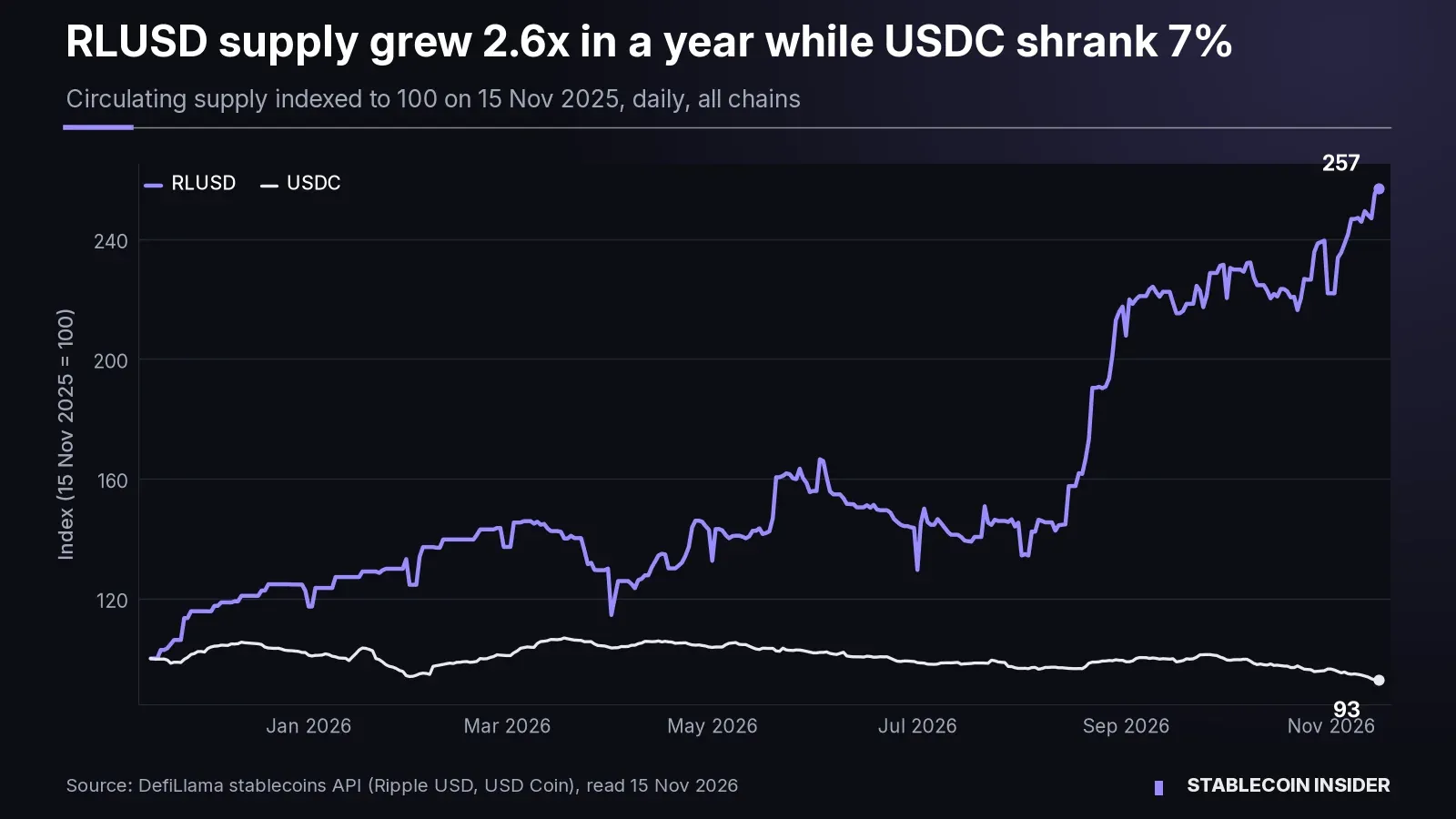
RLUSD's supply index reached 257 on 15 November 2026, with the sharpest step in August and September 2026; USDC's ended at 93 after peaking at $79.6 billion on 18 March 2026 (DefiLlama; DefiLlama). Ripple cited a $2.5 billion market cap when its trust bank was approved on 26 October (Ripple).
RLUSD: best for institutions inside Ripple's network
Best for: banks, brokers, payment firms and market makers that already use Ripple Payments, Ripple Prime or Ripple custody, or that settle on the XRP Ledger. Ripple says RLUSD is used across its payments infrastructure and as collateral in Ripple Prime (Ripple).
Key features
- Available on 8 networks: XRP Ledger, Base, Ethereum, Ink, Optimism, Robinhood Chain, Unichain and the XRPL EVM sidechain (Ripple docs).
- Institutions mint and redeem through the Ripple Mint UI; retail businesses reach RLUSD through exchanges and on-ramps (Ripple docs). Our Ripple Mint walkthrough covers the API flow.
- BNY, the primary reserve custodian, aims to let clients mint and redeem RLUSD directly through BNY, according to a BNY release reported on 27 October 2026 (Banking Dive).
- RLUSD went live on Robinhood Chain and Bitstamp on 27 October 2026, with a Robinhood app listing expected later in the year (Banking Dive; see our Robinhood RLUSD analysis).
Pricing as published
RLUSD pricing as published is not specific. The user terms say a customer "can always redeem one (1) RLUSD for 1 U.S. dollar ($1) with Ripple, less Fees", and that buying from or redeeming with Ripple requires being a customer under the RLUSD Customer Agreement, which is not public (Ripple terms). Direct customers are limited to enterprises that meet bank-level KYC and AML checks (Ripple docs).
| RLUSD pros | RLUSD cons |
|---|---|
| Supply up 157% in 12 months | About one twenty-fifth the size of USDC |
| NYDFS trust issuer; OCC-approved trust bank for reserves | No public redemption fee or minimum |
| Reserve buffer of ~$136.6M on 12 Nov 2026 | No MiCA e-money token authorisation listed |
| Native on the XRP Ledger and Robinhood Chain | 99% of supply on just two chains |
USDC: best for businesses, developers and EU users
Best for: exchanges, fintechs, treasuries and developers that need one dollar token across many chains, deep trading liquidity and a licensed route into the EU. Circle says USDC is accessible to more than 500 million end-user wallet products and available in 185+ countries (Circle).
Key features
- Native on 38 blockchains as of 16 September 2026, from Algorand to ZKsync, including the XRPL (Circle).
- Circle's Cross-Chain Transfer Protocol moves USDC between chains by burn-and-mint, with Fast Transfer in about 8-20 seconds and Standard in 15-19 minutes on Ethereum and L2s (Circle docs).
- Weekly reserve disclosure and monthly assurance from a Big Four accounting firm (Circle).
- Circle Mint is open to exchanges, institutional traders and banks, not individuals or small businesses; smaller firms use Circle Alliance Program ramps (Circle).
Pricing as published
USDC pricing as published depends on the redemption speed. Under Circle Mint's schedule for billing periods starting on or after 19 October 2026, Standard redemptions carry no Circle fee and take up to two business days, while Express redemptions cost 0.05% of the gross amount before credits; customers that mint more than they redeem can earn credits of 25% up to 100% at $100 million of net minting (CryptoSlate).
| USDC pros | USDC cons |
|---|---|
| $69.3B supply, about 25x RLUSD | Supply down 7% in 12 months |
| 38 native chains plus CCTP transfers | Express redemptions cost 0.05% before credits |
| EU e-money licence and MiCA CASP authorisation | Circle Mint closed to individuals and small firms |
| Weekly reserve data and monthly Big Four reports | Rewards depend on platforms such as Coinbase or Krak |
For the issuer workflow, see how to mint and redeem USDC with Circle Mint.
How easy is it to sell RLUSD for USDC on-chain?
Selling RLUSD for USDC on-chain is cheap at institutional sizes on Ethereum. In KyberSwap aggregator quotes we requested at 17:18 CET on 15 November 2026, every size from $10,000 to $25 million came back within 6 basis points of par in both directions (KyberSwap aggregator). Routes ran through Uniswap v4, Uniswap v3, Curve and Sky's LitePSM.
| Trade size | Sell RLUSD for USDC: you receive | Buy RLUSD with USDC: you receive |
|---|---|---|
| $10,000 | 10,001 USDC (+0.72 bps) | 9,999 RLUSD (-0.84 bps) |
| $100,000 | 100,007 USDC (+0.69 bps) | 99,991 RLUSD (-0.87 bps) |
| $1,000,000 | 1,000,048 USDC (+0.48 bps) | 999,887 RLUSD (-1.13 bps) |
| $5,000,000 | 4,999,854 USDC (-0.29 bps) | 4,998,883 RLUSD (-2.23 bps) |
| $10,000,000 | 9,999,037 USDC (-0.96 bps) | 9,996,744 RLUSD (-3.26 bps) |
| $25,000,000 | 24,992,626 USDC (-2.95 bps) | 24,985,666 RLUSD (-5.73 bps) |
Quotes are 1:1 unit comparisons, not executed trades, and exclude gas, which the aggregator estimated at $0.15 to $0.36 per route. At $25 million, selling RLUSD cost about $7,400 against par and buying it about $14,300. Prices move block by block, so treat these as a snapshot of Ethereum pool depth, not a guaranteed cost. Our stablecoin liquidity guide runs the same test for USDC and USDT.
Which pays more rewards, RLUSD or USDC?
RLUSD pays more than USDC on Krak only for Kraken+ subscribers; without a subscription USDC pays more. These rewards are funded by the platform, not the issuer; Ripple's terms say RLUSD is not designed to generate returns (Ripple terms). Krak's rewards page, last updated 10 November 2026, lists these variable rates (Krak):
| Krak program | RLUSD | USDC |
|---|---|---|
| Non-subscribers | Up to 1.75% APY | 2.00% |
| Kraken+ subscribers | Up to 3.75% APY | 2.00% |
| Where offered | US and UK | US, Canada, Australia, UK |
Krak says the program is a loyalty initiative it funds and can change or end. Coinbase's UK USDC page advertises 3.75% rewards, available only to Coinbase One members, with plans from £4.99 a month (Coinbase UK). The GENIUS Act takes effect on 18 January 2027, the same day as the OCC's final implementing rule (OCC); our OCC final rule breakdown covers what it says about yield.
Is RLUSD or USDC better regulated?
RLUSD and USDC are regulated similarly in the US, but USDC has the wider licence set outside it. Both issuers run New York limited purpose trust companies, and both now have OCC national trust bank approvals: Circle announced final approval on 10 July 2026, and Ripple on 26 October 2026 (Circle; Ripple).
The bank roles differ. Ripple National Trust Bank is approved to manage RLUSD reserves and act as collateral trustee for holders, while RLUSD keeps being issued by the New York trust (Ripple). Circle described managing the USDC reserve through its national trust as a planned future capability (Circle).
Europe is the clearest gap. ESMA's interim MiCA register, last updated 11 November 2026, lists Circle Internet Financial Europe SAS as an e-money token issuer authorised by France's ACPR, and has no RLUSD or Ripple issuer entry (ESMA). Ripple Payments Europe S.A. appears only in the crypto-asset service provider file, authorised by Luxembourg's CSSF on 29 June 2026 for exchange and transfer services (ESMA). Our guide on how to check if a stablecoin is MiCA-compliant shows how to read those files.
Which should you choose, RLUSD or USDC?
The stablecoin you should choose is USDC if you pay, collect or hold dollars across several chains, exchanges or countries, or serve EU customers. Choose RLUSD if Ripple is already your payments, custody or prime brokerage provider, if you settle on the XRP Ledger, or if you are a US or UK Krak user paying for Kraken+.
- Exchanges, fintechs and DeFi builders: USDC, for its 38 native chains, CCTP and published redemption fees.
- EU businesses: USDC, because RLUSD has no MiCA e-money token entry on ESMA's register.
- Ripple customers and XRPL settlement: RLUSD, which plugs into Ripple Payments and Ripple Prime, with on-chain exit liquidity into USDC.
- Holders chasing rewards: compare after subscription costs; on Krak, USDC pays more unless you pay for Kraken+.
How we chose
How we chose rests on six checks applied to both coins on 15 November 2026: supply and its 12-month trend (DefiLlama), network coverage (issuer docs), reserve reporting (issuer transparency pages), published mint and redemption terms (Ripple terms and docs, CryptoSlate's report of Circle's fee schedule), on-chain swap cost (KyberSwap quotes) and licensing (OCC, ESMA and issuer licence pages). We did not score either coin, did not test products with our own funds, and left out figures we could not open on a primary or reputable page.
Comparing the two biggest dollars instead? See USDT vs USDC or PYUSD vs USDC. For the full picture, see our Stablecoin regulation hub.
FAQ
Is RLUSD the same as XRP?
Which blockchains support both RLUSD and USDC?
Can Ripple freeze RLUSD?
What happens to RLUSD if Ripple stops issuing it?
Who attests RLUSD and USDC reserves?
Sources: Ripple RLUSD page, Ripple transparency, Ripple RLUSD docs, RLUSD user terms, Ripple RLUSD availability, Ripple OCC approval, Banking Dive, Circle USDC page, Circle transparency, Circle licences, Circle OCC approval, CryptoSlate on Circle Mint fees, Circle CCTP docs, DefiLlama RLUSD, DefiLlama USDC, ESMA interim MiCA register, OCC Bulletin 2026-50, Krak stablecoin rewards, Coinbase UK USDC and KyberSwap aggregator quotes; all read on 15 November 2026.
This content is provided for informational and educational purposes only and doesn't constitute financial, investment, legal or tax advice. Figures were read on 15 November 2026 and can change; reward rates are variable and set by each platform. Swap quotes are a snapshot, not executed trades. Companies and assets mentioned: Ripple, RLUSD, XRP, Circle, USDC, BNY, BlackRock, Robinhood, Bitstamp, Kraken (Krak), Coinbase, KyberSwap, Uniswap, Curve and Sky.