Table of Contents
PYUSD vs USDC is a choice between a dollar built for one payments network and a dollar built for every network. PayPal USD (PYUSD) is issued by Paxos for PayPal and Venmo users; USD Coin (USDC) is issued by Circle and runs on dozens of blockchains. Both are redeemable 1:1 for US dollars. They differ on rewards, reach, fees and regulators.
The best stablecoin for PayPal and Venmo users is PYUSD, which earns a variable 4% PayPal reward and mints free at Paxos. The best stablecoin for most businesses, developers and EU users is USDC, with $70.2 billion in supply, 38 native chains and authorization under the EU's MiCA rules (PayPal; DefiLlama; Circle; Circle licences).
This post covers how PYUSD and USDC compare on supply, chains, holder rewards, mint and redemption fees, reserves and licensing, with figures read from Paxos, PayPal, Circle and DefiLlama on 10 November 2026.
Last updated: 10 November 2026. Fees and terms re-checked against vendor pages on this date.
Key Takeaways
- USDC had $70.2 billion in circulation on 10 November 2026, about 26 times PYUSD's $2.71 billion (DefiLlama USDC; DefiLlama PYUSD).
- PayPal pays a variable 4% annual reward on PYUSD held in the PayPal app; USDC pays nothing by itself, but Coinbase funds USDC rewards whose rate varies by country (PayPal; Coinbase).
- Paxos charges zero fees to mint, hold or redeem PYUSD on its own platform; Circle Mint charges no redemption fee on Standard redemptions and 0.05% on Express (Paxos; CryptoSlate).
- PYUSD is native on 7 blockchains; USDC is native on 38 as of 16 September 2026 (Paxos; Circle).
- Both issuers now hold OCC national trust charters: Paxos converted on 12 December 2025 and Circle National Trust opened on 24 July 2026 (Paxos; Circle).
What is the difference between PYUSD and USDC?
The difference between PYUSD and USDC is distribution. PYUSD is a PayPal product issued by Paxos and designed to move money across PayPal and Venmo, while USDC is Circle's chain-neutral dollar sold through exchanges, banks, wallets and payment companies worldwide.
PayPal launched PYUSD on 7 August 2023 as an ERC-20 token on Ethereum, issued by Paxos Trust Company (PayPal release). Paxos now lists it as issued by Paxos Trust Company, N.A., with reserves held 100% in US dollar deposits, US Treasuries and cash equivalents and monthly attestation reports from KPMG LLP (Paxos attestations). Circle says USDC is backed 100% by cash and cash-equivalent assets, with the majority held in the Circle Reserve Fund (USDXX), an SEC-registered 2a-7 government money market fund managed by BlackRock (Circle USDC page).
PYUSD vs USDC at a glance
The table below compares both stablecoins on the points that decide which one to hold or integrate. Every cell links to the Paxos, PayPal, Circle or DefiLlama page it came from, read on 10 November 2026.
| Dimension | PYUSD (PayPal USD) | USDC (USD Coin) |
|---|---|---|
| Our pick: USDC for most businesses | Pick it if your money already lives in PayPal or Venmo | Pick it for chain reach, liquidity and EU access |
| Issuer | Paxos Trust Company, N.A. (Paxos) | Regulated affiliates of Circle (Circle) |
| Supply, 10 Nov 2026 | $2.71B (DefiLlama) | $70.2B (DefiLlama); Circle showed $69.2B on 5 Nov (Circle) |
| Native chains | 7: Ethereum, Solana, Arbitrum, X Layer, Stellar, Polygon, Stable (Paxos) | 38, from Algorand to ZKsync (Circle) |
| Holder rewards | 4% annual reward in the PayPal app, variable (PayPal) | None from Circle; Coinbase pays rewards that vary by country (Coinbase) |
| Issuer fees | Zero to mint, hold or redeem via Paxos (Paxos) | Standard redemption free; Express 0.05% before credits (CryptoSlate) |
| Federal charter | OCC national trust bank since 12 Dec 2025 (Paxos) | Circle National Trust, OCC charter 25361 (Circle licences) |
| EU status | No MiCA authorization listed on the PYUSD page | French EMI licence No. 17788 (Circle licences) |
Two patterns stand out. PYUSD wins on direct cost and rewards for anyone inside PayPal, but it is small: its whole supply is less than USDC's balance on Base alone, $4.41 billion (DefiLlama). USDC wins on every measure of reach, which is what matters once money has to leave a single app.
PYUSD: best for PayPal, Venmo and US merchants
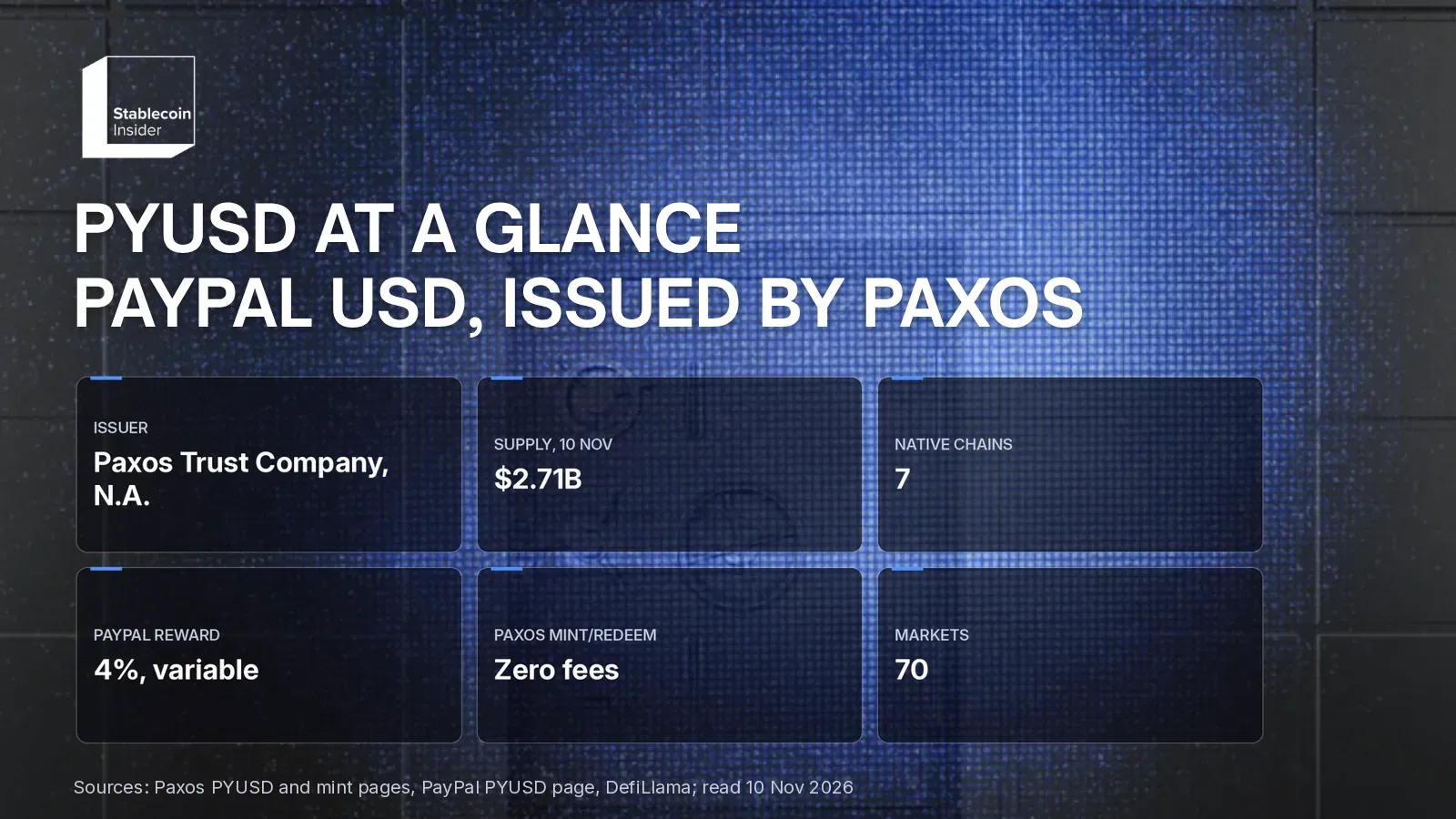
Best for: consumers who already hold a PayPal or Venmo balance, US merchants that want part of their PayPal balance to earn a reward, and institutions that want fee-free primary issuance from Paxos.
Key features
- Available in 70 markets, according to Paxos, with PayPal and Venmo as the main access points (Paxos).
- Native on Ethereum, Solana, Arbitrum, X Layer, Stellar, Polygon and Stable (Paxos). A LayerZero version, PYUSD0, extends it through Stargate Hydra to chains including Aptos, Avalanche, Sei and Tron (LayerZero).
- US merchants can switch on PYUSD Settlement, which sweeps a chosen share of their PayPal balance into PYUSD on a daily to monthly schedule (PayPal).
- Institutions can mint and burn directly on the Paxos Dashboard, by hand, with rules or through the API (Paxos; Paxos docs).
Pricing as published
PYUSD pricing as published is zero for the core actions. PayPal charges no fees to buy, sell, hold or transfer PYUSD between eligible PayPal users; conversions into currencies other than USD include an exchange-rate spread (PayPal). Paxos charges zero fees to mint, hold or redeem Paxos-issued stablecoins on its own infrastructure (Paxos). The reward is 4% a year "as of today", accrues on the average daily balance, is paid monthly in PYUSD, and requires opting in and holding at least 1 PYUSD (PayPal). PayPal's help page says holding rewards are also offered in 60+ markets (PayPal help).
| PYUSD pros | PYUSD cons |
|---|---|
| 4% variable reward paid by PayPal on app balances | Reward lives inside PayPal; self-custodied PYUSD earns nothing from PayPal |
| Zero fees to mint, hold or redeem via Paxos | Supply of $2.71B, down from a $4.21B peak on 5 Mar 2026 |
| Fee-free transfers between eligible PayPal users | 7 native chains; other networks rely on the LayerZero version, PYUSD0 |
| Issuer is an OCC-chartered national trust bank | No MiCA authorization listed, which limits EU distribution |
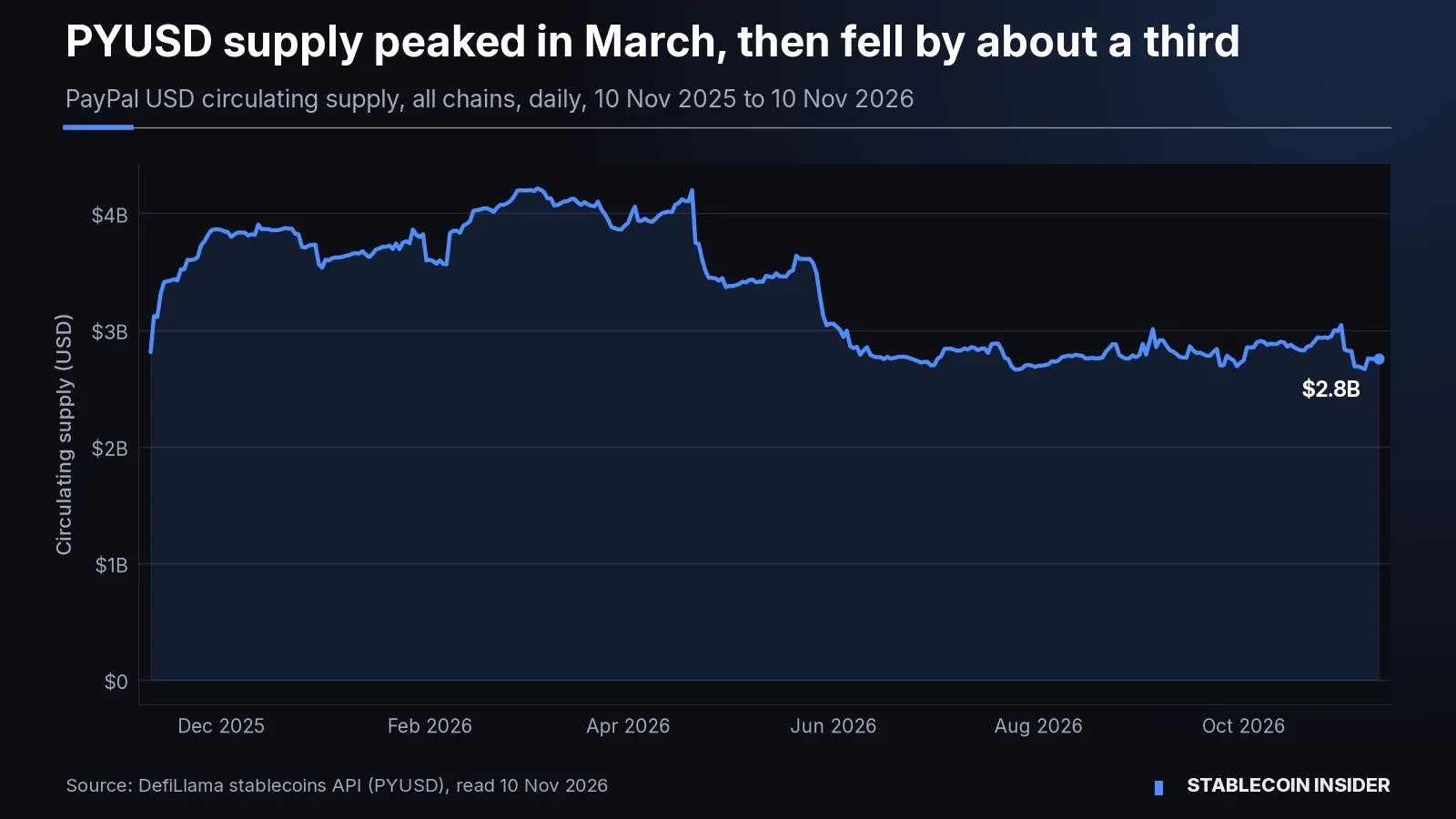
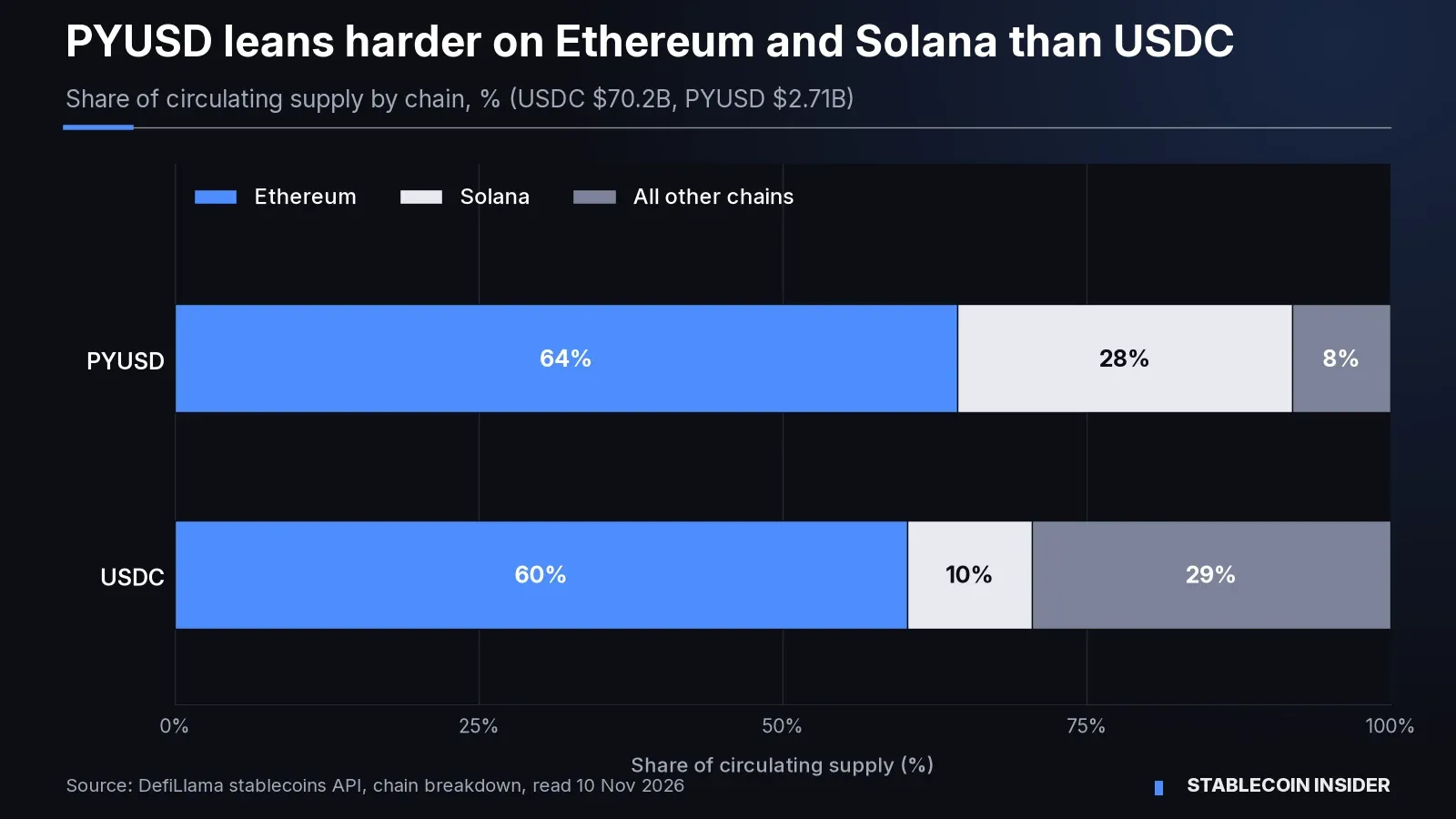
PYUSD's supply peaked at $4.21 billion on 5 March 2026 and stood at $2.75 billion in DefiLlama's daily series on 10 November 2026, almost exactly where it was a year earlier ($2.81 billion on 10 November 2025) (DefiLlama). Ethereum holds 64% of it and Solana 28%.
USDC: best for businesses, developers and EU users
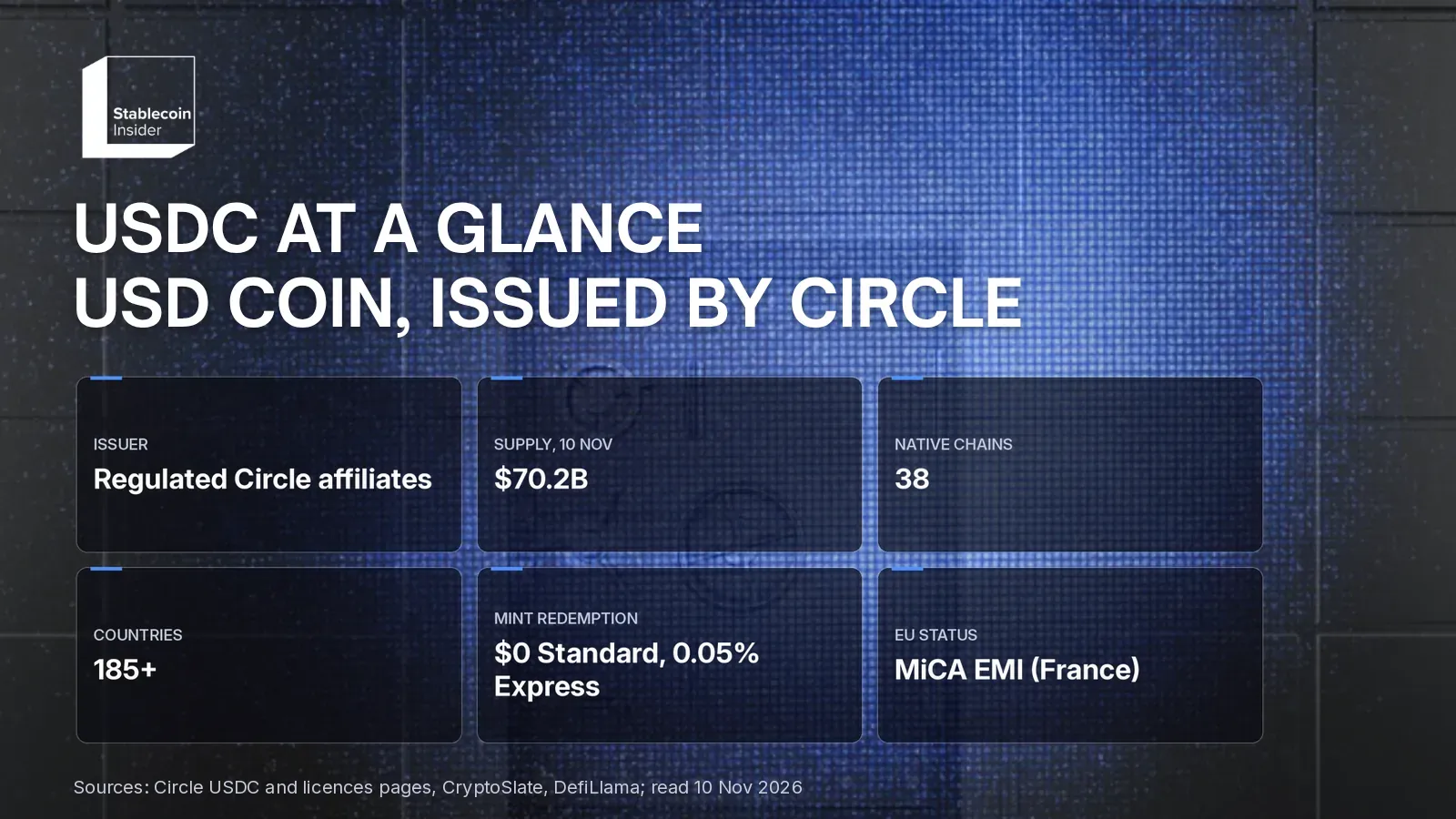
Best for: exchanges, fintechs, payment companies, treasuries and developers that need one dollar token across many chains, deep exchange liquidity and a licensed path into the EU, the UK and Singapore.
Key features
- Natively issued on 38 blockchains as of 16 September 2026, including Ethereum, Solana, Base, Arbitrum, Stellar, Sui and the XRPL (Circle).
- Circle's Cross-Chain Transfer Protocol (CCTP) moves USDC between chains by burning and minting rather than through bridge liquidity pools, with a Fast Transfer option of about 8-20 seconds (Circle docs).
- Circle publishes weekly reserve holdings and monthly attestations by a Big Four accounting firm (Circle transparency).
- Available in 185+ countries; Circle Mint is open only to institutions, while individuals buy USDC through exchanges, neobanks and wallets (Circle).
Pricing as published
USDC pricing as published depends on the route. Under Circle Mint's revised schedule for billing periods starting on or after 19 October 2026, Standard redemptions carry no Circle fee and take up to two business days, while Express redemptions cost 0.05% of the gross amount before net-minting credits (CryptoSlate). Circle Match, an hourly auction inside Mint, pairs redemptions with mints so that matched redemptions pay a fee at or below the Express rate and the minter receives it as a rebate (Circle). Retail holders pay whatever their exchange charges. Coinbase pays USDC rewards that vary by country and account type; its UK page showed 3.60% APY on 10 November 2026 (Coinbase UK; Coinbase help).
| USDC pros | USDC cons |
|---|---|
| $70.2B supply, second only to USDT among dollar stablecoins | No issuer-paid reward; returns depend on exchanges or DeFi |
| 38 native chains plus CCTP burn-and-mint transfers | Express redemptions cost 0.05% before credits |
| Licensed in the EU (French EMI), UK, Singapore, Bermuda and ADGM | Circle Mint is closed to individuals and small businesses |
| Weekly reserve disclosure and monthly Big Four attestations | Supply fell from $75.3B to $70.4B over the past year |
USDC's supply was $70.39 billion in DefiLlama's daily series on 10 November 2026, against $75.28 billion a year earlier and a 12-month peak of $79.63 billion on 18 March 2026 (DefiLlama). Ethereum holds 60% and Solana 10%, with the remaining 29% spread across chains such as Hyperliquid L1, Base and Arbitrum.
Which pays more: PYUSD or USDC?
PYUSD pays more than USDC for a PayPal user, because PayPal's advertised 4% reward is higher than the 3.60% Coinbase showed on its UK USDC page on 10 November 2026 (PayPal; Coinbase UK). Neither token pays the holder anything by itself. Both rewards are set by a distributor, are variable and can change at any time.
That arrangement is now a regulatory question. The GENIUS Act, enacted on 18 July 2025, takes effect on 18 January 2027, the same day as the OCC's final rule (OCC Bulletin 2026-50). The Act bars a permitted issuer from paying holders interest or yield solely for holding its coin, and the OCC dropped a proposed presumption that rewards paid through affiliates or related third parties break that ban, choosing case-by-case review instead (Cullen and Dykman). Our OCC final rule breakdown covers the detail.
Which is cheaper to mint and redeem: PYUSD or USDC?
PYUSD is cheaper to mint and redeem than USDC at the issuer level, because Paxos publishes zero fees while Circle charges 0.05% for Express redemptions. For slower redemptions the gap closes: Circle's Standard option is free but takes up to two business days plus bank settlement (Paxos; CryptoSlate).
| Route | PYUSD | USDC |
|---|---|---|
| Institutional mint | Free via Paxos (Paxos) | Via Circle Mint; matched mints can earn a rebate (Circle) |
| Institutional redemption | Free via Paxos (Paxos) | Standard free; Express 0.05% (CryptoSlate) |
| Consumer buy and sell | No PayPal fee for USD (PayPal) | Set by each exchange or app |
| Moving across chains | PYUSD0 via LayerZero Stargate (LayerZero) | CCTP burn-and-mint; fee deducted from amount (Circle docs) |
For step-by-step issuer access, see how to mint and redeem PYUSD with Paxos and how to mint and redeem USDC with Circle Mint.
Is PYUSD or USDC better regulated?
PYUSD and USDC are both regulated by the OCC at the trust-bank level, but USDC carries the wider licence set. Paxos converted its New York trust charter into a national trust charter on 12 December 2025, the day the OCC conditionally approved it alongside Circle's First National Digital Currency Bank (Paxos; OCC release).
Circle received final OCC approval on 9 July 2026, and Circle National Trust opened on 24 July 2026 offering custody to Circle and its affiliates; managing the USDC reserve is described as a planned future capability (Circle). Circle's licence page also lists Circle New York Trust, a French e-money licence (No. 17788) from the ACPR, a MiCA crypto-asset service provider authorization from the AMF dated 24 April 2026, an FCA e-money licence, a Singapore Major Payment Institution licence, a Bermuda digital asset licence and an ADGM permission (Circle licences).
Which should a business use, PYUSD or USDC?
The stablecoin a business should use is USDC if it pays or collects across chains, exchanges or countries, and PYUSD if its revenue already lands in a PayPal business account. PYUSD Settlement lets a US merchant convert part of its PayPal balance automatically and earn the 4% reward without changing checkout (PayPal). USDC reaches more than 500 million end-user wallet products, Circle says, which makes it the safer default for B2B payouts (Circle).
Our guide to enabling PYUSD Settlement walks through the merchant setup.
How we chose
How we chose comes down to five tests, applied to both coins with the same sources on 10 November 2026: supply and its 12-month trend (DefiLlama), native chain count (issuer pages), published fees for minting, redeeming and transferring (Paxos, PayPal, Circle and CryptoSlate's report of Circle's fee schedule), holder rewards as advertised by the distributor, and licensing (OCC decisions and Circle's licence register). We did not score or rank on estimates, and we left out any figure we could not open on a primary or reputable page.
Stablecoin Insider's verdict on PYUSD vs USDC
USDC is the better stablecoin for most businesses, and PYUSD is the better stablecoin for money that stays inside PayPal. The gap in size, 26 to 1, is the gap in use cases.
- Pick USDC if you settle across chains, list on exchanges or serve EU customers, because it is native on 38 chains and licensed in France (Circle; Circle licences).
- Pick PYUSD if you hold dollars in PayPal or Venmo, because PayPal pays 4% and charges nothing to buy, sell or send between users (PayPal).
- Pick PYUSD for primary issuance at size if fees matter most, because Paxos charges nothing to mint or redeem (Paxos).
Comparing the two largest dollar coins instead? See how USDT vs USDC differ on reserves and reach.
Related hub: see our Stablecoin Payments and Cards Hub for every guide on paying and getting paid in stablecoins.
FAQ
Is PYUSD the same as USDC?
Does PYUSD pay interest?
Can I swap PYUSD for USDC?
Which blockchains support PYUSD and USDC?
Is PYUSD safer than USDC?
Is USDC available in the EU?
Sources: Paxos PYUSD page, Paxos mint and redeem, Paxos PYUSD attestations, Paxos OCC conversion, PayPal PYUSD page, PayPal PYUSD rewards help, PayPal PYUSD Settlement, PayPal launch release, LayerZero PYUSD0, Circle USDC page, Circle transparency, Circle licences, Circle OCC approval, Circle Match, Circle CCTP docs, CryptoSlate on Circle Mint fees, Coinbase UK USDC page, Coinbase USDC rewards help, OCC charter release, OCC Bulletin 2026-50, Cullen and Dykman, DefiLlama PYUSD and DefiLlama USDC, all read on 10 November 2026.
This content is provided for informational and educational purposes only and doesn't constitute financial, investment, legal or tax advice. Rewards, fees, chain support and licences change; every figure here was read on 10 November 2026 from the linked Paxos, PayPal, Circle, Coinbase, OCC and DefiLlama pages. It isn't advice to buy, sell or hold PYUSD, USDC or any other digital asset, or a recommendation to use PayPal, Venmo, Paxos, Circle, Coinbase or any other provider named here.