
Table of Contents
Coinbase now runs a federally chartered trust bank. On 9 November 2026 Coinbase Global (NASDAQ: COIN) said the Office of the Comptroller of the Currency (OCC) had given final approval to charter Coinbase National Trust Company (CNTC), a New York-based national trust bank that will hold crypto as a fiduciary, mainly for institutional clients (Coinbase announcement).
The OCC's licensing database lists the charter as consummated and effective on 6 November 2026, seven months after the regulator's preliminary conditional approval on 2 April 2026 (OCC Corporate Applications Search record). The charter covers custody and related trust activities. It does not cover deposits, loans or, for now, stablecoin issuance.
This post covers what the OCC approved, what the trust bank can and cannot do, the conditions attached, how Coinbase's timeline compares with Circle and Ripple, the community-bank lawsuit hanging over these charters, and what it means for stablecoin custody.
Key Takeaways
- The OCC approved Coinbase National Trust Company on Friday 6 November 2026, and Coinbase announced it on Monday 9 November (Coinbase).
- CNTC is an uninsured national trust bank for fiduciary digital-asset custody; it cannot take deposits or make loans (OCC Corporate Decision #1370).
- The OCC's April decision says the bank "does not propose to issue stablecoins", and any significant change to the business plan needs 60 days' notice and OCC non-objection.
- Conditions include at least $60 million of tier 1 capital and 180 days of operating expenses in eligible liquid assets for the first three years.
- Coinbase will move its whole custody business from its New York-chartered trust company into CNTC over a three-year period.
- Coinbase is the third crypto-native firm in 2026 to win final approval for a new national trust bank, after Circle and Ripple, while the Independent Community Bankers of America is suing the OCC over the charter framework (ICBA).
What did the OCC approve for Coinbase on 6 November 2026?
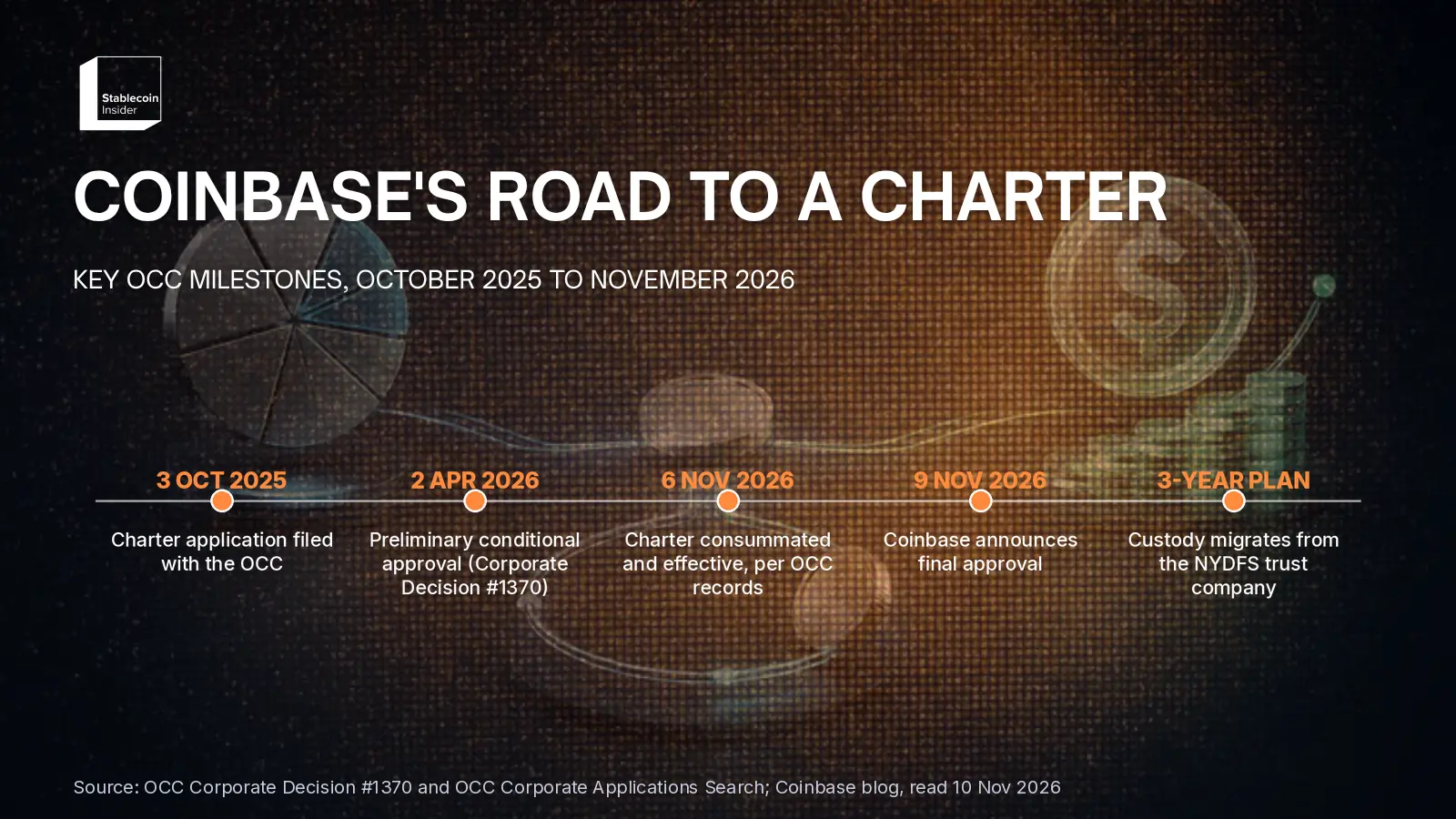
The OCC approved for Coinbase a full national trust bank charter for Coinbase National Trust Company, ending the conditional phase that began in April. The OCC's corporate applications record shows Coinbase filed on 3 October 2025, won preliminary conditional approval on 2 April 2026 and had the charter consummated on 6 November 2026 (OCC CAS). Coinbase's October 2025 charter application is public on the OCC site.
"Last Friday, the OCC approved our application to charter Coinbase National Trust Company," Coinbase wrote, adding that the charter brings "clear and consistent federal uniformity" to a custody business it has run for more than 14 years (Coinbase). Vice Chairman Ryan VanGrack told CoinDesk the approval is "another major step in integrating digital assets into the core infrastructure of the American financial system."
What can Coinbase National Trust Company do?
Coinbase National Trust Company can provide digital-asset custody as a fiduciary, plus transactional services that let custody clients accept, hold and transfer the fiat and crypto in their custody accounts. The OCC's April letter describes a wholly owned Coinbase subsidiary with its main office in New York that will serve "primarily" institutional clients (OCC Corporate Decision #1370).
Three limits stand out in the decision letter:
- No deposits or loans. The bank must limit itself to trust company operations and must not meet the Bank Holding Company Act definition of a bank. Client cash sits in "for benefit of" accounts at third-party banks.
- Affiliates stay separate. Staking, Prime Trading and Prime Financing remain with other Coinbase entities. The trust bank can only refer custody clients to them under its authority to act as a finder.
- No stablecoin issuance in the plan. The OCC dismissed a commenter's stablecoin arguments because "the Bank does not propose to issue stablecoins."
The charter also does not plug Coinbase into Federal Reserve payment rails on its own; that needs a separate Fed account application, as Bitcoin Magazine noted. The OCC letter does expect the bank to apply for stock in a Federal Reserve Bank.
What conditions did the OCC attach?
The conditions the OCC attached are capital, liquidity and business-plan locks that run for the bank's first three years. The table below summarises the main terms of Corporate Decision #1370; each row links to the source document.
| Term | What the OCC requires | Source |
|---|---|---|
| Capital | At least $60 million of tier 1 capital; the greater of 50% of tier 1 or $30 million held in eligible liquid assets | Decision #1370, condition 4 |
| Liquidity | 180 days of operating expenses in eligible liquid assets, not double counted with the capital buffer | Condition 5 |
| Business plan | 60 days' prior notice and OCC non-objection before any significant deviation | Condition 3 |
| GENIUS Act | Conform activities to the GENIUS Act and its implementing rules as they take effect | Condition 2 |
| Custody migration | Move all custody from Coinbase Custody Trust Company (NYDFS) over the three-year de novo period | Decision #1370, proposed bank |
| Deadline | Approval would have expired if the bank had not opened within 18 months of 2 April 2026 | Decision #1370 |
Two patterns stand out. The OCC is treating these crypto trust banks as narrow, highly liquid custody vehicles rather than balance-sheet lenders, and it has written the GENIUS Act into the charter itself, so any future stablecoin activity would come under the OCC's stablecoin rule rather than a fresh charter fight.
How does Coinbase's approval compare with Circle and Ripple?
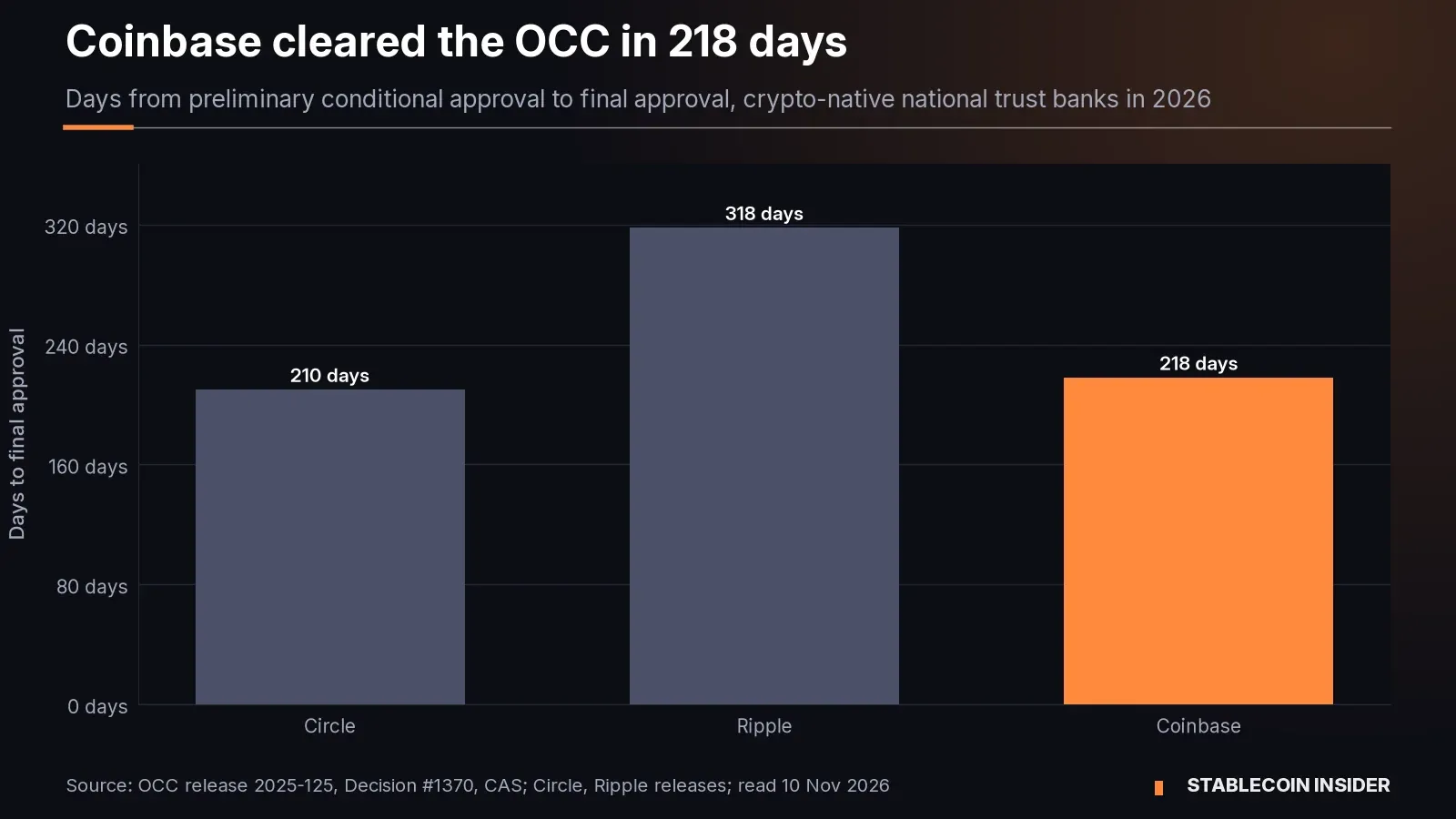
Coinbase's approval compares well with Circle and Ripple: it came faster than Ripple's and about as fast as Circle's. The OCC conditionally approved Circle's First National Digital Currency Bank and Ripple National Trust Bank on 12 December 2025, alongside conversions for BitGo, Fidelity Digital Assets and Paxos (OCC news release 2025-125). Circle won final approval on 10 July 2026 (Circle) and Ripple on 26 October 2026 (Ripple).
| Trust bank | Conditional approval | Final approval | Days between |
|---|---|---|---|
| Circle (First National Digital Currency Bank) | 12 Dec 2025 | 10 Jul 2026 | 210 |
| Ripple National Trust Bank | 12 Dec 2025 | 26 Oct 2026 | 318 |
| Coinbase National Trust Company | 2 Apr 2026 | 6 Nov 2026 | 218 |
Why does a trust charter matter for stablecoins?
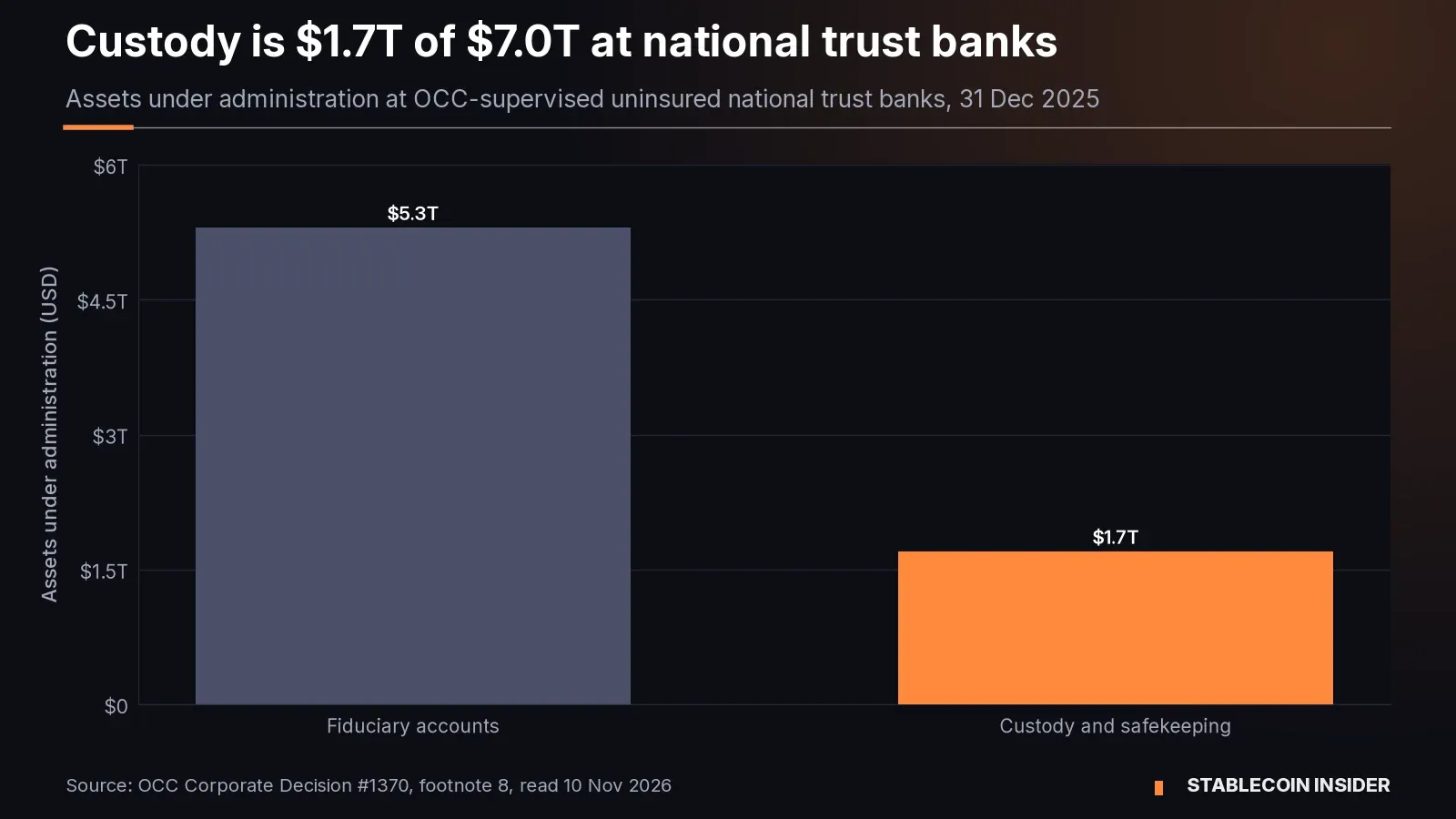
A trust charter matters for stablecoins because custody is where issuer reserves, tokenized collateral and institutional stablecoin balances end up. OCC-supervised uninsured national trust banks reported $7.0 trillion of assets under administration at the end of 2025, of which $1.7 trillion was custody and safekeeping, according to a footnote in the Coinbase decision letter.
Coinbase calls itself "the leading crypto custodian globally" and already pairs custody with stablecoin payments; on the same day it announced a pilot letting PNC corporate clients receive USDC. A federal charter gives that business one supervisor nationwide instead of a New York trust license, which matters to banks and asset managers whose own regulators prefer federally supervised custodians. Bankless points out that Coinbase describes payments and stablecoins only as potential future services, and the OCC letter would require notice before any such shift.
Who is challenging these charters?
The Independent Community Bankers of America is challenging these charters in court. On 2 October 2026 it sued the OCC in the US District Court for the District of Columbia, arguing that the OCC's 2 March 2026 chartering rule and Interpretive Letter 1176 exceed its authority, and asking the court to vacate Protego's conditional trust charter (ICBA statement). "Congress did not create the national trust charter as a side door into the banking system for crypto firms," ICBA President and CEO Rebeca Romero Rainey said.
The suit does not name Coinbase's charter, but it targets the legal basis for the whole category. According to Bitcoin Magazine, ICBA also urged the OCC in December to reject Coinbase's application, and Bankless reports the group asked in May for the approval to be paused over New York Attorney General Letitia James' suit against a Coinbase subsidiary.
Stablecoin Insider's take
Three national trust charters for crypto natives in four months is a structural shift. Custody, reserve management and settlement for dollar stablecoins are moving inside federally supervised entities ahead of the GENIUS Act's 18 January 2027 effective date. The open questions are legal (the ICBA case) and commercial: how quickly Coinbase moves existing clients across, and whether it asks the OCC to widen CNTC's plan toward stablecoin services.
Comparing charters? See how Ripple National Trust Bank differs from Coinbase's custody-only plan. Related hub: see our Stablecoin Regulation Hub for every guide on the GENIUS Act, OCC charters and global rules.
FAQ
Did Coinbase get a bank charter?
When did the OCC approve Coinbase National Trust Company?
Can Coinbase issue a stablecoin through its trust bank?
Are assets at Coinbase National Trust FDIC insured?
What happens to Coinbase Custody Trust Company?
Which other crypto firms have national trust charters?
What happens next?
What happens next is the migration and the courtroom. Watch for the first Coinbase custody clients to move into CNTC, any 60-day notice to the OCC that would widen the bank's plan, a Federal Reserve account application, and the OCC's response in the ICBA case in Washington. The GENIUS Act and the OCC's stablecoin rule take effect on 18 January 2027 (our explainer).
Sources: Coinbase announcement; OCC Corporate Applications Search record; OCC Corporate Decision #1370; Coinbase charter application; OCC news release 2025-125; Circle press release; Ripple press release; ICBA statement; CoinDesk; Bitcoin Magazine; Bankless. All read on 10 November 2026.
This content is provided for informational and educational purposes only and doesn't constitute financial, investment, legal or tax advice. Figures and dates were read from the OCC, Coinbase, Circle, Ripple and ICBA sources linked above on 10 November 2026 and may change. Nothing here is a recommendation to buy or sell COIN shares, USDC, RLUSD or any other digital asset. Do your own research and speak to a licensed adviser before making decisions.