Table of Contents
A Brazilian central bank official has said that one kind of stablecoin “sandwich” is allowed and another is not, according to a report first published on 13 November 2026 and picked up by crypto.news on 16 November. Gerson Romantini, head of the Banco Central do Brasil (BCB) foreign exchange division, spoke at an industry event closed to the press, according to Livecoins. The remarks are reported, not a published rule.
What is binding is older: BCB Resolution 561, issued on 30 April 2026 and in force since 1 October 2026, bars the use of virtual assets when an international payment (eFX) provider settles with its foreign counterparty. This post separates what is in that text from what Romantini is reported to have said, and flags what is still unconfirmed.
Key Takeaways
- Written rule: for eFX providers, settlement with the overseas counterparty must go through a foreign-exchange operation or a non-resident real account, and “the use of virtual assets is prohibited” (Resolution 561, Article 50).
- Reported remark: Romantini said an institution may use virtual assets as technical infrastructure for an FX operation, but may not sell a client a stablecoin that the client sends abroad and sells for fiat to settle.
- Not a new norm: the sources describe his comments as spoken at a closed event; TokenPost and Anti/Hype note they are not a formal finding, policy announcement or published norm.
- Unconfirmed: an anonymous source told Livecoins a 19 November meeting could bar fintechs from this market; the BCB did not respond and no matching event was on its public agenda.
- Enforcement: Romantini reportedly said the BCB is not currently inspecting this activity, which he tied to a lack of resources.
What did the BCB official say about stablecoin sandwiches?
The BCB official said there are two types of stablecoin sandwich operation and that “one can and the other cannot,” according to Livecoins (13 November 2026; quotes translated from Portuguese by Stablecoin Insider). Romantini said the BCB reviewed both models with its regulation departments before reaching that view.
The permitted model, as he described it, is an institution using virtual assets in place of a messaging rail such as SWIFT: “the operation is still a foreign-exchange operation.” The prohibited model is an institution that sells the virtual asset to the client, who takes ownership and then sells it to settle the obligation in fiat abroad. “The client, at bottom, wants to swap reais for dollars,” he said (Livecoins; Anti/Hype and TokenPost summarise the same distinction).
He also described stablecoins as the successor of the “dólar-cabo” market, the informal cross-border money transfer channel, and said clean money that passes through the arrangement “has been marked as bad money,” which “also characterises money laundering” (Livecoins). TokenPost stresses that this is a reported comment, not a formal finding by the central bank.
On enforcement, Livecoins quotes him as saying the BCB has heard that some institutions offer the prohibited structure but has not seen it because it is not running inspections on it, which he explained by lack of resources. He added that a client who buys an FX service and later uses the money for something else is not a problem for the firm.
What does Resolution 561 actually prohibit?
Resolution 561 prohibits eFX providers from using virtual assets to pay or receive funds from their counterparty abroad. The BCB's own Voto 57/2026 defines eFX as a service that lets a provider carry out purchases of goods or services, transfers or withdrawals for clients by pooling many transactions and executing a foreign-exchange operation with an authorised institution.
The amended Article 50, as reproduced from the Official Gazette by LegisWeb (published 5 May 2026), reads in translation: payment or receipt between the eFX provider and its foreign counterparty must be made exclusively “through a foreign-exchange operation or movement in a non-resident’s real account held in Brazil, the use of virtual assets being prohibited.” The same Voto sets the entry-into-force date at 1 October 2026 and says the proposal aims to preserve the integrity of the FX market and align Brazil with FATF standards.
The wording says “virtual assets,” not “stablecoins” by name, and it governs the provider-to-counterparty leg. That is why the written rule and the reported remarks are not the same thing.
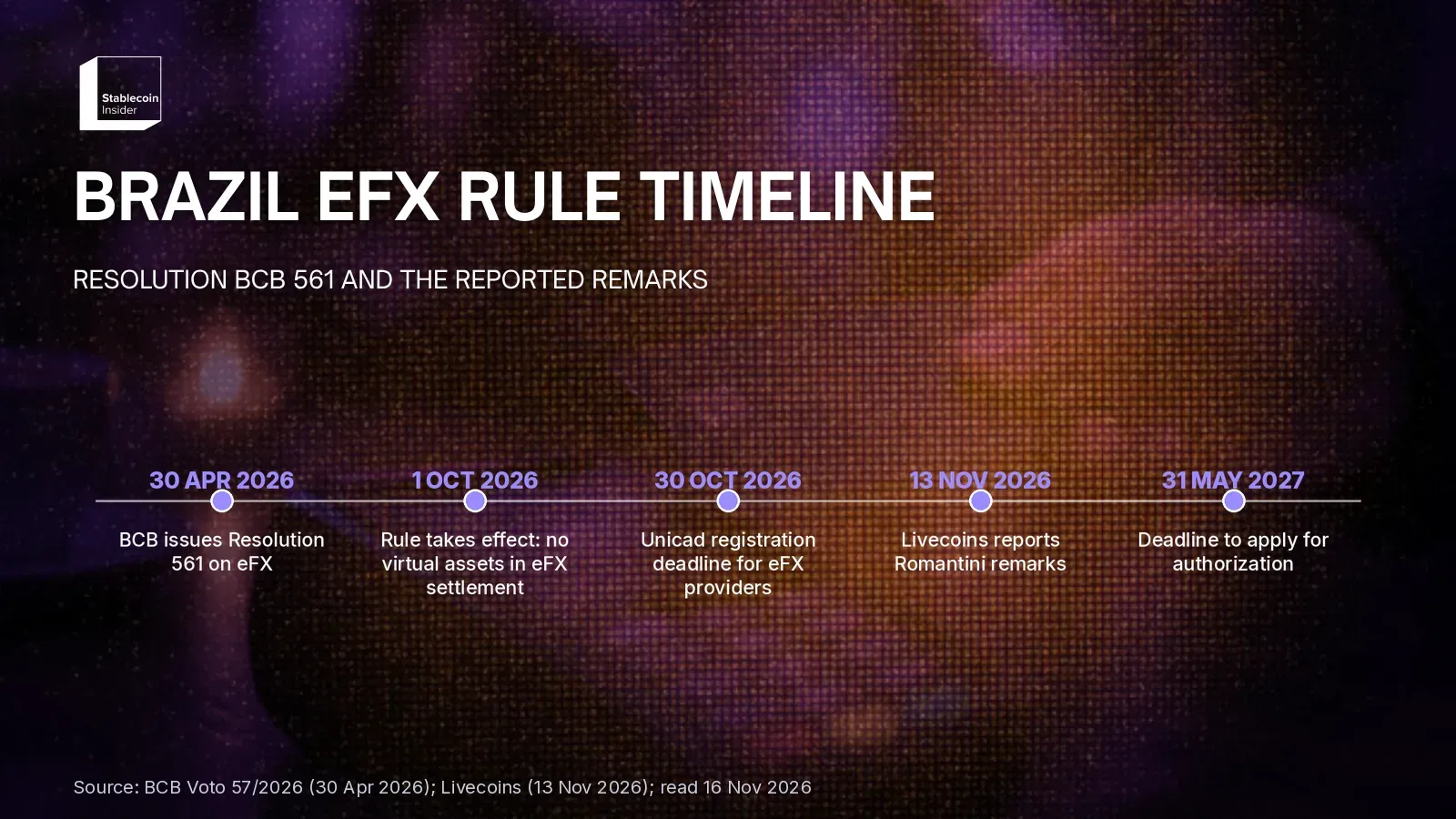
From issue (30 April) to entry into force (1 October) the rule gave institutions 154 days, a Stablecoin Insider calculation; the Voto says the delay was meant to allow systems adjustments and testing.
Which arrangements are covered, and which are only reported?
Only one of the four rows below rests on binding text we could read. The table separates the written rule from reported statements, with the source for each row.
| Arrangement | Position | Basis | Status |
|---|---|---|---|
| eFX provider settles with foreign counterparty using virtual assets | Prohibited | Resolution 561, Art. 50 (Voto 57/2026; LegisWeb) | Written rule, in force 1 Oct 2026 |
| Institution uses virtual assets as technical rail for an FX operation | “Can” | Romantini, as reported by Livecoins | Reported remark; rule basis not stated |
| Institution sells stablecoin to client who sends it abroad and sells it for fiat | “Cannot”; may be laundering | Romantini, as reported by Livecoins | Reported remark; not inspected yet |
| Individual buys or holds stablecoins at an authorised exchange | Not covered by Resolution 561 | crypto.news; TokenPost | Press reading of the rule |
Two things stand out. First, the permitted model sits awkwardly beside Article 50 if both are read as eFX settlement; none of the reports we read says which provision allows it, so it is probably outside eFX, but that is our inference. Second, the prohibited sandwich is described by the official, not written in a published instruction we could find.
What is unconfirmed about the 19 November meeting?
The 19 November meeting is unconfirmed. Livecoins cites an unnamed source who said it could bar fintechs from this market and leave it to banks. Livecoins asked the BCB for comment, got no reply after three days, and found no 19 November event on the authorities' agenda. The article's own subtitle says 16 November while the body says 19 November, a discrepancy Anti/Hype also noticed. Treat the date and the outcome as rumour until the BCB publishes something.
What does this mean for businesses and users?
This means eFX providers should read Article 50 strictly, because it is already in force. Providers not yet authorised have until 31 May 2027 to apply for authorization to keep offering eFX, per the Voto and TokenPost. Users of authorised exchanges are not the target of the reported remarks, but this post is not legal advice and the position for any specific product needs a Brazilian lawyer.
For earlier context on the BCB's direction, see our report on the proposed 24-hour hold on large dollar stablecoin transfers (June 2026) and our Latin America stablecoin regulation comparison.
For the full picture, see our Stablecoin regulation hub.
FAQ
Is it illegal to buy or hold USDT or USDC in Brazil?
Did the BCB publish a new rule or statement on 16 November 2026?
What is eFX?
What happens next?
Three things to watch: whether the BCB publishes written guidance or a new resolution on customer-owned stablecoin structures; whether the reported 19 November meeting is confirmed; and whether the BCB starts inspections of the activity Romantini described. The 31 May 2027 authorization deadline is the next fixed date in the written rule.
Sources: Livecoins (13 Nov 2026); crypto.news (16 Nov 2026); TokenPost (15 Nov 2026); Anti/Hype (14 Nov 2026); BCB, Voto 57/2026 (30 Apr 2026); LegisWeb, Resolution BCB 561 (DOU 5 May 2026). All read on 16 November 2026. The 154-day interval and the English translations of Portuguese quotes are Stablecoin Insider's own. We could not open the BCB’s normative portal page for the final resolution, so Article 50 is quoted from the Voto draft and the Official Gazette text via LegisWeb, which match.
This content is provided for informational and educational purposes only and doesn't constitute financial, investment, legal or tax advice. Statements attributed to the BCB official are as reported by the outlets above and were read on 16 November 2026; they may be corrected or superseded. It isn't a recommendation to use or avoid any product or service mentioned.