Table of Contents
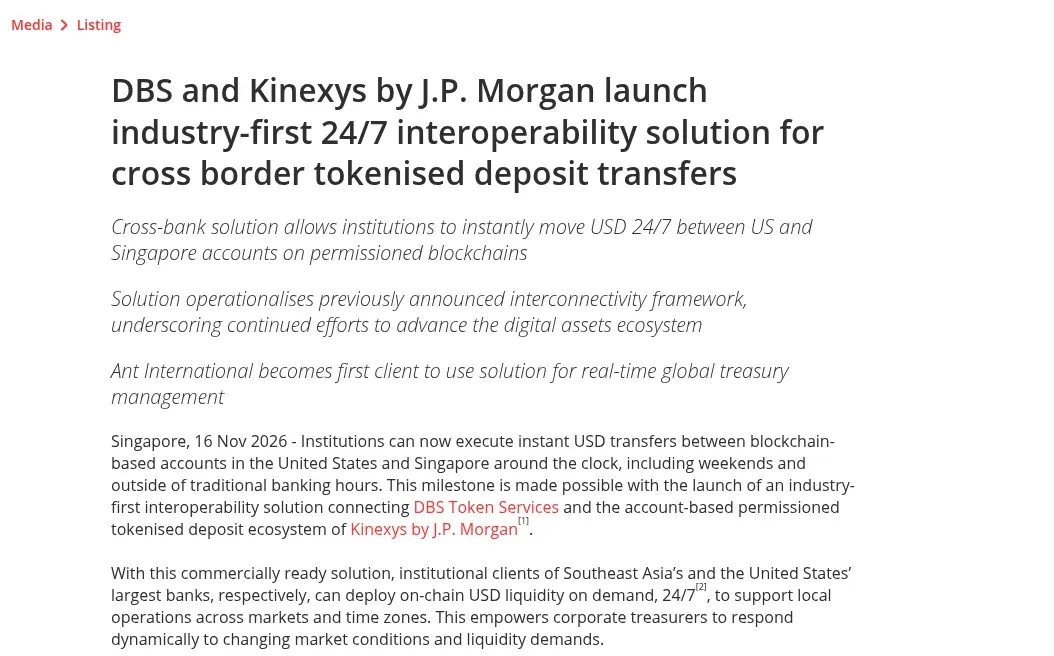
DBS and Kinexys by J.P. Morgan launched a live service on Monday, 16 November 2026, that lets institutional clients move US dollars instantly between blockchain-based accounts in the United States and Singapore at any hour, including weekends. Ant International is the first client, using it for treasury and liquidity management across its entities in both markets, according to DBS's announcement.
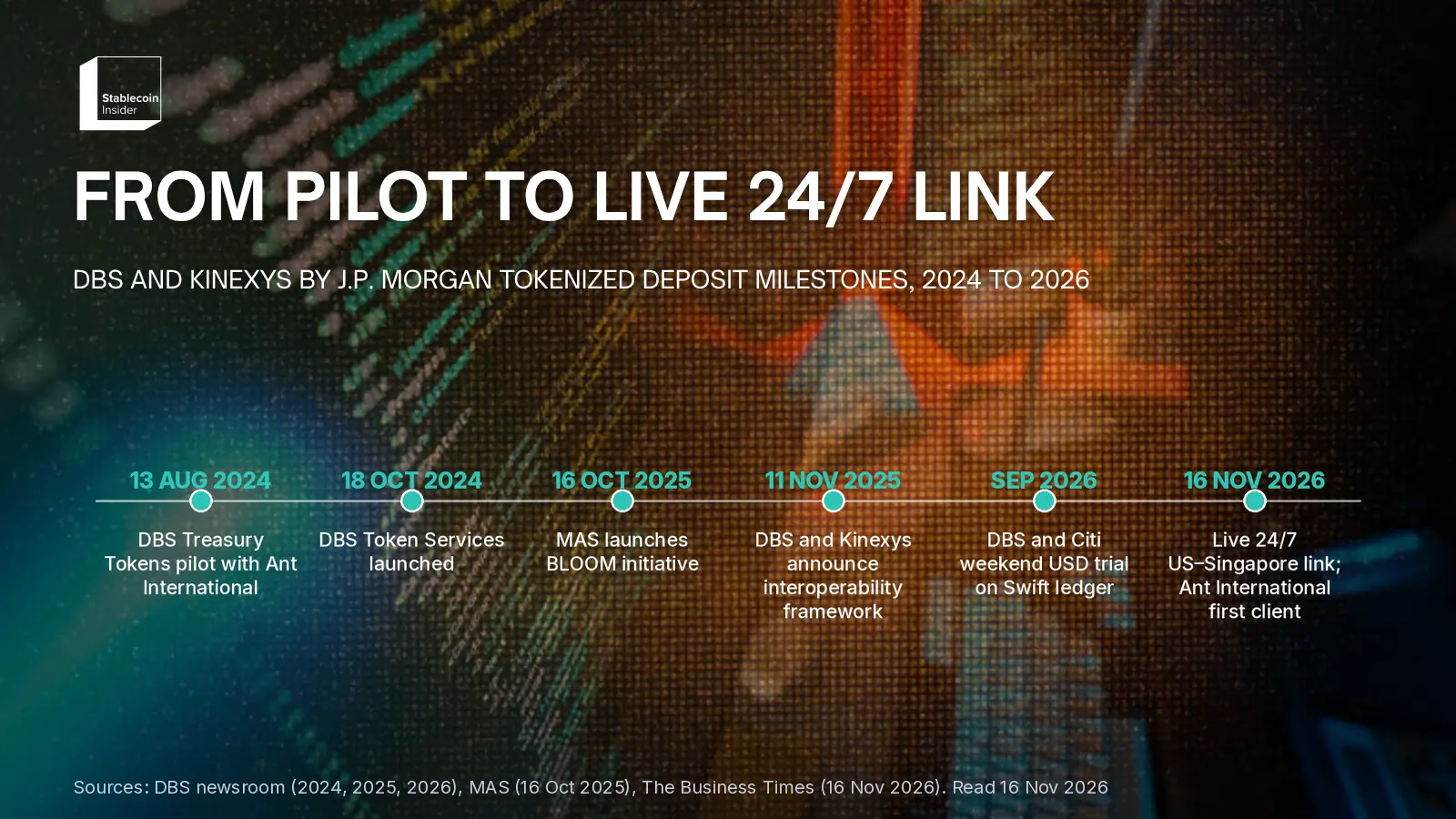
The service connects DBS Token Services with Kinexys's account-based, permissioned tokenised deposit network, with Partior handling settlement orchestration. It puts into operation the interoperability framework the two banks announced on 11 November 2025, though in a narrower form than that announcement described.
Key Takeaways
- The link is live for USD only, between the US and Singapore, and only between the two banks' permissioned networks.
- Ant International is the first named client. DBS has not disclosed fees, transfer limits or volumes.
- Kinexys transfers settle 24/7/365, but moving money between ordinary J.P. Morgan deposit accounts and blockchain accounts pauses for three hours every Saturday (3–6 p.m. ET).
- The 2025 framework also covered public blockchains, using J.P. Morgan Deposit Tokens (JPMD) on Base as an example. Monday's announcement does not mention public chains.
- The launch advances MAS's Project BLOOM, where DBS and Kinexys co-lead the token interoperability workgroup.
What did DBS and J.P. Morgan launch on 16 November 2026?
DBS and J.P. Morgan launched what DBS calls an "industry-first" interoperability solution for cross-border tokenised deposit transfers. Institutions can now send instant USD transfers between blockchain-based accounts at DBS in Singapore and at J.P. Morgan in the US around the clock, outside normal banking hours (DBS).
Before this, each bank already offered 24/7 settlement, but only inside its own system. The 2025 framework release said both banks "currently offer clients 24/7 liquidity and real-time settlement of payments within their individual ecosystems." The new piece is the bridge between the two.
Kinexys is J.P. Morgan's blockchain business. Its website reports more than $3 trillion in transaction volume since inception and more than $7 billion in average daily volume, citing JPMorgan Chase data for 2025. Those figures cover all of Kinexys, not this new link.
What does the service cover, and what is not disclosed?
The service covers US dollar transfers between the two banks' permissioned networks; pricing, limits and volumes are not disclosed. The table sets out what the announcements state and where the gaps are. Rows link to the source for each point.
| Item | What the sources say | Source |
|---|---|---|
| Currency and corridor | USD, between accounts in the US and Singapore | DBS |
| Networks connected | DBS Token Services and the Kinexys Blockchain Deposit Account network, both permissioned and account-based | DBS |
| Settlement layer | Partior orchestrates settlement; DBS and Kinexys are founding shareholders | DBS |
| Hours | 24/7, including weekends; Kinexys transfers complete on a 24/7/365, same-day basis | DBS, Kinexys |
| Known gap | Funding moves between ordinary deposit accounts and blockchain accounts pause Sat 3–6 p.m. ET; Kinexys says a fix is in development | Kinexys |
| Clients | Institutional clients; Ant International first | DBS |
| Public chains (e.g. JPMD on Base) | In the 2025 framework scope; not mentioned in the launch | DBS 2025 |
| Fees, limits, volumes | Not disclosed | — |
Two points stand out. First, "24/7" applies to transfers inside the blockchain accounts. The weekend pause affects topping up or draining those accounts from J.P. Morgan's legacy deposit system. Second, the live product is narrower than the 2025 plan, which spoke of "both public and permissioned blockchain environments."
When is the weekly downtime in Singapore and Europe?
The weekly downtime falls early on Sunday morning in Singapore. Kinexys gives the window as 3–6 p.m. ET every Saturday (Kinexys). With US Eastern time on standard time (UTC−5) in November, our conversion gives:
| Location | Local time | Day |
|---|---|---|
| New York (ET, UTC−5) | 15:00–18:00 | Saturday |
| UTC | 20:00–23:00 | Saturday |
| Central Europe (CET, UTC+1) | 21:00–24:00 | Saturday |
| Singapore (SGT, UTC+8) | 04:00–07:00 | Sunday |
Three hours is 1.8% of a 168-hour week. The release does not say whether DBS Token Services has a comparable maintenance window on its side.
Why does Ant International need 24/7 dollar transfers?
Ant International needs 24/7 dollar transfers because it runs entities across several time zones and wants to move cash between them without waiting for banking cut-offs. Kelvin Li, General Manager of Platform Tech at Ant International, said the company requires "treasury solutions with round-the-clock agility, speed and efficiency" (DBS).
Ant has worked with both banks before. In August 2024 it became the pilot client for DBS Treasury Tokens, which DBS said could cut intra-group settlement "from potentially days to seconds." DBS says Ant was also one of the first in Asia to connect to Kinexys's Blockchain Deposit Account network.
How does this compare with stablecoin settlement?
This differs from stablecoin settlement because the money stays a bank deposit. DBS defines tokenised deposits as "digital representations of commercial bank deposits that exist on a blockchain" (DBS). A stablecoin holder instead has a claim tied to the issuer's reserves, as our tokenized deposits explainer sets out alongside the legal and balance-sheet differences.
The two models are not walled off from each other in Singapore. MAS launched BLOOM on 16 October 2025 to enable settlement in "tokenised bank liabilities and well-regulated stablecoins." Its initial workstream on distributing and clearing settlement assets lists Circle and Stripe alongside DBS, OCBC, Partior and UOB.
The banks are also chasing weekend corporate payments by other routes. In September, DBS and Citi reported a weekend USD payment trial between Singapore and the US on the Swift Digital Ledger (The Business Times), which we covered in our report on that trial.
What does the launch mean for corporate treasurers?
For corporate treasurers, the launch means that clients of both banks can move USD between the US and Singapore outside banking hours without switching to a stablecoin. It is limited to those two banks' institutional clients. DBS cites a Money20/20 and FXC Intelligence projection that Asia's outbound cross-border payments will reach $24 trillion by 2033, up from $13.5 trillion in 2025 (DBS). That is a 78% increase on our arithmetic; DBS describes it as "nearly double."
DBS also cites its October 2026 report, which found that 88% of corporations are deploying or piloting tokenised money use cases. The Business Times reports that the survey covered 422 business leaders in 11 markets (The Business Times). These are survey responses about tokenised money in general, not usage of this service.
Stablecoin Insider's take
Comparing bank deposit tokens with consumer products? See how SoFi splits its tokenized deposit from its SoFiUSD stablecoin.
For the full picture, see our Stablecoin payments hub.
FAQ
Can individuals or small businesses use the DBS–Kinexys link?
Is a tokenised deposit the same as a stablecoin?
What is Partior's role?
Does the service support Singapore dollars or other currencies?
What happens next?
Next, watch three things. Kinexys says a fix for the Saturday downtime is "under development," with no date given (Kinexys). DBS and Kinexys will keep co-leading BLOOM's token interoperability workgroup, which DBS says is developing frameworks and live use cases across networks (DBS). And the 2025 framework's public-chain route, with JPMD on Base, remains unannounced as a live product (DBS). Neither bank has given dates for more clients, currencies or corridors.
Sources: DBS, launch release (16 Nov 2026); DBS, interoperability framework release (11 Nov 2025); Kinexys by J.P. Morgan, website and footnotes; MAS, BLOOM launch release (16 Oct 2025); DBS, Treasury Tokens pilot (13 Aug 2024); DBS, DBS Token Services launch (18 Oct 2024); Partior website; The Business Times (16 Nov 2026). All read on 16 November 2026. Time-zone conversions and percentage figures are Stablecoin Insider calculations.
This content is provided for informational and educational purposes only and doesn't constitute financial, investment, legal or tax advice. Product details were read from DBS, J.P. Morgan/Kinexys, MAS and Partior pages on 16 November 2026 and may change. It isn't a recommendation to use DBS, J.P. Morgan, Kinexys, Partior, Ant International, Citi, SoFi or any stablecoin or tokenised deposit product mentioned.