
Table of Contents
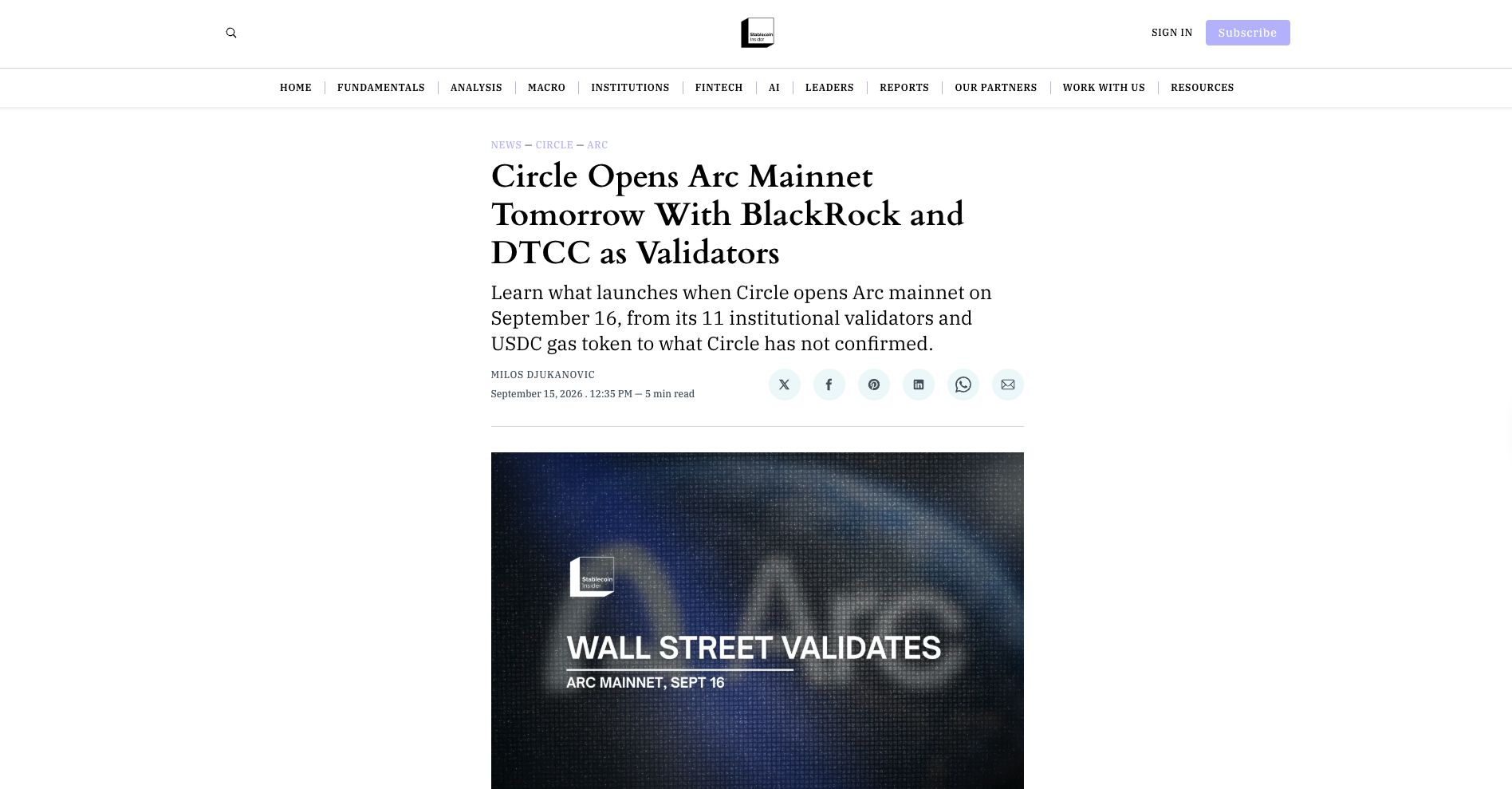
Circle opened Arc public mainnet on September 16, 2026, making the USDC-native Layer 1 available to anyone who wants to deploy or transact. The network runs on chain ID 5042 with USDC as the gas token, so every fee is denominated in dollars rather than in a volatile asset. Block times are running near 506 milliseconds with instant finality.
Eleven institutions validate alongside Circle: BlackRock, DTCC, Galaxy, Global Payments, ICE, Mastercard, MoneyGram, SBI, Standard Chartered, Sumitomo Corporation, and Visa. The validator set is permissioned, meaning Circle selects who produces blocks. Deployment and transacting are open to all.
The opening arrives one day after the Senate failed to advance the CLARITY Act, which leaves US market structure unresolved. Circle is launching its most ambitious infrastructure bet into exactly the regulatory ambiguity it spent two years lobbying to remove.
Jeremy Allaire described Arc on Circle's second-quarter earnings call as "a bigger opportunity than USDC."
Key Takeaways
- Arc public mainnet went live on September 16, 2026, on chain ID 5042.
- USDC is the gas token, with block times near 506 milliseconds.
- Eleven institutional validators secure the network alongside Circle, all permissioned.
- No ARC token has launched, and counterfeit versions are already circulating.
- Arc opened one day after CLARITY Act cloture failed in the Senate.
What Is Actually Live
The mainnet RPC and the Arcscan explorer are both serving requests. Native accounting uses 18 decimals while the ERC-20 USDC contract at 0x3600000000000000000000000000000000000000 uses six, which matters for anyone writing integrations. Trace and archive access are available, contract source verification is not yet.
Bridging in runs through Circle's CCTP from Ethereum, Base, Solana, and other supported chains, arriving as native USDC rather than a wrapped asset. There is no faucet on mainnet. Several third-party bridges have been quoting fees far above normal in the first hours, in some cases reported near 50%.
OKX Wallet and Binance Wallet both confirmed day-one support ahead of the opening. The named day-one roster also includes Aave, Morpho, Uniswap, Fireblocks, Kraken, Ledger, and MetaMask, which we listed in full in yesterday's Arc launch preview.
The Chain Did Not Begin Today
Explorer data at the opening showed block height already in the millions rather than starting from genesis. That reflects the private mainnet phase, which has been producing blocks with institutional participants for months. What changed today is access, not the start of the chain.
The distinction matters when reading early throughput figures. Activity on a network that has been running privately is not the same signal as a cold start, and comparisons to other launch-day chains will be misleading.
What early activity looks like
The first hours brought what every new EVM chain brings: token deployments, cross-chain traffic, and speculative launches unrelated to the institutional use cases Circle describes. That mix is not a failure mode. It is what permissionless deployment on a permissioned validator set actually produces.
The Revenue Case Behind the Launch
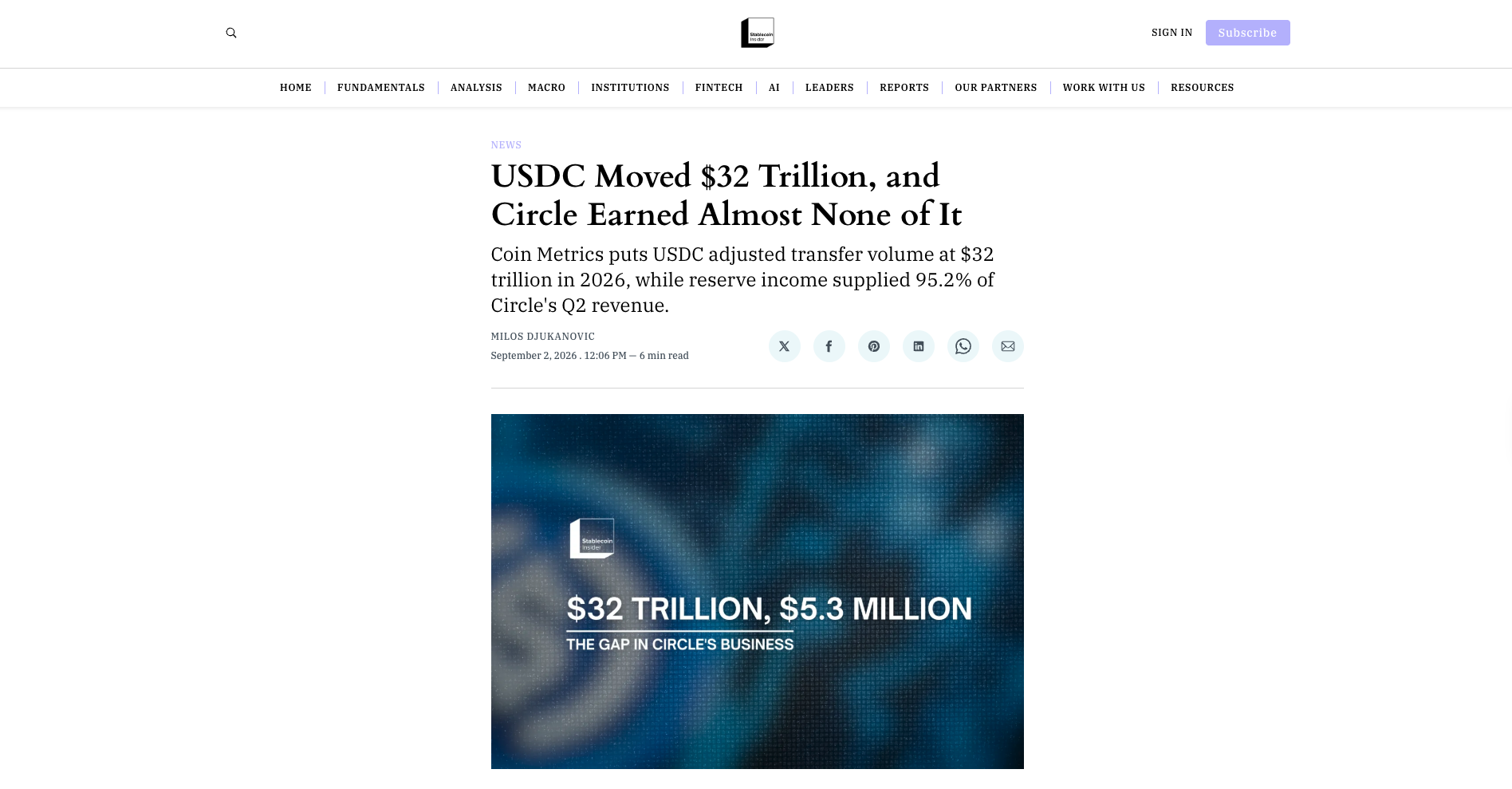
Arc exists because Circle captures almost nothing from USDC movement. Reserve income supplied 95.2% of second-quarter revenue against $5.3 million in transaction revenue, while USDC settled roughly $32 trillion in adjusted transfer volume during 2026. A gas layer Circle operates is the first plausible route to fee income that does not depend on interest rates.
That only works if settlement volume migrates from Ethereum, Base, and Solana. Institutional flows move slowly even when economics favour the move, and the largest stated integrations sit further out. The structural problem is set out in our analysis of USDC reserve income.
There Is Still No ARC Token
Mainnet going live does not change the token position. Circle has published a whitepaper describing ARC as a coordination and governance asset, and raised $222 million in a presale at a $3 billion fully diluted valuation in May, but no token has been issued or distributed. No airdrop has been announced.
Anything trading under the ARC name today, including tokens deployed on Arc itself, is counterfeit. Fake faucets and launch-reward claim pages have appeared alongside the opening, and mainnet has no faucet at all. Contract addresses should come only from official project channels.
This is the predictable cost of opening a chain with a recognisable name and no token. Anyone bridging should send a small test transfer before committing size.
The impulse driving most of those counterfeit purchases is simply wanting a small position in something early. If that is the actual goal, the regulated version of the same instinct starts at a similar size, where you invest $5 and earn $25. It is a slower product than a launch-day token, and that is the whole distinction being drawn here.
Launching Without Market Structure
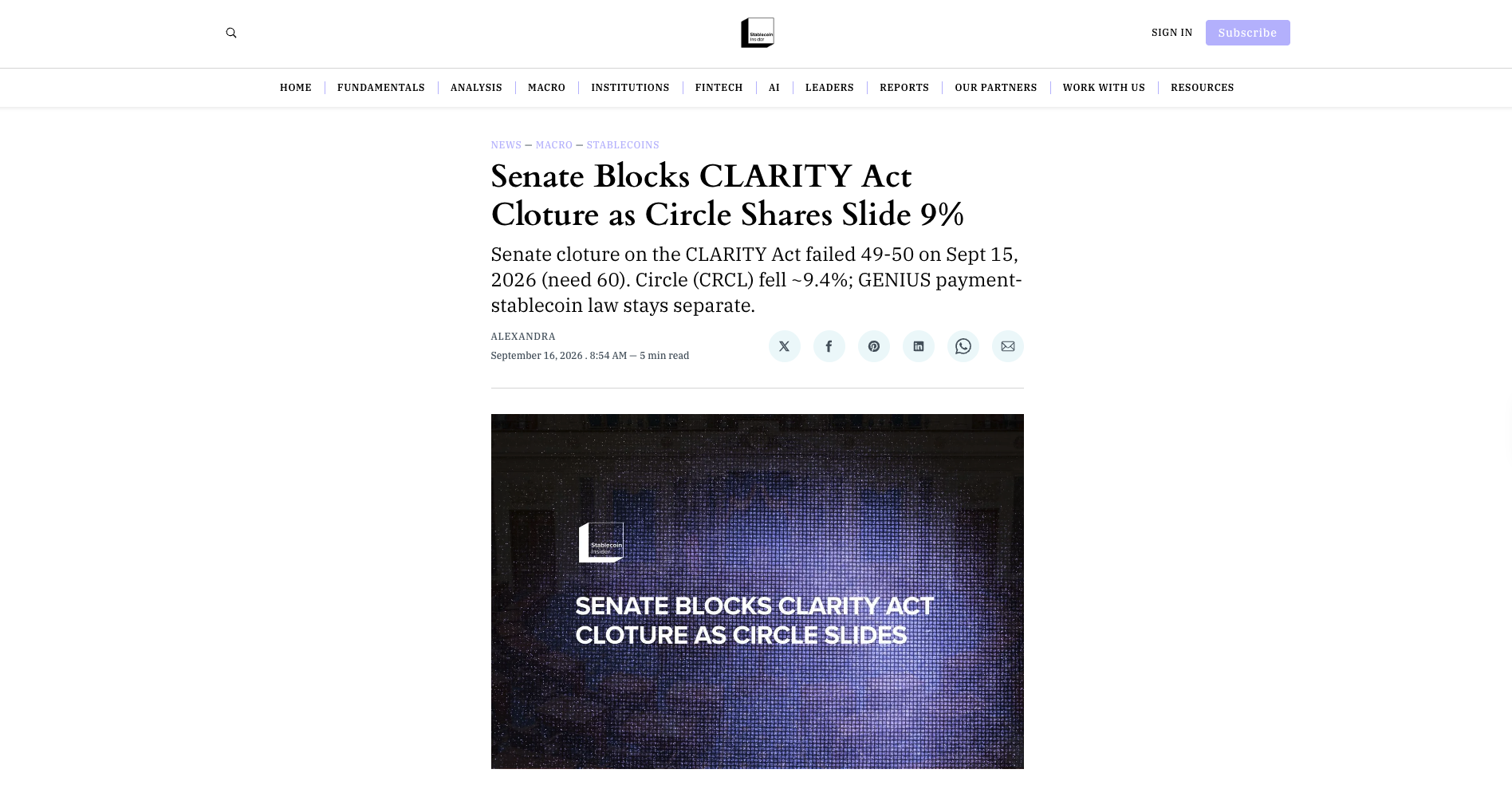
Senate cloture on the CLARITY Act failed 49 to 50 on September 15, well short of the 60 needed, and Circle shares fell roughly 9.4% on the result. The compressed calendar before the November midterms makes revival difficult this session. That leaves the GENIUS Act as the operative federal law for payment stablecoins.
For Arc specifically, the consequence is that a compliance-first chain built by a US-listed issuer now operates without the market structure statute it was designed to anticipate. Circle holds an OCC national trust charter granted in July, which gives it federal supervision that most chain operators lack. The full vote breakdown is in our report on the blocked CLARITY cloture.
What to Watch This Week
Three signals separate a working launch from a successful announcement. Whether the named day-one applications are genuinely live rather than merely listed, whether validators are operating independent infrastructure or Circle-managed nodes, and what real-value throughput looks like once bridged balances build.
BlackRock's BUIDL deployment and the DTCC tokenization work, targeted for the second half of 2027, remain the load-bearing institutional commitments. Neither is a launch-day event. The near-term measure is simply how much USDC crosses in and stays.
Most of the teams that ship onto a new chain in its first months are small, and the coordination layer around them is whatever was already running before the deploy. Free employee scheduling and time tracking for your team covers that stage, and you add payroll and HR when you need it. No card or code required, so a first cycle can run alongside a launch week rather than through it.
FAQs:
1. Is Arc mainnet live?
Yes. Circle opened Arc public mainnet on September 16, 2026. The network runs on chain ID 5042 with USDC as the native gas token, block times near 506 milliseconds, and instant finality, following a private mainnet phase with more than 100 institutional and ecosystem builders.
2. Is there an ARC token I can buy?
No. No ARC token has been issued, distributed, or listed, and no airdrop has been announced. Circle has published a whitepaper describing ARC as a coordination asset and completed a $222 million presale in May 2026, but anything trading under that name today is counterfeit.
3. How do I get USDC onto Arc?
Through Circle's CCTP from Ethereum, Base, Solana, and other supported chains, which delivers native USDC rather than a wrapped asset. There is no mainnet faucet. Some third-party bridges have been quoting unusually high fees in the first hours, so checking the rate before sending matters.
4. Who validates the Arc network?
Eleven institutions alongside Circle: BlackRock, DTCC, Galaxy, Global Payments, ICE, Mastercard, MoneyGram, SBI, Standard Chartered, Sumitomo Corporation, and Visa. The set is permissioned, so Circle selects validators, though contract deployment and transacting are open to anyone.
5. How does the failed CLARITY vote affect Arc?
Senate cloture failed 49 to 50 on September 15, leaving US crypto market structure unresolved and the GENIUS Act as the operative federal law for payment stablecoins. Arc launches into that ambiguity, though Circle's OCC national trust charter gives it federal supervision independent of the bill.
Disclaimer:
This content is provided for informational and educational purposes only and does not constitute financial, investment, legal, or tax advice; no material herein should be interpreted as a recommendation, endorsement, or solicitation to buy or sell any financial instrument, and readers should conduct their own independent research or consult a qualified professional.