
Table of Contents
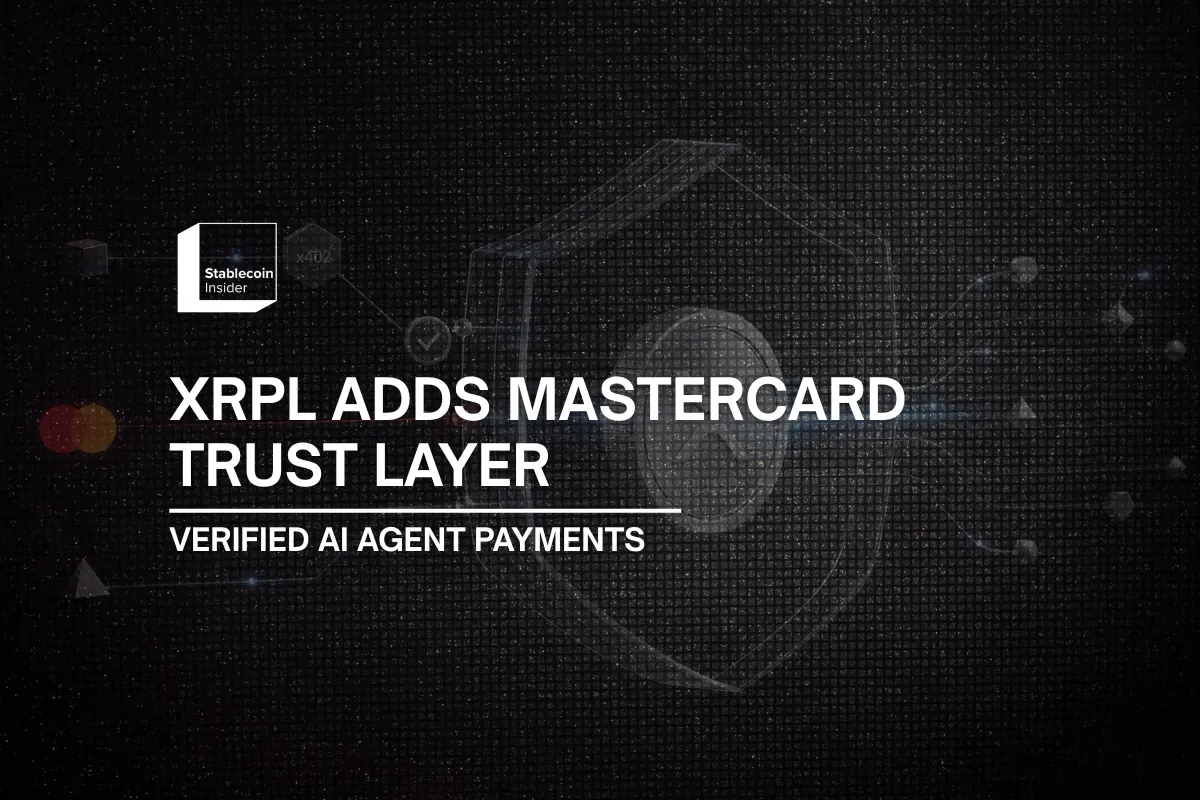
Agent payments on the XRP Ledger now support Mastercard's Verifiable Intent standard, according to a July 24, 2026 announcement from t54.ai, the AI infrastructure firm building agentic commerce on the XRPL. The integration lets developers attach a cryptographic proof to each x402 payment that confirms who authorized it, under what spending limits, and for which exact purchase, all screened before settlement.
The upgrade lands as the ledger's agentic economy crosses 1.4 million transactions settled through the x402 Facilitator, which handles payments in XRP and the RLUSD stablecoin. The network passed its first million agentic payments on July 8, meaning volume added roughly 400,000 transactions in about two weeks.
The significance for stablecoins is direct: RLUSD is a settlement asset in these flows, and Mastercard's trust layer gives regulated dollar tokens a compliance edge in machine-to-machine payments.
"Crossing 1M agentic transactions on the XRPL is an exciting milestone, but I believe we're still in the early stages of what's possible." - J. Akinyele, Head of Engineering at RippleX
Key Takeaways
- XRP Ledger integrated Mastercard's Verifiable Intent on July 24, 2026, adding verified authorization to x402 agent payments.
- RLUSD is a core settlement asset, pairing Ripple's regulated stablecoin with a Mastercard-grade compliance layer.
- Agentic transactions crossed 1.4 million, up from one million on July 8, showing steep growth in machine payments.
- Verifiable Intent is optional, so standard x402 payments keep working while credentialed ones get risk-screened.
- The trust layer differentiates XRPL from settling in USDC on permissionless networks like Base or Solana.
What Was Announced
Verifiable Intent is a cryptographic proof carried alongside an x402 payment that answers the three questions a risk engine needs before trusting an autonomous transaction: who authorized it, under what limits, and for exactly which purchase. It follows Mastercard's Agentic Payments framework.
Through the XRPL x402 Facilitator, developers can now attach these credentials so every agent request is automatically run through the Facilitator's risk service, with Trustline screening applied before settlement. The check happens before funds move, which matters because blockchain transactions are irreversible once settled.
The integration was built by t54.ai, which added Verifiable Intent support to the x402 Facilitator it operates on the XRP Ledger. Crucially, the feature is optional, so standard x402 payments continue to function unchanged, and only payments with attached credentials get the extra verification step.
This sits on top of infrastructure that has been live since February 2026, when the x402 Facilitator first went live on the XRPL and let AI agents pay for services using XRP and RLUSD without an account, API key, or prior relationship between the parties.
Why This Matters for Stablecoins
Every agentic payment needs a currency, and on the XRP Ledger that currency is either XRP or RLUSD, Ripple's regulated dollar stablecoin. As Verifiable Intent hardens the trust layer, it strengthens the case for settling agent payments in a compliant stablecoin rather than a volatile asset.
The combination is the differentiator. RLUSD carries NYDFS approval and federal trust bank standing, and pairing that with Mastercard credentialing gives enterprise buyers a materially different risk profile than settling in USDC on a permissionless Layer 2. For regulated businesses and financial institutions, provenance and authorization matter as much as speed.
This is the same machine-to-machine thesis we covered in our Coinbase x402 USDC coverage, where USDC became the default settlement asset for agent payments on Base. The XRPL move is the competing answer: instead of the deepest developer tooling, Ripple leans on regulated rails and a card-network trust layer.
For stablecoins broadly, the pattern is now unmistakable. Whether the settlement asset is USDC on Base or RLUSD on the XRPL, the agentic economy is being built to run on regulated dollar tokens, not on cards retrofitted for autonomous software. The same logic drives trade-finance moves like the one in our XDC and Bridge agentic payments coverage, where stablecoin settlement and AI agent infrastructure arrive together.
The x402 Standard and the Agentic Economy
The x402 protocol activates HTTP 402, the "Payment Required" status code reserved in the web's original specification but left unused for three decades. It lets an AI agent pay a server directly with a small stablecoin transfer, with no account, API key, or prior relationship required.
The standard has gained rapid institutional structure. On July 15, the Linux Foundation formally launched the x402 Foundation to steward the spec, backed by Visa, Mastercard, and Ripple among others, giving what began as a Coinbase contribution a vendor-neutral governance home.
Mastercard's role runs deeper than credentialing. Its Agent Pay for Machines program, launched in June 2026 with more than 30 partners, aims to let machines make authorized payments across the company's global network, and Ripple joined that program on June 10.
On the XRPL specifically, the appeal is operational. Fixed-fee micropayments and three-to-five-second settlement make thousands of sub-cent transactions per session viable, which is exactly the profile an autonomous agent generates.
The Competitive Picture: Regulated Rails vs Developer Reach
The agentic payments race is no longer about whether machines will pay through something like x402, but about which networks and which dollars they will use. That contest is playing out across several chains at once.
Coinbase has pushed USDC on Base with the deepest developer tooling and the widest integration surface, betting that agent commerce rewards whoever makes acceptance easiest. Ripple is betting the opposite, that enterprise adoption will follow whoever offers the strongest compliance and trust guarantees.
Verifiable Intent is the clearest expression of that strategy. By embedding Mastercard-aligned authorization into the payment itself, the XRPL is targeting the buyers most cautious about handing spending power to autonomous software: banks, regulated firms, and large enterprises. It mirrors how card networks are entering stablecoin infrastructure elsewhere, as with the Visa Stablecoin Platform built for banks and fintechs.
It is worth noting the caveats. Academic researchers have documented concrete attack vectors in the x402 protocol, including weaknesses in authorization binding and replay protection, which is precisely the class of risk that credentialing layers like Verifiable Intent aim to mitigate but do not fully eliminate.
Conclusion
The XRP Ledger's Verifiable Intent integration adds a verification layer that could make autonomous stablecoin payments safer for the institutions most hesitant to adopt them. By proving authorization before settlement, it addresses the irreversibility problem at the heart of onchain agent commerce.
For stablecoins, the takeaway is structural. RLUSD gains a compliance-first lane in the agentic economy, reinforcing that regulated dollar tokens, not cards, are the settlement layer being built for machine-to-machine payments.
Execution and adoption will decide the winner. The 1.4 million transaction figure shows real momentum, but the numbers remain small against the scale Ripple envisions, and whether regulated rails or developer reach wins the agentic market is still an open question heading into the second half of 2026.
FAQ:
1. What is Mastercard's Verifiable Intent on the XRP Ledger?
Verifiable Intent is a cryptographic proof attached to an x402 payment on the XRP Ledger that confirms who authorized a transaction, under what spending limits, and for which exact purchase. Integrated by t54.ai and announced on July 24, 2026, it lets the XRPL x402 Facilitator screen credentialed agent payments through a risk service before they settle onchain.
2. How does RLUSD fit into XRP Ledger agent payments?
RLUSD, Ripple's regulated dollar stablecoin, is one of the two settlement assets for agent payments on the XRP Ledger, alongside XRP. Because RLUSD carries NYDFS approval and federal trust bank standing, pairing it with Mastercard's Verifiable Intent gives enterprise users a compliance-focused option for machine-to-machine stablecoin payments.
3. What is x402 and how does it work?
The x402 protocol activates HTTP 402, the "Payment Required" status code left unused in the web's original design. It lets an AI agent pay a server directly with a small stablecoin transfer, with no account, API key, or prior relationship, and on the XRP Ledger the full round trip clears in three to five seconds using XRP or RLUSD.
4. How many agent payments has the XRP Ledger processed?
The XRP Ledger has settled more than 1.4 million agentic transactions through t54.ai's x402 Facilitator as of late July 2026. The network crossed its first million agentic payments on July 8, meaning it added roughly 400,000 transactions in about two weeks.
5. How does XRPL compare to Coinbase and Base for agent payments?
Coinbase has focused on USDC settlement on Base with deep developer tooling and wide integration, while the XRP Ledger emphasizes regulated rails, using RLUSD and Mastercard's Verifiable Intent trust layer. The distinction is strategic: Coinbase optimizes for developer reach and ease of acceptance, while Ripple targets enterprise buyers who prioritize compliance and verified authorization.
Disclaimer:
This content is provided for informational and educational purposes only and does not constitute financial, investment, legal, or tax advice; no material herein should be interpreted as a recommendation, endorsement, or solicitation to buy or sell any financial instrument, and readers should conduct their own independent research or consult a qualified professional.