

Table of Contents
Federal Reserve staff published a note on September 4, 2026 examining whether regulated payment stablecoins should be folded into the official US money supply measures. Payment stablecoins sit outside every monetary aggregate today, and the note maps what would have to be resolved before that changes.
The central accounting problem is that the same dollar could be counted twice. An issuer takes in dollars, places them in a bank deposit or government money market fund, and mints tokens against that reserve, and both the reserve and the token could end up inside the same aggregate.
The GENIUS Act makes the overlap structural rather than incidental. Its permitted reserve assets are bank deposits, US Treasuries, and government money market funds, which are precisely the instruments already captured in M1 and M2.
The note is independent staff research reflecting only its authors' views. It is not part of a Federal Reserve policy deliberation, and current definitions have not changed.
Key Takeaways
- Fed staff published the note on September 4, examining stablecoin treatment in the monetary aggregates.
- Payment stablecoins are excluded from M1 and M2 today, and the note proposes no change to that.
- Counting tokens at face value risks double-counting reserves already inside the aggregates.
- Classification would depend on economic use, with payment behaviour pointing to M1 and store-of-value use to M2.
- US circulation would need separating from global activity, which issuers do not currently report.
The Same-Dollar Problem
The mechanics are straightforward once stated. A customer sends dollars to an issuer, the issuer holds them in a bank deposit or money market fund, and a stablecoin of identical face value is minted, so counting the token adds a line to an aggregate that already contains its backing.
Not every reserve creates the problem. Only assets already represented in M1 or M2 produce duplication, so the distortion varies with each issuer's reserve composition and with how each reserve asset is treated statistically.
The consequence is a measurement problem rather than a monetary one. A larger headline figure driven by reclassification would say nothing about newly created purchasing power, which matters because M1 and M2 are what analysts use to judge dollar liquidity.
Reserve composition determines the size of the issue. Circle holds most of its reserve in the Circle Reserve Fund, an SEC-registered government money market fund holding cash, short-dated Treasuries, and overnight repurchase agreements, with USDC circulating supply at $71.826 billion against reserve fair value of $71.904 billion as of July 31.
Where a Stablecoin Would Sit
The note makes classification depend on how tokens are actually used rather than on what they are called. M1 covers currency and highly liquid balances that can be spent immediately, while M2 adds savings-type instruments including small time deposits and retail money market funds.
The argument for M1 rests on settlement speed. Blockchain transactions settle instantly, so a stablecoin used for everyday household and business payments could arguably be more liquid than a demand deposit.
The argument for M2 rests on observed behaviour. Payment stablecoins are widely used to hold value between crypto trades and as short-term investments, which points toward placement outside M1, and the note is explicit that it is unclear whether GENIUS Act payment stablecoins will serve the same purposes.
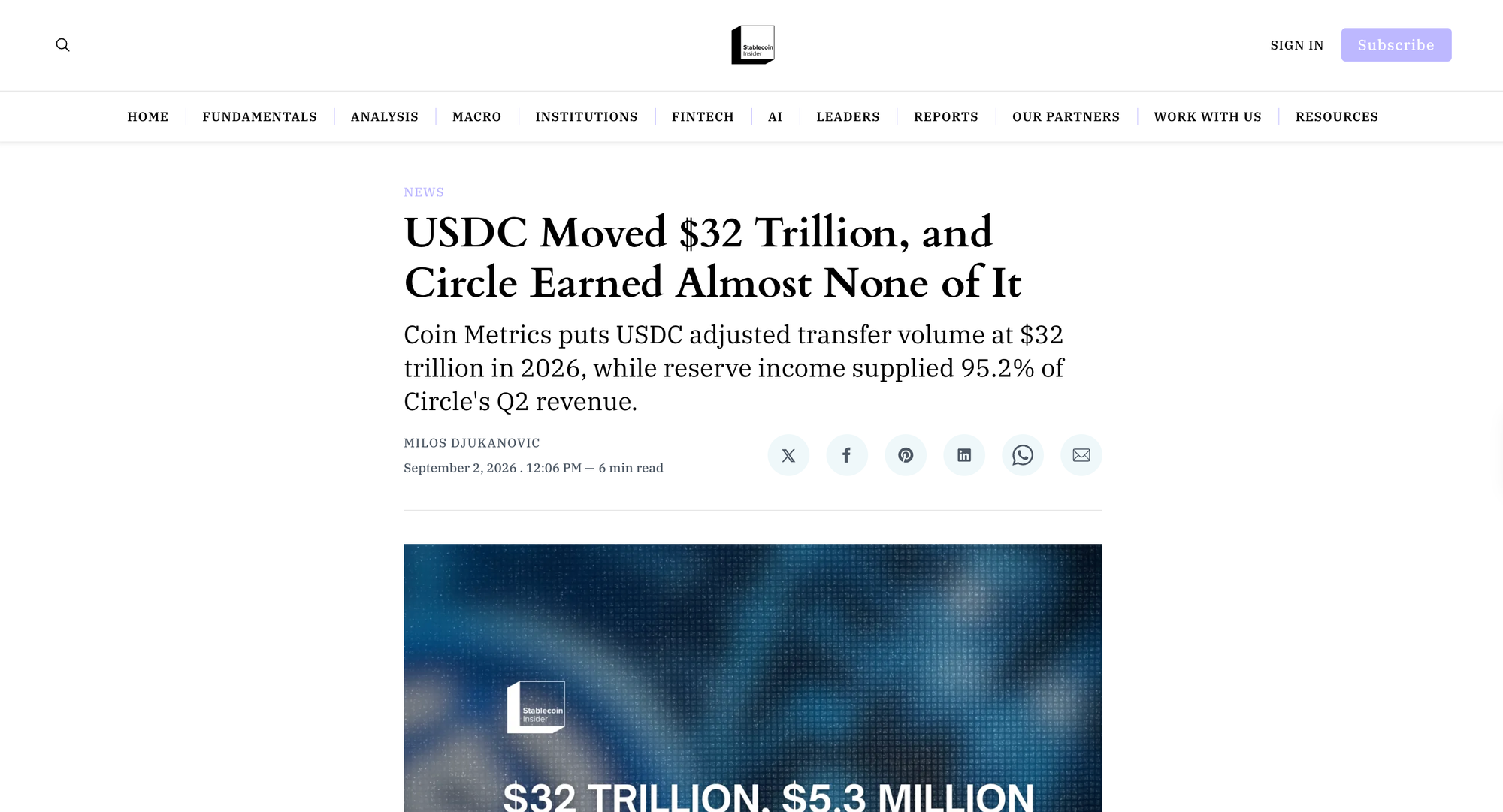
Current usage data complicates the question further. USDC settled roughly $32 trillion in adjusted transfer volume this year, with most of it market infrastructure rather than commerce, as we detailed in our USDC transfer volume analysis.
Why This Matters for Stablecoins
The classification question determines whether stablecoins become visible in official monetary statistics. At present a $292 billion global market is entirely absent from figures that central banks, analysts, and policymakers use to assess money supply.
The scale comparison shows why the answer is not urgent. US M2 stood at $23.218 trillion in July 2026, so even the entire global stablecoin market would represent a small fraction of it, though only a portion of that supply is held by US residents.
The geographic problem may be the harder one. Issuers report global circulation and do not distinguish US-resident ownership, so a US monetary aggregate cannot incorporate a figure that includes holders in every other country.
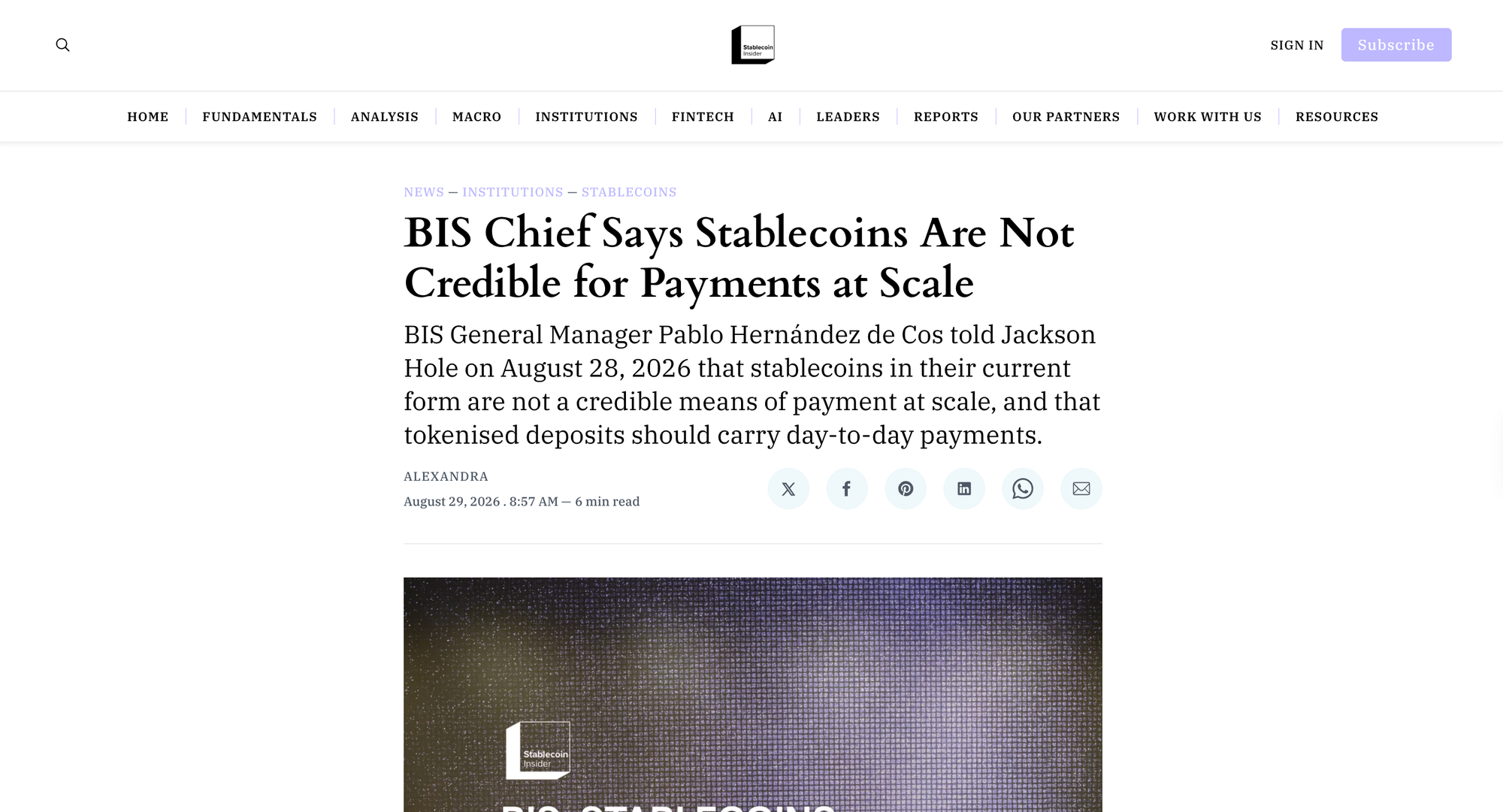
The exercise also connects to a live international debate. The Bank for International Settlements argued last week that stablecoins fail as payment at scale, a position we covered in our BIS Jackson Hole analysis, and Fed staff are simultaneously working out how they would be measured if they succeed.
What This Note Is and Is Not
It is staff research. FEDS Notes reflect the views of their authors, not the Board of Governors, and this one changes nothing about how the aggregates are currently constructed.
It is also not a proposal. The note sets out assessment factors and accounting problems rather than recommending that stablecoins be added to any measure, and no timeline is attached.
What makes it worth attention is what it implies about direction. Central bank staff do not usually publish frameworks for measuring instruments they expect to remain marginal.
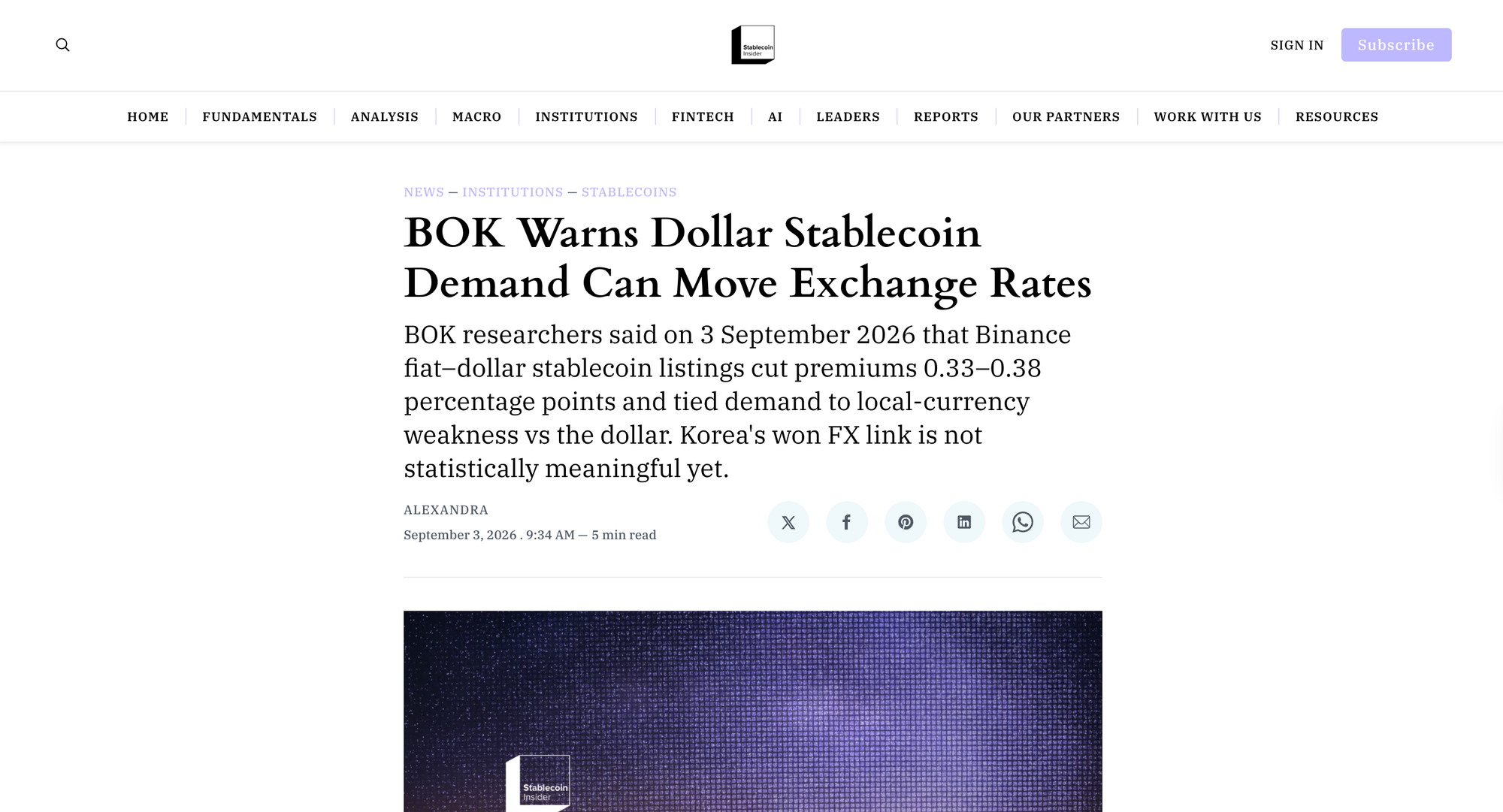
Similar work is appearing elsewhere. Bank of Korea researchers published findings this month on how dollar stablecoin demand transmits into foreign exchange markets, covered in our Bank of Korea study analysis, which is the same category of question approached from the currency side.
Conclusion
The note identifies a problem that sounds technical and is not. If regulators fold stablecoins into money supply figures without adjusting for reserves already counted, the statistics would show more money without more purchasing power existing.
The GENIUS Act made this unavoidable by design. Requiring reserves in bank deposits, Treasuries, and government money funds guarantees that a well-regulated stablecoin is backed by assets the aggregates already measure.
What the note does not answer is when any of this becomes necessary. Payment stablecoins remain outside the aggregates, and the framework exists for the moment their scale makes exclusion the larger distortion.
FAQ:
1. What did the Federal Reserve note say?
A FEDS Note published September 4, 2026 examined how regulated payment stablecoins might be treated in the US monetary aggregates M1 and M2. It sets out the accounting problems that would need resolving, including double-counting of reserves already inside the aggregates, and does not propose any classification change.
2. Are stablecoins counted in the money supply now?
No. Payment stablecoins sit outside every official US monetary aggregate, including the monetary base, M1, and M2. The note maps what a future change would involve without recommending one, and current definitions remain unchanged.
3. What is the same-dollar problem?
If an issuer receives dollars, places them in a bank deposit or money market fund, and mints stablecoins against that reserve, counting the tokens at face value could add a new line to an aggregate that already contains the backing. Only reserve assets already represented in M1 or M2 create this overlap, so the effect varies with each issuer's reserve mix.
4. Would stablecoins go into M1 or M2?
It would depend on economic use. M1 covers currency and highly liquid balances spendable immediately, and a stablecoin used for everyday payments could arguably be more liquid than a demand deposit given instant blockchain settlement. Use as a store of value or short-term investment would point toward placement in non-M1 M2.
5. Is this Federal Reserve policy?
No. FEDS Notes are independent staff research reflecting the views of their authors rather than the Board of Governors, and the note is explicitly not part of a policy deliberation. No rule, timeline, or proposal accompanies it.
Disclaimer:
This content is provided for informational and educational purposes only and does not constitute financial, investment, legal, or tax advice; no material herein should be interpreted as a recommendation, endorsement, or solicitation to buy or sell any financial instrument, and readers should conduct their own independent research or consult a qualified professional.