
Table of Contents
Coinbase announced on July 23, 2026, that all Coinbase Business customers can now accept USDC payments directly from AI agents, turning machine-to-machine stablecoin commerce into a standard merchant feature. The capability runs on x402, the open payment standard Coinbase created for automated payments, with settlement handled by Coinbase Payments and no separate integration work required.
The rollout is one of three products Coinbase shipped the same day for what it calls the agent economy. The company also expanded Coinbase for Agents with real-time market data and plain-English conditional trading commands, and released a CDP x402 SDK that lets developers add agent payment acceptance to online services in a few lines of code.
The timing is anchored to a striking internal metric. Coinbase said that in June, traffic from AI agents exceeded human traffic on its Base documentation pages for the first time.
"We re-architected how transactions work for a new online agentic economy. Agents, on one side of the transaction, will go and read the Coinbase developer docs, create a wallet for themselves, and are ready to shop." - Sid Coelho-Prabhu, Head of Coinbase Business
Key Takeaways
- Coinbase Business customers can now accept USDC directly from AI agents, starting the week of July 23, 2026.
- Payments run on x402, Coinbase's open standard for automated machine-to-machine payments, settled by Coinbase Payments.
- Agent traffic overtook human traffic on Coinbase's Base documentation pages for the first time in June.
- Merchants face no chargeback risk and earn 3.35% rewards on idle USDC balances in supported markets.
- Early volumes remain tiny, with average x402 payments around 20 cents as of March analysis.
What Coinbase Launched
The headline feature makes agentic payments an accounts-receivable product rather than a developer experiment. Any Coinbase Business customer can switch on USDC acceptance from AI agents without building a separate checkout flow, with transactions settling on Base or other supported chains.
Sid Coelho-Prabhu, who leads Coinbase Business, described the launch as completing an end-to-end loop. An agent discovers Coinbase's developer documentation, spins up its own wallet, gets funded, pays a merchant that accepts via Coinbase Business, and settles in USDC.
The second product, an expansion of Coinbase for Agents, gives autonomous systems access to real-time market data streams and lets users set conditional trading commands in plain English. The third, the CDP x402 SDK, packages agent payment acceptance for developers with managed wallets and spend controls included.
Coinbase Business currently operates in the US and Singapore, and the company noted that individual features and USDC reward rates vary by market. Merchants in supported regions earn 3.35% rewards on idle USDC balances held in their accounts.
How x402 Turns Stablecoins Into the Agent Payment Rail
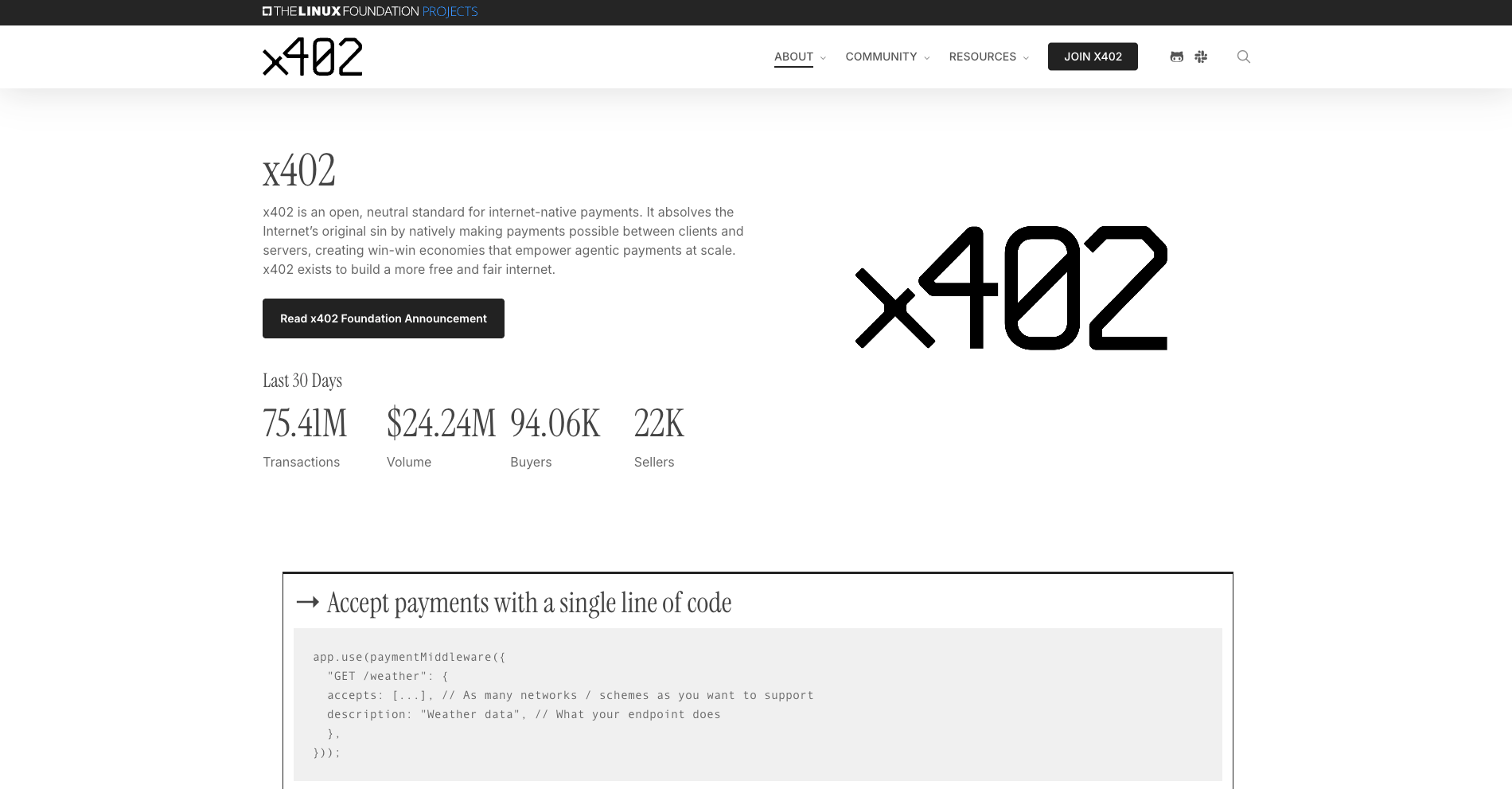
The x402 standard, launched by Coinbase in May 2025, revives the long-dormant HTTP 402 Payment Required status code. When an agent hits a paywalled API or service, the server responds with a payment request, the agent signs a stablecoin transaction, and retries the request with proof of payment attached.
The design solves a problem no card network was built for. Traditional payment systems assume a human clicking a button, with credentials, 3D Secure checks, and chargeback rights layered on top, none of which map onto autonomous software making thousands of sub-dollar purchases.
Stablecoins fit because they are programmable, final, and divisible to fractions of a cent. USDC settlement on Base gives an agent the same money format whether it is buying $0.20 of API access or paying a monthly cloud storage bill.
The ecosystem around the standard is already forming. Amazon added Coinbase x402 to Bedrock AgentCore Payments in May, letting agents built on AWS pay for services in USDC, and the x402-based Agentic. market launched in April to help agents discover compatible services.
Who Is Actually Paying: Early Adoption and Honest Caveats
Coelho-Prabhu said agents are making real transactions for real businesses today, concentrated in digital infrastructure. Bots are buying OpenRouter credits, domain names, and cloud storage from Amazon and Google, which he called the earliest adopters of agentic commerce, adding that an explosion of more mainstream commerce feels very close.
The current numbers deserve sober framing. An Artemis analyst who examined x402 activity in March found the average payment was worth about 20 cents, and roughly half of the transactions looked gamified rather than commercial.
That gap between narrative and volume is exactly why this launch matters as a test. Packaging agent acceptance as an ordinary business feature, with no code required, removes the last merchant-side excuse, so the next two quarters of x402 volume will show whether agentic commerce is a revenue line or a curiosity.
Coinbase, for its part, is not hedging. The company has called AI payments its most high-conviction bet, and the July 23 rollout ties that bet directly to USDC throughput.
Why This Matters for Stablecoins
Every serious framework for agentic commerce converges on stablecoins as the settlement layer, and this launch hardwires USDC into the most complete stack yet. If agents become meaningful economic actors, the payment volume flows through stablecoin rails by default, not through cards retrofitted with agent permissions.
The competitive context makes the move sharper. Circle's USDC has been fighting for distribution since Open USD launched on June 30 with backing from Visa, Mastercard, and BlackRock, and Coinbase sits on both sides of that fight as a USDC partner and an Open USD consortium member.
Agentic payments give USDC a lane the consortium token does not yet touch. Machine-to-machine micropayments reward the deepest developer tooling and the widest existing integration surface, which is where Coinbase's CDP stack and Base give USDC a structural head start.
There is also a payments-fundamentals angle we have tracked across our MetaMask Money Account coverage and the Open USD consortium launch: stablecoin products are increasingly winning on being embedded, not on being crypto. An agent paying 20 cents for an API call never sees a blockchain, and that invisibility is the adoption story.
Conclusion
Coinbase just gave the merchant side of agentic commerce a light switch. Businesses that could not previously justify integration work can now accept USDC from AI agents by toggling a feature, which shifts the bottleneck from infrastructure to actual agent demand.
The honest read is that this is early plumbing for a market that barely exists yet, with sub-dollar average payments and a meaningful share of experimental activity. But the direction of travel is unambiguous: agent traffic already outnumbers human traffic where developers live, and someone will own the payment rail those agents use.
For stablecoins, the launch is a structural win regardless of near-term volume. It establishes USDC as the default currency of a payment category that cards cannot serve, and it makes the case that the next hundred million stablecoin users may not be users at all.
FAQ:
1. What did Coinbase announce on July 23, 2026?
Coinbase announced that all Coinbase Business customers can accept USDC payments directly from AI agents, using the x402 open payment standard with settlement through Coinbase Payments. The company simultaneously expanded Coinbase for Agents with real-time market data and conditional trading commands, and released a CDP x402 SDK for developers.
2. What is x402?
The x402 standard is an open payment protocol Coinbase launched in May 2025, built around the HTTP 402 Payment Required status code. It lets websites and APIs request payment from software, so an AI agent can receive the request, sign a stablecoin transaction, and retry with proof of payment, enabling automated machine-to-machine commerce without cards or manual checkout.
3. Can AI agents pay with stablecoins?
Yes. AI agents can create their own wallets, hold USDC, and pay merchants automatically through the x402 standard, and as of July 23, 2026, any Coinbase Business customer can accept those payments without custom integration. Early agent purchases are concentrated in digital infrastructure such as API credits, domain names, and cloud storage.
4. Why do AI agent payments use stablecoins instead of cards?
Card networks assume a human at checkout, with credentials, fraud checks, and chargeback rights that do not translate to autonomous software making high-frequency, sub-dollar purchases. Stablecoins like USDC are programmable, settle with finality, and divide into fractions of a cent, which makes them the natural money format for machine-to-machine transactions.
5. How big is the AI agent payment market today?
Still small. Analysis from March 2026 put the average x402 payment at roughly 20 cents, with about half of examined transactions appearing gamified rather than commercial. The forward signal is stronger: agent traffic surpassed human traffic on Coinbase's Base documentation pages for the first time in June 2026, and Amazon has integrated x402 into Bedrock AgentCore Payments.
Disclaimer:
This content is provided for informational and educational purposes only and does not constitute financial, investment, legal, or tax advice; no material herein should be interpreted as a recommendation, endorsement, or solicitation to buy or sell any financial instrument, and readers should conduct their own independent research or consult a qualified professional.


