Table of Contents
USDT now runs on more than a dozen networks, and the fee to send it can range from almost nothing to several dollars. Which network you pick often matters more than which exchange you use.
The surprise in 2026 is that Tron, the most popular USDT network, is no longer the cheapest. On two of the three exchanges we checked, it was the most expensive option.
This guide compares live USDT withdrawal fees on OKX, Kraken and Bitso across every network they support, then explains wallet-to-wallet costs and how to pick the cheapest route.
On 25 November 2026, OKX charged 2 USDT to withdraw on Tron but just 0.13 USDT on Ethereum and fractions of a cent on Polygon, Arbitrum and Plasma. On Bitso, Tron cost 3.1 USDT against 0.01 USDT on Polygon.
Key Takeaways
- Tron was the priciest USDT withdrawal on OKX and Bitso.
- Ethereum cost under 0.50 USDT on all three exchanges.
- Plasma, Polygon and Arbitrum cost almost nothing on OKX.
- Kraken charges flat fees, often 1 USDT per network.
- The receiver's network decides what you can use.
USDT Withdrawal Fees by Network at a Glance
| Network | OKX | Kraken | Bitso |
|---|---|---|---|
| Tron (TRC20) | 2 USDT | 1 USDT | 3.1 USDT |
| Ethereum (ERC20) | 0.13 USDT | 0.4712 USDT | 0.03 USDT |
| Solana | 0.4 USDT | 0.6916 USDT | 0.75 USDT |
| TON | 0.036 USDT | 0.1 USDT | Not listed |
| Polygon | 0.004 USDT | 1 USDT | 0.01 USDT |
| Arbitrum One | 0.0022 USDT | 1 USDT | Not listed |
| Plasma (USDT0) | 0.0000026 USDT | 0.1 USDT | Not listed |
| Aptos | 0.00044 USDT | 0.3 USDT | Not listed |
Fees were read from each exchange's public fee page on 25 November 2026. For how the three biggest networks differ as payment rails, see our guide to TRC20 vs ERC20 rails.
What to note: OKX updates its fees with network conditions, so check the withdrawal screen before you confirm.
OKX: Fees That Follow the Network
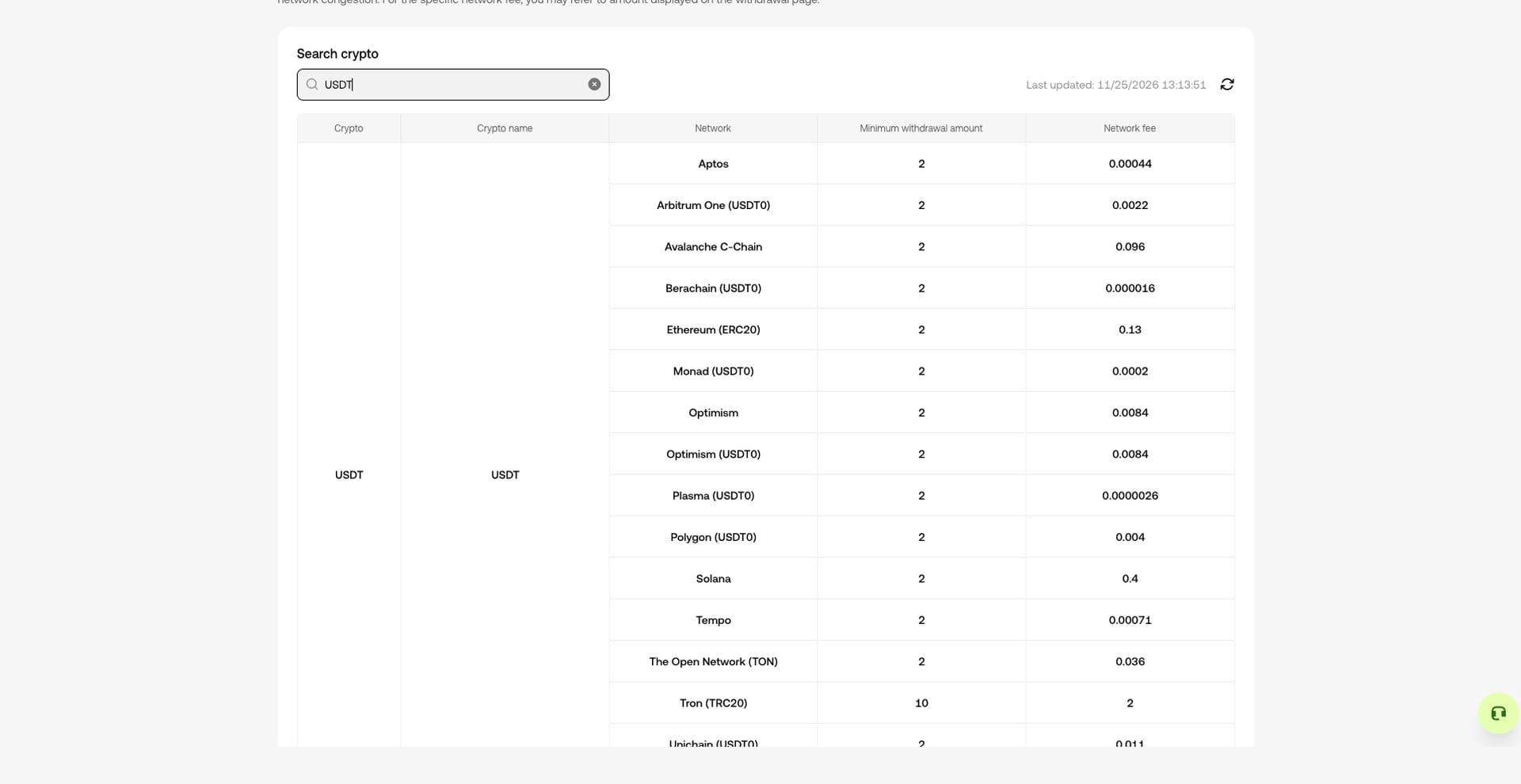
OKX lists USDT on 16 networks, and its fees track the real network cost. On 25 November 2026, its page was last updated at 13:13 that day.
Plasma cost 0.0000026 USDT, Polygon 0.004 USDT and Arbitrum 0.0022 USDT. Ethereum cost 0.13 USDT and Solana 0.4 USDT.
Tron was the most expensive at 2 USDT, with a 10 USDT minimum withdrawal. Every other network had a 2 USDT minimum.
What to note: on OKX, sending 100 USDT on Tron costs about 500 times more than on Polygon.
Kraken: Flat Fees, With a Few Bargains
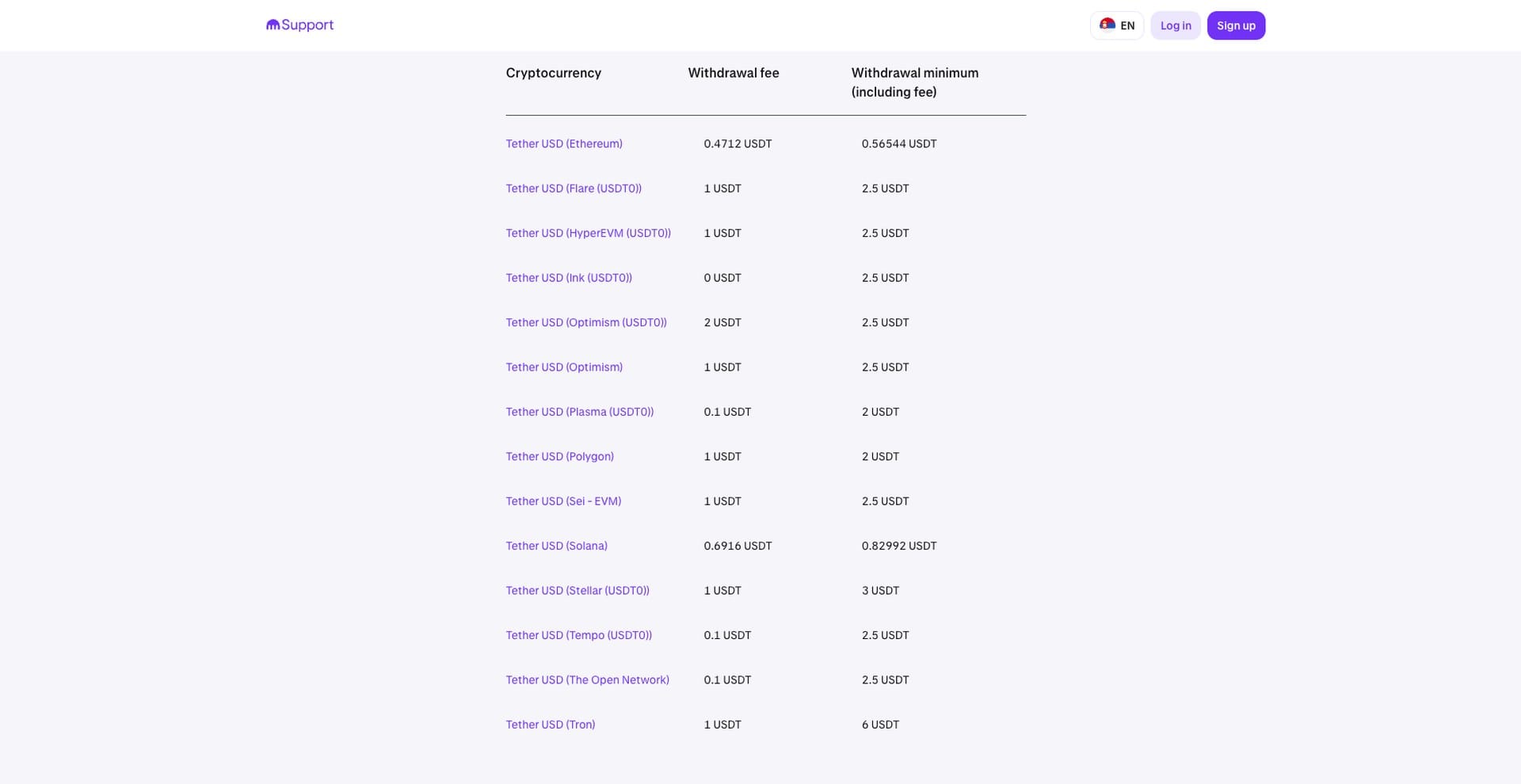
Kraken sets mostly flat fees. Tron, Polygon, Arbitrum, Avalanche and Optimism all cost 1 USDT per withdrawal.
Its cheapest options were Ink at 0 USDT, and Plasma, Tempo and TON at 0.1 USDT. Ethereum cost 0.4712 USDT and Solana 0.6916 USDT.
On Kraken, Tron was cheaper than on OKX, but its minimum withdrawal was 6 USDT, including the fee.
What to note: Kraken's fee page header says it was last updated on 31 December 2025, so confirm the fee in your account.
Bitso: Tron Costs 310 Times More Than Polygon
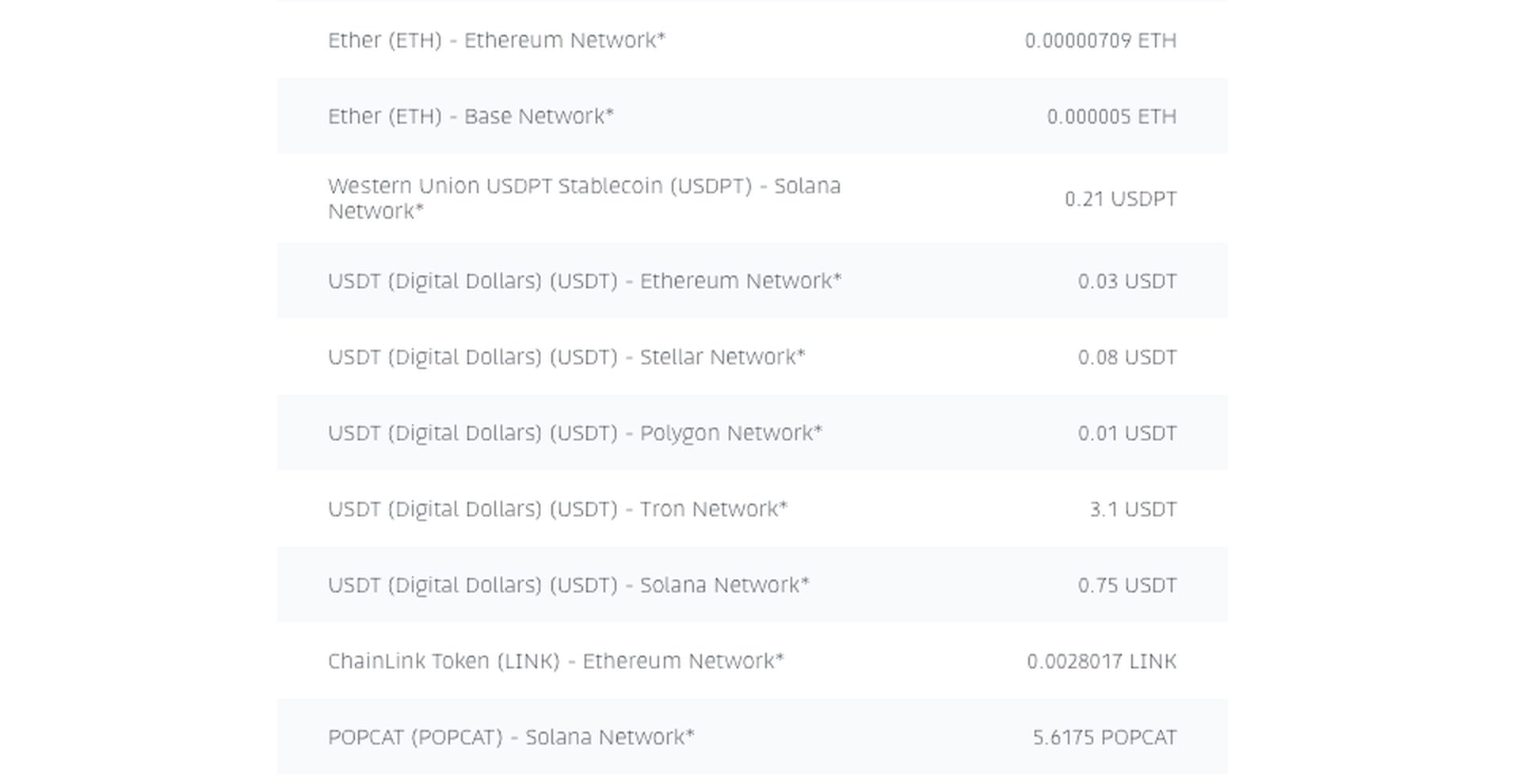
Latin America's Bitso supports USDT on five networks. Polygon cost 0.01 USDT, Ethereum 0.03 USDT and Stellar 0.08 USDT.
Solana cost 0.75 USDT and Tron 3.1 USDT. That makes Tron 310 times more expensive than Polygon on the same platform.
Bitso charges nothing to receive USDT on any of the five networks.
What to note: Bitso labels these fees as fixed, so they do not move with network traffic.
Why Tron Costs More Than You Expect
Tron charges for USDT transfers in energy. Without energy, a transfer burns about 6.43 TRX, or 13.03 TRX if the receiving wallet has never held USDT.
At around $0.33 per TRX in October 2026, that is about $2.12, or $4.30 for a new wallet. Exchanges pass that cost on, which is why Tron withdrawals now cost more than Ethereum on OKX and Bitso.
If you send from your own wallet, renting energy can cut the cost sharply. Our guide to the cheapest Tron transfers found 2.62 TRX per transfer on a 30-day rental.
What to note: Tron is still widely accepted, so it can be worth the fee when the receiver only supports Tron.
Plasma: Zero-Fee USDT Transfers
Plasma is a blockchain built for stablecoins, launched in beta in September 2025. A protocol "paymaster" pays the gas for simple USDT transfers, so users can send USDT without holding the network's own token.
The free lane covers only direct USDT transfers. More complex transactions still pay a fee, which can be paid in stablecoins.
On OKX, a Plasma withdrawal cost 0.0000026 USDT, the lowest of any network. On Kraken, it cost 0.1 USDT.
What to note: the person receiving must have a Plasma address and a way to use or move USDT from it.
What USDT0 Means for Fees
Several of the cheapest options, including Plasma, Arbitrum and Polygon on OKX, are labelled USDT0. USDT0 is a version of USDT that moves between chains through LayerZero's technology.
Each USDT0 is backed 1:1 by USDT locked on Ethereum. It is operated by Everdawn Labs, not issued directly by Tether.
For sending, USDT0 works like USDT on its own network. The risk is sending it to a platform that does not support that version.
What to note: check that the receiving platform lists the exact network name, including "USDT0".
TON: Cheap and Built Into Telegram
USDT on TON cost 0.036 USDT to withdraw on OKX and 0.1 USDT on Kraken. It is one of the cheapest networks that many everyday users can easily receive on.
That is because TON wallets are built into Telegram, which many people already use. Our guide to USDT on TON compares the main wallets and their fees.
TON transfers often need a memo when sending to an exchange, so copy it exactly.
What to note: a missing memo is one of the most common reasons exchange deposits on TON go missing.
How to Pick the Cheapest Network
- Ask which networks the receiver supports.
- Compare fees on those networks only.
- Check the withdrawal minimum, not just the fee.
- Send a small test to new addresses.
- Match the network name exactly on both sides.
The cheapest network on paper is useless if the receiver cannot accept it. Sending to an unsupported network can lose the funds or require a slow recovery.
What to note: for regular transfers, agree on one cheap network with the people you pay.
Risks and Limitations
- Fees change with network traffic and exchange policy.
- Not every platform supports every network.
- USDT0 and USDT may not be interchangeable everywhere.
- Some networks need a memo for exchange deposits.
- Minimum withdrawals can exceed small transfers.
No funds were sent, traded or withdrawn for this guide. Fees were read from OKX, Kraken and Bitso public pages on 25 November 2026.
What to note: the fee shown on the final withdrawal screen is the one you pay.
Conclusion
The cheapest way to send USDT in 2026 is usually not Tron. On OKX and Bitso, Tron cost more than every other network, while Polygon, Arbitrum and Plasma cost almost nothing.
Ethereum has also become cheap, at 0.03 to 0.47 USDT per withdrawal across the three exchanges. Kraken's flat 1 USDT fees make TON, Plasma and Tempo its best options.
Pick the cheapest network the receiver supports, check the minimum, and send a test first.
Read Next:
- TRC20 vs ERC20 vs Solana: Rails Compared 2026
- Cheapest Way to Send USDT on TRON in 2026: Energy Rental, Staking and GasFree Compared
- USDT on TON in 2026: Walt, Gram Wallet and Keeper Fees Explained
FAQs:
1. What is the cheapest network to send USDT?
It depends on the exchange. On OKX, Plasma, Polygon and Arbitrum cost under 0.01 USDT. On Bitso, Polygon cost 0.01 USDT, and on Kraken, Ink, Plasma, Tempo and TON cost 0.1 USDT or less.
2. Is Tron still the cheapest way to send USDT?
Not for exchange withdrawals. On 25 November 2026, Tron cost 2 USDT on OKX and 3.1 USDT on Bitso, more than any other network on those platforms.
3. How much does it cost to send USDT on Ethereum?
Exchange withdrawals on Ethereum cost 0.13 USDT on OKX, 0.4712 USDT on Kraken and 0.03 USDT on Bitso on 25 November 2026.
4. Can I send USDT for free?
On Plasma, a protocol paymaster sponsors simple USDT transfers between wallets. Exchange withdrawals to Plasma still carry a small fee, such as 0.1 USDT on Kraken.
5. What is USDT0?
USDT0 is a version of USDT that moves across chains using LayerZero. Each token is backed 1:1 by USDT locked on Ethereum.
Disclaimer:
This content is provided for informational and educational purposes only and does not constitute financial, investment, tax or legal advice; no material herein should be interpreted as a recommendation, endorsement, or solicitation to buy or sell any token, and readers should conduct their own independent research or consult a qualified professional. Fees and supported networks are drawn from public exchange pages and reporting at the time of writing, are not independently verified here, and may change. No funds were sent, traded or withdrawn for this article.