
Table of Contents
Cregis founder and CEO Shawn Yan explains why he chose infrastructure over trading in 2017, what MPC can and cannot protect, and why a license alone does not earn an institution's trust.
Most of the digital asset industry measures itself in market cycles. Shawn Yan built his company around what survives them.
In 2017, as many of today's major exchanges were being founded, Shawn Yan, Founder and CEO of Cregis, chose not to build another trading platform. His bet was simpler: whatever prices did, businesses would still need to hold, manage and move digital assets.
Nine years later, Cregis reports serving more than 4,000 businesses across 50+ countries, with over $300 billion in transactions secured. Around half of its customers are no longer crypto-native.
In a conversation with Stablecoin Insider, Yan walked through what went wrong early, why custody is the hardest step still ahead, where MPC stops being enough, when a buyer should pick someone else, and the one thing he would ask a CFO to do first.
From WeChat Tools to Digital Asset Infrastructure
Yan's first business, started in 2013, built SaaS tools for merchants operating through WeChat. It was profitable in its first year. It also showed him how quickly that kind of product gets copied, in a crowded market where the technology was relatively easy to replicate.
That pushed him toward financial SaaS and closer to fintech. Bitcoin itself was not new to him: he had encountered it at university and experimented with mining. But it was only by working with fintech businesses that he began to see its commercial potential.
By 2017, more companies were exploring digital assets for cross-border payments, treasury management, trading services and international business. The infrastructure to support them was largely missing, so many built their own wallet systems and internal tools, absorbing the development cost, operational complexity and security risk themselves.
"We chose to focus on underlying technology rather than build another trading platform. Our belief was simple: market cycles would come and go, but as long as businesses continued to use digital assets, they would need secure, stable and manageable infrastructure to support them," Yan said.
Starting With a Problem Worth Paying For
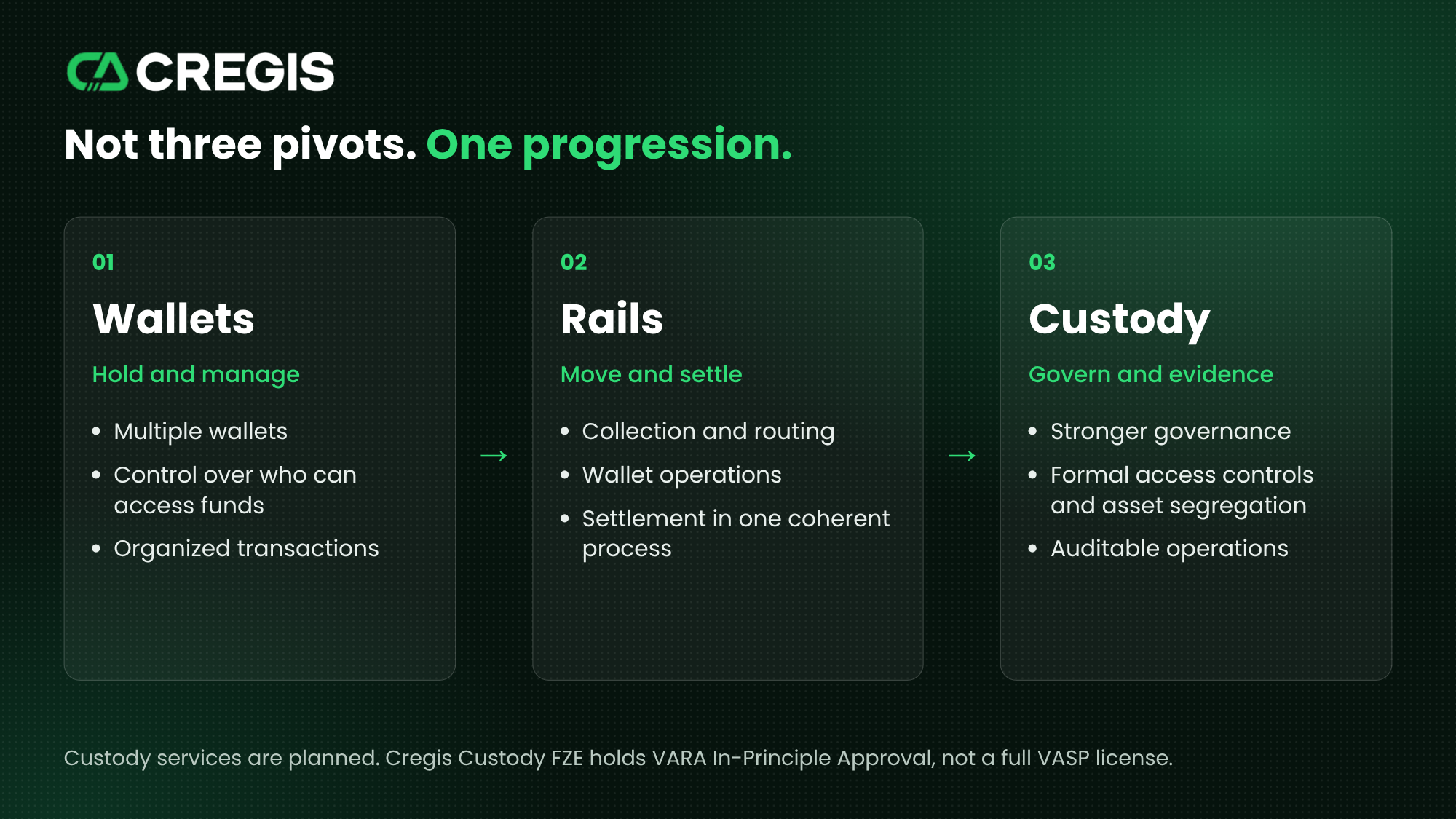
The day-one problem was ordinary. A company holding digital assets has different requirements from an individual: it has to manage multiple wallets, control who can access funds, and organize transactions as part of its business operations. For a company whose core business is not technology, building all of that alone is hard.
So Cregis began with enterprise wallet infrastructure, which later became its Wallet-as-a-Service offering.
Asked to name the first paying customer, Yan said he could not. The industry was still in an early, somewhat unstructured stage, and he does not think the category even had a clear definition yet.
"We were simply trying to solve problems that businesses were willing to pay to solve. Looking back, that was probably one of the more important things: we started with a real business need, rather than trying to create demand for a product," he said.
Seeing an Opportunity Is Not the Same as Being Ready
The first mistake came before Cregis. Yan's SaaS business underestimated how fast a low-barrier product could be replicated, and the move into financial SaaS came before the company had the right strategy, team structure or talent in place.
"It taught me that seeing an opportunity is not the same as being ready to execute on it," Yan said.
The second lesson came from enterprise customers, who do not always describe their underlying problems accurately. A request for a feature does not prove the feature is what they need, so you have to dig deeper into the real problem behind the request.
Cregis therefore does not build a product simply because one customer asks. It looks for recurring problems across customers and markets, on the view that the same issue appearing in different business environments may point to a broader infrastructure gap.
"Building for the long term requires more than responding quickly to requests. It requires knowing which problems are worth solving."
Wallets, Then Rails, Then Custody
Yan does not describe the company's product history as three strategic shifts. He describes one progression, with each step created by what customers ran into next.
Wallets came first because businesses needed a secure way to hold and manage digital assets. Once those wallets were in real operations, managing assets turned out to be only part of the job. Customers also had to move funds between parties, wallets and payment channels, and then settle.
Some customers were managing payment gateways separately from their wallet infrastructure, creating fragmented processes and making it harder to manage and oversee the movement of funds. This led us to develop Cregis Rails, a broader fund-flow orchestration and payment infrastructure layer designed to connect different aspects of digital asset operations.
One of the key products within this layer today is Cregis Payment Engine, which helps businesses integrate crypto payment processing into their existing operations.
Custody followed the institutions. As banks and financial institutions entered the market, their requirements went beyond conventional wallet security to stronger governance, formal access controls, clearer asset segregation and operations they could show were properly managed and auditable. That is the need behind Cregis Custody.
Asked which step was hardest, Yan pointed to the one still ahead of him.
"If I had to identify the most challenging step, it would be custody in the future. The technical requirements are demanding, but the biggest challenge is trust," he said.
With banks and other regulated institutions, decisions take longer, due diligence goes deeper and expectations around governance are much higher.
"We are confident in the direction, but we also understand that institutional trust takes time to establish."
What MPC Protects, and Where It Stops
Cregis positions self-custody as its edge in payment flows, and Multi-Party Computation sits at the center of that claim.
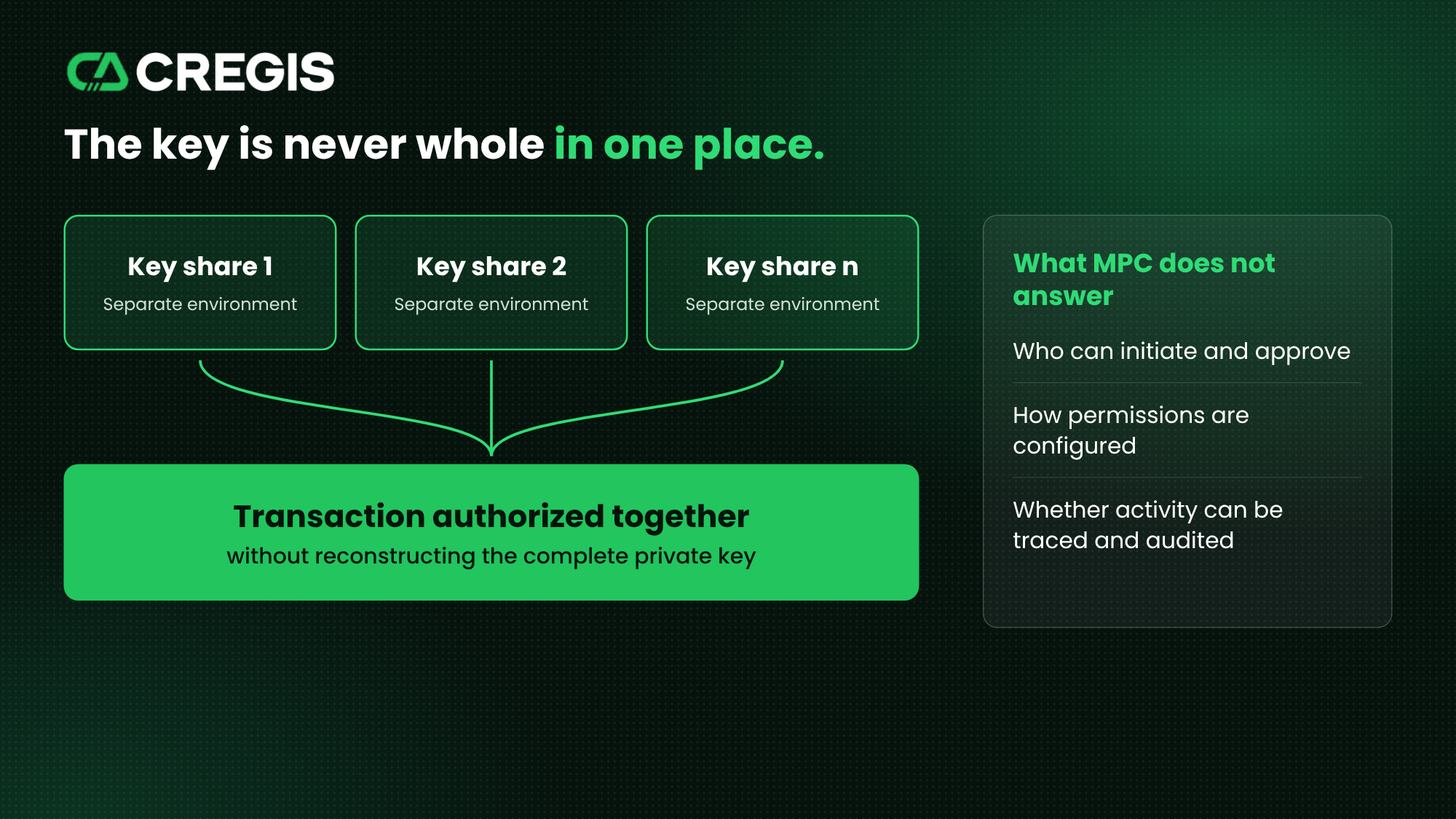
In practical terms, the private key is never stored whole in one location. It is divided into cryptographic shares, held across separate environments and used together to authorize transactions without the complete key ever being reconstructed in one place. That reduces the risk of a single point of failure.
"Cregis itself does not have access to the complete private key, so customers retain control of their assets," Yan said.
For payment businesses processing frequent transactions across multiple wallets, that means not relying on a third party to hold their funds. But Yan was direct about the limit.
"MPC is only one part of enterprise security."
A strong key setup does not answer the operational questions an enterprise also has to get right:
- Who can initiate and approve a transaction
- How access permissions are configured
- Whether activity can be properly traced and audited
"For an individual, the main concern may be whether their assets can be stolen. For an enterprise, security also involves making sure that funds are managed according to its internal policies and operational requirements," he explained.
The model also has a boundary of its own. Early wallets were designed for individuals managing their own assets. Larger institutions today may manage funds belonging to customers and other stakeholders, and banks and other highly regulated organizations can have different requirements around independent custody, governance and external oversight.
"We believe self-custody remains particularly relevant for businesses that want direct control over their assets and payment operations. At the same time, it is not necessarily the right model for every institution."
What the First 30 Days Look Like
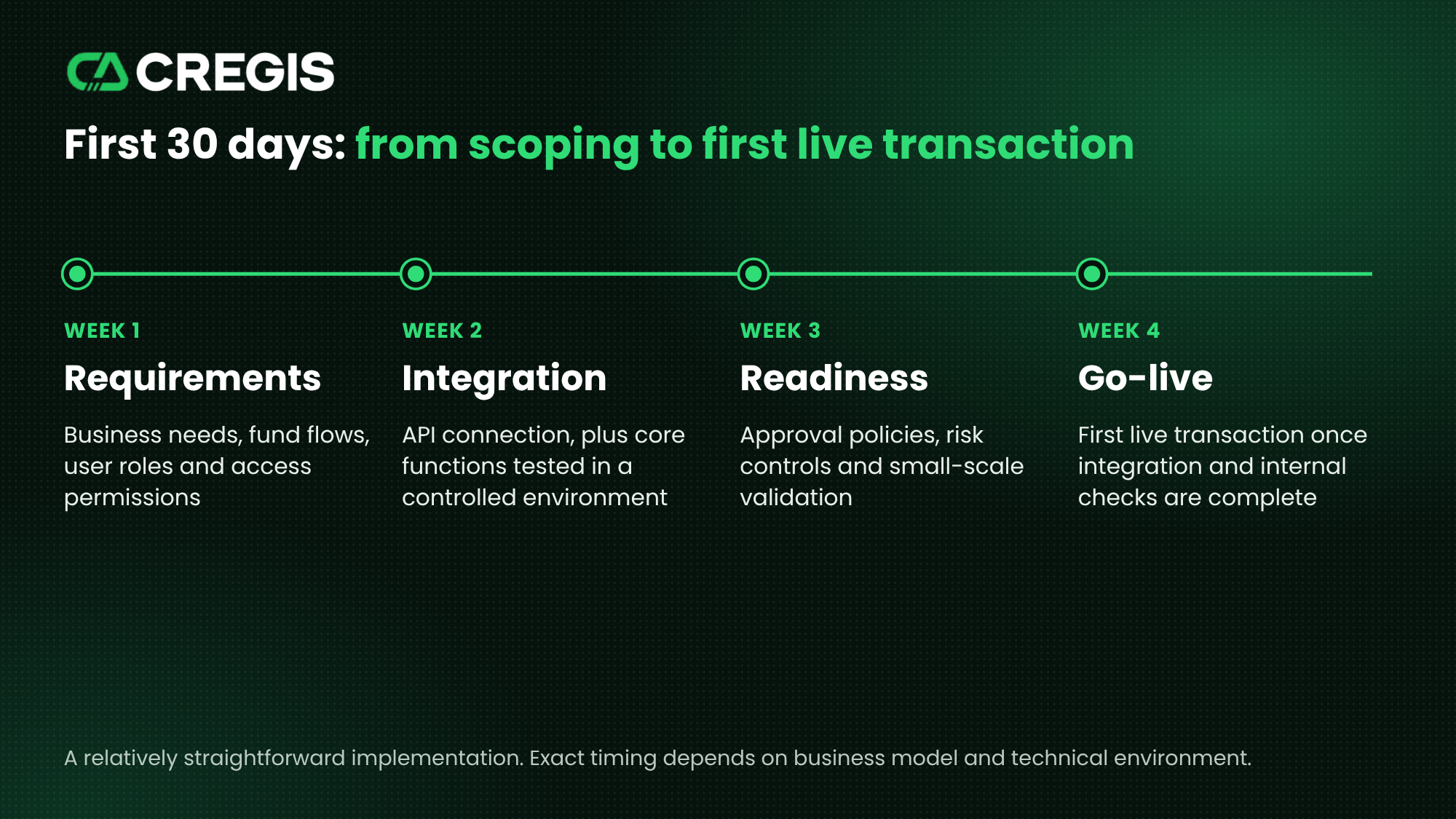
The exact timeline depends on the customer's business model, technical environment and integration requirements. A relatively straightforward implementation, Yan said, can be organized into four stages:
- Week one: requirements: Cregis maps the customer's business needs and fund flows, then configures the initial environment, including user roles and access permissions.
- Week two: integration: The customer's developers connect to the APIs and relevant systems, and both teams test core functions and transaction flows in a controlled environment.
- Week three: operational readiness: Transaction approval policies, risk controls and other business rules are configured, followed by small-scale validation against real operating requirements.
- Week four: go-live: If integration and internal checks are complete, the customer can move toward its first live transaction.
Yan's point is that the API connection is not the finish line. The customer also needs to know how to operate the system, how to manage permissions and what to do when something unexpected happens.
"A successful integration should leave the customer with a working operational process, not just a functioning piece of software," he said.
Half the Customer Base Is No Longer Crypto-Native
Cregis started close to the crypto-native ecosystem, with exchanges and OTC firms. Today its 4,000+ clients also include payment service providers, payment gateways, foreign exchange brokers, fintech companies and traditional financial institutions, including banks.
Around 50% of the customer base now comes from non-crypto-native businesses.
"These companies may not necessarily consider themselves part of the crypto industry. They are simply responding to customers, partners or business opportunities that require them to work with digital assets," Yan said.
Cregis does not publicly disclose revenue by customer segment. Yan's only comment on concentration was that the business does not depend on a single type of customer, and that this diversity has made it more resilient.
USDT, USDC, and the Wrong Question About Trading
Stablecoins account for the majority of activity across Cregis customers, with USDT and USDC the most widely used. USDT commonly runs on TRON (TRC20), BNB Smart Chain (BEP20) and Ethereum (ERC20), although the platform supports dozens of networks.
The choice comes down to transaction costs, speed, liquidity and the networks a customer's counterparties already use.
Asked what share of client activity is payments, treasury or settlement rather than trading, Yan did not offer a percentage. He questioned the split instead. Even customers involved in trading have to collect funds, manage balances, transfer assets between accounts, handle settlement and reconcile transactions.
"I wouldn't reduce the distinction to whether a customer is a trading company or a payment company. The more important question is what they are actually using the infrastructure to do," he said.
The company's broader direction is the full lifecycle of enterprise digital asset operations: payment and settlement, treasury management, fund routing and asset management. As stablecoin adoption grows, Yan expects those operational use cases to matter more.
An In-Principle Approval Is Not a License
Yan draws a hard line between Cregis's existing technology business and its planned custody business, because they sit under different regulatory requirements.
Cregis has primarily operated as a technology infrastructure provider. Wallet infrastructure, payment-related technology and fund-flow management do not automatically require a financial services license in every jurisdiction, though that depends on the activity and local rules.
For that business, the company relies on independent assessments: SOC 2 Type I, SOC 2 Type II and ISO 27001:2022. Those are not financial licenses, Yan noted, but they show information security controls and operating processes have been assessed against established standards.
Custody is different.
"This is a different business with a financial nature."
Cregis Custody FZE has received In-Principle Approval from Dubai's Virtual Assets Regulatory Authority (VARA) and is progressing toward full licensure. Yan was careful about what that does and does not mean.
"The IPA is an important milestone, but it is not a full VASP licence and does not currently authorise us to commence the relevant regulated virtual asset activities. We will only provide those services once the full authorisation has been granted."
The company is also assessing and pursuing custody-related licensing in other markets, but said it cannot disclose details while those processes are ongoing.
Yan does not treat a license as an edge in itself.
"They are an important entry requirement for regulated activities, but they don't automatically create trust. You still need technology, operating capabilities, governance and local expertise to serve customers properly."
When to Choose Cregis, and When Not To
Asked how a treasury team should weigh Cregis against Fireblocks, BVNK and others, Yan declined to claim the top spot.
"I would rather help a customer understand whether we are a good fit than suggest that we are the best choice for everyone," he said.
Where he says Cregis fits:
- Businesses where payment operations, settlement and fund-flow orchestration are central to the digital asset strategy, including PSPs, FX brokers, fintechs and financial institutions
- Teams managing frequent transactions across different wallets, counterparties and networks
- Companies that want to integrate into existing systems rather than replace them, and keep direct control of assets through self-custody
- Buyers that need regional experience across APAC, the Middle East and other markets, with practical support, reasonable pricing and flexible integration
Where he says it may not:
- A company primarily looking for a fully outsourced custody arrangement today
- A business that needs a specific regulated service Cregis is not yet authorized to provide in its jurisdiction
- A buyer that needs a very different product architecture
"The important thing is to start with the customer's actual operating requirements, rather than choosing a provider based on its brand name alone."
What the Middle East Taught Cregis About Expansion
Cregis has built more than 200 long-term paying customers in the Middle East over two years. Yan does not credit that to rising interest in crypto.
"It required us to understand the local market, build relationships with partners and establish the ability to support customers over the long term," he said.
The lesson he took is that global expansion cannot mean carrying the same product and sales approach into every country. A payment provider in Dubai, an FX broker in Latin America and a financial institution in America have quite different needs.
Next, Cregis is putting more focus on the Americas, Latin America and Africa, where Yan sees growing interest in stablecoins for cross-border payments, fund management and other financial operations. Winning there, he said, takes people on the ground, the right partners and a team that supports customers beyond the first sale.
"I don't think international expansion is about how quickly you can enter a market. It's about whether you can build a business there that customers are willing to work with over the long term."
Three Years Out, and What Would Change the Plan
Over the next three years, Yan wants Cregis to be one of the leading names in enterprise digital asset infrastructure.
"Not just a company with a broad range of products, but a platform that businesses genuinely rely on to manage their digital assets and financial operations."
He sees room beyond the core infrastructure layers, including asset conversion, global transfers and other financial services built around enterprise operations, provided they respond to real customer demand rather than adding products for their own sake.
Regulation, the pace of stablecoin adoption, customer needs and changes in the wider financial system could all reshape those priorities.
"I don't think a three-year plan should be treated as something fixed. The important thing is to stay clear about the problems we want to solve, while remaining open to changes in how the market develops," he said.
Trust Comes Down to Two Things
For Yan, the responsibility scales with the customer base. Behind the thousands of businesses on Cregis are many more users and their assets.
"A problem with infrastructure doesn't necessarily stop at one customer; it can also affect confidence in the wider digital asset ecosystem."
He reduces trust to two requirements. First, products have to solve real problems and work reliably in a customer's daily operations. Second, it takes time.
"It's built through years of delivering what you've promised, handling problems responsibly and consistently meeting customer expectations."
The One Action for a CFO
Asked what a CFO at a traditional company should do after reading this, Yan did not suggest a company-wide digital asset strategy or a major infrastructure investment.
He suggested starting with one real payment or settlement flow: a specific cross-border payment, supplier settlement or treasury process already in daily operations. Then ask whether stablecoins could make it more efficient, and run a small pilot that compares the actual results on:
- Transaction costs
- Settlement time
- Operational workload
- Liquidity requirements
- The controls needed to manage the funds
That shows where stablecoins offer a genuine advantage, where existing payment systems still work better, and what additional infrastructure or compliance arrangements may be needed.
"You don't have to believe in every aspect of digital assets, or make a big bet on the future of finance. Start with a business problem you already have, and see whether the technology can solve it," Yan said.
Final Take
The most useful part of the conversation was how often Yan declined the easy claim.
He would not call Cregis the right choice for everyone, would not count an in-principle approval as a license, and would not present MPC as complete enterprise security. He also called the company's hardest step one it has not finished.
That restraint matches the bet he made in 2017. Infrastructure does not win on a good quarter. It wins when customers keep trusting it with their funds after the market has moved on.
For Cregis, the test now is whether a company built on self-custody for payment businesses can earn the slower, harder trust of banks. If Yan is right, the institutions adopting stablecoins will not start with a grand strategy. They will start with one payment flow, and judge the infrastructure by how it performs.
About Cregis
Cregis is an enterprise digital asset infrastructure platform founded in 2017 and headquartered in Hong Kong. It serves more than 4,000 businesses across 50+ countries and regions, including crypto exchanges, fintech companies, payment providers, digital banks, brokers and Web3 businesses.
Its three-layer stack spans Wallet Infrastructure, Fund Flow Orchestration and Custody Capabilities, enabling enterprises to manage the full lifecycle of digital assets. Cregis Custody FZE, a separate legal entity under the Cregis brand, holds In-Principle Approval from VARA and is not authorized to conduct regulated virtual asset activities until full authorization is granted.
About Stablecoin Insider
Stablecoin Insider is the leading media and research platform covering stablecoins, digital payments, on-chain finance, treasury infrastructure, and the evolving global financial system. The publication focuses on enterprise adoption, fintech innovation, banking transformation, and the broader stablecoin ecosystem.